Paper I — Q1
(a) A particle moving in a central force field describes the path r = ke^αθ, where k and α are constants. If the mass of the…
A particle moving in a central force field describes the path r = ke^αθ, where k and α are constants. If the mass of the particle is m, find the law of force. 10 marks
A capillary tube having 1·0 mm diameter, 20 cm in length is fitted horizontally to a vessel in which alcohol is kept fully up to the neck. Density of alcohol is 8 × 10² kg/m³. The depth of the centre of the capillary tube below the surface of alcohol is 40 cm. Find the amount of alcohol that will flow out of the capillary tube in 10 minutes. Coefficient of viscosity of alcohol is 0·0012 Ns/m². 10 marks
An observer detects two explosions, one that occurs near him at a certain time and another that occurs 2·0 ms later 100 km away. Another observer finds that the two explosions occur at the same place. What time interval separates the explosions to the second observer? 10 marks
A thin film of petrol of thickness 9 × 10⁻⁶ cm is viewed at an angle 30° to the normal. Find the wavelength(s) of light in visible spectrum which can be viewed in the reflected light. The refractive index of the film μ = 1·35. 10 marks
A mass m is suspended by two springs having force constants k₁ and k₂ as shown in the figure. The mass m is displaced vertically downward and then released. If at any instant t, the displacement of the mass m is x, then show that the motion of the mass is simple harmonic motion having frequency
f = 1/(2π) √[1/m (k₁k₂)/(k₁+k₂)] 10 marks
हिंदी में प्रश्न पढ़ें
एक कण का पथ केंद्रीय बल क्षेत्र में r = ke^αθ से वर्णित किया जाता है, जहाँ कि k और α नियतांक हैं । यदि कण का द्रव्यमान m है, तो बल का नियम ज्ञात कीजिए । (10 अंक)
एक 1·0 mm व्यास और 20 cm लंबाई वाली केशिकीय नलिका एक बर्तन, जिसमें 8 × 10² kg/m³ घनत्व का एल्कोहॉल भरा है, से क्षैतिज दिशा में जुड़ी है । केशिकीय नलिका के केंद्र की गहराई एल्कोहॉल के पृष्ठ से 40 cm नीचे है । 10 मिनट में केशिकीय नलिका से बहने वाले एल्कोहॉल की मात्रा ज्ञात कीजिए । एल्कोहॉल का श्यानता गुणांक 0·0012 Ns/m² है । (10 अंक)
एक प्रेक्षक दो विस्फोट देखता है, पहला जो कि उसके पास किसी समय पर होता है तथा दूसरा जो कि 2·0 ms बाद 100 km दूर होता है । एक दूसरा प्रेक्षक पाता है कि दोनों विस्फोट एक ही स्थान पर होते हैं । दूसरे प्रेक्षक के लिए विस्फोटों का समय अंतराल क्या होगा? (10 अंक)
9 × 10⁻⁶ cm पतले पेट्रोल की परत (फिल्म) को लम्बवत् दिशा से 30° कोण पर देखा जाता है । परावर्तित प्रकाश के उन तरंगदैर्घ्य(यों) को ज्ञात कीजिए जो कि दृश्य वर्णक्रम (स्पेक्ट्रम) में आते हैं । पेट्रोल की परत (फिल्म) का अपवर्तनांक μ = 1·35 है । (10 अंक)
चित्र में दर्शाए अनुसार एक द्रव्यमान m, दो स्प्रिंगों जिनका बल नियतांक k₁ और k₂ है, से लटकाया गया है । द्रव्यमान m को उर्ध्वाधर दिशा में नीचे की तरफ थोड़ा-सा विस्थापित करके छोड़ दिया जाता है । यदि किसी समय t पर द्रव्यमान m का विस्थापन x हो, तो दिखाइए कि द्रव्यमान की गति सरल आवर्त गति है जिसकी आवृत्ति
f = 1/(2π) √[1/m (k₁k₂/(k₁+k₂))] है । (10 अंक)
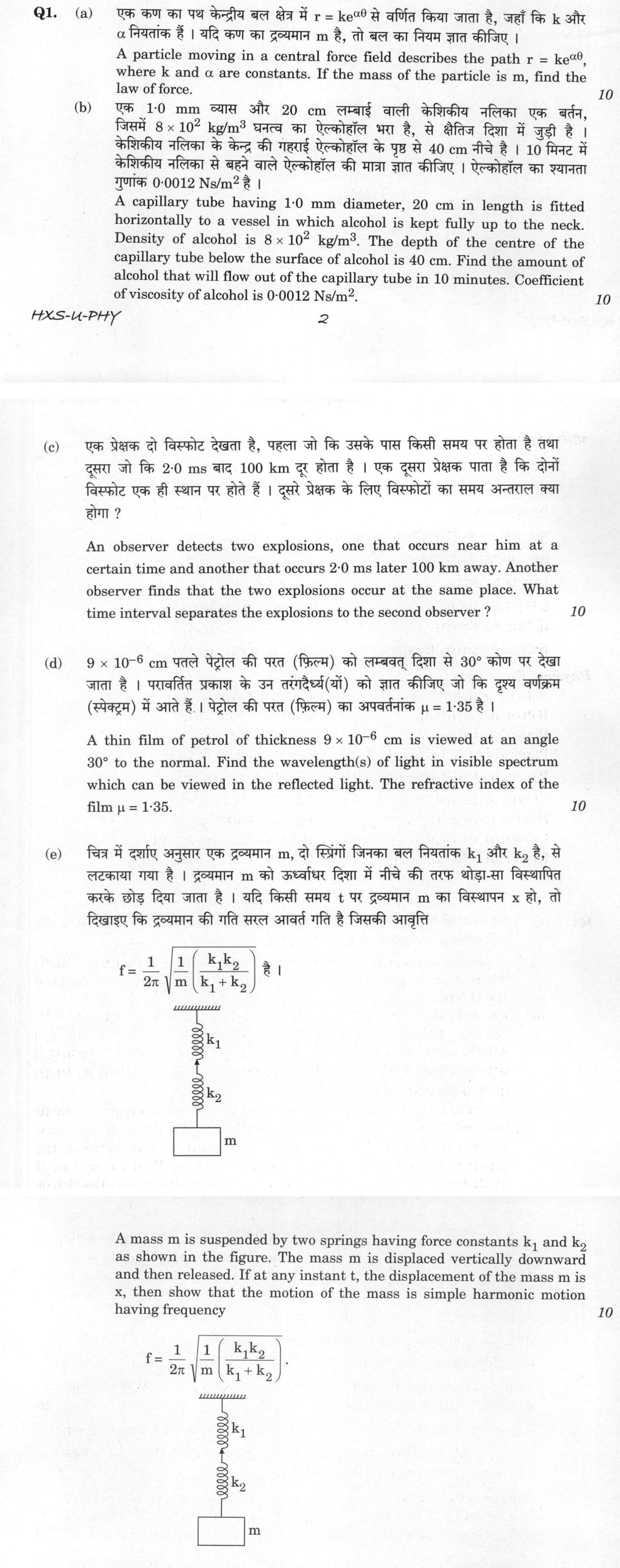
The figure this question refers to, in words
The question paper is a scan and the diagram did not survive as text. This is the figure as read from the original page — every component, value and label — so the question can be worked from the text below.
(e) A vertical mass-spring system suspended from a fixed horizontal ceiling with hatching. A helical spring with spring constant k1 hangs vertically from the ceiling. Connected in series directly below it is a second helical spring with spring constant k2. Suspended from the bottom of the second spring is a rectangular mass block, labeled m to its right.
(e) A vertical mass-spring system suspended from a fixed horizontal ceiling indicated by hatching. Connected to the ceiling and hanging vertically is a first helical spring labelled k1. Connected directly in series below the first spring is a second helical spring labelled k2. Suspended from the bottom of the second spring is a rectangular mass labelled m to its right.
Model answer
Written by UPSC Answer Check against this question's marking rubric, to the expected length. UPSC does not publish answers for Mains — this is one way to score well, not an official key.
(a) For a central orbit, use Binet’s formula: F(r) = −m h² u² (d²u/dθ² + u), where u = 1/r and h = r² dθ/dt. Given r = k e^(αθ), so u = 1/r = (1/k)e^(−αθ). Differentiate: du/dθ = −αu, d²u/dθ² = α²u. Substitute in Binet’s formula: F(r) = −m h² u²(α²u + u) = −m h²(1 + α²)u³ = −m h²(1 + α²)/r³. If L = m h is the angular momentum of the particle, then h = L/m, so F(r) = −L²(1 + α²)/(m r³). Thus the force is an attractive inverse-cube force: F(r) = −m h²(1 + α²)/r³ = −L²(1 + α²)/(m r³). This is valid for h ≠ 0, i.e. non-radial motion.
(b) Use Poiseuille’s formula for steady laminar flow through a horizontal capillary tube: Q = πR⁴Δp/(8ηL). Here R = 1.0/2 mm = 0.5 mm = 5.0×10⁻⁴ m, L = 20 cm = 0.20 m, h = 40 cm = 0.40 m, ρ = 8×10² kg/m³, η = 0.0012 N s/m², t = 10 min = 600 s. The driving pressure difference is the hydrostatic head: Δp = ρgh = (8×10²)(9.8)(0.40) = 3136 Pa. Now R⁴ = (5.0×10⁻⁴)⁴ = 6.25×10⁻¹⁴ m⁴. Therefore Q = π(6.25×10⁻¹⁴)(3136) / [8(0.0012)(0.20)] = π(1.96×10⁻¹⁰)/(0.00192) = 3.206×10⁻⁷ m³/s. Volume flowing out in 10 minutes: V = Qt = (3.206×10⁻⁷)(600) = 1.924×10⁻⁴ m³ = 192.4 cm³. Mass flowing out: M = ρV = (8×10²)(1.924×10⁻⁴) = 0.1539 kg = 153.9 g. Hence the amount of alcohol flowing out is V ≈ 1.92×10⁻⁴ m³ = 192 cm³, M ≈ 0.154 kg = 154 g. This assumes steady laminar flow, no end effects, and neglects surface-tension effects.
(c) Let the first observer’s frame be S. Take event 1 at x₁ = 0, t₁ = 0. For event 2, Δx = 100 km = 1.00×10⁵ m, Δt = 2.0 ms = 2.0×10⁻³ s. Let S′ be the observer’s frame in which the two explosions occur at the same place, so Δx′ = 0. By the Lorentz transformation, Δx′ = γ(Δx − vΔt) = 0, which gives v = Δx/Δt = (1.00×10⁵)/(2.0×10⁻³) = 5.0×10⁷ m/s. Also, Δt′ = γ(Δt − vΔx/c²). Using v = Δx/Δt, Δt′ = Δt/γ = Δt√(1 − v²/c²). Now v/c = (5.0×10⁷)/(3.0×10⁸) = 1/6. Thus Δt′ = (2.0×10⁻³)√(1 − 1/36) = (2.0×10⁻³)(√35/6) = (√35/3)×10⁻³ s ≈ 1.972×10⁻³ s. So the time interval for the second observer is Δt′ = (√35/3) ms ≈ 1.97 ms.
(d) For thin-film interference in reflected light, the optical path difference between rays reflected from the top and bottom surfaces is Δ = 2μt cos r, where r is the angle of refraction inside the film. The angle of incidence is i = 30°. By Snell’s law, sin i = μ sin r, so sin r = sin 30°/1.35 = 0.5/1.35 = 0.37037. Hence r ≈ 21.74°, cos r = √(1 − sin²r) = √(1 − 0.13717) = 0.92888. The film thickness is t = 9×10⁻⁶ cm = 9×10⁻⁸ m. Therefore 2μt cos r = 2(1.35)(9×10⁻⁸)(0.92888) = 2.257×10⁻⁷ m. For a petrol film in air or on a rarer medium, one reflection suffers an extra π phase change. The condition for constructive interference in reflected light is 2μt cos r = (n − 1/2)λ, n = 1, 2, 3, … Thus λ = 2μt cos r/(n − 1/2). For n = 1: λ = (2.257×10⁻⁷)/0.5 = 4.514×10⁻⁷ m = 451.4 nm. For n = 2: λ = (2.257×10⁻⁷)/1.5 = 1.505×10⁻⁷ m = 150.5 nm. For n = 3: λ = (2.257×10⁻⁷)/2.5 = 9.03×10⁻⁸ m = 90.3 nm. Only 451.4 nm lies in the visible range 400–700 nm. Therefore the visible wavelength viewed in reflected light is λ ≈ 451 nm (blue-violet).
(e) The two springs are in series, so the tension in both springs is the same at any instant. Let T₀ = mg be the equilibrium tension. Let T be the instantaneous tension when the mass is displaced downward by x from equilibrium. For the mass, m d²x/dt² = mg − T = −(T − T₀). Let ΔT = T − T₀. The additional extensions of the two springs are y₁ = ΔT/k₁, y₂ = ΔT/k₂. Since the springs are in series, the total additional downward displacement of the mass is x = y₁ + y₂ = ΔT(1/k₁ + 1/k₂) = ΔT(k₁ + k₂)/(k₁k₂). Hence ΔT = (k₁k₂/(k₁ + k₂))x. Substituting into the equation of motion, m d²x/dt² = −(k₁k₂/(k₁ + k₂))x. This is the standard simple-harmonic equation d²x/dt² + ω²x = 0, with ω² = (k₁k₂)/[m(k₁ + k₂)]. Therefore ω = √[(k₁k₂)/(m(k₁ + k₂))]. The frequency is f = ω/(2π) = 1/(2π) √[(k₁k₂)/(m(k₁ + k₂))] = 1/(2π) √[1/m (k₁k₂)/(k₁ + k₂)]. Thus the motion is simple harmonic with frequency f = 1/(2π) √[1/m (k₁k₂)/(k₁ + k₂)]. This assumes ideal massless springs obeying Hooke’s law and neglects damping.
What "Solve" is asking you to do
Choose the method, then carry it through to a final answer. Identifying what kind of problem this is and why that method applies is the first thing marked; a correct figure arrived at invisibly earns almost nothing.
Structure that answers it
Given data and what is required → method chosen, with the reason it applies → set-up (equation, circuit, free body, trial balance) → working, step by step → answer with units and any condition of validity
Where marks are lost
Doing the middle steps mentally and writing only the result. In mathematics papers, a further loss comes from giving a decimal where the exact value in surds or fractions was wanted, or from skipping the justification a part explicitly asks for.
How this answer will be evaluated
Approach
Framework: Principle > Setup and diagram > Derivation > Result and limiting case. (a) derive: given > assumptions > stepwise derivation > result > check | (b) calculate: given > formula > substitution > result with units > interpretation | (c) calculate: given > formula > substitution > result with units > interpretation | (d) calculate: given > formula > substitution > result with units > interpretation | (e) derive: given > assumptions > stepwise derivation > result > check Full marks: Complete derivation with all steps, units, and physical interpretation
Key points expected
- State Binet's formula for central force
- Compute 1/r and its derivatives wrt θ
- Substitute into Binet's formula
- Express final force in terms of r
- State Poiseuille's law for flow rate
- Convert all given values to SI units
- Calculate pressure difference from depth
- Compute volume flow rate and total volume
Evaluation rubric
Each sub-part is marked on its own, against the marks and word limit printed on the paper.
- (a) Derive the law of force for a particle moving in a central force field with path r = ke^(αθ). 10 marks
derive— given → assumptions → stepwise derivation → result → check
Must cover
- State Binet's formula for central force
- Compute 1/r and its derivatives wrt θ
- Substitute into Binet's formula
- Express final force in terms of r
Loses marks
- Formula substitution without derivation
- Dropping units or dimensional check
- Incorrect derivative of 1/r
Earns more
- Show angular momentum conservation
- Verify dimensions of force
- Identify force as inverse cube law
- State sign of force (attractive/repulsive)
Extra mark
- Mention physical interpretation of force law
- Compare with known central force orbits
- (b) Calculate the amount of alcohol flowing out of the capillary tube in 10 minutes. 10 marks
calculate— given → formula → substitution → result with units → interpretation
Must cover
- State Poiseuille's law for flow rate
- Convert all given values to SI units
- Calculate pressure difference from depth
- Compute volume flow rate and total volume
Loses marks
- Incorrect unit conversion
- Missing pressure difference calculation
- No final answer with units
Earns more
- Show unit conversions explicitly
- Verify dimensions of flow rate
- State assumptions (laminar flow, no slip)
- Express final answer in appropriate units
Extra mark
- Mention Reynolds number check for laminar flow
- Discuss effect of tube length on flow
- (c) Calculate the time interval between explosions for the second observer. 10 marks
calculate— given → formula → substitution → result with units → interpretation
Must cover
- Identify second observer's frame as rest frame
- Apply Lorentz transformation for time
- Calculate relative velocity of frames
- Compute time interval in second frame
Loses marks
- Incorrect frame identification
- Missing Lorentz transformation
- No final answer with units
Earns more
- Show Lorentz transformation equations
- Verify units of time interval
- State assumptions (inertial frames)
- Express final answer in milliseconds
Extra mark
- Mention physical interpretation of time dilation
- Compare with classical time interval
- (d) Find the wavelength(s) of visible light in reflected light from the petrol film. 10 marks
calculate— given → formula → substitution → result with units → interpretation
Must cover
- State condition for constructive interference
- Calculate optical path difference
- Solve for wavelengths in visible range
- Check for phase change at boundaries
Loses marks
- Incorrect interference condition
- Missing phase change consideration
- No final answer with units
Earns more
- Show interference condition derivation
- Verify wavelengths are in visible spectrum
- State assumptions (thin film, normal incidence)
- Express final answer in nanometers
Extra mark
- Mention physical interpretation of interference
- Discuss effect of viewing angle
- (e) Show that the motion is simple harmonic with the given frequency. 10 marks
derive— given → assumptions → stepwise derivation → result → check
Must cover
- Draw labelled diagram of spring-mass system
- Write equation of motion for mass m
- Derive effective spring constant
- Show frequency formula matches given expression
Loses marks
- Missing diagram or force balance
- Incorrect effective spring constant
- No final answer matching given formula
Earns more
- Show force balance at equilibrium
- Verify dimensions of frequency
- State assumptions (massless springs, small oscillations)
- Express final answer in terms of k₁, k₂, m
Extra mark
- Mention physical interpretation of effective spring constant
- Compare with single spring case
Practice this exact question
Write your answer and it is marked point by point against the model answer above — what you covered, what you missed, what you got wrong.
Evaluate my answer →More from Physics 2021 Paper I
- Q1 (a) A particle moving in a central force field describes the path r = ke^αθ, where k and…
- Q2 (a) A body of mass m at rest splits into two masses m₁ and m₂ by an explosion. After the…
- Q3 (a) In a step-index optical fiber system, explain the terms pulse dispersion and material…
- Q4 (a) (i) Define moment of inertia and radius of gyration of a body of mass M rotating abou…