Paper I — Q4
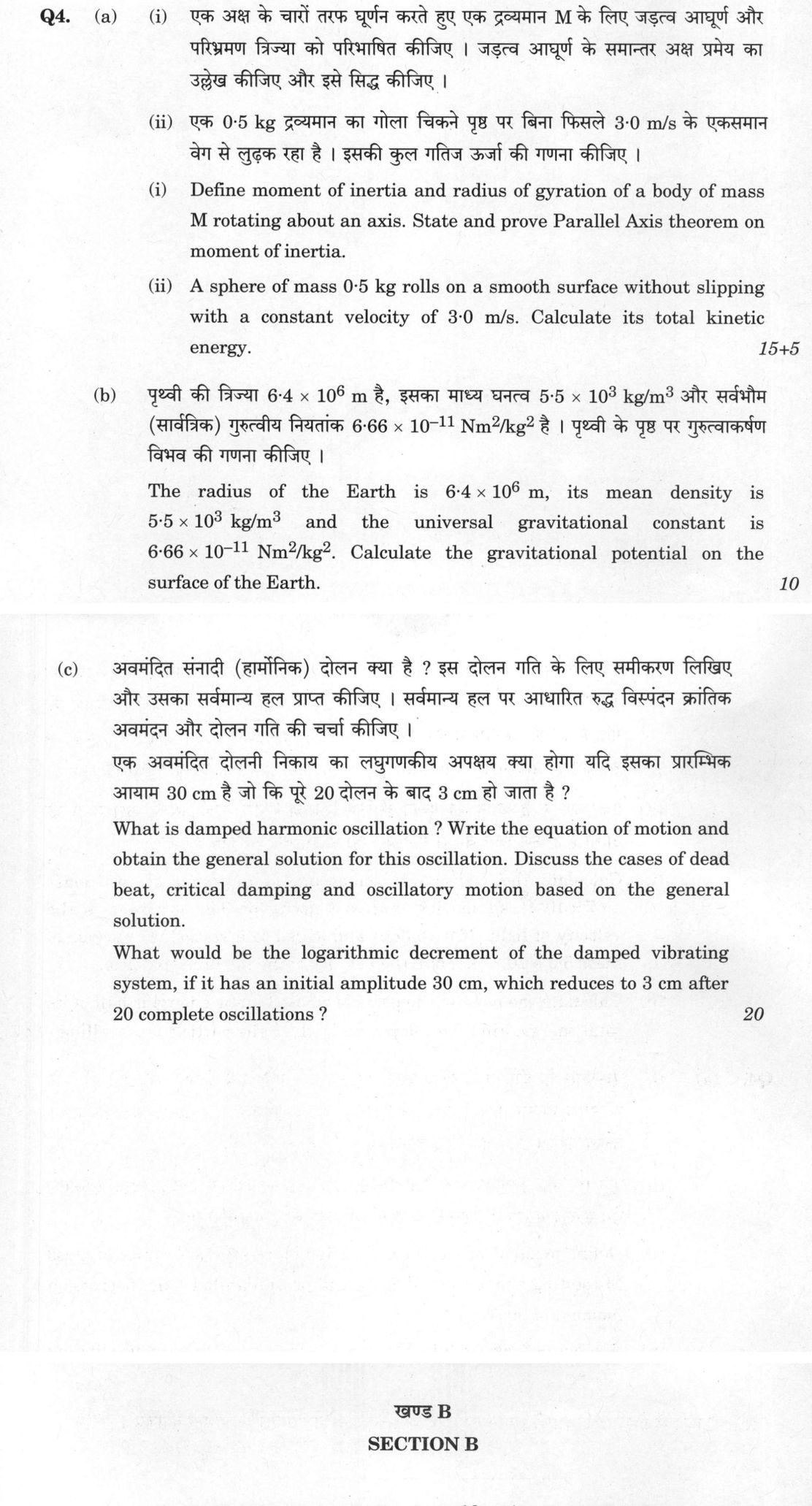
(a) (i) Define moment of inertia and radius of gyration of a body of mass M rotating about an axis. State and prove Parallel Axis…
Define moment of inertia and radius of gyration of a body of mass M rotating about an axis. State and prove Parallel Axis theorem on moment of inertia. 15 marks
A sphere of mass 0·5 kg rolls on a smooth surface without slipping with a constant velocity of 3·0 m/s. Calculate its total kinetic energy. 5 marks
The radius of the Earth is 6·4 × 10⁶ m, its mean density is 5·5 × 10³ kg/m³ and the universal gravitational constant is 6·66 × 10⁻¹¹ Nm²/kg². Calculate the gravitational potential on the surface of the Earth. 10 marks
What is damped harmonic oscillation? Write the equation of motion and obtain the general solution for this oscillation. Discuss the cases of dead beat, critical damping and oscillatory motion based on the general solution.
What would be the logarithmic decrement of the damped vibrating system, if it has an initial amplitude 30 cm, which reduces to 3 cm after 20 complete oscillations? 20 marks
हिंदी में प्रश्न पढ़ें
एक अक्ष के चारों तरफ घूर्णन करते हुए एक द्रव्यमान M के लिए जड़त्व आघूर्ण और परिभ्रमण त्रिज्या को परिभाषित कीजिए। जड़त्व आघूर्ण के समांतर अक्ष प्रमेय का उल्लेख कीजिए और इसे सिद्ध कीजिए। (15 अंक)
एक 0·5 kg द्रव्यमान का गोला चिकने पृष्ठ पर बिना फिसले 3·0 m/s के एकसमान वेग से लुढ़क रहा है। इसकी कुल गतिज ऊर्जा की गणना कीजिए। (5 अंक)
पृथ्वी की त्रिज्या 6·4 × 10⁶ m है, इसका माध्य घनत्व 5·5 × 10³ kg/m³ और सर्वभौम (सार्वत्रिक) गुरुत्वीय नियतांक 6·66 × 10⁻¹¹ Nm²/kg² है। पृथ्वी के पृष्ठ पर गुरुत्वाकर्षण विभव की गणना कीजिए। (10 अंक)
अवमंदित संनादी (हार्मोनिक) दोलन क्या है ? इस दोलन गति के लिए समीकरण लिखिए और उसका सर्वमान्य हल प्राप्त कीजिए । सर्वमान्य हल पर आधारित रुद्ध विस्पंदन क्रांतिक अवमंदन और दोलन गति की चर्चा कीजिए ।
एक अवमंदित दोलनी निकाय का लघुगणकीय अपक्षय क्या होगा यदि इसका प्रारंभिक आयाम 30 cm है जो कि पूरे 20 दोलन के बाद 3 cm हो जाता है ? (20 अंक)
Model answer
Written by UPSC Answer Check against this question's marking rubric, to the expected length. UPSC does not publish answers for Mains — this is one way to score well, not an official key.
(a)(i) The moment of inertia of a body about an axis is I = Σ mᵢ rᵢ² = ∫ r² dm, where rᵢ or r is the perpendicular distance of the mass element from the axis. The radius of gyration k is defined by I = M k², so k = √(I/M). It is the perpendicular distance at which the whole mass may be imagined concentrated without changing I.
Parallel Axis theorem: For any axis and a parallel axis through the centre of mass, I = I(CM) + M d², where d is the perpendicular distance between the axes.
Proof: Take the centre of mass as origin and the axis through it along z. Let the parallel axis pass through (d₁,d₂,0) in the xy-plane. For an element dm at (x,y,z), the squared distance from the centre-of-mass axis is x²+y², and from the parallel axis is (x-d₁)²+(y-d₂)². Hence I = ∫[(x-d₁)²+(y-d₂)²] dm = ∫(x²+y²) dm -2d₁∫x dm -2d₂∫y dm +(d₁²+d₂²)∫dm. Since the origin is the centre of mass, ∫x dm=0 and ∫y dm=0. Also ∫(x²+y²)dm=I(CM), ∫dm=M and d²=d₁²+d₂². Therefore I=I(CM)+M d².
(a)(ii) For a solid sphere rolling without slipping, I = 2/5 MR² and ω = v/R. Total kinetic energy is E = 1/2 Mv² + 1/2 Iω² = 1/2 Mv² + 1/2 × 2/5 MR² × (v/R)² = 1/2 Mv² + 1/5 Mv² = 7/10 Mv². Given M=0.5 kg, v=3.0 m/s, E = 7/10 × 0.5 × (3.0)² = 3.15 J = 63/20 J. Total kinetic energy = 3.15 J.
(b) The gravitational potential at the Earth’s surface is V = -GM/R. Using mean density ρ, M = (4/3)πR³ρ, so V = -(4/3)πGρR². Substitute R=6.4×10⁶ m, ρ=5.5×10³ kg/m³, G=6.66×10⁻¹¹ N m² kg⁻²: V = -(4/3)π(6.66×10⁻¹¹)(5.5×10³)(6.4×10⁶)² = -(4/3)π(6.66×5.5×4.096)×10⁵ = -(4/3)π(150.03648)×10⁵ = -6.2847×10⁷ J kg⁻¹. V ≈ -6.28×10⁷ J kg⁻¹ (taking zero potential at infinity).
(c) In damped harmonic oscillation, a restoring force -kx acts along with a damping force -b dx/dt. Newton’s law gives m d²x/dt² = -kx - b dx/dt, or d²x/dt² + 2β dx/dt + ω₀²x = 0, where β=b/(2m) and ω₀=√(k/m). The trial solution x=exp(rt) gives r²+2βr+ω₀²=0, so r=-β±√(β²-ω₀²). The general solution is x(t)=C₁ exp(r₁t)+C₂ exp(r₂t).
- If β>ω₀, let γ=√(β²-ω₀²). Then x=exp(−βt)(C₁ exp(γt)+C₂ exp(−γt)). This is overdamped or dead-beat motion: non-oscillatory, with slow return to equilibrium.
- If β=ω₀, the roots are equal, r=-β. Then x=(C₁+C₂t) exp(−βt). This is critical damping: the fastest non-oscillatory return to equilibrium.
- If β<ω₀, let ω=√(ω₀²-β²). Then x=exp(−βt)(C₁ cos ωt+C₂ sin ωt) = A exp(−βt) cos(ωt+φ). This is underdamped or oscillatory motion; amplitude decays exponentially.
For logarithmic decrement, use A_n = A₀ exp(−β nT), so Λ = (1/n) ln(A₀/A_n). Here A₀=30 cm, A_n=3 cm, n=20: Λ = (1/20) ln(30/3) = (1/20) ln 10 = 2.302585/20 = 0.11513. Logarithmic decrement Λ = (ln 10)/20 ≈ 0.115 (dimensionless).
What "Derive" is asking you to do
Reach the stated expression from a starting relation, justifying every step. The destination is printed in the question, so only the route earns marks, and the assumptions you work under are part of that route.
Structure that answers it
Assumptions and notation defined → starting relation or governing equation → each step with its justification → the required expression → limiting case or boundary check
Where marks are lost
Writing the standard result first and fitting three lines to it, which an examiner reads at a glance. Marks also go on assumptions left unstated — lossless medium, small amplitude, errors independent with zero mean — and on symbols used before they are defined, even when the question says usual notations.
How this answer will be evaluated
Approach
(a(i)) define: precise definition > the distinguishing feature > one example | (a(ii)) calculate: given > formula > substitution > result with units > interpretation | (b) calculate: given > formula > substitution > result with units > interpretation | (c) discuss: intro > 3-4 dimensions > example > balanced close Full marks: Complete derivations, correct calculations with units, clear discussion of all cases
Key points expected
- Define moment of inertia as sum of mr²
- Define radius of gyration as k = sqrt(I/M)
- State Parallel Axis theorem: I = I_cm + Md²
- Derive theorem using vector separation of position
- Identify total KE as translational plus rotational
- Use I = (2/5)MR² for solid sphere
- Apply rolling condition v = ωR
- Substitute values to find final energy
Evaluation rubric
Each sub-part is marked on its own, against the marks and word limit printed on the paper.
- (a(i)) Definitions of moment of inertia and radius of gyration, plus statement and proof of Parallel Axis theorem. 15 marks
define— precise definition → the distinguishing feature → one example
Must cover
- Define moment of inertia as sum of mr²
- Define radius of gyration as k = sqrt(I/M)
- State Parallel Axis theorem: I = I_cm + Md²
- Derive theorem using vector separation of position
Loses marks
- States theorem without derivation
- Confuses radius of gyration with radius of body
Earns more
- Draws diagram showing axis and parallel axis
- Uses vector notation for derivation
- Mentions perpendicular distance d explicitly
Extra mark
- Mentions Perpendicular Axis theorem as contrast
- (a(ii)) Total kinetic energy of a rolling sphere using translational and rotational components. 5 marks
calculate— given → formula → substitution → result with units → interpretation
Must cover
- Identify total KE as translational plus rotational
- Use I = (2/5)MR² for solid sphere
- Apply rolling condition v = ωR
- Substitute values to find final energy
Loses marks
- Ignores rotational kinetic energy
- Uses wrong moment of inertia for sphere
Earns more
- Shows derivation of total KE formula
- Carries units through calculation
Extra mark
- Mentions energy distribution ratio
- (b) Gravitational potential on Earth's surface using given radius, density, and G. 10 marks
calculate— given → formula → substitution → result with units → interpretation
Must cover
- State formula V = -GM/R
- Calculate mass M from density and volume
- Substitute given values for R, ρ, and G
- Compute final potential with correct units
Loses marks
- Forgets to calculate mass from density
- Uses wrong formula for potential
Earns more
- Shows step-by-step calculation of mass
- Checks dimensional consistency
Extra mark
- Mentions potential is negative for bound system
- (c) Definition, equation, general solution, and cases of damped harmonic oscillation, plus logarithmic decrement calculation. 20 marks
discuss— intro → 3-4 dimensions → example → balanced close
Must cover
- Define damped harmonic oscillation
- Write equation of motion with damping term
- Derive general solution for damped oscillator
- Discuss dead beat, critical, and oscillatory cases
Loses marks
- Confuses critical damping with dead beat
- Fails to derive general solution
Earns more
- Calculates logarithmic decrement correctly
- Uses given amplitudes and oscillation count
- Explains physical meaning of each damping case
Extra mark
- Draws displacement-time graph for each case
Practice this exact question
Write your answer and it is marked point by point against the model answer above — what you covered, what you missed, what you got wrong.
Evaluate my answer →More from Physics 2021 Paper I
- Q1 (a) A particle moving in a central force field describes the path r = ke^αθ, where k and…
- Q2 (a) A body of mass m at rest splits into two masses m₁ and m₂ by an explosion. After the…
- Q3 (a) In a step-index optical fiber system, explain the terms pulse dispersion and material…
- Q4 (a) (i) Define moment of inertia and radius of gyration of a body of mass M rotating abou…
- Q5 (a) Given that the electric potential of a system of charges is V = 12/r² + 1/r³ volt. Ca…
- Q6 (a) In an inertial reference frame S there is only a uniform electric field E⃗ = 8 kVm⁻¹.…
- Q7 (a) A region 1, z < 0, has a dielectric material with εᵣ = 3·2 and a region 2, z > 0 has…