Paper I — Q6
(a) In an inertial reference frame S there is only a uniform electric field E⃗ = 8 kVm⁻¹. Find the magnitude of E⃗' and B⃗' in…
In an inertial reference frame S there is only a uniform electric field E⃗ = 8 kVm⁻¹. Find the magnitude of E⃗' and B⃗' in the inertial reference frame S' moving with a constant velocity v⃗ relative to the frame S at an angle α = 45^° to the vector E⃗. The velocity of the frame S' is 0.6 times the velocity of light c. 20 marks
In the given circuit, L = 2·0 μH, R = 1·0 Ω, R₀ = 2·0 Ω and E = 3·0 V. Find the amount of heat generated in the coil after the switch S is disconnected. The internal resistance of the source is negligible. 10 marks
Explain the characteristics of the following thermodynamic processes for a perfect gas : Isothermal process
Adiabatic process
Isobaric process
Isochoric process
Obtain the expression for the work done by the gas during the above processes. 20 marks
हिंदी में प्रश्न पढ़ें
एक जड़त्वीय संदर्भ फ्रेम S में एकसमान तीव्रता का वैद्युत क्षेत्र E⃗ = 8 kVm⁻¹ विद्यमान है । E⃗' और B⃗' का परिमाण दूसरे जड़त्वीय संदर्भ फ्रेम S' में ज्ञात कीजिए जो कि S फ्रेम के सापेक्ष एकसमान वेग v⃗ से तथा सदिश E⃗ क्षेत्र से α = 45^° के कोण पर गति कर रहा है । फ्रेम S' का वेग प्रकाश के वेग c का 0.6 गुना है । (20 अंक)
दिए गए परिपथ में L = 2·0 μH, R = 1·0 Ω, R₀ = 2·0 Ω और E = 3·0 V है । जब परिपथ के कुंजी S को भंग कर दिया जाता है, तो कुंडली में उत्पन्न ऊष्मा की मात्रा ज्ञात कीजिए । स्रोत का आंतरिक प्रतिरोध नगण्य है । (10 अंक)
आदर्श गैस के लिए निम्नलिखित ऊष्मागतिक प्रक्रियाओं के अभिलक्षणों की व्याख्या कीजिए : समतापी प्रक्रिया
रूद्धोष्म प्रक्रिया
समदाबी प्रक्रिया
समआयतनिक प्रक्रिया
उपर्युक्त प्रक्रियाओं के दौरान गैस के द्वारा किए गए कार्य का व्यंजक प्राप्त कीजिए । (20 अंक)
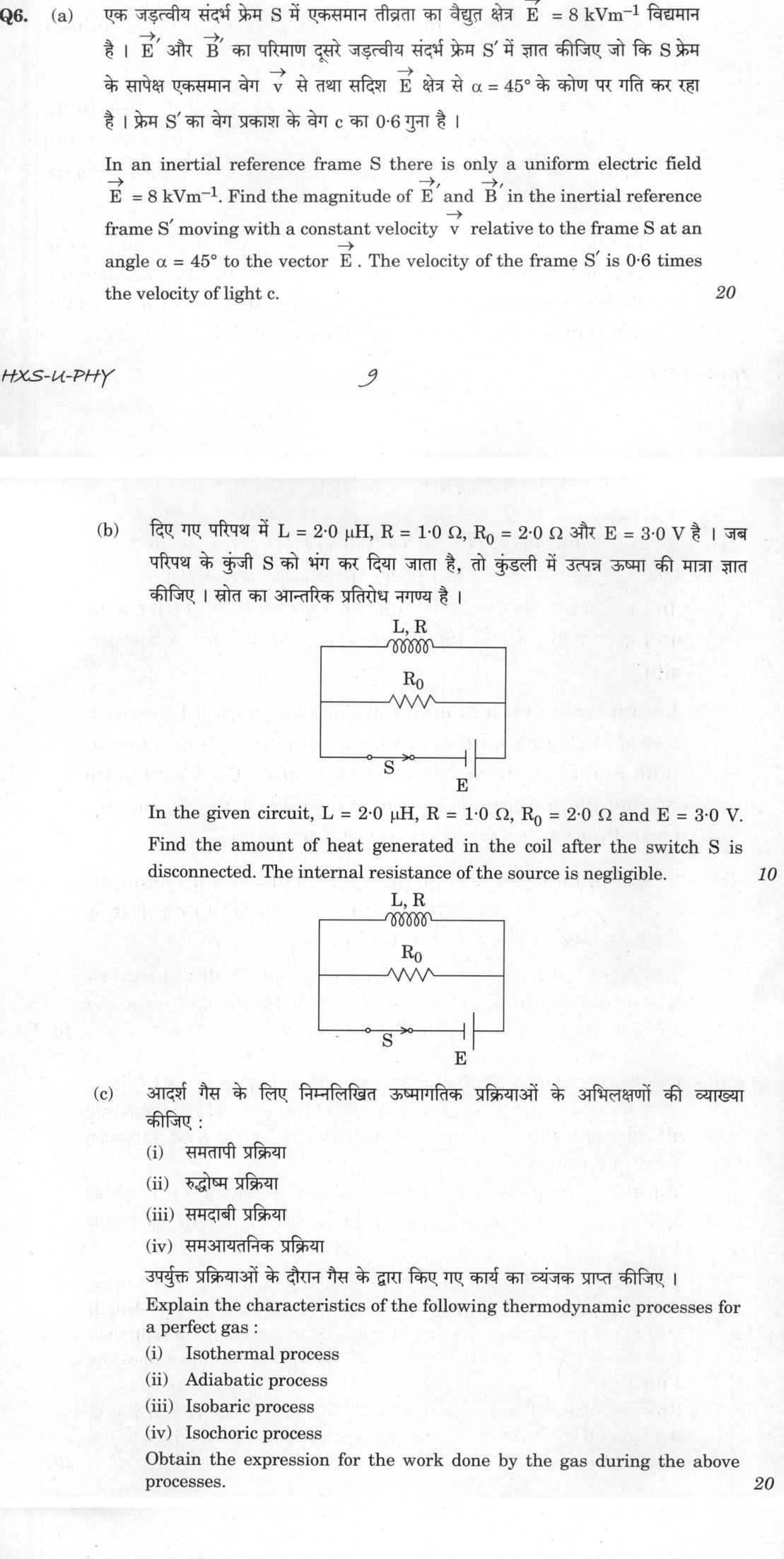
The figure this question refers to, in words
The question paper is a scan and the diagram did not survive as text. This is the figure as read from the original page — every component, value and label — so the question can be worked from the text below.
(b) A circuit diagram consisting of three parallel horizontal branches connected across two vertical wires. The top branch contains a coil (inductor with internal resistance) labelled 'L, R'. The middle branch contains a resistor labelled 'R_0'. The bottom branch contains a switch labelled 'S' in series with a DC voltage source labelled 'E', where the positive terminal (longer plate) is on the left and the negative terminal (shorter plate) is on the right. When the switch S is closed, both the top branch (L, R) and the middle branch (R_0) are connected in parallel across the voltage source E.
Model answer
Written by UPSC Answer Check against this question's marking rubric, to the expected length. UPSC does not publish answers for Mains — this is one way to score well, not an official key.
(a) Let E = E₀ x̂, with E₀ = 8 kV m⁻¹ = 8×10³ V m⁻¹. The velocity is v = 0.6c, so β = 0.6 and γ = 1/√(1−β²) = 1/√(1−0.36) = 1/0.8 = 5/4. Since α = 45° is the angle between v and E, the components of E parallel and perpendicular to v are E_∥ = E₀ cos 45° and E_⊥ = E₀ sin 45°.
Using the Lorentz field transformation, with B = 0 in S: E′_∥ = E_∥, E′_⊥ = γ E_⊥, B′_∥ = 0, B′_⊥ = −γ(v×E)/c².
Therefore, |E′| = √(E₀² cos²45° + γ² E₀² sin²45°) = E₀ √(1/2 + γ²/2) = 8×10³ √(1/2 + (25/16)/2) = 8×10³ √(41/32) = 1000√82 V m⁻¹ ≈ 9.06×10³ V m⁻¹.
Also, |B′| = γ v E₀ sin45° / c² = γβ E₀ sin45° / c = (5/4)(3/5)(8×10³)(√2/2)/(3×10⁸) = √2×10⁻⁵ T ≈ 1.41×10⁻⁵ T.
Final: |E′| = 1000√82 V m⁻¹ ≈ 9.06 kV m⁻¹; |B′| = √2×10⁻⁵ T ≈ 14.1 μT.
(b) When switch S is closed in steady state, the inductor acts as a short circuit. Hence the voltage across the branch L, R is E, so the initial current through the coil is I₀ = E/R = 3.0/1.0 = 3.0 A.
After S is disconnected, the source is removed. The L, R branch and the R₀ branch form a closed discharge loop with total resistance R + R₀ = 1.0 + 2.0 = 3.0 Ω. Let i(t) be the loop current. By Kirchhoff’s voltage law, L di/dt + (R+R₀)i = 0 ⇒ i(t) = I₀ e^[−(R+R₀)t/L].
Total heat dissipated in the loop is Q_total = ∫₀^∞ i²(R+R₀) dt = 1/2 L I₀² = 1/2 × 2.0×10⁻⁶ × (3.0)² = 9.0×10⁻⁶ J.
Heat generated in the coil resistance R is Q_coil = ∫₀^∞ i²R dt = R/(R+R₀) Q_total = (1.0/3.0)(9.0×10⁻⁶) = 3.0×10⁻⁶ J.
Final: Heat generated in the coil = 3.0 μJ.
(c)(i) Isothermal process: T is constant. For a perfect gas, PV = nRT = constant, which is Boyle’s law. Since U depends only on T, ΔU = 0, so Q = W. The work done by the gas is W = ∫ P dV = ∫ nRT dV/V = nRT ln(V_f/V_i) = nRT ln(P_i/P_f). Valid for a quasi-static reversible isothermal process. The P-V curve is a rectangular hyperbola.
(c)(ii) Adiabatic process: No heat exchange occurs: Q = 0. For a perfect gas, PV^γ = constant, TV^(γ−1) = constant, and T^γ P^(1−γ) = constant, where γ = C_P/C_V. By the first law, ΔU = −W. For a reversible adiabatic expansion, W = ∫ P dV = (P_i V_i − P_f V_f)/(γ−1) = nR(T_i − T_f)/(γ−1) = nC_V(T_i − T_f). During expansion the gas cools; during compression it heats. The adiabatic curve is steeper than an isotherm.
(c)(iii) Isobaric process: P is constant. For a perfect gas, V/T = constant, which is Charles’s law. The heat absorbed is Q = nC_P ΔT, and ΔU = nC_V ΔT. The work done by the gas is W = P(V_f − V_i) = nR(T_f − T_i). Using Q = ΔU + W gives C_P − C_V = R.
(c)(iv) Isochoric process: V is constant. For a perfect gas, P/T = constant, which is Gay-Lussac’s law. Since dV = 0, no work is done by the gas: W = ∫ P dV = 0. Thus Q = ΔU = nC_V ΔT.
What "Solve" is asking you to do
Choose the method, then carry it through to a final answer. Identifying what kind of problem this is and why that method applies is the first thing marked; a correct figure arrived at invisibly earns almost nothing.
Structure that answers it
Given data and what is required → method chosen, with the reason it applies → set-up (equation, circuit, free body, trial balance) → working, step by step → answer with units and any condition of validity
Where marks are lost
Doing the middle steps mentally and writing only the result. In mathematics papers, a further loss comes from giving a decimal where the exact value in surds or fractions was wanted, or from skipping the justification a part explicitly asks for.
How this answer will be evaluated
Approach
(a) calculate: given > formula > substitution > result with units > interpretation | (b) calculate: given > formula > substitution > result with units > interpretation | (c) explain: definition/context > points in order > small example > short close Full marks: Complete derivations with correct units, clear diagrams, and physical interpretation for all parts.
Key points expected
- State Lorentz transformation equations for E and B
- Resolve E into components parallel and perpendicular to v
- Calculate gamma factor for v = 0.6c
- Compute final magnitudes with units
- Determine steady-state current through inductor before switching
- Apply energy conservation: Heat = Initial magnetic energy
- Use formula U = 1/2 L I²
- Substitute values and calculate final heat in Joules
Evaluation rubric
Each sub-part is marked on its own, against the marks and word limit printed on the paper.
- (a) Calculate magnitudes of E' and B' in frame S' using Lorentz transformations. 20 marks
calculate— given → formula → substitution → result with units → interpretation
Must cover
- State Lorentz transformation equations for E and B
- Resolve E into components parallel and perpendicular to v
- Calculate gamma factor for v = 0.6c
- Compute final magnitudes with units
Loses marks
- Using Galilean transformations instead of Lorentz
- Forgetting to resolve E into components
- Dropping units in final answer
Earns more
- Correctly identify B = 0 in frame S
- Show vector diagram of field components
- Verify dimensions of final answers
Extra mark
- Mention invariance of E·B or E² - c²B²
- (b) Calculate heat generated in the coil after switch S is disconnected. 10 marks
calculate— given → formula → substitution → result with units → interpretation
Must cover
- Determine steady-state current through inductor before switching
- Apply energy conservation: Heat = Initial magnetic energy
- Use formula U = 1/2 L I²
- Substitute values and calculate final heat in Joules
Loses marks
- Using total circuit energy instead of inductor energy
- Incorrect calculation of initial current
- Confusing heat in coil with total heat in circuit
Earns more
- Draw circuit diagram with current directions
- Explicitly state assumption of negligible internal resistance
- Show calculation of equivalent resistance for initial current
Extra mark
- Discuss time constant of the decay circuit
- (c) Explain characteristics of four thermodynamic processes and derive work expressions. 20 marks
explain— definition/context → points in order → small example → short close
Must cover
- Define each process (Isothermal, Adiabatic, Isobaric, Isochoric)
- State the constant variable for each process
- Derive work done expression for each process
- Show integration steps for work calculation
Loses marks
- Listing formulas without derivation
- Confusing adiabatic and isothermal work expressions
- Missing the isochoric work (which is zero)
Earns more
- Provide P-V diagram sketches for each process
- Mention first law of thermodynamics application
- Compare work done in different processes
Extra mark
- Mention real-world examples for each process
Practice this exact question
Write your answer and it is marked point by point against the model answer above — what you covered, what you missed, what you got wrong.
Evaluate my answer →More from Physics 2021 Paper I
- Q3 (a) In a step-index optical fiber system, explain the terms pulse dispersion and material…
- Q4 (a) (i) Define moment of inertia and radius of gyration of a body of mass M rotating abou…
- Q5 (a) Given that the electric potential of a system of charges is V = 12/r² + 1/r³ volt. Ca…
- Q6 (a) In an inertial reference frame S there is only a uniform electric field E⃗ = 8 kVm⁻¹.…
- Q7 (a) A region 1, z < 0, has a dielectric material with εᵣ = 3·2 and a region 2, z > 0 has…
- Q8 (a) (i) The melting point of tin is 232°C, its latent heat of fusion is 14 cal/g and the…