Paper I — Q7
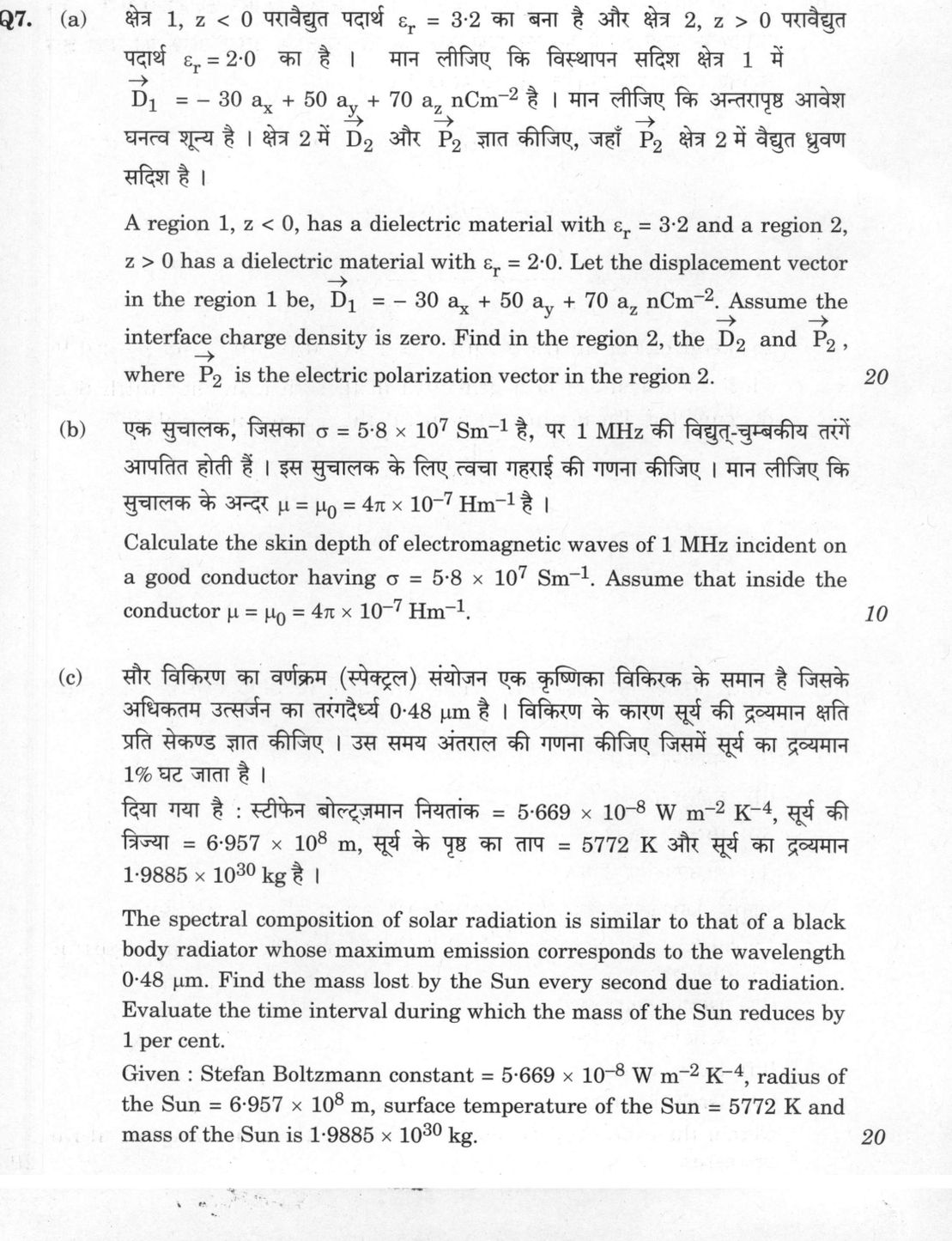
(a) A region 1, z < 0, has a dielectric material with εᵣ = 3·2 and a region 2, z > 0 has a dielectric material with εᵣ = 2·0. Let…
A region 1, z < 0, has a dielectric material with εᵣ = 3·2 and a region 2, z > 0 has a dielectric material with εᵣ = 2·0. Let the displacement vector in the region 1 be, D⃗₁ = – 30 aₓ + 50 aᵧ + 70 aᵤ nCm⁻². Assume the interface charge density is zero. Find in the region 2, the D⃗₂ and P⃗₂, where P⃗₂ is the electric polarization vector in the region 2. 20 marks
Calculate the skin depth of electromagnetic waves of 1 MHz incident on a good conductor having σ = 5·8 × 10⁷ Sm⁻¹. Assume that inside the conductor μ = μ₀ = 4π × 10⁻⁷ Hm⁻¹. 10 marks
The spectral composition of solar radiation is similar to that of a black body radiator whose maximum emission corresponds to the wavelength 0·48 μm. Find the mass lost by the Sun every second due to radiation. Evaluate the time interval during which the mass of the Sun reduces by 1 per cent.
Given : Stefan Boltzmann constant = 5·669 × 10⁻⁸ W m⁻² K⁻⁴, radius of the Sun = 6·957 × 10⁸ m, surface temperature of the Sun = 5772 K and mass of the Sun is 1·9885 × 10³⁰ kg. 20 marks
हिंदी में प्रश्न पढ़ें
क्षेत्र 1, z < 0 परावैद्युत पदार्थ εᵣ = 3·2 का बना है और क्षेत्र 2, z > 0 परावैद्युत पदार्थ εᵣ = 2·0 का है । मान लीजिए कि विस्थापन सदिश क्षेत्र 1 में D⃗₁ = – 30 aₓ + 50 aᵧ + 70 aᵤ nCm⁻² है । मान लीजिए कि अंतरापृष्ठ आवेश घनत्व शून्य है । क्षेत्र 2 में D⃗₂ और P⃗₂ ज्ञात कीजिए, जहाँ P⃗₂ क्षेत्र 2 में वैद्युत ध्रुवण सदिश है । (20 अंक)
एक सुचालक, जिसका σ = 5·8 × 10⁷ Sm⁻¹ है, पर 1 MHz की विद्युत-चुंबकीय तरंगें आपतित होती हैं । इस सुचालक के लिए त्वचा गहराई की गणना कीजिए । मान लीजिए कि सुचालक के अंदर μ = μ₀ = 4π × 10⁻⁷ Hm⁻¹ है । (10 अंक)
सौर विकिरण का वर्णक्रम (स्पेक्ट्रल) संयोजन एक कृष्णिका विकिरक के समान है जिसके अधिकतम उत्सर्जन का तरंगदैर्ध्य 0·48 μm है । विकिरण के कारण सूर्य की द्रव्यमान क्षति प्रति सेकंड ज्ञात कीजिए । उस समय अंतराल की गणना कीजिए जिसमें सूर्य का द्रव्यमान 1% घट जाता है ।
दिया गया है : स्टीफन बोल्ट्ज़मान नियतांक = 5·669 × 10⁻⁸ W m⁻² K⁻⁴, सूर्य की त्रिज्या = 6·957 × 10⁸ m, सूर्य के पृष्ठ का ताप = 5772 K और सूर्य का द्रव्यमान 1·9885 × 10³⁰ kg है । (20 अंक)
Model answer
Written by UPSC Answer Check against this question's marking rubric, to the expected length. UPSC does not publish answers for Mains — this is one way to score well, not an official key.
(a) At the z = 0 interface the normal direction is z, so I take the third component printed as 70 aᵤ as the normal component 70 a_z. The boundary conditions are: with zero free surface charge, the normal component of D⃗ is continuous; and the tangential component of E⃗ is continuous. Thus D₂ₙ = D₁ₙ and E₂ₜ = E₁ₜ.
Given D⃗₁ = –30 aₓ + 50 aᵧ + 70 a_z nC m⁻². Therefore D₂z = D₁z = 70 nC m⁻².
For tangential parts, E₁x = D₁x/(ε₀ εᵣ₁), E₁y = D₁y/(ε₀ εᵣ₁). Since E₂x = E₁x, E₂y = E₁y, D₂x = ε₀ εᵣ₂ E₂x = (εᵣ₂/εᵣ₁) D₁x = (2.0/3.2)(–30) = –18.75 nC m⁻² = –75/4 nC m⁻². D₂y = (εᵣ₂/εᵣ₁) D₁y = (2.0/3.2)(50) = 31.25 nC m⁻² = 125/4 nC m⁻².
Hence D⃗₂ = (–75/4 aₓ + 125/4 aᵧ + 70 a_z) nC m⁻² = (–18.75 aₓ + 31.25 aᵧ + 70 a_z) nC m⁻².
The polarization vector follows from D⃗ = ε₀E⃗ + P⃗ and D⃗ = ε₀εᵣE⃗, so P⃗ = D⃗ – ε₀E⃗ = D⃗ – D⃗/εᵣ = (1 – 1/εᵣ)D⃗. For region 2, εᵣ₂ = 2.0, so P⃗₂ = (1 – 1/2)D⃗₂ = D⃗₂/2.
Therefore P⃗₂ = (–75/8 aₓ + 125/8 aᵧ + 35 a_z) nC m⁻² = (–9.375 aₓ + 15.625 aᵧ + 35 a_z) nC m⁻².
(b) For a good conductor, the skin depth is obtained from the high-frequency approximation of the wave equation, δ = √(2/(ω μ σ)) = 1/√(π f μ σ), valid when σ ≫ ωε.
Here f = 1 MHz = 10⁶ Hz, σ = 5.8 × 10⁷ S m⁻¹, μ = μ₀ = 4π × 10⁻⁷ H m⁻¹.
Then π f μ σ = π × 10⁶ × 4π × 10⁻⁷ × 5.8 × 10⁷ = 23.2 π² × 10⁶.
Therefore δ = 1/√(23.2 π² × 10⁶) m = 1/(π × √23.2 × 1000) m.
Using √23.2 ≈ 4.81664, δ ≈ 6.6086 × 10⁻⁵ m.
δ ≈ 6.61 × 10⁻⁵ m = 66.1 μm.
(c) The Sun is treated as a black-body sphere. By the Stefan–Boltzmann law, its radiating power is L = 4πR²σT⁴.
Given R = 6.957 × 10⁸ m, T = 5772 K, σ = 5.669 × 10⁻⁸ W m⁻² K⁻⁴.
First, R² = (6.957 × 10⁸)² = 4.8399849 × 10¹⁷ m². Area A = 4πR² = 4π × 4.8399849 × 10¹⁷ = 6.0821044 × 10¹⁸ m².
Also, T⁴ = (5772)⁴ = 1.1099548 × 10¹⁵ K⁴.
Thus L = 6.0821044 × 10¹⁸ × 5.669 × 10⁻⁸ × 1.1099548 × 10¹⁵ = 3.827063 × 10²⁶ W.
By Einstein’s mass–energy relation, the mass lost per second is dm/dt = L/c², with c = 2.99792458 × 10⁸ m s⁻¹.
So dm/dt = 3.827063 × 10²⁶ / (2.99792458 × 10⁸)² = 3.827063 × 10²⁶ / 8.9875518 × 10¹⁶ = 4.25818 × 10⁹ kg s⁻¹.
Mass lost by the Sun every second due to radiation ≈ 4.26 × 10⁹ kg s⁻¹.
For a 1 per cent decrease, the mass lost is ΔM = 0.01 × 1.9885 × 10³⁰ = 1.9885 × 10²⁸ kg.
Therefore the required time is t = ΔM/(dm/dt) = 1.9885 × 10²⁸ / 4.25818 × 10⁹ = 4.6698 × 10¹⁸ s.
Converting to years, using 1 year = 3.15576 × 10⁷ s, t = 4.6698 × 10¹⁸ / 3.15576 × 10⁷ = 1.4798 × 10¹¹ years.
Time interval for the Sun’s mass to reduce by 1 per cent ≈ 1.48 × 10¹¹ years.
The λmax = 0.48 μm datum is not needed when T = 5772 K is given; using Wien’s law with it would give T ≈ 6.04 × 10³ K. The calculation above uses the stated surface temperature and assumes constant solar luminosity.
What "Calculate" is asking you to do
Apply the standard formula or schedule to data the question has already supplied — a table of readings, cost records, a balance sheet — and produce the number. The method is rarely in doubt; the marks sit in the named intermediate quantities, each of which has to appear as a labelled line.
Structure that answers it
Data as given → formula or standard treatment, named → substitution → each intermediate, labelled → result with units
Where marks are lost
Omitting an intermediate the marking scheme pays for separately, or rounding at an intermediate line so the final figure drifts. In commerce and accountancy, any figure in a statement that no numbered working note supports is treated as unearned.
How this answer will be evaluated
Approach
(a) calculate: given > formula > substitution > result with units > interpretation | (b) calculate: given > formula > substitution > result with units > interpretation | (c) calculate: given > formula > substitution > result with units > interpretation Full marks: Correct application of boundary conditions, formulas, and unit consistency with clear steps.
Key points expected
- Apply boundary condition: normal D continuous (σ=0)
- Apply boundary condition: tangential E continuous
- Calculate D2 components using εr1 and εr2
- Calculate P2 using P = D - εE
- State skin depth formula δ = √(2/ωμσ)
- Substitute ω = 2πf with f = 1 MHz
- Use given σ and μ values
- Provide final result with units (m)
Evaluation rubric
Each sub-part is marked on its own, against the marks and word limit printed on the paper.
- (a) Determine D2 and P2 in region 2 using boundary conditions. 20 marks
calculate— given → formula → substitution → result with units → interpretation
Must cover
- Apply boundary condition: normal D continuous (σ=0)
- Apply boundary condition: tangential E continuous
- Calculate D2 components using εr1 and εr2
- Calculate P2 using P = D - εE
Loses marks
- Assuming tangential D is continuous
- Ignoring relative permittivity in E calculation
Earns more
- Explicitly state E1 = D1/ε1
- Show vector component resolution
- Verify units (nCm⁻²)
Extra mark
- Physical interpretation of polarization direction
- (b) Compute skin depth δ for 1 MHz wave in conductor. 10 marks
calculate— given → formula → substitution → result with units → interpretation
Must cover
- State skin depth formula δ = √(2/ωμσ)
- Substitute ω = 2πf with f = 1 MHz
- Use given σ and μ values
- Provide final result with units (m)
Loses marks
- Using f instead of ω in formula
- Omitting units in final answer
Earns more
- Show intermediate calculation of ω
- Check dimensional consistency
Extra mark
- Comparison with typical conductor dimensions
- (c) Find mass loss rate and time for 1% mass reduction. 20 marks
calculate— given → formula → substitution → result with units → interpretation
Must cover
- Use Stefan-Boltzmann law: P = σAT⁴
- Calculate total power radiated by Sun
- Use E=mc² to find mass loss per second
- Calculate time for 1% mass loss
Loses marks
- Forgetting to square radius in area calculation
- Using wrong value for speed of light
Earns more
- Show calculation of Sun's surface area
- Explicitly state c = 3×10⁸ m/s
- Convert 1% to decimal (0.01)
Extra mark
- Contextualize time in years
Practice this exact question
Write your answer and it is marked point by point against the model answer above — what you covered, what you missed, what you got wrong.
Evaluate my answer →More from Physics 2021 Paper I
- Q4 (a) (i) Define moment of inertia and radius of gyration of a body of mass M rotating abou…
- Q5 (a) Given that the electric potential of a system of charges is V = 12/r² + 1/r³ volt. Ca…
- Q6 (a) In an inertial reference frame S there is only a uniform electric field E⃗ = 8 kVm⁻¹.…
- Q7 (a) A region 1, z < 0, has a dielectric material with εᵣ = 3·2 and a region 2, z > 0 has…
- Q8 (a) (i) The melting point of tin is 232°C, its latent heat of fusion is 14 cal/g and the…