Paper I — Q5
(a) Given that the electric potential of a system of charges is V = 12/r² + 1/r³ volt. Calculate the electric field vector at the…
Given that the electric potential of a system of charges is V = 12/r² + 1/r³ volt. Calculate the electric field vector at the Cartesian point (4, 2, 3) m. 10 marks
Eight indistinguishable balls are to be arranged in six distinguishable boxes. Calculate the total number of ways in which the above can be done. 10 marks
A rod of length l is perpendicular to a uniform magnetic field B. The rod revolves at an angular speed ω about an axis passing through one end of the rod and parallel to the magnetic field B. Find the voltage induced across the rod's ends. 10 marks
Calculate the critical constants for CO₂ for which the Van der Waals constants are given by a = 0·0072 and b = 0·002. Also calculate the Boyle's temperature of CO₂. The unit of pressure is atmosphere and the unit of volume is that of a gm-mole of the gas at NTP. 10 marks
Consider the two branch parallel circuit shown in the diagram. Determine the resonant frequency of the circuit. 10 marks
हिंदी में प्रश्न पढ़ें
एक आवेशों के तंत्र का वैद्युत विभव V = 12/r² + 1/r³ वोल्ट से दिया गया है । कार्तीय निर्देशांक (4, 2, 3) m पर स्थित बिंदु के लिए वैद्युत क्षेत्र सदिश की गणना कीजिए । (10 अंक)
आठ अविभेदित गेंदों को छः विभेदित डिब्बों में रखना है । इस बात की गणना कीजिए कि उपर्युक्त कार्य को कुल कितनी विधियों से कर सकते हैं । (10 अंक)
l लंबाई की एक छड़ एकसमान चुंबकीय क्षेत्र B के लंबवत है । यह छड़ अपने एक सिरे से गुजरते हुए तथा चुंबकीय क्षेत्र B के समांतर अक्ष के चारों तरफ कोणीय चाल ω से घूर्णन कर रही है । छड़ के सिरों के आर-पार प्रेरित वोल्टता ज्ञात कीजिए । (10 अंक)
CO₂ के क्रांतिक नियतांक की गणना कीजिए जिसके लिए वान्डर वाल्स नियतांक a = 0·0072 और b = 0·002 दिया गया है । CO₂ के लिए बॉयल ताप की भी गणना कीजिए । दाब का मात्रक (इकाई) वायुमंडल (atmosphere) और आयतन का मात्रक (इकाई) NTP पर गैस के एक gm-mole के समान है । (10 अंक)
चित्र में दिए गए द्वि-शाखी समांतर परिपथ के लिए अनुनाद आवृत्ति की गणना कीजिए । (10 अंक)
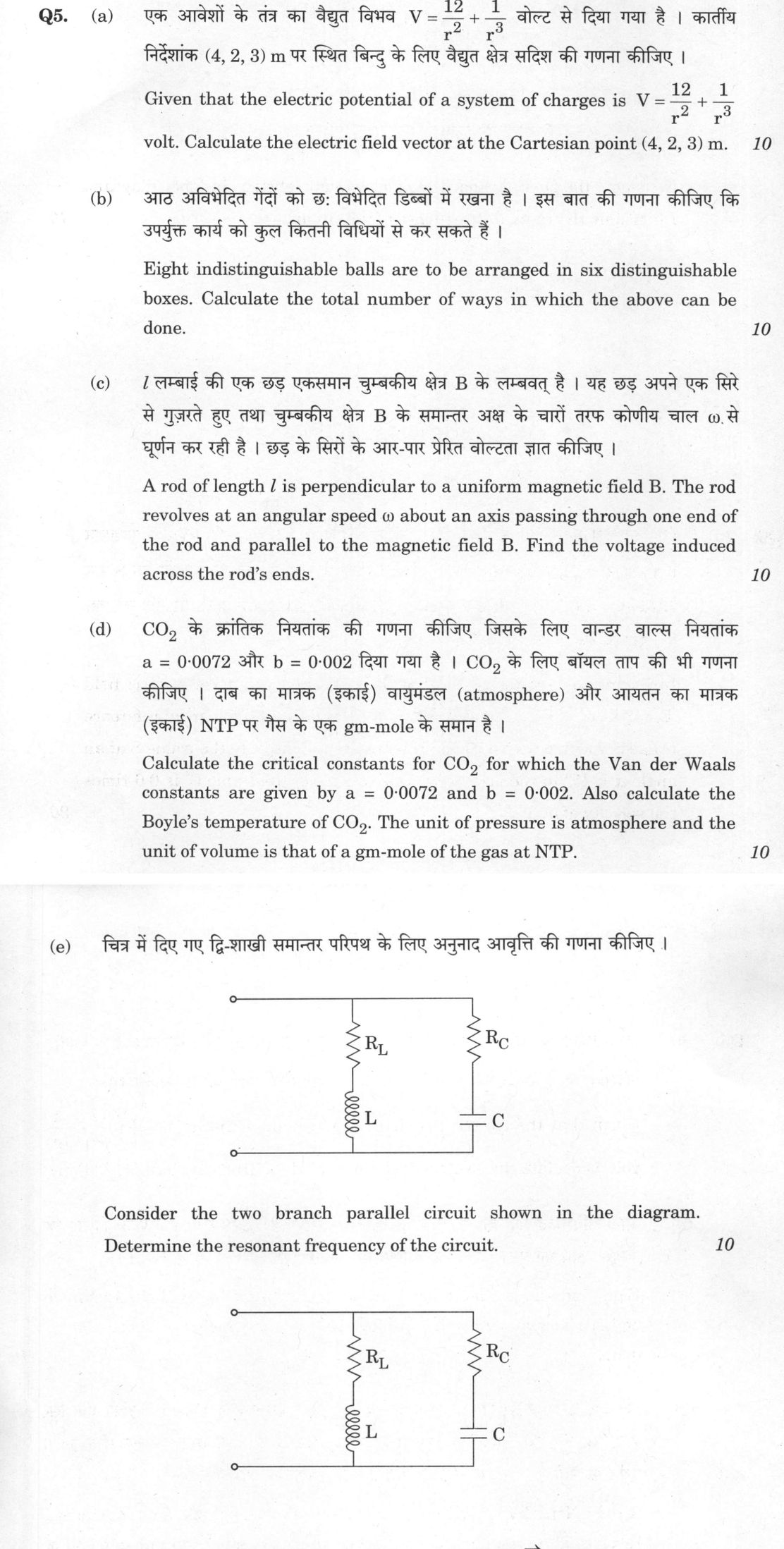
The figure this question refers to, in words
The question paper is a scan and the diagram did not survive as text. This is the figure as read from the original page — every component, value and label — so the question can be worked from the text below.
(e) A two-branch parallel circuit connected across two open input terminals on the left (an upper terminal line and a lower terminal line). Connected in parallel across the two lines are two vertical branches: the first branch consists of a resistor of resistance R_L connected in series above an inductor of inductance L; the second branch consists of a resistor of resistance R_C connected in series above a capacitor of capacitance C.
Model answer
Written by UPSC Answer Check against this question's marking rubric, to the expected length. UPSC does not publish answers for Mains — this is one way to score well, not an official key.
(a) The electric field is obtained from the potential by the gradient relation E = -∇V. Here V = 12/r² + 1/r³ volt, and r = √(x² + y² + z²). Since V depends only on r, ∇V = (dV/dr) (r vector/r). Differentiating, dV/dr = -24/r³ - 3/r⁴. Therefore E = -(dV/dr) (r vector/r) = (24/r³ + 3/r⁴) (r vector/r) = (24/r⁴ + 3/r⁵) r vector.
At the point (4, 2, 3) m, r² = 4² + 2² + 3² = 16 + 4 + 9 = 29, so r = √29 m, r⁴ = 841, and r⁵ = 841√29. Thus E = [24/841 + 3/(841√29)] (4 i + 2 j + 3 k) V/m. Equivalently, E = [(24√29 + 3)/(841√29)] (4 i + 2 j + 3 k) V/m.
Final answer: E = [(96√29 + 12) i + (48√29 + 6) j + (72√29 + 9) k] / (841√29) V/m.
(b) Let the six distinguishable boxes receive x₁, x₂, x₃, x₄, x₅, x₆ balls. Since the eight balls are indistinguishable, only the counts matter. Hence x₁ + x₂ + x₃ + x₄ + x₅ + x₆ = 8, where each xᵢ is a non-negative integer.
By the stars-and-bars method, the number of non-negative integer solutions is C(8 + 6 - 1, 6 - 1) = C(13, 5). Now C(13, 5) = 13!/(5!8!) = (13 × 12 × 11 × 10 × 9)/(5 × 4 × 3 × 2 × 1) = 154440/120 = 1287.
Final answer: 1287 ways.
(c) Let x be the distance of an element of the rod from the axis of rotation. The rod rotates about an axis through one end and parallel to the magnetic field B. The speed of the element is v = ωx. The velocity v is perpendicular to B and to the rod. The motional emf induced between the ends is obtained by integrating (v × B)·dl along the rod. Here dl is along the rod, so emf = ∫ from 0 to l (v × B)·dl = ∫ from 0 to l ω x B dx = Bω ∫ from 0 to l x dx = ½ Bωl².
The same result follows from Faraday’s law: in time dt the rod sweeps area ½l² dθ, so flux change is B(½l² ω dt), giving emf = ½Bωl².
Final answer: The voltage induced across the rod’s ends is V = ½ Bωl² volt. Its polarity depends on the sense of rotation.
(d) For one mole, the Van der Waals equation is (P + a/V²)(V - b) = RT. The critical constants are obtained from (∂P/∂V)_T = 0 and (∂²P/∂V²)_T = 0, giving V_c = 3b, P_c = a/(27b²), T_c = 8a/(27Rb). The Boyle temperature is T_B = a/(Rb).
Given: a = 0.0072, b = 0.002, pressure in atm, and volume in the volume of one gm-mole of gas at NTP. At NTP, P = 1 atm, V = 1 volume unit, T = 273 K. Therefore R = PV/T = 1/273 atm·volume-unit·K⁻¹·mol⁻¹.
Now V_c = 3b = 3 × 0.002 = 0.006 volume units. If converted to litres, using 1 volume unit = 22.4 L, V_c = 0.006 × 22.4 = 0.1344 L/mol.
P_c = a/(27b²) = 0.0072/[27 × (0.002)²] = 0.0072/(27 × 0.000004) = 0.0072/0.000108 = 66.666... atm = 200/3 atm.
T_c = 8a/(27Rb) = 8 × 0.0072/[27 × (1/273) × 0.002] = 291.2 K.
Boyle temperature: T_B = a/(Rb) = 0.0072/[(1/273) × 0.002] = 982.8 K.
Final answer: V_c = 0.006 volume units = 0.1344 L/mol, P_c = 66.67 atm, T_c = 291.2 K, T_B = 982.8 K.
(e) Let branch 1 have impedance Z₁ = R_L + jωL, and branch 2 have impedance Z₂ = R_C - j/(ωC). The total admittance is Y = 1/Z₁ + 1/Z₂.
Now 1/Z₁ = (R_L - jωL)/(R_L² + ω²L²), and 1/Z₂ = (R_C + j/(ωC))/(R_C² + 1/(ω²C²)).
Therefore the imaginary part of Y, i.e. the susceptance B, is B = -ωL/(R_L² + ω²L²) + (1/(ωC))/(R_C² + 1/(ω²C²)). Simplify the second term: (1/(ωC))/(R_C² + 1/(ω²C²)) = ωC/(1 + ω²C²R_C²). So B = -ωL/(R_L² + ω²L²) + ωC/(1 + ω²C²R_C²).
At parallel resonance, the voltage and current are in phase, so the susceptance vanishes: B = 0. Hence ωL/(R_L² + ω²L²) = ωC/(1 + ω²C²R_C²). Cancelling ω, L/(R_L² + ω²L²) = C/(1 + ω²C²R_C²). Cross-multiplying: L(1 + ω²C²R_C²) = C(R_L² + ω²L²). Thus L + Lω²C²R_C² = CR_L² + Cω²L². Rearranging, L - CR_L² = ω²[L C(L - CR_C²)]. Therefore ω_r² = (L - CR_L²)/[L C(L - CR_C²)].
Hence the resonant angular frequency is ω_r = √[(L - CR_L²)/(L C(L - CR_C²))] rad/s, and the resonant frequency is f_r = ω_r/(2π) = (1/(2π)) √[(L - CR_L²)/(L C(L - CR_C²))] Hz.
Final answer: f_r = (1/(2π)) √[(L - CR_L²)/(L C(L - CR_C²))] Hz, valid when the quantity under the square root is positive.
What "Calculate" is asking you to do
Apply the standard formula or schedule to data the question has already supplied — a table of readings, cost records, a balance sheet — and produce the number. The method is rarely in doubt; the marks sit in the named intermediate quantities, each of which has to appear as a labelled line.
Structure that answers it
Data as given → formula or standard treatment, named → substitution → each intermediate, labelled → result with units
Where marks are lost
Omitting an intermediate the marking scheme pays for separately, or rounding at an intermediate line so the final figure drifts. In commerce and accountancy, any figure in a statement that no numbered working note supports is treated as unearned.
How this answer will be evaluated
Approach
Framework: Principle > Setup and diagram > Derivation > Result and limiting case. (a) calculate: given > formula > substitution > result with units > interpretation | (b) calculate: given > formula > substitution > result with units > interpretation | (c) derive: given > assumptions > stepwise derivation > result > check | (d) calculate: given > formula > substitution > result with units > interpretation | (e) calculate: given > formula > substitution > result with units > interpretation Full marks: Complete derivation with units, correct final values, physical interpretation
Key points expected
- State relation E = -grad V
- Compute partial derivatives dV/dx, dV/dy, dV/dz
- Substitute r = 5 m into derivatives
- Final vector with units V/m
- Identify as stars and bars problem
- State formula C(n+k-1, k-1)
- Substitute n=8, k=6
- Final integer result
Evaluation rubric
Each sub-part is marked on its own, against the marks and word limit printed on the paper.
- (a) Electric field vector at (4, 2, 3) m from given potential V. 10 marks
calculate— given → formula → substitution → result with units → interpretation
Must cover
- State relation E = -grad V
- Compute partial derivatives dV/dx, dV/dy, dV/dz
- Substitute r = 5 m into derivatives
- Final vector with units V/m
Loses marks
- Missing negative sign in E = -grad V
- Arithmetic error in r^2 or r^3
Earns more
- Explicit calculation of r^2 and r^3
- Vector notation for E
Extra mark
- Physical interpretation of field direction
- (b) Total ways to arrange 8 indistinguishable balls in 6 distinguishable boxes. 10 marks
calculate— given → formula → substitution → result with units → interpretation
Must cover
- Identify as stars and bars problem
- State formula C(n+k-1, k-1)
- Substitute n=8, k=6
- Final integer result
Loses marks
- Treating balls as distinguishable
- Wrong formula for indistinguishable objects
Earns more
- Explicit calculation of binomial coefficient
Extra mark
- Mention of generating function method
- (c) Voltage induced across rotating rod in magnetic field B. 10 marks
derive— given → assumptions → stepwise derivation → result → check
Must cover
- Draw labelled diagram of rotating rod
- Use motional EMF dV = B v dl
- Integrate from 0 to l
- Result V = (1/2) B l^2 omega
Loses marks
- Missing factor of 1/2 in final result
- No integration shown
Earns more
- Explanation of velocity v = omega r
- Direction of induced EMF
Extra mark
- Physical interpretation of energy source
- (d) Critical constants and Boyle's temperature for CO2 from Van der Waals constants. 10 marks
calculate— given → formula → substitution → result with units → interpretation
Must cover
- State Pc = a/27b^2
- State Vc = 3b
- State Tc = 8a/27Rb
- Calculate Boyle's temperature T_B = a/Rb
Loses marks
- Wrong critical point formulas
- Missing Boyle's temperature calculation
Earns more
- Substitution of a=0.0072, b=0.002
- Units for each constant
Extra mark
- Comparison with experimental values
- (e) Resonant frequency of two-branch parallel RLC circuit. 10 marks
calculate— given → formula → substitution → result with units → interpretation
Must cover
- Draw circuit with impedances Z1, Z2
- Set imaginary part of Y_total to zero
- Derive resonance condition
- Final frequency formula
Loses marks
- Setting impedance to zero instead of admittance
- Missing derivation of resonance condition
Earns more
- Explicit admittance calculation
- Simplification of complex fractions
Extra mark
- Special case when R_L = R_C
Practice this exact question
Write your answer and it is marked point by point against the model answer above — what you covered, what you missed, what you got wrong.
Evaluate my answer →More from Physics 2021 Paper I
- Q2 (a) A body of mass m at rest splits into two masses m₁ and m₂ by an explosion. After the…
- Q3 (a) In a step-index optical fiber system, explain the terms pulse dispersion and material…
- Q4 (a) (i) Define moment of inertia and radius of gyration of a body of mass M rotating abou…
- Q5 (a) Given that the electric potential of a system of charges is V = 12/r² + 1/r³ volt. Ca…
- Q6 (a) In an inertial reference frame S there is only a uniform electric field E⃗ = 8 kVm⁻¹.…
- Q7 (a) A region 1, z < 0, has a dielectric material with εᵣ = 3·2 and a region 2, z > 0 has…
- Q8 (a) (i) The melting point of tin is 232°C, its latent heat of fusion is 14 cal/g and the…