Paper I — Q3
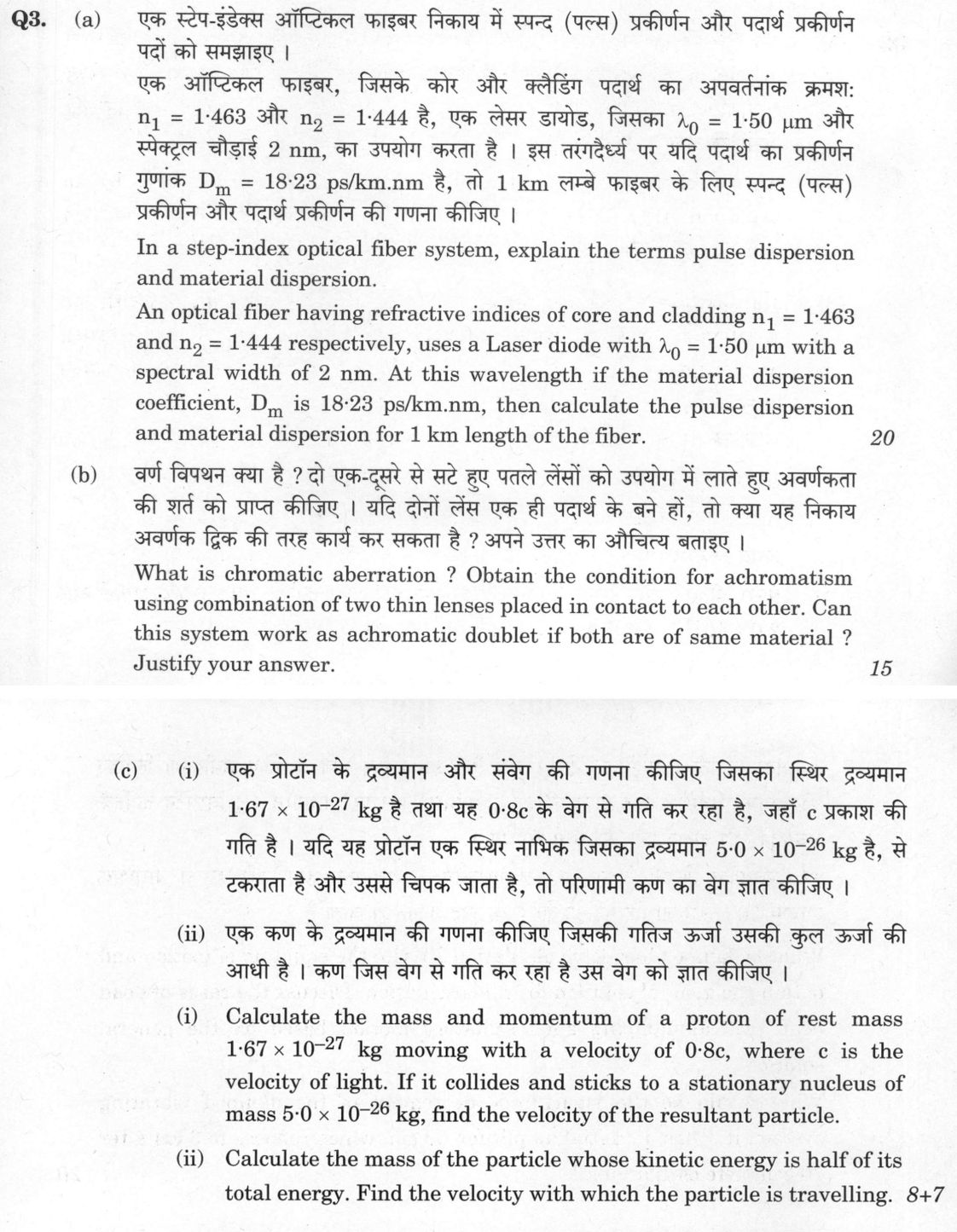
(a) In a step-index optical fiber system, explain the terms pulse dispersion and material dispersion. An optical fiber having…
In a step-index optical fiber system, explain the terms pulse dispersion and material dispersion.
An optical fiber having refractive indices of core and cladding n₁ = 1·463 and n₂ = 1·444 respectively, uses a Laser diode with λ₀ = 1·50 μm with a spectral width of 2 nm. At this wavelength if the material dispersion coefficient, Dₘ is 18·23 ps/km.nm, then calculate the pulse dispersion and material dispersion for 1 km length of the fiber. 20 marks
What is chromatic aberration? Obtain the condition for achromatism using combination of two thin lenses placed in contact to each other. Can this system work as achromatic doublet if both are of same material? Justify your answer. 15 marks
Calculate the mass and momentum of a proton of rest mass 1·67 × 10⁻²⁷ kg moving with a velocity of 0·8c, where c is the velocity of light. If it collides and sticks to a stationary nucleus of mass 5·0 × 10⁻²⁶ kg, find the velocity of the resultant particle. 8 marks
Calculate the mass of the particle whose kinetic energy is half of its total energy. Find the velocity with which the particle is travelling. 7 marks
हिंदी में प्रश्न पढ़ें
एक स्टेप-इंडेक्स ऑप्टिकल फाइबर निकाय में स्पंद (पल्स) प्रकीर्णन और पदार्थ प्रकीर्णन पदों को समझाइए ।
एक ऑप्टिकल फाइबर, जिसके कोर और क्लैडिंग पदार्थ का अपवर्तनांक क्रमशः: n₁ = 1·463 और n₂ = 1·444 है, एक लेसर डायोड, जिसका λ₀ = 1·50 μm और स्पेक्ट्रल चौड़ाई 2 nm, का उपयोग करता है । इस तरंगदैर्ध्य पर यदि पदार्थ का प्रकीर्णन गुणांक Dₘ = 18·23 ps/km.nm है, तो 1 km लम्बे फाइबर के लिए स्पंद (पल्स) प्रकीर्णन और पदार्थ प्रकीर्णन की गणना कीजिए । (20 अंक)
वर्ण विपथन क्या है ? दो एक-दूसरे से सटे हुए पतले लेंसों को उपयोग में लाते हुए अवर्णकता की शर्त को प्राप्त कीजिए । यदि दोनों लेंस एक ही पदार्थ के बने हों, तो क्या यह निकाय अवर्णक द्विक की तरह कार्य कर सकता है ? अपने उत्तर का औचित्य बताइए । (15 अंक)
एक प्रोटॉन के द्रव्यमान और संवेग की गणना कीजिए जिसका स्थिर द्रव्यमान 1·67 × 10⁻²⁷ kg है तथा यह 0·8c के वेग से गति कर रहा है, जहाँ c प्रकाश की गति है। यदि यह प्रोटॉन एक स्थिर नाभिक जिसका द्रव्यमान 5·0 × 10⁻²⁶ kg है, से टकराता है और उससे चिपक जाता है, तो परिणामी कण का वेग ज्ञात कीजिए। (8 अंक)
एक कण के द्रव्यमान की गणना कीजिए जिसकी गतिज ऊर्जा उसकी कुल ऊर्जा की आधी है। कण जिस वेग से गति कर रहा है उस वेग को ज्ञात कीजिए। (7 अंक)
Model answer
Written by UPSC Answer Check against this question's marking rubric, to the expected length. UPSC does not publish answers for Mains — this is one way to score well, not an official key.
(a) Pulse dispersion is the broadening in time of an optical pulse as it travels along a fiber because different rays/modes or different wavelength components arrive after different delays. In a step-index multimode fiber, rays making different angles with the axis travel different path lengths, causing intermodal pulse dispersion. Material dispersion is the broadening caused by dependence of the refractive index of the core material on wavelength λ; different spectral components of the source travel with different group velocities. For a source of spectral width Δλ, material delay per km is DₘΔλ.
For the step-index fiber, let L=1 km=1000 m, c=3·00×10⁸ m s⁻¹. The fastest axial ray has delay t₁ = n₁L/c. The extreme guided ray satisfies cos θmax = n₂/n₁, so its path length is L/cos θmax = n₁L/n₂. Its delay is t₂ = n₁(n₁L/n₂)/c = n₁²L/(c n₂). Hence intermodal pulse dispersion for 1 km is Δτp = t₂ − t₁ = n₁L(n₁−n₂)/(c n₂).
Given n₁=1·463, n₂=1·444, n₁−n₂=0·019, n₁(n₁−n₂)/n₂ = 1·463×0·019/1·444 = 0·01925. Therefore Δτp = 1000×0·01925/(3·00×10⁸) = 6·4167×10⁻⁸ s = 64·17 ns.
Material dispersion: Δτm = DₘLΔλ = 18·23 ps km⁻¹ nm⁻¹ × 1 km × 2 nm = 36·46 ps = 3·646×10⁻¹¹ s. Thus the modal pulse dispersion is about 64·17 ns, while material dispersion for 1 km is only 36·46 ps.
(b) Chromatic aberration is the defect in which a lens forms images of different colours at different positions because the refractive index, and hence focal length, depends on wavelength. For a converging lens, blue light is focused closer than red light, producing coloured fringes.
For two thin lenses in contact, combined power is P = P₁ + P₂ = 1/f₁ + 1/f₂. Let ω=(n_F−n_C)/(n_D−1) be the dispersive power. For small change of refractive index, δP₁ = ω₁P₁, δP₂ = ω₂P₂. Achromatism requires the combined focal length to be the same for two colours, i.e. δP=0: ω₁P₁ + ω₂P₂ = 0, or ω₁/f₁ + ω₂/f₂ = 0. This is the condition for achromatism of two thin lenses in contact.
If both lenses are made of the same material, then ω₁=ω₂=ω. Hence ω(1/f₁ + 1/f₂)=0, so 1/f₁ + 1/f₂ = 0, i.e. P=0 and f=∞. Thus the combination cannot act as a finite-focus achromatic doublet; it merely becomes an afocal system. So, two lenses of the same material placed in contact cannot form an achromatic doublet.
(c)(i) Given m₀=1·67×10⁻²⁷ kg, v=0·8c. γ = 1/√(1−v²/c²) = 1/√(1−0·64) = 1/0·6 = 5/3. Relativistic mass: m = γm₀ = (5/3)(1·67×10⁻²⁷) = 2·783×10⁻²⁷ kg. Momentum: p = mv = γm₀v = (5/3)(1·67×10⁻²⁷)(0·8×3·00×10⁸) = 6·68×10⁻¹⁹ kg m s⁻¹.
After sticking to a stationary nucleus of mass M=5·0×10⁻²⁶ kg, momentum is conserved: p = (γm₀ + M)V. Thus V = p/(γm₀ + M) = 6·68×10⁻¹⁹/(2·783×10⁻²⁷ + 5·0×10⁻²⁶) = 6·68×10⁻¹⁹/(5·278×10⁻²⁶) = 1·266×10⁷ m s⁻¹ = 0·0422c, in the original direction.
(c)(ii) Let the rest mass be m₀. Total energy E=γm₀c² and kinetic energy K=(γ−1)m₀c². Given K=E/2, (γ−1)m₀c² = γm₀c²/2. So 2(γ−1)=γ, giving γ=2. Therefore relativistic mass is m = γm₀ = 2m₀. Since m₀ is not specified, only this ratio can be given.
Also, γ = 1/√(1−v²/c²) = 2, so 1−v²/c² = 1/4, v²/c² = 3/4, v = (√3/2)c = 0·866c = 2·598×10⁸ m s⁻¹.
What "Calculate" is asking you to do
Apply the standard formula or schedule to data the question has already supplied — a table of readings, cost records, a balance sheet — and produce the number. The method is rarely in doubt; the marks sit in the named intermediate quantities, each of which has to appear as a labelled line.
Structure that answers it
Data as given → formula or standard treatment, named → substitution → each intermediate, labelled → result with units
Where marks are lost
Omitting an intermediate the marking scheme pays for separately, or rounding at an intermediate line so the final figure drifts. In commerce and accountancy, any figure in a statement that no numbered working note supports is treated as unearned.
How this answer will be evaluated
Approach
(a) calculate: given > formula > substitution > result with units > interpretation | (b) derive: given > assumptions > stepwise derivation > result > check | (c(i)) calculate: given > formula > substitution > result with units > interpretation | (c(ii)) calculate: given > formula > substitution > result with units > interpretation Full marks: All parts show full derivation, correct units, and physical interpretation; no conceptual errors.
Key points expected
- Define pulse dispersion and material dispersion
- Calculate numerical value of material dispersion
- Calculate numerical value of pulse dispersion
- Carry units (ps/km.nm, nm, km) in calculation
- Define chromatic aberration
- Derive condition for achromatism (1/f1 + 1/f2 = 0)
- Justify why same material cannot form achromatic doublet
- Use lens maker's formula in derivation
Evaluation rubric
Each sub-part is marked on its own, against the marks and word limit printed on the paper.
- (a) Define pulse and material dispersion; calculate both for the given fiber parameters. 20 marks
calculate— given → formula → substitution → result with units → interpretation
Must cover
- Define pulse dispersion and material dispersion
- Calculate numerical value of material dispersion
- Calculate numerical value of pulse dispersion
- Carry units (ps/km.nm, nm, km) in calculation
Loses marks
- Formula substitution without derivation or definition
- Dropping units in final answer
- Confusing material and pulse dispersion terms
Earns more
- State formula for material dispersion (Δτ = D_m * L * Δλ)
- State formula for pulse dispersion
- Substitute given values explicitly (n1, n2, λ0, D_m)
Extra mark
- Mention physical interpretation of dispersion in fiber
- (b) Define chromatic aberration; derive achromatism condition for two thin lenses in contact; justify material requirement. 15 marks
derive— given → assumptions → stepwise derivation → result → check
Must cover
- Define chromatic aberration
- Derive condition for achromatism (1/f1 + 1/f2 = 0)
- Justify why same material cannot form achromatic doublet
- Use lens maker's formula in derivation
Loses marks
- Stating condition without derivation
- Failing to justify material requirement
- Confusing achromatism with other aberration corrections
Earns more
- State dispersion relation (1/f = (n-1)(1/R1 - 1/R2))
- Show that V1/V2 ≠ 1 for achromatism
- Mention crown and flint glass as typical pair
Extra mark
- Draw labelled diagram of two thin lenses in contact
- (c(i)) Calculate relativistic mass and momentum of proton; find velocity after inelastic collision with nucleus. 8 marks
calculate— given → formula → substitution → result with units → interpretation
Must cover
- Calculate relativistic mass (m = m0/√(1-v²/c²))
- Calculate relativistic momentum (p = mv)
- Apply conservation of momentum for collision
- Calculate final velocity of resultant particle
Loses marks
- Using classical (non-relativistic) formulas
- Dropping units in intermediate or final steps
- Failing to apply conservation of momentum correctly
Earns more
- State Lorentz factor γ = 1/√(1-0.8²) = 5/3
- Show momentum conservation equation explicitly
- Carry units (kg, m/s) in all steps
Extra mark
- Mention that kinetic energy is not conserved in inelastic collision
- (c(ii)) Calculate mass of particle where KE = ½ total energy; find its velocity. 7 marks
calculate— given → formula → substitution → result with units → interpretation
Must cover
- Use relation KE = ½ E_total
- Derive or state E_total = γm0c²
- Solve for mass (m0) or γ
- Calculate velocity v from γ
Loses marks
- Using classical KE = ½mv² instead of relativistic
- Failing to relate KE and total energy correctly
- Dropping units or not checking dimensions
Earns more
- Show that γ = 2 (since KE = (γ-1)m0c² = ½γm0c²)
- Calculate v = c√(1 - 1/γ²) = c√(3)/2
- Carry units and check dimensions
Extra mark
- Mention that this corresponds to v ≈ 0.866c
Practice this exact question
Write your answer and it is marked point by point against the model answer above — what you covered, what you missed, what you got wrong.
Evaluate my answer →More from Physics 2021 Paper I
- Q1 (a) A particle moving in a central force field describes the path r = ke^αθ, where k and…
- Q2 (a) A body of mass m at rest splits into two masses m₁ and m₂ by an explosion. After the…
- Q3 (a) In a step-index optical fiber system, explain the terms pulse dispersion and material…
- Q4 (a) (i) Define moment of inertia and radius of gyration of a body of mass M rotating abou…
- Q5 (a) Given that the electric potential of a system of charges is V = 12/r² + 1/r³ volt. Ca…
- Q6 (a) In an inertial reference frame S there is only a uniform electric field E⃗ = 8 kVm⁻¹.…