Paper I — Q2
(a) A body of mass m at rest splits into two masses m₁ and m₂ by an explosion. After the split the bodies move with a total…
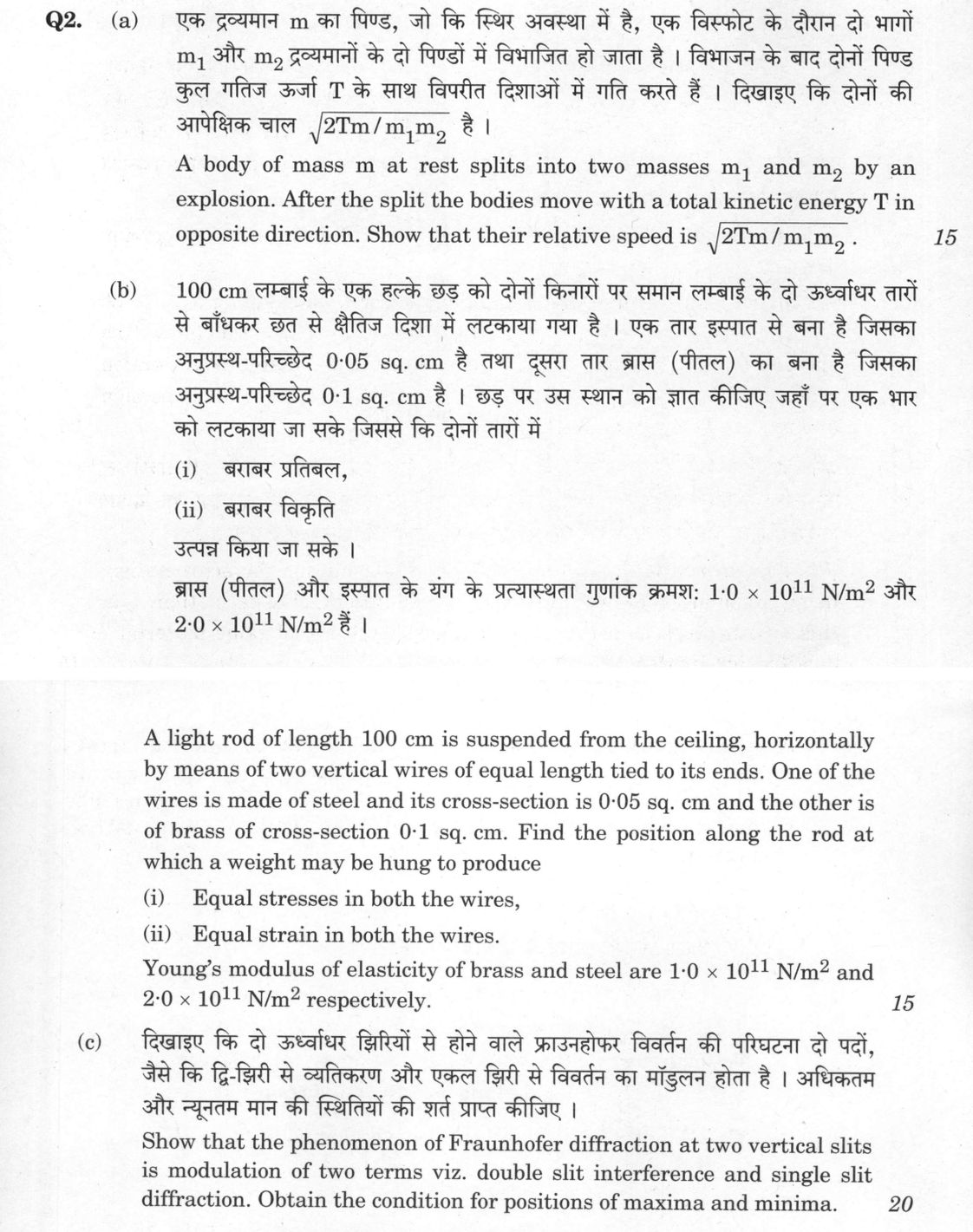
A body of mass m at rest splits into two masses m₁ and m₂ by an explosion. After the split the bodies move with a total kinetic energy T in opposite direction. Show that their relative speed is √(2Tm/m₁m₂). 15 marks
A light rod of length 100 cm is suspended from the ceiling, horizontally by means of two vertical wires of equal length tied to its ends. One of the wires is made of steel and its cross-section is 0·05 sq. cm and the other is of brass of cross-section 0·1 sq. cm. Find the position along the rod at which a weight may be hung to produce
Equal stresses in both the wires,
Equal strain in both the wires.
Young's modulus of elasticity of brass and steel are 1·0 × 10¹¹ N/m² and 2·0 × 10¹¹ N/m² respectively. 15 marks
Show that the phenomenon of Fraunhofer diffraction at two vertical slits is modulation of two terms viz. double slit interference and single slit diffraction. Obtain the condition for positions of maxima and minima. 20 marks
हिंदी में प्रश्न पढ़ें
एक द्रव्यमान m का पिंड, जो कि स्थिर अवस्था में है, एक विस्फोट के दौरान दो भागों m₁ और m₂ द्रव्यमानों के दो पिंडों में विभाजित हो जाता है । विभाजन के बाद दोनों पिंड कुल गतिज ऊर्जा T के साथ विपरीत दिशाओं में गति करते हैं । दिखाइए कि दोनों की आपेक्षिक चाल √(2Tm/m₁m₂) है । (15 अंक)
100 cm लम्बाई के एक हल्के छड़ को दोनों किनारों पर समान लम्बाई के दो ऊर्ध्वाधर तारों से बाँधकर छत से क्षैतिज दिशा में लटकाया गया है । एक तार इस्पात से बना है जिसका अनुप्रस्थ-परिच्छेद 0·05 sq. cm है तथा दूसरा तार ब्रास (पीतल) का बना है जिसका अनुप्रस्थ-परिच्छेद 0·1 sq. cm है । छड़ पर उस स्थान को ज्ञात कीजिए जहाँ पर एक भार को लटकाया जा सके जिससे कि दोनों तारों में
बराबर प्रतिबल,
बराबर विकृति
उत्पन्न किया जा सके ।
ब्रास (पीतल) और इस्पात के यंग के प्रत्यास्थता गुणांक क्रमशः 1·0 × 10¹¹ N/m² और 2·0 × 10¹¹ N/m² हैं । (15 अंक)
दिखाइए कि दो उर्ध्वाधर छिद्रों से होने वाले फ्राउनहोफर विवर्तन की परिघटना दो पदों, जैसे कि द्वि-छिरी से व्यतिकरण और एकल छिरी से विवर्तन का मॉडुलन होता है । अधिकतम और न्यूनतम मान की स्थितियों की शर्त प्राप्त कीजिए । (20 अंक)
Model answer
Written by UPSC Answer Check against this question's marking rubric, to the expected length. UPSC does not publish answers for Mains — this is one way to score well, not an official key.
(a) Let the two fragments move with speeds v₁ and v₂ in opposite directions. Since the original body was at rest, linear momentum conservation gives m₁v₁ − m₂v₂ = 0, so m₁v₁ = m₂v₂ = p. The total kinetic energy is T = (1/2)m₁v₁² + (1/2)m₂v₂² = p²/(2m₁) + p²/(2m₂) = p²(m₁ + m₂)/(2m₁m₂) = p²m/(2m₁m₂), where m = m₁ + m₂. Thus p = √(2Tm₁m₂/m). The relative speed is v_rel = v₁ + v₂ = p/m₁ + p/m₂ = p(m₁ + m₂)/(m₁m₂) = pm/(m₁m₂). Substituting p: v_rel = [√(2Tm₁m₂/m)] m/(m₁m₂) = √(2Tm/m₁m₂). Thus the relative speed is √(2Tm/m₁m₂). This assumes no external impulse and non-relativistic speeds.
(b) Let L = 100 cm = 1 m. Let x be the distance of the hung weight W from the steel-wire end. From vertical equilibrium and moments about the steel end: T_s + T_b = W, and T_bL = Wx. Hence T_s = W(L − x)/L, T_b = Wx/L. Given A_s = 0.05 cm² = 5 × 10⁻⁶ m², A_b = 0.1 cm² = 1 × 10⁻⁵ m², Y_s = 2.0 × 10¹¹ N/m², Y_b = 1.0 × 10¹¹ N/m².
(i) Equal stresses means T_s/A_s = T_b/A_b. Therefore (L − x)/A_s = x/A_b. Solving: x = LA_b/(A_s + A_b) = 100 cm × 0.1/(0.05 + 0.1) = 100 × 0.1/0.15 = 200/3 cm = 66.7 cm. Thus the weight must be hung at 200/3 cm = 66.7 cm from the steel end, i.e. 100/3 cm = 33.3 cm from the brass end.
(ii) Equal strains means (T_s/A_s)/Y_s = (T_b/A_b)/Y_b, or T_s/(A_sY_s) = T_b/(A_bY_b). Thus (L − x)/(A_sY_s) = x/(A_bY_b). Solving: x = LA_bY_b/(A_sY_s + A_bY_b). Using SI units: A_sY_s = (5 × 10⁻⁶)(2.0 × 10¹¹) = 1.0 × 10⁶ N, A_bY_b = (1 × 10⁻⁵)(1.0 × 10¹¹) = 1.0 × 10⁶ N. Hence x = 100 cm × (1.0 × 10⁶)/(2.0 × 10⁶) = 50 cm. Thus the weight must be hung at the midpoint, 50 cm from either end. This is valid within the elastic limit.
(c) Let the slit width be a and the distance between slit centres be d. For Fraunhofer diffraction at angle θ, the single-slit amplitude is A₁ = A₀ ∫ from −a/2 to a/2 exp[i(2π/λ)x sinθ] dx = A₀ a sinβ/β, where β = (πa sinθ)/λ. The second slit has an extra phase δ = (2π/λ)d sinθ relative to the first. The resultant amplitude is A = A₁ + A₁e^(iδ) = A₁(1 + e^(iδ)) = 2A₁ cos(δ/2)e^(iδ/2). Therefore the intensity is I = I₀ (sinβ/β)² cos²(δ/2). This is explicitly the product of the single-slit diffraction factor (sinβ/β)² and the double-slit interference factor cos²(δ/2); hence the interference term is modulated by the diffraction envelope.
For minima:
- Double-slit interference minima: cos²(δ/2) = 0, so δ/2 = (n + 1/2)π, giving d sinθ = (n + 1/2)λ, n = 0, ±1, ±2, …
- Single-slit diffraction minima: sinβ = 0 with β ≠ 0, so a sinθ = mλ, m = ±1, ±2, ±3, … Thus zero intensity occurs wherever either condition is satisfied.
For maxima:
- Principal double-slit interference maxima: cos²(δ/2) = 1, so d sinθ = nλ, n = 0, ±1, ±2, … These are the main maxima of the two-slit pattern. If such a maximum also satisfies a sinθ = mλ, it is missing; the missing-order condition is d/a = n/m.
- Single-slit diffraction envelope alone has a central maximum at β = 0 and secondary maxima at tanβ = β, approximately β = (m + 1/2)π. For the exact combined pattern, maxima satisfy dI/dθ = 0; excluding minima, this gives tan(δ/2) = (a/d)(cotβ − 1/β). In the usual elementary treatment, the sharp principal maxima are therefore taken at d sinθ = nλ, with missing orders as above.
For a screen at distance D and small θ, using sinθ ≈ y/D, the positions are approximately y_max = nλD/d, y_min = (n + 1/2)λD/d and also y_min = mλD/a. Hence two-slit Fraunhofer diffraction is double-slit interference modulated by single-slit diffraction, with the above conditions for maxima and minima.
What "Derive" is asking you to do
Reach the stated expression from a starting relation, justifying every step. The destination is printed in the question, so only the route earns marks, and the assumptions you work under are part of that route.
Structure that answers it
Assumptions and notation defined → starting relation or governing equation → each step with its justification → the required expression → limiting case or boundary check
Where marks are lost
Writing the standard result first and fitting three lines to it, which an examiner reads at a glance. Marks also go on assumptions left unstated — lossless medium, small amplitude, errors independent with zero mean — and on symbols used before they are defined, even when the question says usual notations.
How this answer will be evaluated
Approach
Framework: Principle > Setup and diagram > Derivation > Result and limiting case. (a) derive: given > assumptions > stepwise derivation > result > check | (b) calculate: given > formula > substitution > result with units > interpretation | (c) derive: given > assumptions > stepwise derivation > result > check Full marks: Complete derivations with correct algebra, clear diagrams, and physical interpretation.
Key points expected
- Apply conservation of linear momentum (initial momentum zero).
- Express total kinetic energy T in terms of m1, m2, v1, v2.
- Define relative speed as v1 + v2 (opposite directions).
- Algebraically eliminate velocities to obtain √(2Tm/m1m2).
- Draw labelled free-body diagram of rod and wires.
- Apply torque equilibrium about one end of the rod.
- Relate stress to force/area and strain to stress/Young's modulus.
- Solve for distance x from steel wire end for both cases.
Evaluation rubric
Each sub-part is marked on its own, against the marks and word limit printed on the paper.
- (a) Derive the expression for relative speed of two masses after explosion. 15 marks
derive— given → assumptions → stepwise derivation → result → check
Must cover
- Apply conservation of linear momentum (initial momentum zero).
- Express total kinetic energy T in terms of m1, m2, v1, v2.
- Define relative speed as v1 + v2 (opposite directions).
- Algebraically eliminate velocities to obtain √(2Tm/m1m2).
Loses marks
- Assuming equal masses without justification.
- Dropping the square root in final step.
Earns more
- Explicitly state m = m1 + m2.
- Check dimensions of the final result.
Extra mark
- Mention physical interpretation of relative speed in CM frame.
- (b) Calculate position of weight for equal stress and equal strain conditions. 15 marks
calculate— given → formula → substitution → result with units → interpretation
Must cover
- Draw labelled free-body diagram of rod and wires.
- Apply torque equilibrium about one end of the rod.
- Relate stress to force/area and strain to stress/Young's modulus.
- Solve for distance x from steel wire end for both cases.
Loses marks
- Confusing stress and strain formulas.
- Forgetting to use Young's modulus in part (ii).
Earns more
- Convert cm² to m² explicitly.
- State assumption of light rod (negligible weight).
Extra mark
- Verify result is within 0-100 cm range.
- (c) Derive intensity pattern showing modulation of interference and diffraction. 20 marks
derive— given → assumptions → stepwise derivation → result → check
Must cover
- Write amplitude as product of single-slit and double-slit terms.
- Derive intensity I = I0 (sin β/β)² cos² α.
- Identify β = (πa sin θ)/λ and α = (πd sin θ)/λ.
- State conditions for maxima (α = nπ) and minima (α = (n+1/2)π).
Loses marks
- Confusing interference and diffraction angles.
- Omitting the single-slit diffraction factor.
Earns more
- Define a (slit width) and d (slit separation) clearly.
- Mention envelope function (sin β/β)².
Extra mark
- Sketch the intensity pattern showing missing orders.
Practice this exact question
Write your answer and it is marked point by point against the model answer above — what you covered, what you missed, what you got wrong.
Evaluate my answer →More from Physics 2021 Paper I
- Q1 (a) A particle moving in a central force field describes the path r = ke^αθ, where k and…
- Q2 (a) A body of mass m at rest splits into two masses m₁ and m₂ by an explosion. After the…
- Q3 (a) In a step-index optical fiber system, explain the terms pulse dispersion and material…
- Q4 (a) (i) Define moment of inertia and radius of gyration of a body of mass M rotating abou…
- Q5 (a) Given that the electric potential of a system of charges is V = 12/r² + 1/r³ volt. Ca…