Paper II — Q1
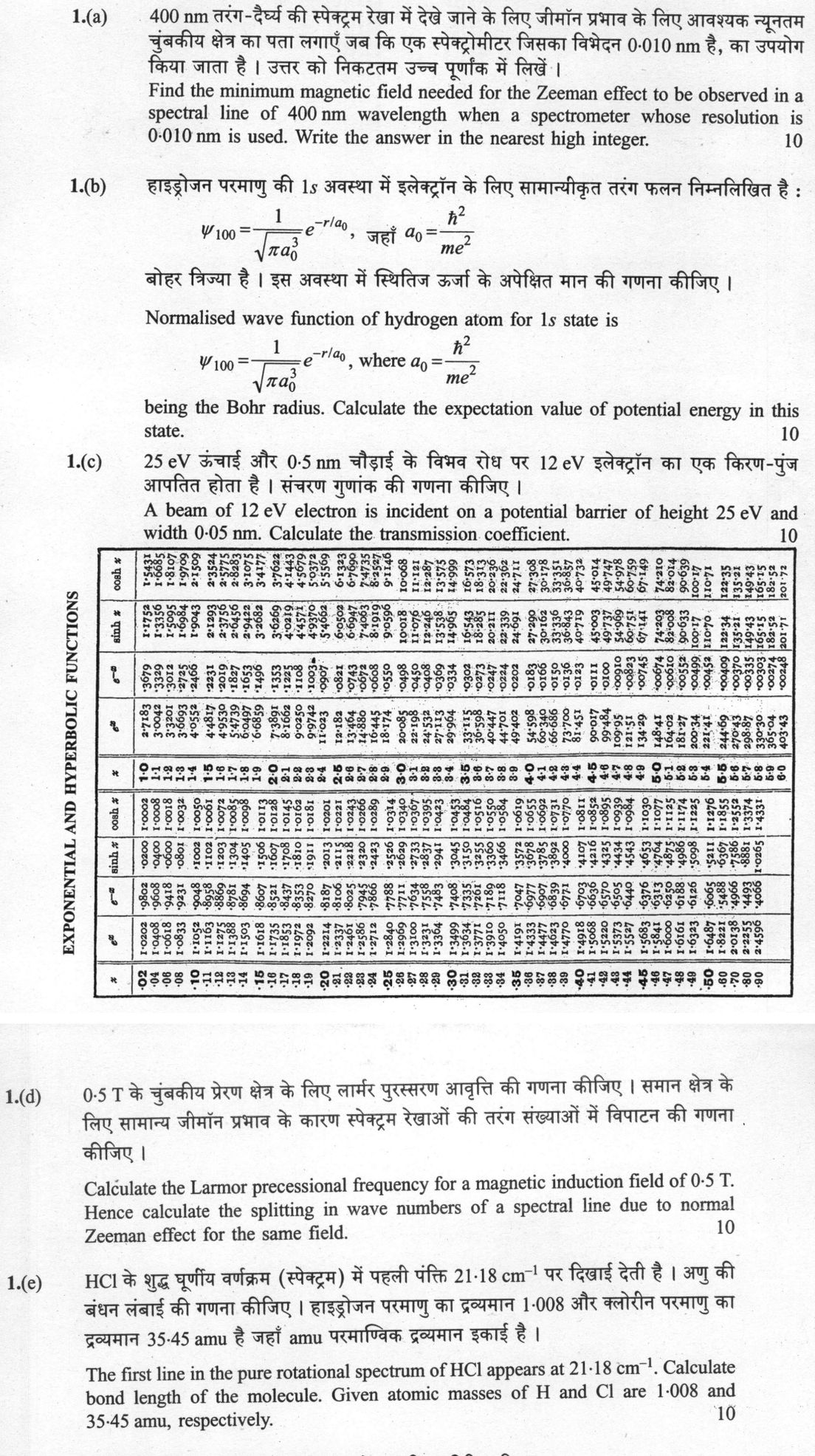
(a) Find the minimum magnetic field needed for the Zeeman effect to be observed in a spectral line of 400 nm wavelength when a…
Find the minimum magnetic field needed for the Zeeman effect to be observed in a spectral line of 400 nm wavelength when a spectrometer whose resolution is 0·010 nm is used. Write the answer in the nearest high integer. 10 marks
Normalised wave function of hydrogen atom for 1s state is ψ₁₀₀ = 1/(√(π a₀³)) e^-r/a₀, where a₀ = (ℏ²)/(me²) being the Bohr radius. Calculate the expectation value of potential energy in this state. 10 marks
A beam of 12 eV electron is incident on a potential barrier of height 25 eV and width 0·05 nm. Calculate the transmission coefficient. 10 marks
Calculate the Larmor precessional frequency for a magnetic induction field of 0·5 T. Hence calculate the splitting in wave numbers of a spectral line due to normal Zeeman effect for the same field. 10 marks
The first line in the pure rotational spectrum of HCl appears at 21·18 cm⁻¹. Calculate bond length of the molecule. Given atomic masses of H and Cl are 1·008 and 35·45 amu, respectively. 10 marks
हिंदी में प्रश्न पढ़ें
400 nm तरंग-दैर्घ्य की स्पेक्ट्रम रेखा में देखे जाने के लिए ज़ीमान प्रभाव के लिए आवश्यक न्यूनतम चुंबकीय क्षेत्र का पता लगाइए जब कि एक स्पेक्ट्रोमीटर जिसका विभेदन 0·010 nm है, का उपयोग किया जाता है । उत्तर को निकटतम उच्च पूर्णांक में लिखें । 10 अंक
हाइड्रोजन परमाणु की 1s अवस्था में इलेक्ट्रॉन के लिए सामान्यीकृत तरंग फलन निम्नलिखित है : ψ₁₀₀ = 1/(√(π a₀³)) e^-r/a₀, जहाँ a₀ = (ℏ²)/(me²) बोहर त्रिज्या है । इस अवस्था में स्थितिज ऊर्जा के अपेक्षित मान की गणना कीजिए । 10 अंक
25 eV ऊँचाई और 0·5 nm चौड़ाई के विभव रोध पर 12 eV इलेक्ट्रॉन का एक किरण-पुंज आपतित होता है । संचरण गुणांक की गणना कीजिए । 10 अंक
0·5 T के चुंबकीय प्रेरण क्षेत्र के लिए लार्मर पुरस्सरण आवृत्ति की गणना कीजिए। समान क्षेत्र के लिए सामान्य ज़ीमान प्रभाव के कारण स्पेक्ट्रम रेखाओं की तरंग संख्याओं में विपाटन की गणना कीजिए। 10 अंक
HCl के शुद्ध घूर्णीय वर्णक्रम (स्पेक्ट्रम) में पहली पंक्ति 21·18 cm⁻¹ पर दिखाई देती है। अणु की बंधन लंबाई की गणना कीजिए। हाइड्रोजन परमाणु का द्रव्यमान 1·008 और क्लोरीन परमाणु का द्रव्यमान 35·45 amu है जहाँ amu परमाणविक द्रव्यमान इकाई है। 10 अंक
Model answer
Written by UPSC Answer Check against this question's marking rubric, to the expected length. UPSC does not publish answers for Mains — this is one way to score well, not an official key.
(a) For the normal Zeeman effect, the energy of a magnetic substate is ΔE = m_l μ_B B, where μ_B = eħ/(2m). For an allowed transition with Δm_l = ±1, the frequency displacement is
Δν = ΔE/h = eB/(4πm).
Using λ = c/ν, the corresponding wavelength displacement is
Δλ = (λ²/c) Δν = eλ²B/(4πmc).
The spectrometer can just resolve a wavelength difference equal to its resolution, so the minimum field satisfies
Δλ = 0.010 nm = 1.0×10⁻¹¹ m.
Thus
B_min = 4πmc Δλ/(eλ²).
Substitute m = 9.109×10⁻³¹ kg, c = 2.998×10⁸ m s⁻¹, e = 1.602×10⁻¹⁹ C, λ = 400 nm = 4.00×10⁻⁷ m:
B_min = [4π(9.109×10⁻³¹)(2.998×10⁸)(1.0×10⁻¹¹)] / [(1.602×10⁻¹⁹)(4.00×10⁻⁷)²] = 3.43×10⁻³² / 2.56×10⁻³² T = 1.34 T.
Since the question asks for the nearest higher integer, the minimum required field is
B_min ≈ 2 T.
(b) The potential energy of the electron in the hydrogen atom is V(r) = −e²/r, in the units implicit in a₀ = ħ²/(m e²). Therefore
⟨V⟩ = ∫ ψ₁₀₀* (−e²/r) ψ₁₀₀ dτ.
With
ψ₁₀₀ = (πa₀³)^(−1/2) e^(−r/a₀),
we have
|ψ₁₀₀|² = (1/(πa₀³)) e^(−2r/a₀).
The volume element is dτ = r² sinθ dr dθ dφ, and the angular integral gives 4π. Hence
⟨V⟩ = −(4πe²/(πa₀³)) ∫₀∞ e^(−2r/a₀) r dr = −(4e²/a₀³) ∫₀∞ r e^(−2r/a₀) dr.
Use
∫₀∞ r e^(−αr) dr = 1/α².
Here α = 2/a₀, so the integral equals a₀²/4. Therefore
⟨V⟩ = −(4e²/a₀³)(a₀²/4) = −e²/a₀.
Using a₀ = ħ²/(m e²),
e²/a₀ = m e⁴/ħ² = 2 × 13.6 eV = 27.2 eV.
Thus
⟨V⟩ = −27.2 eV = −4.36×10⁻¹⁸ J.
(c) For a rectangular potential barrier of height V₀ and width a, with E < V₀, define
κ = √(2m(V₀ − E))/ħ.
The exact transmission coefficient is
T = 1 / [1 + (V₀²/(4E(V₀ − E))) sinh²(κa)].
Here
E = 12 eV, V₀ = 25 eV, V₀ − E = 13 eV = 13 × 1.602×10⁻¹⁹ J = 2.083×10⁻¹⁸ J,
a = 0.05 nm = 5.0×10⁻¹¹ m.
Therefore
κ = √(2 × 9.109×10⁻³¹ × 2.083×10⁻¹⁸) / (1.055×10⁻³⁴) = 1.847×10¹⁰ m⁻¹.
Then
κa = 1.847×10¹⁰ × 5.0×10⁻¹¹ = 0.9235.
So
sinh(0.9235) = 1.0605,
and
sinh²(κa) = 1.1247.
The prefactor is
V₀²/[4E(V₀ − E)] = 25²/[4 × 12 × 13] = 625/624 = 1.0016.
Hence
T = 1 / [1 + 1.0016 × 1.1247] = 1 / 2.1265 = 0.470.
Thus
T ≈ 0.470 = 47.0%.
This is valid for a rectangular barrier, non-relativistic electrons, and no image-potential corrections.
(d)(i) The Larmor angular frequency for an electron in a magnetic field B is
ω_L = eB/(2m).
The ordinary precessional frequency is therefore
ν_L = ω_L/(2π) = eB/(4πm).
For B = 0.5 T,
ν_L = (1.602×10⁻¹⁹ × 0.5) / (4π × 9.109×10⁻³¹) = 6.998×10⁹ s⁻¹ ≈ 7.0×10⁹ Hz = 7.0 GHz.
So
ν_L ≈ 7.0×10⁹ Hz = 7.0 GHz.
(d)(ii) In the normal Zeeman effect, the energy shift is
ΔE = μ_B B = eħB/(2m).
The corresponding frequency shift is
Δν = ΔE/h = eB/(4πm),
which is the same as the Larmor precessional frequency. The splitting in wave numbers is
Δν~ = Δν/c = eB/(4πmc).
Using c = 2.998×10¹⁰ cm s⁻¹,
e/(4πmc) = (1.602×10⁻¹⁹) / [4π × 9.109×10⁻³¹ × 2.998×10¹⁰] = 0.4669 cm⁻¹ T⁻¹.
For B = 0.5 T,
Δν~ = 0.4669 × 0.5 = 0.2334 cm⁻¹.
Thus the adjacent Zeeman components are separated by
Δν~ ≈ 0.233 cm⁻¹.
If one defines the separation between the two extreme σ-components, it is twice this value:
2Δν~ ≈ 0.467 cm⁻¹.
(e) Within the rigid-rotor approximation for a diatomic molecule, the rotational term is
F(J) = B J(J + 1),
where
B = h/(8π²cI).
The first pure rotational line corresponds to J = 0 → 1. Its wave number is
Δν~ = F(1) − F(0) = 2B.
Given Δν~ = 21.18 cm⁻¹,
B = 21.18/2 = 10.59 cm⁻¹.
Therefore the moment of inertia is
I = h/(8π²cB).
Using B in cm⁻¹ and c = 2.998×10¹⁰ cm s⁻¹,
I = 6.626×10⁻³⁴ / [8π² × 2.998×10¹⁰ × 10.59] = 2.643×10⁻⁴⁷ kg m².
The reduced mass is
μ = m_H m_Cl/(m_H + m_Cl).
With m_H = 1.008 amu and m_Cl = 35.45 amu,
μ = (1.008 × 35.45)/(1.008 + 35.45) amu = 35.7336/36.458 amu = 0.98013 amu.
Using 1 amu = 1.66054×10⁻²⁷ kg,
μ = 0.98013 × 1.66054×10⁻²⁷ = 1.6275×10⁻²⁷ kg.
The bond length r is
r = √(I/μ) = √(2.643×10⁻⁴⁷ / 1.6275×10⁻²⁷) = √(1.624×10⁻²⁰) = 1.274×10⁻¹⁰ m.
Thus
r ≈ 1.274×10⁻¹⁰ m = 0.1274 nm = 1.274 Å.
What "Calculate" is asking you to do
Apply the standard formula or schedule to data the question has already supplied — a table of readings, cost records, a balance sheet — and produce the number. The method is rarely in doubt; the marks sit in the named intermediate quantities, each of which has to appear as a labelled line.
Structure that answers it
Data as given → formula or standard treatment, named → substitution → each intermediate, labelled → result with units
Where marks are lost
Omitting an intermediate the marking scheme pays for separately, or rounding at an intermediate line so the final figure drifts. In commerce and accountancy, any figure in a statement that no numbered working note supports is treated as unearned.
How this answer will be evaluated
Approach
Framework: Principle > Setup and diagram > Derivation > Result and limiting case. (a) calculate: given > formula > substitution > result with units > interpretation | (b) calculate: given > formula > substitution > result with units > interpretation | (c) calculate: given > formula > substitution > result with units > interpretation | (d) calculate: given > formula > substitution > result with units > interpretation | (e) calculate: given > formula > substitution > result with units > interpretation Full marks: Complete derivations with correct units, physical interpretation, and accurate numerical results.
Key points expected
- State Zeeman splitting formula Δλ = eλ²B / 4πmc²
- Set Δλ equal to resolution 0.010 nm
- Substitute λ = 400 nm and constants
- Provide final answer as nearest high integer
- Write potential energy operator V(r) = -e²/4πε₀r
- Set up integral <V> = ∫ψ*Vψ dτ
- Perform radial integration over volume
- State final result in terms of a₀ or eV
Evaluation rubric
Each sub-part is marked on its own, against the marks and word limit printed on the paper.
- (a) Minimum magnetic field for Zeeman splitting to exceed spectrometer resolution. 10 marks
calculate— given → formula → substitution → result with units → interpretation
Must cover
- State Zeeman splitting formula Δλ = eλ²B / 4πmc²
- Set Δλ equal to resolution 0.010 nm
- Substitute λ = 400 nm and constants
- Provide final answer as nearest high integer
Loses marks
- Using energy splitting formula without converting to wavelength
- Dropping units in intermediate steps
Earns more
- Explicitly state assumption of normal Zeeman effect
- Show unit conversion for wavelength
Extra mark
- Mention g-factor value used
- (b) Expectation value of potential energy for hydrogen 1s state. 10 marks
calculate— given → formula → substitution → result with units → interpretation
Must cover
- Write potential energy operator V(r) = -e²/4πε₀r
- Set up integral <V> = ∫ψ*Vψ dτ
- Perform radial integration over volume
- State final result in terms of a₀ or eV
Loses marks
- Forgetting the 4πr² volume element
- Incorrect limits of integration
Earns more
- Show integration by parts or standard integral result
- Relate result to total energy E₁
Extra mark
- Mention Virial theorem relation <V> = 2E
- (c) Transmission coefficient for electron tunneling through a barrier. 10 marks
calculate— given → formula → substitution → result with units → interpretation
Must cover
- Identify tunneling regime (E < V₀)
- Calculate decay constant κ = √(2m(V₀-E))/ℏ
- Apply transmission formula T ≈ 16(E/V₀)(1-E/V₀)e^(-2κa)
- Substitute values and calculate final T
Loses marks
- Using reflection coefficient instead of transmission
- Unit mismatch in energy or width
Earns more
- Show calculation of κ explicitly
- Verify E < V₀ condition
Extra mark
- Mention validity of thin barrier approximation
- (d) Larmor frequency and wave number splitting for B = 0.5 T. 10 marks
calculate— given → formula → substitution → result with units → interpretation
Must cover
- Calculate Larmor frequency ω = eB/2m
- Convert to frequency ν = ω/2π
- Calculate wave number splitting Δν̃ = eB/4πmc
- Provide splitting in cm⁻¹
Loses marks
- Confusing angular frequency with linear frequency
- Incorrect unit conversion for wave number
Earns more
- Show conversion from frequency to wave number
- State assumption of normal Zeeman effect
Extra mark
- Mention selection rules for transitions
- (e) Bond length of HCl from rotational spectrum first line. 10 marks
calculate— given → formula → substitution → result with units → interpretation
Must cover
- Calculate reduced mass μ of HCl
- Use rotational energy formula ΔE = 2B(J+1)
- Relate B to moment of inertia I = μr²
- Solve for bond length r
Loses marks
- Using total mass instead of reduced mass
- Incorrect transition assignment (J=0→1)
Earns more
- Show calculation of reduced mass explicitly
- State assumption of rigid rotor
Extra mark
- Mention centrifugal distortion correction
Practice this exact question
Write your answer and it is marked point by point against the model answer above — what you covered, what you missed, what you got wrong.
Evaluate my answer →More from Physics 2021 Paper II
- Q1 (a) Find the minimum magnetic field needed for the Zeeman effect to be observed in a spec…
- Q2 (a) Using Pauli spin matrices prove that, (i) σₓσᵧ + σᵧσₓ = 0; σᵧσᵤ + σᵤσᵧ = 0; σₓσᵤ + σᵤ…
- Q3 (a) In observing the Raman spectrum of a sample using 3637Å as the exciting line, one get…
- Q4 (a) A particle of rest mass m₀ has a kinetic energy K, show that its de Broglie wavelengt…