Paper II — Q5
(a) An X-ray beam of wavelength (λ₁) undergoes a first order Bragg reflection at a Bragg angle of 30°. X-ray of wavelength 97 nm…
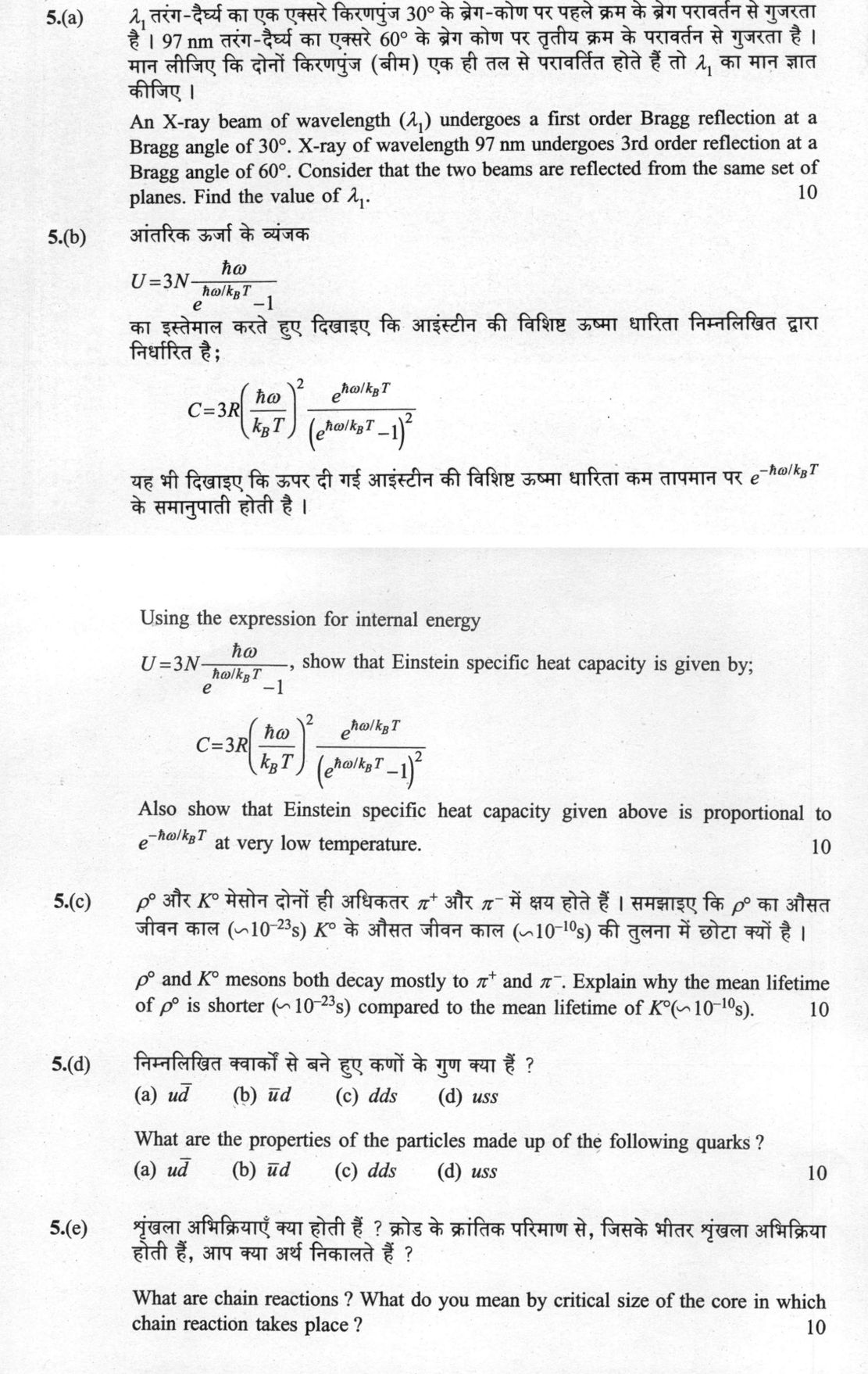
An X-ray beam of wavelength (λ₁) undergoes a first order Bragg reflection at a Bragg angle of 30°. X-ray of wavelength 97 nm undergoes 3rd order reflection at a Bragg angle of 60°. Consider that the two beams are reflected from the same set of planes. Find the value of λ₁. 10 marks
Using the expression for internal energy U=3N(ℏω)/(e^ℏω/k_BT-1), show that Einstein specific heat capacity is given by; C=3R((ℏω)/(k_BT))²(e^ℏω/k_BT)/((e^ℏω/k_BT-1)²). Also show that Einstein specific heat capacity given above is proportional to e⁻ℏω/k_BT at very low temperature. 10 marks
ρ^° and K^° mesons both decay mostly to π⁺ and π⁻. Explain why the mean lifetime of ρ^° is shorter (∼10⁻²³s) compared to the mean lifetime of K^°(∼10⁻¹⁰s). 10 marks
What are the properties of the particles made up of the following quarks ? (a) ud̄ (b) ūd (c) dds (d) uss 10 marks
What are chain reactions ? What do you mean by critical size of the core in which chain reaction takes place ? 10 marks
हिंदी में प्रश्न पढ़ें
λ₁ तरंग-दैर्घ्य का एक एक्सरे किरणपुंज 30° के ब्रैग-कोण पर पहले क्रम के ब्रैग परावर्तन से गुजरता है । 97 nm तरंग-दैर्घ्य का एक्सरे 60° के ब्रैग कोण पर तृतीय क्रम के परावर्तन से गुजरता है । मान लीजिए कि दोनों किरणपुंज (बीम) एक ही तल से परावर्तित होते हैं तो λ₁ का मान ज्ञात कीजिए । (10 अंक)
आंतरिक ऊर्जा के व्यंजक U=3N(ℏω)/(e^ℏω/k_BT-1) का इस्तेमाल करते हुए दिखाइए कि आइंस्टीन की विशिष्ट ऊष्मा धारिता निम्नलिखित द्वारा निर्धारित है; C=3R((ℏω)/(k_BT))²(e^ℏω/k_BT)/((e^ℏω/k_BT-1)²)। यह भी दिखाइए कि ऊपर दी गई आइंस्टीन की विशिष्ट ऊष्मा धारिता कम तापमान पर e⁻ℏω/k_BT के समानुपाती होती है । (10 अंक)
ρ^° और K^° मेसॉन दोनों ही अधिकतर π⁺ और π⁻ में क्षय होते हैं । समझाइए कि ρ^° का औसत जीवन काल (∼10⁻²³s) K^° के औसत जीवन काल (∼10⁻¹⁰s) की तुलना में छोटा क्यों है । (10 अंक)
निम्नलिखित क्वार्कों से बने हुए कणों के गुण क्या हैं ? (a) ud̄ (b) ūd (c) dds (d) uss (10 अंक)
श्रृंखला अभिक्रियाएँ क्या होती हैं ? कोर के क्रांतिक परिमाण से, जिसके भीतर श्रृंखला अभिक्रिया होती है, आप क्या अर्थ निकालते हैं ? (10 अंक)
Model answer
Written by UPSC Answer Check against this question's marking rubric, to the expected length. UPSC does not publish answers for Mains — this is one way to score well, not an official key.
(a) Use Bragg’s law: nλ = 2d sin θ. The same set of planes means the interplanar spacing d is the same for both reflections.
For the first beam: 1 × λ₁ = 2d sin 30° = 2d × (1/2) = d. So λ₁ = d.
For the second beam: 3 × 97 nm = 2d sin 60° = 2d × (√3/2) = d√3. Therefore d = (3 × 97)/√3 nm = 97√3 nm.
Since λ₁ = d, λ₁ = 97√3 nm ≈ 168.0 nm.
Condition: Both reflections occur from the same set of crystallographic planes, so d is unchanged.
(b) The Einstein internal energy is U = 3N ħω/(e^(ħω/k_BT) − 1).
Let x = ħω/(k_BT). Then U = 3N ħω/(e^x − 1).
The specific heat at constant volume is C = (∂U/∂T)_V.
Differentiate U with respect to T: dU/dT = 3N ħω d/dT[(e^x − 1)⁻¹] = 3N ħω × [−(e^x − 1)⁻² e^x dx/dT].
Now x = ħω/(k_BT), so dx/dT = −ħω/(k_BT²) = −x/T.
Therefore dU/dT = 3N ħω × (e^x − 1)⁻² e^x × (x/T) = 3N ħω × (ħω/(k_BT²)) × e^x/(e^x − 1)² = 3N k_B × (ħω/(k_BT))² × e^x/(e^x − 1)².
For one mole, N = N_A and N_A k_B = R. Hence C = 3R (ħω/(k_BT))² e^(ħω/k_BT)/(e^(ħω/k_BT) − 1)².
At very low temperature, T ≪ ħω/k_B. Then x = ħω/(k_BT) ≫ 1, so e^x ≫ 1 and e^x − 1 ≈ e^x.
Thus C ≈ 3R x² e^x/(e^x)² = 3R x² e^(−x) = 3R (ħω/(k_BT))² e^(−ħω/k_BT).
Therefore, apart from the algebraic factor (ħω/k_BT)², the Einstein specific heat varies exponentially as C ∝ e^(−ħω/k_BT) at very low temperature.
(c) The ρ⁰ meson has quark content uū − dd̄ type combination; it has zero strangeness and no quantum number forbidding its decay into two pions. The decay ρ⁰ → π⁺ + π⁻ is allowed by the strong interaction. Strong interactions are fast, with characteristic times of order 10⁻²³ s. Hence the mean lifetime of ρ⁰ is about 10⁻²³ s.
The K⁰ meson has nonzero strangeness. For example, K⁰ = d s̄ (or d anti-s) and has strangeness S = +1. The final pions π⁺ and π⁻ have zero strangeness. Therefore the decay K⁰ → π⁺ + π⁻ changes strangeness by one unit. Strong and electromagnetic interactions conserve strangeness, so they cannot cause this decay. It must proceed through the weak interaction, which violates strangeness. Weak decays are much slower than strong decays, giving lifetimes of order 10⁻¹⁰ s or longer.
Thus the large lifetime difference arises because ρ⁰ decays strongly, while K⁰ must decay weakly because strangeness is not conserved in the final π⁺π⁻ state.
(d)
- (d)(a) u d̄: Quark charges are u = +2/3, d̄ = +1/3. Total charge Q = +1. Baryon number B = 0. Strangeness S = 0. This is the π⁺ meson in its ground pseudoscalar state, with J^P = 0⁻, isospin I = 1, I₃ = +1, mass ≈ 139.6 MeV/c², mean lifetime ≈ 2.60 × 10⁻⁸ s. It decays weakly. The vector excitation with the same quark content is ρ⁺, J^P = 1⁻, mass ≈ 775 MeV/c², decaying strongly with lifetime ≈ 10⁻²³ s.
- (d)(b) ū d: ū has charge −2/3, d has charge −1/3. Total charge Q = −1. B = 0, S = 0. This is the π⁻ meson, J^P = 0⁻, I = 1, I₃ = −1, mass ≈ 139.6 MeV/c², mean lifetime ≈ 2.60 × 10⁻⁸ s. It decays weakly. Its vector counterpart is ρ⁻.
- (d)(c) d d s: Charges: d = −1/3, d = −1/3, s = −1/3, so Q = −1. Baryon number B = 1. Strangeness S = −1. This is the Σ⁻ baryon, J^P = (1/2)⁺, isospin I = 1, I₃ = −1, mass ≈ 1197.4 MeV/c², mean lifetime ≈ 1.48 × 10⁻¹⁰ s. It decays weakly.
- (d)(d) u s s: Charges: u = +2/3, s = −1/3, s = −1/3, so Q = 0. Baryon number B = 1. Strangeness S = −2. This is the Ξ⁰ baryon, J^P = (1/2)⁺, isospin I = 1/2, I₃ = +1/2, mass ≈ 1314.9 MeV/c², mean lifetime ≈ 2.90 × 10⁻¹⁰ s. It decays weakly.
(e) A chain reaction is a self-sustaining sequence of nuclear fissions in which neutrons released in one fission cause further fissions in nearby fissile nuclei. For example, when a slow neutron is absorbed by ²³⁵U, the nucleus splits and emits 2–3 neutrons plus about 200 MeV energy. If at least one of these neutrons causes another fission on average, the process continues as a chain reaction.
The multiplication factor k is defined as k = (number of neutrons causing fission in the next generation)/(number causing fission in the present generation).
- If k < 1, the reaction is subcritical and dies out.
- If k = 1, the reaction is critical and is self-sustaining at constant power.
- If k > 1, the reaction is supercritical and grows rapidly.
The critical size of the core is the minimum size of the fissile core for which k = 1. In a small core, many neutrons leak out through the surface before causing further fission. If the core is smaller than the critical size, neutron leakage and parasitic absorption exceed neutron production, so the chain reaction cannot be sustained. If the core is larger than the critical size, the reaction becomes supercritical.
The critical size depends on the fissile material, its purity and enrichment, density, shape, and the presence of a reflector. A sphere has the smallest surface-to-volume ratio, so it gives the smallest critical size for a given material. A neutron reflector surrounding the core scatters some escaping neutrons back, reducing the critical size. The corresponding mass is called the critical mass, M_c = ρV_c.
In one-speed diffusion theory for a bare spherical core, the critical condition is approximately (π/R_c)² = (νΣ_f − Σ_a)/D, so R_c = π√[D/(νΣ_f − Σ_a)], where R_c is the critical radius, D is the diffusion coefficient, ν is the average number of neutrons per fission, Σ_f is the macroscopic fission cross-section, and Σ_a is the macroscopic absorption cross-section. This expression is valid for a homogeneous bare spherical core under one-speed diffusion theory.
What "Solve" is asking you to do
Choose the method, then carry it through to a final answer. Identifying what kind of problem this is and why that method applies is the first thing marked; a correct figure arrived at invisibly earns almost nothing.
Structure that answers it
Given data and what is required → method chosen, with the reason it applies → set-up (equation, circuit, free body, trial balance) → working, step by step → answer with units and any condition of validity
Where marks are lost
Doing the middle steps mentally and writing only the result. In mathematics papers, a further loss comes from giving a decimal where the exact value in surds or fractions was wanted, or from skipping the justification a part explicitly asks for.
How this answer will be evaluated
Approach
(a) calculate: given > formula > substitution > result with units > interpretation | (b) derive: given > assumptions > stepwise derivation > result > check | (c) explain: definition/context > points in order > small example > short close | (d) describe: define > structure or process in order > labelled diagram > significance | (e) define: precise definition > the distinguishing feature > one example Full marks: Complete derivations with correct limits; precise particle identification; clear physical reasoning for lifetimes.
Key points expected
- State Bragg's law nλ = 2d sinθ
- Equate interplanar spacing d for both cases
- Substitute n=1, θ=30° and n=3, θ=60°
- Solve for λ₁ with correct units
- Differentiate U with respect to T
- Apply chain rule for exponential term
- Substitute Nk_B = R for molar heat capacity
- Show C ∝ e^(-ℏω/k_BT) as T → 0
Evaluation rubric
Each sub-part is marked on its own, against the marks and word limit printed on the paper.
- (a) Value of λ₁ using Bragg's law for two different orders and angles. 10 marks
calculate— given → formula → substitution → result with units → interpretation
Must cover
- State Bragg's law nλ = 2d sinθ
- Equate interplanar spacing d for both cases
- Substitute n=1, θ=30° and n=3, θ=60°
- Solve for λ₁ with correct units
Loses marks
- Using degrees in sine function without conversion
- Confusing Bragg angle with incidence angle
Earns more
- Explicitly show the ratio of sinθ terms
- Check dimensional consistency of d
Extra mark
- Mention physical meaning of Bragg angle
- (b) Derivation of Einstein specific heat formula and low-temperature limit. 10 marks
derive— given → assumptions → stepwise derivation → result → check
Must cover
- Differentiate U with respect to T
- Apply chain rule for exponential term
- Substitute Nk_B = R for molar heat capacity
- Show C ∝ e^(-ℏω/k_BT) as T → 0
Loses marks
- Skipping the derivative of the denominator
- Failing to show the low-T approximation
Earns more
- Define Einstein temperature θ_E = ℏω/k_B
- Show high-temperature limit C → 3R
Extra mark
- Compare with Dulong-Petit law
- (c) Reason for the difference in lifetimes of ρ° and K° mesons. 10 marks
explain— definition/context → points in order → small example → short close
Must cover
- Identify decay mode of ρ° (strong interaction)
- Identify decay mode of K° (weak interaction)
- Relate interaction strength to decay rate
- Connect decay rate to mean lifetime
Loses marks
- Attributing K° decay to strong interaction
- Confusing lifetime with half-life
Earns more
- Mention quark content of both mesons
- Note that K° decay violates strangeness
Extra mark
- Cite specific decay channels (e.g., ρ° → ππ)
- (d) Properties (charge, baryon number, type) of four quark combinations. 10 marks
describe— define → structure or process in order → labelled diagram → significance
Must cover
- Calculate electric charge for each combination
- Identify particle type (meson/baryon)
- Assign baryon number (0 or 1)
- Identify specific particle names (e.g., π+, Λ, Σ)
Loses marks
- Incorrect charge calculation
- Misidentifying mesons as baryons
Earns more
- List quark charges used (u=+2/3, d=-1/3, s=-1/3)
- Mention spin or parity if known
Extra mark
- Draw quark diagrams for baryons
- (e) Definition of chain reaction and critical size in nuclear context. 10 marks
define— precise definition → the distinguishing feature → one example
Must cover
- Define self-sustaining chain reaction
- Define critical size/mass
- Explain neutron multiplication factor k=1
- Relate size to neutron leakage
Loses marks
- Confusing chain reaction with chemical reaction
- Ignoring the role of geometry in criticality
Earns more
- Distinguish sub-critical, critical, super-critical
- Mention role of moderator or reflector
Extra mark
- Reference to specific reactor types
Practice this exact question
Write your answer and it is marked point by point against the model answer above — what you covered, what you missed, what you got wrong.
Evaluate my answer →More from Physics 2021 Paper II
- Q2 (a) Using Pauli spin matrices prove that, (i) σₓσᵧ + σᵧσₓ = 0; σᵧσᵤ + σᵤσᵧ = 0; σₓσᵤ + σᵤ…
- Q3 (a) In observing the Raman spectrum of a sample using 3637Å as the exciting line, one get…
- Q4 (a) A particle of rest mass m₀ has a kinetic energy K, show that its de Broglie wavelengt…
- Q5 (a) An X-ray beam of wavelength (λ₁) undergoes a first order Bragg reflection at a Bragg…
- Q6 (a) What is the importance of study of deuteron ? Obtain the solution of Schrödinger equa…
- Q7 (a) An n-p-n transistor with β = 49 is used in common-emitter amplifier mode with Vcc = 1…
- Q8 (a) Sketch the dc load line for the circuit shown. (10 marks) (b) A solid contains a dilu…