Paper II — Q3
(a) In observing the Raman spectrum of a sample using 3637Å as the exciting line, one gets stoke line at 3980Å. Deduce the Raman…
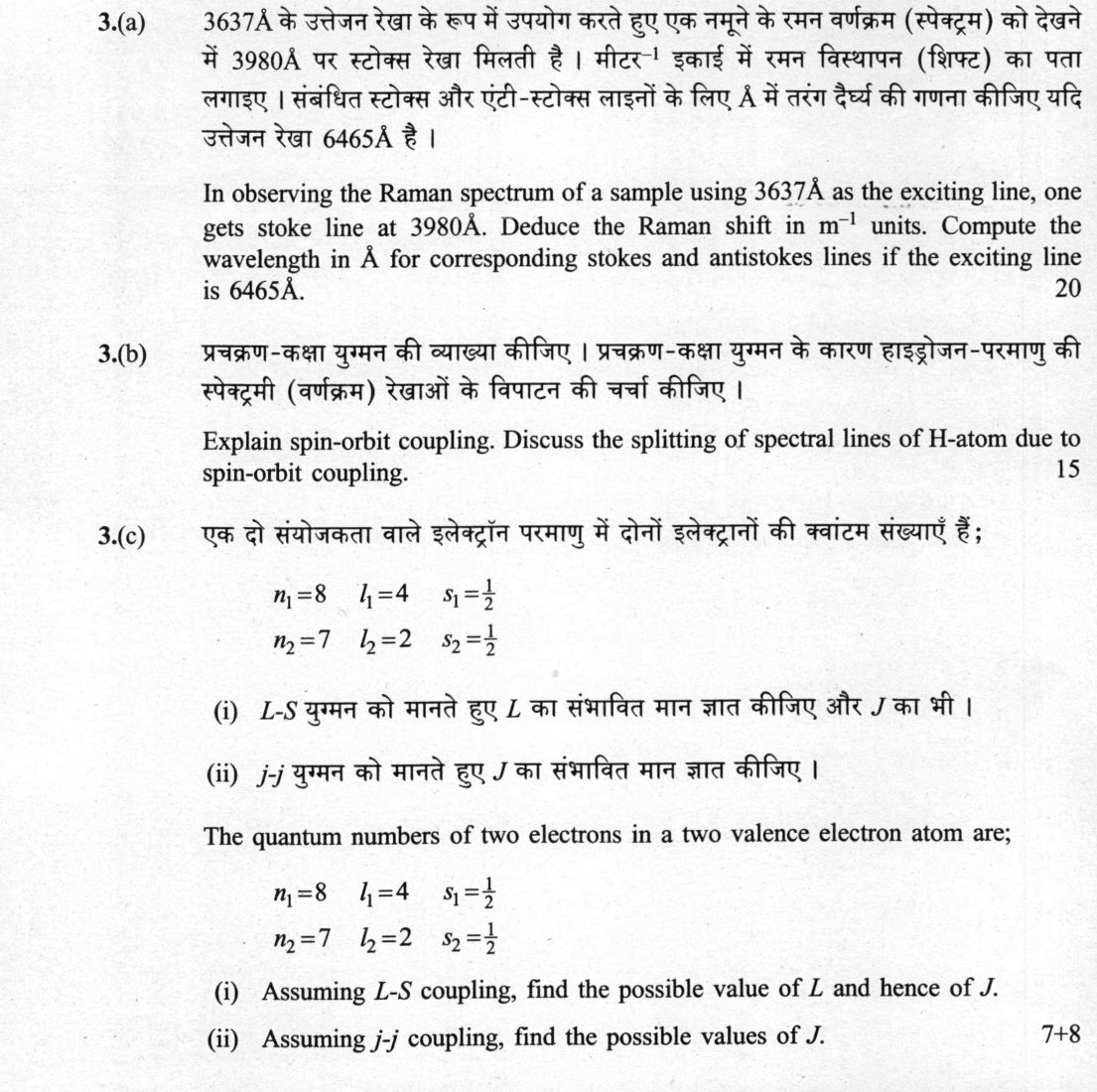
In observing the Raman spectrum of a sample using 3637Å as the exciting line, one gets stoke line at 3980Å. Deduce the Raman shift in m⁻¹ units. Compute the wavelength in Å for corresponding stokes and antistokes lines if the exciting line is 6465Å. 20 marks
Explain spin-orbit coupling. Discuss the splitting of spectral lines of H-atom due to spin-orbit coupling. 15 marks
The quantum numbers of two electrons in a two valence electron atom are; n₁=8 l₁=4 s₁=½ n₂=7 l₂=2 s₂=½
Assuming L-S coupling, find the possible value of L and hence of J.
Assuming j-j coupling, find the possible values of J. (7+8 marks)
हिंदी में प्रश्न पढ़ें
3637Å के उत्तेजन रेखा के रूप में उपयोग करते हुए एक नमूने के रमन वर्णक्रम (स्पेक्ट्रम) को देखने में 3980Å पर स्टोक्स रेखा मिलती है । मीटर⁻¹ इकाई में रमन विस्थापन (शिफ्ट) का पता लगाइए । संबंधित स्टोक्स और एंटी-स्टोक्स लाइनों के लिए Å में तरंग दैर्घ्य की गणना कीजिए यदि उत्तेजन रेखा 6465Å है । (20 अंक)
प्रचक्रण-कक्षा युग्मन की व्याख्या कीजिए । प्रचक्रण-कक्षा युग्मन के कारण हाइड्रोजन-परमाणु की स्पेक्ट्रमी (वर्णक्रम) रेखाओं के विपाटन की चर्चा कीजिए । (15 अंक)
एक दो संयोजकता वाले इलेक्ट्रॉन परमाणु में दोनों इलेक्ट्रॉनों की क्वांटम संख्याएँ हैं; n₁=8 l₁=4 s₁=½ n₂=7 l₂=2 s₂=½
L-S युग्मन को मानते हुए L का संभावित मान ज्ञात कीजिए और J का भी ।
j-j युग्मन को मानते हुए J का संभावित मान ज्ञात कीजिए । (7+8 अंक)
Model answer
Written by UPSC Answer Check against this question's marking rubric, to the expected length. UPSC does not publish answers for Mains — this is one way to score well, not an official key.
(a) The Raman shift is the difference between the wavenumbers of the incident and Stokes-scattered radiation. For λ₀ = 3637 Å and λₛ = 3980 Å,
ν̄ = 1/λ, so
Δν̄ = 1/λ₀ − 1/λₛ = 1/3637 − 1/3980 Å⁻¹ = (3980 − 3637)/(3637 × 3980) Å⁻¹ = 343/14,475,260 Å⁻¹.
Since 1 Å⁻¹ = 10¹⁰ m⁻¹,
Δν̄ = (343/14,475,260) × 10¹⁰ m⁻¹ = 2.36956 × 10⁵ m⁻¹ = 2369.6 cm⁻¹.
Thus the Raman shift is Δν̄ = 2.37 × 10⁵ m⁻¹ = 2369.6 cm⁻¹.
Now take the exciting line λ₀ = 6465 Å. The same shift in Å⁻¹ is
a = 2.36956 × 10⁻⁵ Å⁻¹.
For the Stokes line,
1/λₛ = 1/6465 − a = 1.54679 × 10⁻⁴ − 2.36956 × 10⁻⁵ = 1.30983 × 10⁻⁴ Å⁻¹.
Hence
λₛ = 1/(1.30983 × 10⁻⁴) Å = 7634.55 Å.
For the anti-Stokes line,
1/λₐ = 1/6465 + a = 1.54679 × 10⁻⁴ + 2.36956 × 10⁻⁵ = 1.78375 × 10⁻⁴ Å⁻¹.
Hence
λₐ = 1/(1.78375 × 10⁻⁴) Å = 5606.18 Å.
Therefore, for exciting line 6465 Å, Stokes line λₛ ≈ 7635 Å and anti-Stokes line λₐ ≈ 5606 Å.
(b) Spin-orbit coupling arises from the interaction of the intrinsic spin magnetic moment of an electron with the magnetic field produced by its orbital motion in the electric field of the nucleus. In the electron’s rest frame, the nuclear Coulomb field appears partly as a magnetic field, and this field couples to the electron spin. The interaction is relativistic in origin and produces fine-structure splitting.
The spin-orbit Hamiltonian is written as
H_SO = ξ(r) L·S,
where
ξ(r) = (1/(2mₑ²c²))(1/r)(dV/dr).
For the hydrogen atom,
V(r) = −e²/(4π ε₀ r),
so
dV/dr = e²/(4π ε₀ r²)
and hence
ξ(r) = e²/(8π ε₀ mₑ² c² r³).
In the coupled representation, L and S combine to give J = L + S. Using
L·S = ½(J² − L² − S²),
the first-order energy shift is
E_SO = (ħ²/2) ξ̄ [j(j+1) − l(l+1) − s(s+1)],
where ξ̄ is the radial average of ξ(r). For one electron, s = 1/2, so j = l ± 1/2 for l ≠ 0; for l = 0, L·S has zero expectation value and there is no spin-orbit splitting. Thus each level with l ≠ 0 splits into two fine-structure levels, j = l + 1/2 and j = l − 1/2. For hydrogen, the j = l + 1/2 level lies higher in energy than the j = l − 1/2 level.
Because the upper and lower atomic levels involved in a spectral transition are split differently, a single spectral line splits into several closely spaced components. The electric dipole selection rules are
Δl = ±1, Δj = 0, ±1,
with j = 0 ↔ j = 0 forbidden. For example, the Balmer Hα line splits into a multiplet because the n = 3 and n = 2 levels have different j values. The spin-orbit splitting is very small, of order α² compared with the gross energy. This discussion is valid in first-order perturbation theory; for hydrogen, the complete fine structure also includes relativistic kinetic-energy and Darwin corrections, but spin-orbit coupling alone gives the j-dependent splitting.
(c)(i) In L-S coupling, the individual orbital angular momenta couple to give total L, and the spins couple to give total S.
Here l₁ = 4 and l₂ = 2. Therefore
L = |l₁ − l₂|, …, l₁ + l₂ = 2, 3, 4, 5, 6.
Also s₁ = s₂ = 1/2, so
S = 0 or 1.
For S = 0, J = L, so
J = 2, 3, 4, 5, 6.
For S = 1, J = |L − 1|, …, L + 1. Thus:
- L = 2 gives J = 1, 2, 3
- L = 3 gives J = 2, 3, 4
- L = 4 gives J = 3, 4, 5
- L = 5 gives J = 4, 5, 6
- L = 6 gives J = 5, 6, 7
Hence the possible L values are L = 2, 3, 4, 5, 6, and the overall possible J values are J = 1, 2, 3, 4, 5, 6, 7.
(c)(ii) In j-j coupling, each electron first couples its own l and s to give j.
For electron 1:
l₁ = 4, s₁ = 1/2,
so
j₁ = 4 ± 1/2 = 7/2 or 9/2.
For electron 2:
l₂ = 2, s₂ = 1/2,
so
j₂ = 2 ± 1/2 = 3/2 or 5/2.
Now couple j₁ and j₂ to give total J:
J = |j₁ − j₂|, …, j₁ + j₂.
Possible cases:
- j₁ = 9/2, j₂ = 5/2: J = 2, 3, 4, 5, 6, 7
- j₁ = 9/2, j₂ = 3/2: J = 3, 4, 5, 6
- j₁ = 7/2, j₂ = 5/2: J = 1, 2, 3, 4, 5, 6
- j₁ = 7/2, j₂ = 3/2: J = 2, 3, 4, 5
Therefore the possible J values in j-j coupling are J = 1, 2, 3, 4, 5, 6, 7.
What "Calculate" is asking you to do
Apply the standard formula or schedule to data the question has already supplied — a table of readings, cost records, a balance sheet — and produce the number. The method is rarely in doubt; the marks sit in the named intermediate quantities, each of which has to appear as a labelled line.
Structure that answers it
Data as given → formula or standard treatment, named → substitution → each intermediate, labelled → result with units
Where marks are lost
Omitting an intermediate the marking scheme pays for separately, or rounding at an intermediate line so the final figure drifts. In commerce and accountancy, any figure in a statement that no numbered working note supports is treated as unearned.
How this answer will be evaluated
Approach
(a) calculate: given > formula > substitution > result with units > interpretation | (b) explain: definition/context > points in order > small example > short close | (c(i)) calculate: given > formula > substitution > result with units > interpretation | (c(ii)) calculate: given > formula > substitution > result with units > interpretation Full marks: All parts fully derived with correct units, clear diagrams, and physical interpretation.
Key points expected
- Convert wavelengths to wavenumbers (cm⁻¹ or m⁻¹)
- Calculate Raman shift as difference in wavenumbers
- Apply shift to new excitation wavenumber
- Convert final wavenumbers back to Å
- Define spin-orbit interaction (L·S coupling)
- Explain origin (magnetic field of orbiting electron)
- Discuss splitting of energy levels (fine structure)
- Mention specific H-atom line splitting (e.g., Lyman-alpha)
Evaluation rubric
Each sub-part is marked on its own, against the marks and word limit printed on the paper.
- (a) Raman shift in m⁻¹ and new Stokes/Anti-Stokes wavelengths for 6465Å excitation. 20 marks
calculate— given → formula → substitution → result with units → interpretation
Must cover
- Convert wavelengths to wavenumbers (cm⁻¹ or m⁻¹)
- Calculate Raman shift as difference in wavenumbers
- Apply shift to new excitation wavenumber
- Convert final wavenumbers back to Å
Loses marks
- Using wavelength difference instead of wavenumber difference
- Dropping units in intermediate steps
Earns more
- Explicit unit conversion steps
- Dimensional check on final answer
Extra mark
- Physical interpretation of Stokes vs Anti-Stokes
- (b) Definition of spin-orbit coupling and its effect on H-atom spectral lines. 15 marks
explain— definition/context → points in order → small example → short close
Must cover
- Define spin-orbit interaction (L·S coupling)
- Explain origin (magnetic field of orbiting electron)
- Discuss splitting of energy levels (fine structure)
- Mention specific H-atom line splitting (e.g., Lyman-alpha)
Loses marks
- Confusing spin-orbit with Zeeman effect
- No mention of H-atom specific application
Earns more
- Vector model diagram of L and S
- Mention of Landé g-factor
Extra mark
- Quantitative energy shift formula
- (c(i)) Possible L and J values for L-S coupling scheme. 7 marks
calculate— given → formula → substitution → result with units → interpretation
Must cover
- Calculate total L from l₁ and l₂
- Calculate total S from s₁ and s₂
- Determine J range from L and S
- List all valid term symbols
Loses marks
- Incorrect range for L or J
- Missing term symbols
Earns more
- Step-by-step vector addition logic
- Clear listing of term symbols
Extra mark
- Mention of Pauli exclusion principle check
- (c(ii)) Possible J values for j-j coupling scheme. 8 marks
calculate— given → formula → substitution → result with units → interpretation
Must cover
- Calculate j₁ from l₁ and s₁
- Calculate j₂ from l₂ and s₂
- Determine J range from j₁ and j₂
- List all valid J values
Loses marks
- Incorrect j values for individual electrons
- Incorrect J range calculation
Earns more
- Step-by-step vector addition logic
- Clear listing of J values
Extra mark
- Comparison with L-S coupling results
Practice this exact question
Write your answer and it is marked point by point against the model answer above — what you covered, what you missed, what you got wrong.
Evaluate my answer →More from Physics 2021 Paper II
- Q1 (a) Find the minimum magnetic field needed for the Zeeman effect to be observed in a spec…
- Q2 (a) Using Pauli spin matrices prove that, (i) σₓσᵧ + σᵧσₓ = 0; σᵧσᵤ + σᵤσᵧ = 0; σₓσᵤ + σᵤ…
- Q3 (a) In observing the Raman spectrum of a sample using 3637Å as the exciting line, one get…
- Q4 (a) A particle of rest mass m₀ has a kinetic energy K, show that its de Broglie wavelengt…
- Q5 (a) An X-ray beam of wavelength (λ₁) undergoes a first order Bragg reflection at a Bragg…
- Q6 (a) What is the importance of study of deuteron ? Obtain the solution of Schrödinger equa…