Paper II — Q4
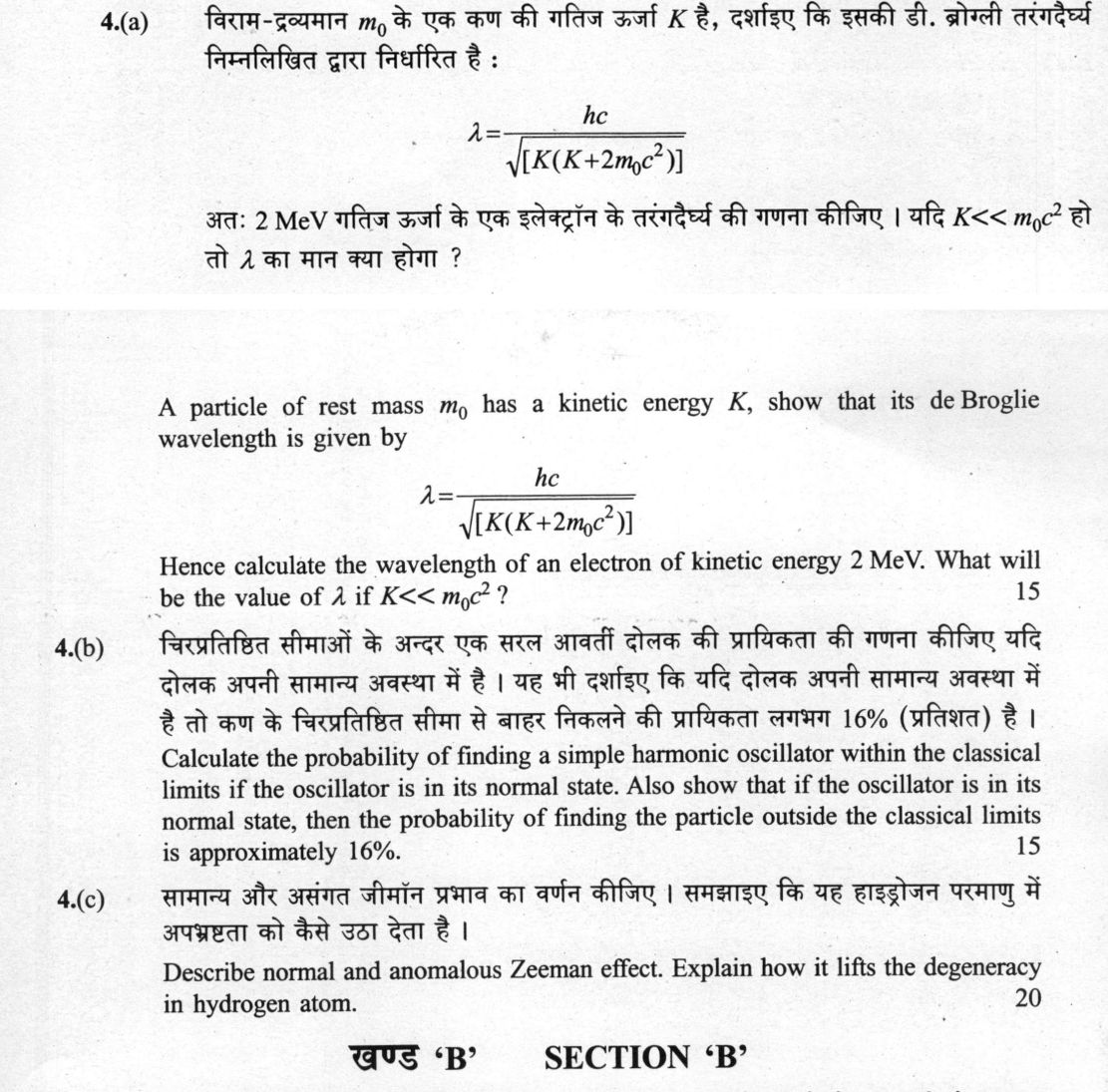
(a) A particle of rest mass m₀ has a kinetic energy K, show that its de Broglie wavelength is given by λ =…
A particle of rest mass m₀ has a kinetic energy K, show that its de Broglie wavelength is given by
λ = hc/√[K(K+2m₀c²)]
Hence calculate the wavelength of an electron of kinetic energy 2 MeV. What will be the value of λ if K<< m₀c² ? 15 marks
Calculate the probability of finding a simple harmonic oscillator within the classical limits if the oscillator is in its normal state. Also show that if the oscillator is in its normal state, then the probability of finding the particle outside the classical limits is approximately 16%. 15 marks
Describe normal and anomalous Zeeman effect. Explain how it lifts the degeneracy in hydrogen atom. 20 marks
हिंदी में प्रश्न पढ़ें
विराम-द्रव्यमान m₀ के एक कण की गतिज ऊर्जा K है, दर्शाइए कि इसकी डी. ब्रोगली तरंगदैर्घ्य निम्नलिखित द्वारा निर्धारित है :
λ = hc/√[K(K+2m₀c²)]
अतः 2 MeV गतिज ऊर्जा के एक इलेक्ट्रॉन के तरंगदैर्घ्य की गणना कीजिए । यदि K<< m₀c² हो तो λ का मान क्या होगा ? (15 अंक)
चिरप्रतिबंधित सीमाओं के अंदर एक सरल आवर्ती दोलक की प्रायिकता की गणना कीजिए यदि दोलक अपनी सामान्य अवस्था में है । यह भी दर्शाइए कि यदि दोलक अपनी सामान्य अवस्था में है तो कण के चिरप्रतिबंधित सीमा से बाहर निकलने की प्रायिकता लगभग 16% (प्रतिशत) है । (15 अंक)
सामान्य और असंगत ज़ीमान प्रभाव का वर्णन कीजिए । समझाइए कि यह हाइड्रोजन परमाणु में अपभ्रष्टता को कैसे उठा देता है । (20 अंक)
Model answer
Written by UPSC Answer Check against this question's marking rubric, to the expected length. UPSC does not publish answers for Mains — this is one way to score well, not an official key.
(a) Using the relativistic energy–momentum relation, E² = p²c² + m₀²c⁴. The total energy is E = K + m₀c². Hence p²c² = (K + m₀c²)² − m₀²c⁴ = K² + 2Km₀c² = K(K + 2m₀c²). Therefore p = √[K(K + 2m₀c²)]/c. By de Broglie’s relation, λ = h/p, so λ = hc/√[K(K + 2m₀c²)]. This is valid for a free relativistic particle of rest mass m₀.
For an electron, m₀c² = 0.511 MeV and K = 2 MeV. Then K + 2m₀c² = 2 + 1.022 = 3.022 MeV, K(K + 2m₀c²) = 2 × 3.022 = 6.044 MeV². Thus √[K(K + 2m₀c²)] = √6.044 MeV = 2.458 MeV = 2.458 × 10⁶ eV. Using hc = 1240 eV nm, λ = 1240 eV nm / (2.458 × 10⁶ eV) = 5.04 × 10⁻⁴ nm. Hence λ ≈ 0.504 pm = 5.04 × 10⁻¹³ m.
If K ≪ m₀c², then K + 2m₀c² ≈ 2m₀c². Therefore λ ≈ hc/√[2Km₀c²] = h/√(2m₀K). So the non-relativistic de Broglie formula is recovered, with condition K ≪ m₀c².
(b) For a simple harmonic oscillator, the normal state is the ground state n = 0. Its energy is E₀ = ½ ħω. The classical turning points ±A satisfy ½ mω²A² = ½ ħω, so A = √(ħ/(mω)). The ground-state wavefunction is ψ₀(x) = (mω/(πħ))^¼ exp(−mωx²/(2ħ)). Let α = mω/ħ. The probability inside the classical limits is P_in = ∫ from −A to A of |ψ₀|² dx = √(α/π) ∫ from −A to A of exp(−αx²) dx. Put u = √α x. Since A = 1/√α, the limits become u = −1 to +1. Hence P_in = (1/√π) ∫ from −1 to 1 of exp(−u²) du = (2/√π) ∫ from 0 to 1 of exp(−u²) du = erf(1). Using erf(1) = 0.8427007929, P_in = erf(1) ≈ 0.8427 = 84.27%. Therefore the probability outside the classical limits is P_out = 1 − erf(1) = erfc(1) = 0.1572992071 ≈ 0.1573. Thus P_out ≈ 15.73% ≈ 16%, as required.
(c) The normal Zeeman effect occurs when the resultant spin of the atom is zero, S = 0. The magnetic moment is due only to orbital motion: μ = −(μ_B/ħ)L, where μ_B is the Bohr magneton. In a constant magnetic field B along the z-axis, the interaction energy is ΔE = −μ·B = μ_B B mₗ. Thus a level with orbital quantum number l splits into 2l + 1 equally spaced sublevels. Electric dipole selection rules allow Δmₗ = 0, ±1, so a single spectral line ν₀ splits into three components: ν₀ − μ_B B/h, ν₀, ν₀ + μ_B B/h. The central component is π-polarized, and the two side components are σ⁺ and σ⁻ polarized. This is the normal Zeeman triplet.
The anomalous Zeeman effect occurs when S ≠ 0 and spin-orbit coupling is present. The total magnetic moment now involves both orbital and spin contributions. In the weak-field Zeeman regime, spin-orbit coupling dominates and J is a good quantum number. The energy shift is ΔE = gⱼ μ_B B Mⱼ, where Mⱼ = −J, …, +J, and the Landé g-factor is gⱼ = 1 + [J(J+1) + S(S+1) − L(L+1)]/[2J(J+1)]. Because gⱼ differs from 1 and depends on L, S, J, the splitting is no longer a simple triplet. A fine-structure level splits into 2J + 1 components, and transitions obey ΔMⱼ = 0, ±1, producing many lines. This more complex pattern is called the anomalous Zeeman effect.
In hydrogen, the non-relativistic energy depends only on the principal quantum number n, so states with different l, mₗ, and mₛ are degenerate. A magnetic field along z reduces the spherical symmetry to axial symmetry. The perturbation H′ = (μ_B/ħ)(Lz + 2Sz)B depends on the magnetic quantum numbers. Therefore states with different mₗ or mⱼ acquire different energies: ΔE = μ_B B(mₗ + 2mₛ) in the simple spin-orbit-free description, or ΔE = gⱼ μ_B B Mⱼ when fine structure is included. This removes the m-degeneracy of the hydrogen levels. For example, an l = 1 level splits into mₗ = −1, 0, +1 components. Since the hydrogen electron has spin ½, its weak-field splitting is generally anomalous rather than a pure normal triplet. In strong fields, the Paschen–Back effect can occur, where L and S decouple and the shift becomes approximately μ_B B(mₗ + 2mₛ).
What "Derive" is asking you to do
Reach the stated expression from a starting relation, justifying every step. The destination is printed in the question, so only the route earns marks, and the assumptions you work under are part of that route.
Structure that answers it
Assumptions and notation defined → starting relation or governing equation → each step with its justification → the required expression → limiting case or boundary check
Where marks are lost
Writing the standard result first and fitting three lines to it, which an examiner reads at a glance. Marks also go on assumptions left unstated — lossless medium, small amplitude, errors independent with zero mean — and on symbols used before they are defined, even when the question says usual notations.
How this answer will be evaluated
Approach
Framework: Principle > Setup and diagram > Derivation > Result and limiting case. (a) derive: given > assumptions > stepwise derivation > result > check | (b) calculate: given > formula > substitution > result with units > interpretation | (c) describe: define > structure or process in order > labelled diagram > significance Full marks: Rigorous derivation with correct units, accurate numerical values, and clear physical interpretation of limits.
Key points expected
- Relativistic energy-momentum relation E² = p²c² + m₀²c⁴
- Substitute E = K + m₀c² to isolate p
- Calculate λ for K=2 MeV using m₀c²=0.511 MeV
- Show non-relativistic limit λ = h/√(2m₀K)
- Define classical limits x = ±√(2ħ/mω)
- Use ground state wavefunction ψ₀(x)
- Integrate |ψ₀|² from -x₀ to +x₀
- Show result is ~84% (implying 16% outside)
Evaluation rubric
Each sub-part is marked on its own, against the marks and word limit printed on the paper.
- (a) Derive relativistic de Broglie wavelength formula and calculate for 2 MeV electron. 15 marks
derive— given → assumptions → stepwise derivation → result → check
Must cover
- Relativistic energy-momentum relation E² = p²c² + m₀²c⁴
- Substitute E = K + m₀c² to isolate p
- Calculate λ for K=2 MeV using m₀c²=0.511 MeV
- Show non-relativistic limit λ = h/√(2m₀K)
Loses marks
- Using classical p=mv without relativistic correction
- Missing units in final numerical answer
Earns more
- Explicitly state assumption K << m₀c² for limit
- Dimensional check of final formula
Extra mark
- Comparison of relativistic vs non-relativistic λ values
- (b) Calculate probability of SHO within classical limits and show outside probability is 16%. 15 marks
calculate— given → formula → substitution → result with units → interpretation
Must cover
- Define classical limits x = ±√(2ħ/mω)
- Use ground state wavefunction ψ₀(x)
- Integrate |ψ₀|² from -x₀ to +x₀
- Show result is ~84% (implying 16% outside)
Loses marks
- Confusing classical turning points with zero points
- Incorrect limits of integration
Earns more
- Use of error function (erf) for integration
- Numerical evaluation of erf(√2)
Extra mark
- Sketch of probability density vs classical limits
- (c) Describe normal/anomalous Zeeman effects and explain degeneracy lifting in hydrogen. 20 marks
describe— define → structure or process in order → labelled diagram → significance
Must cover
- Define Normal Zeeman (singlet, Δm_l = 0, ±1)
- Define Anomalous Zeeman (multiplet, spin-orbit)
- Explain lifting of m_l degeneracy by B field
- Explain lifting of l degeneracy by spin-orbit coupling
Loses marks
- Confusing normal and anomalous conditions
- Ignoring spin in anomalous effect
Earns more
- Selection rules for transitions
- Mention of Landé g-factor
Extra mark
- Energy level diagram for Zeeman splitting
Practice this exact question
Write your answer and it is marked point by point against the model answer above — what you covered, what you missed, what you got wrong.
Evaluate my answer →More from Physics 2021 Paper II
- Q1 (a) Find the minimum magnetic field needed for the Zeeman effect to be observed in a spec…
- Q2 (a) Using Pauli spin matrices prove that, (i) σₓσᵧ + σᵧσₓ = 0; σᵧσᵤ + σᵤσᵧ = 0; σₓσᵤ + σᵤ…
- Q3 (a) In observing the Raman spectrum of a sample using 3637Å as the exciting line, one get…
- Q4 (a) A particle of rest mass m₀ has a kinetic energy K, show that its de Broglie wavelengt…
- Q5 (a) An X-ray beam of wavelength (λ₁) undergoes a first order Bragg reflection at a Bragg…
- Q6 (a) What is the importance of study of deuteron ? Obtain the solution of Schrödinger equa…
- Q7 (a) An n-p-n transistor with β = 49 is used in common-emitter amplifier mode with Vcc = 1…