Paper II — Q7
(a) An n-p-n transistor with β = 49 is used in common-emitter amplifier mode with Vcc = 10V and RL = 2 kΩ. If a 100 kΩ resistor…
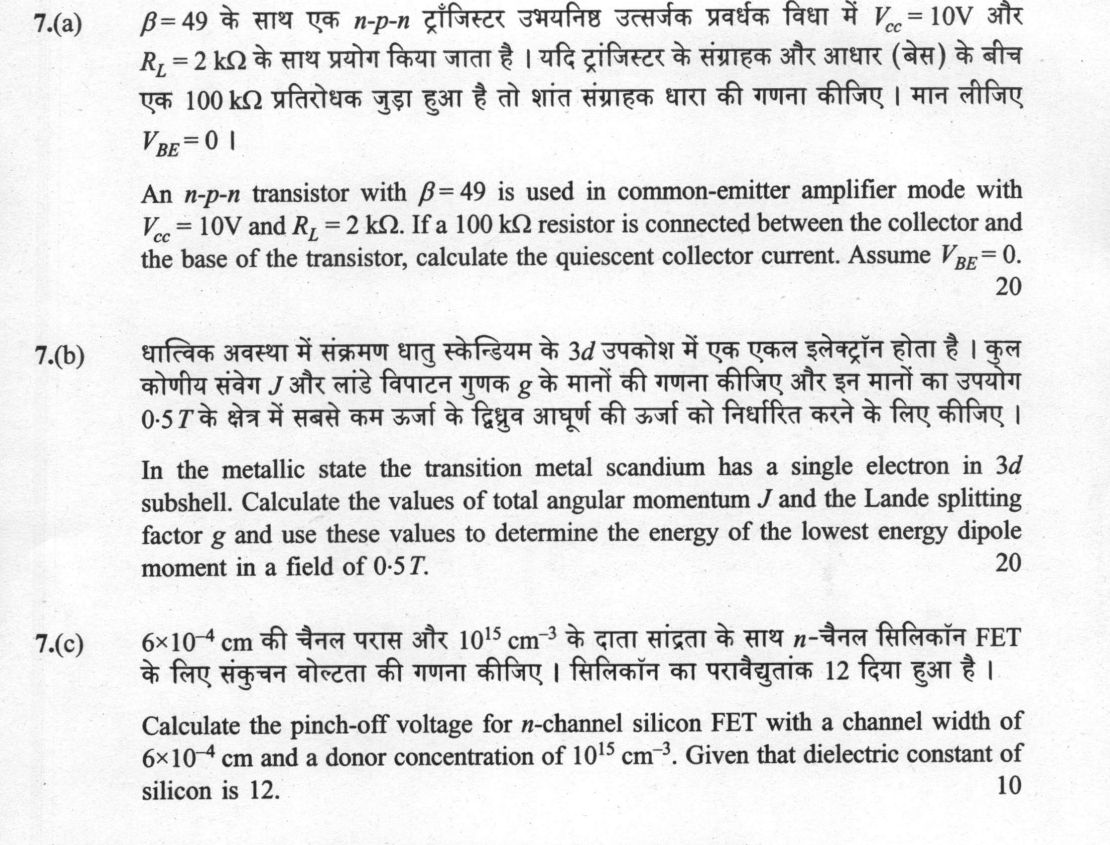
An n-p-n transistor with β = 49 is used in common-emitter amplifier mode with Vcc = 10V and RL = 2 kΩ. If a 100 kΩ resistor is connected between the collector and the base of the transistor, calculate the quiescent collector current. Assume VBE = 0. 20 marks
In the metallic state the transition metal scandium has a single electron in 3d subshell. Calculate the values of total angular momentum J and the Lande splitting factor g and use these values to determine the energy of the lowest energy dipole moment in a field of 0·5 T. 20 marks
Calculate the pinch-off voltage for n-channel silicon FET with a channel width of 6×10⁻⁴ cm and a donor concentration of 10¹⁵ cm⁻³. Given that dielectric constant of silicon is 12. 10 marks
हिंदी में प्रश्न पढ़ें
β = 49 के साथ एक n-p-n ट्रांजिस्टर उभयनिष्ठ उत्सर्जक प्रवर्धक विधा में Vcc = 10V और RL = 2 kΩ के साथ प्रयोग किया जाता है । यदि ट्रांजिस्टर के संग्राहक और आधार (बेस) के बीच एक 100 kΩ प्रतिरोधक जुड़ा हुआ है तो शांत संग्राहक धारा की गणना कीजिए । मान लीजिए VBE = 0 । (20 अंक)
धात्विक अवस्था में संक्रमण धातु स्कैंडियम के 3d उपकोश में एक एकल इलेक्ट्रॉन होता है । कुल कोणीय संवेग J और लांडे विपाटन गुणांक g के मानों की गणना कीजिए और इन मानों का उपयोग 0·5 T के क्षेत्र में सबसे कम ऊर्जा के द्विध्रुव आघूर्ण की ऊर्जा को निर्धारित करने के लिए कीजिए । (20 अंक)
6×10⁻⁴ cm की चैनल परास और 10¹⁵ cm⁻³ के दाता सांद्रता के साथ n-चैनल सिलिकॉन FET के लिए संकुचन वोल्टता की गणना कीजिए । सिलिकॉन का परावैद्युतांक 12 दिया हुआ है । (10 अंक)
Model answer
Written by UPSC Answer Check against this question's marking rubric, to the expected length. UPSC does not publish answers for Mains — this is one way to score well, not an official key.
(a) Let the feedback resistor be R_f = 100 kΩ, collector load R_L = 2 kΩ, Vcc = 10 V, β = 49. The emitter is grounded and VBE = 0, so the base voltage is V_B = 0.
Let I_C be the quiescent collector current and I_B the base current. The current through the collector-to-base feedback resistor is the base current: I_B = (V_C − V_B)/R_f = V_C/R_f.
At the collector node, the current through R_L is I_C + I_B, because I_B leaves the collector node towards the base. Hence V_C = Vcc − (I_C + I_B)R_L.
Using the transistor relation I_C = β I_B, this becomes V_C = Vcc − (β I_B + I_B)R_L = Vcc − (β + 1)I_B R_L. But V_C = I_B R_f, so I_B R_f = Vcc − (β + 1)I_B R_L => I_B[R_f + (β + 1)R_L] = Vcc => I_B = Vcc/[R_f + (β + 1)R_L].
Therefore I_C = β I_B = β Vcc/[R_f + (β + 1)R_L].
Substituting the values, with Vcc in volts, resistances in kΩ and current in mA: I_C = 49 × 10/[100 + (49 + 1) × 2] mA = 490/[100 + 100] mA = 490/200 mA = 2.45 mA.
Check the active region: V_C = I_B R_f = (I_C/β)R_f = (2.45/49) × 100 V = 5 V. Thus V_CE = V_C − 0 = 5 V > 0, so the transistor is in the active region.
Final: I_C ≈ 2.45 mA.
(b) For scandium in the metallic state, the single 3d electron has orbital quantum number L = 2 and spin S = 1/2. Hund’s third rule applies: for a shell less than half filled, the ground-state total angular momentum is J = |L − S| = 2 − 1/2 = 3/2.
So the ground term is ²D_3/2, giving J = 3/2.
The Landé splitting factor is g_J = 1 + [J(J + 1) + S(S + 1) − L(L + 1)]/[2J(J + 1)].
Here J(J + 1) = (3/2)(5/2) = 15/4, S(S + 1) = (1/2)(3/2) = 3/4, L(L + 1) = 2 × 3 = 6.
Thus g_J = 1 + [15/4 + 3/4 − 6]/[2 × 15/4] = 1 + [18/4 − 24/4]/(15/2) = 1 + [−6/4]/(15/2) = 1 + [−3/2]/[15/2] = 1 − 1/5 = 4/5 = 0.8.
In a magnetic field B along z, the Zeeman energy is E = g_J μ_B B m_J, where m_J = −J, −J + 1, …, +J. The lowest energy level has m_J = −J = −3/2.
Therefore E_min = g_J μ_B B (−3/2) = (4/5)(−3/2) μ_B B = −(6/5) μ_B B.
With B = 0.5 T and μ_B = 9.274 × 10⁻²⁴ J/T, μ_B B = 9.274 × 10⁻²⁴ × 0.5 = 4.637 × 10⁻²⁴ J.
Hence E_min = −(6/5) × 4.637 × 10⁻²⁴ J = −5.564 × 10⁻²⁴ J ≈ −5.56 × 10⁻²⁴ J.
In electron-volts, E_min ≈ −5.56 × 10⁻²⁴ / 1.602 × 10⁻¹⁹ eV ≈ −3.47 × 10⁻⁵ eV.
Final: J = 3/2, g = 4/5 = 0.8, and the lowest Zeeman level energy is ≈ −5.56 × 10⁻²⁴ J = −3.47 × 10⁻⁵ eV.
(c) For an n-channel FET, pinch-off occurs when the depletion regions extending from the two gate junctions just meet at the centre of the channel. Let the full channel width be d = 6 × 10⁻⁴ cm = 6 × 10⁻⁶ m. The half-width is a = d/2 = 3 × 10⁻⁶ m.
For an abrupt p⁺–n junction, the depletion width into the n-side is W = sqrt[2 ε_s (V + V_bi)/(q N_D)]. Ignoring the built-in potential V_bi, or defining the internal pinch-off voltage, pinch-off occurs when W = a. Thus V_p = q N_D a²/(2 ε_s).
Since a = d/2, V_p = q N_D (d/2)²/(2 ε_s) = q N_D d²/(8 ε_s).
Given κ = 12 for silicon, ε_s = κ ε0 = 12 × 8.854 × 10⁻¹² F/m = 1.0625 × 10⁻¹⁰ F/m.
Also, N_D = 10¹⁵ cm⁻³ = 10²¹ m⁻³, q = 1.602 × 10⁻¹⁹ C, d = 6 × 10⁻⁶ m.
Therefore V_p = [1.602 × 10⁻¹⁹ × 10²¹ × (6 × 10⁻⁶)²]/[8 × 1.0625 × 10⁻¹⁰].
Compute the numerator: 1.602 × 10⁻¹⁹ × 10²¹ = 160.2 C/m³, and (6 × 10⁻⁶)² = 36 × 10⁻¹² m². So 160.2 × 36 × 10⁻¹² = 5.767 × 10⁻⁹.
The denominator is 8 × 1.0625 × 10⁻¹⁰ = 8.500 × 10⁻¹⁰.
Hence V_p = 5.767 × 10⁻⁹ / 8.500 × 10⁻¹⁰ V ≈ 6.79 V.
Final: V_p ≈ 6.79 V. This uses the given 6 × 10⁻⁴ cm as the full channel width. If the question instead means the half-width, the value would be four times larger, about 27.1 V.
What "Calculate" is asking you to do
Apply the standard formula or schedule to data the question has already supplied — a table of readings, cost records, a balance sheet — and produce the number. The method is rarely in doubt; the marks sit in the named intermediate quantities, each of which has to appear as a labelled line.
Structure that answers it
Data as given → formula or standard treatment, named → substitution → each intermediate, labelled → result with units
Where marks are lost
Omitting an intermediate the marking scheme pays for separately, or rounding at an intermediate line so the final figure drifts. In commerce and accountancy, any figure in a statement that no numbered working note supports is treated as unearned.
How this answer will be evaluated
Approach
(a) calculate: given > formula > substitution > result with units > interpretation | (b) calculate: given > formula > substitution > result with units > interpretation | (c) calculate: given > formula > substitution > result with units > interpretation Full marks: Rigorous derivation with correct units and physical interpretation for all parts.
Key points expected
- KVL loop equation including feedback resistor
- Base current expression in terms of collector current
- Substitution of β=49 and VBE=0
- Final current value with units
- Quantum numbers l and s for 3d¹
- Calculation of J and g-factor
- Energy formula ΔE = gμB mJ B
- Numerical value for lowest energy state
Evaluation rubric
Each sub-part is marked on its own, against the marks and word limit printed on the paper.
- (a) Quiescent collector current for a collector-to-base biased n-p-n transistor. 20 marks
calculate— given → formula → substitution → result with units → interpretation
Must cover
- KVL loop equation including feedback resistor
- Base current expression in terms of collector current
- Substitution of β=49 and VBE=0
- Final current value with units
Loses marks
- Ignoring feedback resistor in base loop
- Assuming VBE=0.7V despite instruction
Earns more
- Circuit diagram with labelled nodes
- Explicit statement of DC load line
Extra mark
- Stability factor calculation
- (b) Total angular momentum J, Lande g-factor, and Zeeman energy for Sc 3d electron. 20 marks
calculate— given → formula → substitution → result with units → interpretation
Must cover
- Quantum numbers l and s for 3d¹
- Calculation of J and g-factor
- Energy formula ΔE = gμB mJ B
- Numerical value for lowest energy state
Loses marks
- Using wrong mJ value for lowest energy
- Confusing orbital and spin g-factors
Earns more
- Explanation of Hund's rules application
- Unit conversion for magnetic moment
Extra mark
- Diagram of Zeeman splitting levels
- (c) Pinch-off voltage for an n-channel silicon FET. 10 marks
calculate— given → formula → substitution → result with units → interpretation
Must cover
- Pinch-off voltage formula Vp = (q a² N) / (2 ε)
- Substitution of channel width and doping
- Use of dielectric constant ε = 12ε₀
- Final voltage value in Volts
Loses marks
- Using relative dielectric constant without ε₀
- Incorrect power of channel width
Earns more
- Definition of depletion width at pinch-off
- Unit consistency check
Extra mark
- Mention of built-in potential
Practice this exact question
Write your answer and it is marked point by point against the model answer above — what you covered, what you missed, what you got wrong.
Evaluate my answer →More from Physics 2021 Paper II
- Q4 (a) A particle of rest mass m₀ has a kinetic energy K, show that its de Broglie wavelengt…
- Q5 (a) An X-ray beam of wavelength (λ₁) undergoes a first order Bragg reflection at a Bragg…
- Q6 (a) What is the importance of study of deuteron ? Obtain the solution of Schrödinger equa…
- Q7 (a) An n-p-n transistor with β = 49 is used in common-emitter amplifier mode with Vcc = 1…
- Q8 (a) Sketch the dc load line for the circuit shown. (10 marks) (b) A solid contains a dilu…