Paper II — Q8
(a) Sketch the dc load line for the circuit shown. (10 marks) (b) A solid contains a dilute concentration of Nd³⁺ ions, each of…
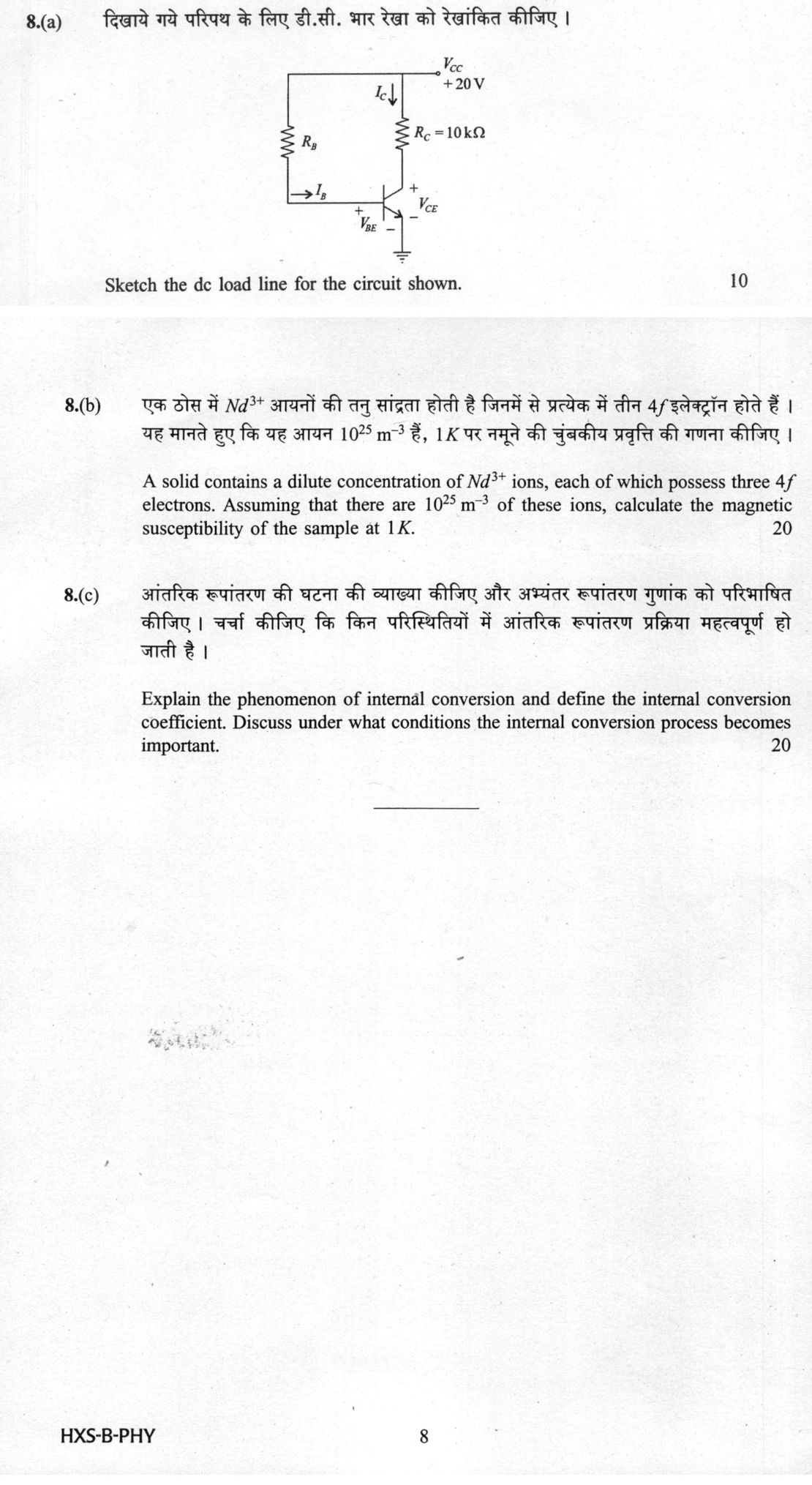
Sketch the dc load line for the circuit shown. 10 marks
A solid contains a dilute concentration of Nd³⁺ ions, each of which possess three 4f electrons. Assuming that there are 10²⁵ m⁻³ of these ions, calculate the magnetic susceptibility of the sample at 1K. 20 marks
Explain the phenomenon of internal conversion and define the internal conversion coefficient. Discuss under what conditions the internal conversion process becomes important. 20 marks
हिंदी में प्रश्न पढ़ें
दिखाये गये परिपथ के लिए डी.सी. भार रेखा को रेखांकित कीजिए । (10 अंक)
एक ठोस में Nd³⁺ आयनों की तनु सांद्रता होती है जिनमें से प्रत्येक में तीन 4f इलेक्ट्रॉन होते हैं । यह मानते हुए कि यह आयन 10²⁵ m⁻³ हैं, 1K पर नमूने की चुंबकीय प्रवृत्ति की गणना कीजिए । (20 अंक)
आंतरिक रूपांतरण की घटना की व्याख्या कीजिए और अभ्यंतर रूपांतरण गुणांक को परिभाषित कीजिए । चर्चा कीजिए कि किन परिस्थितियों में आंतरिक रूपांतरण प्रक्रिया महत्वपूर्ण हो जाती है । (20 अंक)
The figure this question refers to, in words
The question paper is a scan and the diagram did not survive as text. This is the figure as read from the original page — every component, value and label — so the question can be worked from the text below.
(a) A common-emitter NPN transistor circuit: The emitter is connected directly to ground. The base is connected through a resistor labelled R_B to a DC voltage supply terminal labelled V_cc = +20 V. An arrow pointing into the base indicates base current I_B, and the voltage between base and emitter is marked as V_BE with '+' at the base and '-' at the emitter. The collector is connected through a resistor R_C = 10 kOmega to the same +20 V supply rail. A downward arrow indicates collector current I_C above R_C. The voltage between collector and emitter is marked as V_CE with '+' at the collector and '-' at the emitter.
Model answer
Written by UPSC Answer Check against this question's marking rubric, to the expected length. UPSC does not publish answers for Mains — this is one way to score well, not an official key.
(a) For the collector-emitter output loop, apply Kirchhoff’s voltage law: V_CC = I_C R_C + V_CE. Hence the dc load-line equation is I_C = (V_CC − V_CE)/R_C. With V_CC = 20 V and R_C = 10 kΩ, I_C = (20 − V_CE)/10 mA. Cutoff occurs at I_C = 0, giving V_CE = 20 V. Saturation occurs at V_CE = 0, giving I_C = 20/10 = 2 mA. The slope is dI_C/dV_CE = −1/R_C = −0.1 mA/V. Sketch I_C vertically versus V_CE horizontally: draw a straight dc load line joining the points (20 V, 0) and (0 V, 2 mA). The quiescent point Q lies where this line intersects the output characteristic selected by the base current I_B = (20 − V_BE)/R_B. Since R_B is not given, Q is not fixed numerically.
(b) Nd³⁺ has the configuration 4f³. Using Hund’s rules:
- Spin S = 3 × (1/2) = 3/2.
- Orbital angular momentum L = 3 + 2 + 1 = 6.
- Since the shell is less than half-filled, J = L − S = 6 − 3/2 = 9/2.
The Landé g-factor is g_J = 1 + [J(J+1) + S(S+1) − L(L+1)]/[2J(J+1)]. Here J(J+1) = (9/2)(11/2) = 99/4, S(S+1) = (3/2)(5/2) = 15/4, and L(L+1) = 6 × 7 = 42. Thus g_J = 1 + [99/4 + 15/4 − 42]/(99/2) = 1 + [−27/2]/(99/2) = 1 − 3/11 = 8/11.
The effective magnetic moment is p_eff = g_J √[J(J+1)] μ_B = (8/11)√(99/4) μ_B = (12√11/11) μ_B ≈ 3.62 μ_B. Therefore p_eff² = 144/11.
Using the Curie law for a dilute paramagnet, χ = μ₀ n p_eff² μ_B²/(3 k_B T). Substitute n = 10²⁵ m⁻³, T = 1 K, μ₀ = 4π × 10⁻⁷ H m⁻¹, μ_B = 9.274 × 10⁻²⁴ J T⁻¹, and k_B = 1.381 × 10⁻²³ J K⁻¹: χ = [(4π × 10⁻⁷)(10²⁵)(144/11)(9.274 × 10⁻²⁴)²]/[3(1.381 × 10⁻²³)(1)]. Numerically, χ ≈ 3.42 × 10⁻⁴. This is the dimensionless SI volume susceptibility. In cgs volume susceptibility it is χ_SI/(4π) ≈ 2.72 × 10⁻⁵.
(c)(i) Internal conversion is a process in which an excited nucleus transfers its de-excitation energy directly to an atomic orbital electron, usually a K-shell electron, instead of emitting a gamma-ray photon. The electron is ejected with kinetic energy E_e = ΔE − B_e, where ΔE is the nuclear transition energy and B_e is the binding energy of the electron in its shell. The nucleus loses energy ΔE. The resulting atomic vacancy is filled by outer electrons, giving characteristic X-rays or Auger electrons. Internal conversion is not beta decay; it is an electromagnetic interaction between the nucleus and atomic electrons.
The internal conversion coefficient α is defined as the ratio of the number of internal conversion electrons emitted to the number of gamma photons emitted for the same nuclear transition: α = N_e/N_γ = λ_e/λ_γ. For a particular shell, α_K = N_e(K)/N_γ, α_L = N_e(L)/N_γ, etc. The total coefficient is α = α_K + α_L + α_M + ... The branching ratio for internal conversion is α/(1+α), while that for gamma emission is 1/(1+α).
(c)(ii) Internal conversion becomes important under the following conditions:
- Low transition energy: gamma emission is strongly suppressed, while internal conversion can still occur if the transition energy exceeds the electron binding energy.
- High atomic number Z: the electron density near the nucleus and Coulomb overlap are larger, and α increases rapidly with Z, roughly as Z³ for K-shell conversion.
- High multipolarity or large angular-momentum change: gamma emission is highly retarded, so internal conversion competes strongly or dominates.
- E0 transitions, such as 0⁺ → 0⁺: single gamma emission is forbidden, so internal conversion becomes a dominant de-excitation mode.
- Availability of tightly bound s electrons: K-shell conversion is important when ΔE > B_K; otherwise L-, M-, or higher-shell conversion may occur if energetically allowed.
- Retarded or forbidden nuclear transitions: whenever the gamma transition probability is small, internal conversion becomes relatively more probable.
What "Calculate" is asking you to do
Apply the standard formula or schedule to data the question has already supplied — a table of readings, cost records, a balance sheet — and produce the number. The method is rarely in doubt; the marks sit in the named intermediate quantities, each of which has to appear as a labelled line.
Structure that answers it
Data as given → formula or standard treatment, named → substitution → each intermediate, labelled → result with units
Where marks are lost
Omitting an intermediate the marking scheme pays for separately, or rounding at an intermediate line so the final figure drifts. In commerce and accountancy, any figure in a statement that no numbered working note supports is treated as unearned.
How this answer will be evaluated
Approach
Framework: Principle > Setup and diagram > Derivation > Result and limiting case. (a) map: locate accurately > label > one line on why it matters | (b) calculate: given > formula > substitution > result with units > interpretation | (c) explain: definition/context > points in order > small example > short close Full marks: Complete derivations with units, clear diagrams, and physical interpretation.
Key points expected
- Identify Vcc = 20V and Rc = 10kΩ from diagram
- Determine saturation current Ic(sat) = Vcc/Rc
- Determine cutoff voltage Vce(cutoff) = Vcc
- Plot line connecting (Vce, 0) and (0, Ic) on axes
- Determine total angular momentum J for 3 4f electrons
- Apply Curie's Law: χ = Nμ₀μeff²/3kT
- Substitute N = 10²⁵ m⁻³ and T = 1 K
- Provide final result with correct SI units
Evaluation rubric
Each sub-part is marked on its own, against the marks and word limit printed on the paper.
- (a) Sketch the DC load line for the given BJT circuit. 10 marks
map— locate accurately → label → one line on why it matters
Must cover
- Identify Vcc = 20V and Rc = 10kΩ from diagram
- Determine saturation current Ic(sat) = Vcc/Rc
- Determine cutoff voltage Vce(cutoff) = Vcc
- Plot line connecting (Vce, 0) and (0, Ic) on axes
Loses marks
- Omitting units (V, A, kΩ) on the diagram
- Drawing a curve instead of a straight line
- Failing to label the intercepts
Earns more
- Label axes as Vce and Ic clearly
- Mark the two intercept points with values
- Indicate the Q-point location on the line
Extra mark
- Mention the equation Vce = Vcc - IcRc
- (b) Calculate magnetic susceptibility of Nd³⁺ ions at 1K. 20 marks
calculate— given → formula → substitution → result with units → interpretation
Must cover
- Determine total angular momentum J for 3 4f electrons
- Apply Curie's Law: χ = Nμ₀μeff²/3kT
- Substitute N = 10²⁵ m⁻³ and T = 1 K
- Provide final result with correct SI units
Loses marks
- Dropping units in intermediate steps
- Using wrong value for number of ions N
- Formula substitution without showing derivation of μeff
Earns more
- Show calculation of Landé g-factor
- Explicitly state the effective magnetic moment μeff
- Use correct value for Bohr magneton μB
Extra mark
- Mention Hund's rules for determining J
- (c) Explain internal conversion and define the coefficient. 20 marks
explain— definition/context → points in order → small example → short close
Must cover
- Define internal conversion as non-radiative transition
- Define internal conversion coefficient α = Ic/Iγ
- Discuss dependence on nuclear charge Z
- Discuss dependence on transition energy
Loses marks
- Confusing with external conversion
- Failing to define the coefficient mathematically
- Vague description without physical mechanism
Earns more
- Mention ejection of orbital electron
- Compare with gamma emission
- Note importance for low-energy transitions
Extra mark
- Mention specific multipole orders (E1, M1, etc.)
Practice this exact question
Write your answer and it is marked point by point against the model answer above — what you covered, what you missed, what you got wrong.
Evaluate my answer →More from Physics 2021 Paper II
- Q5 (a) An X-ray beam of wavelength (λ₁) undergoes a first order Bragg reflection at a Bragg…
- Q6 (a) What is the importance of study of deuteron ? Obtain the solution of Schrödinger equa…
- Q7 (a) An n-p-n transistor with β = 49 is used in common-emitter amplifier mode with Vcc = 1…
- Q8 (a) Sketch the dc load line for the circuit shown. (10 marks) (b) A solid contains a dilu…