Paper II — Q6
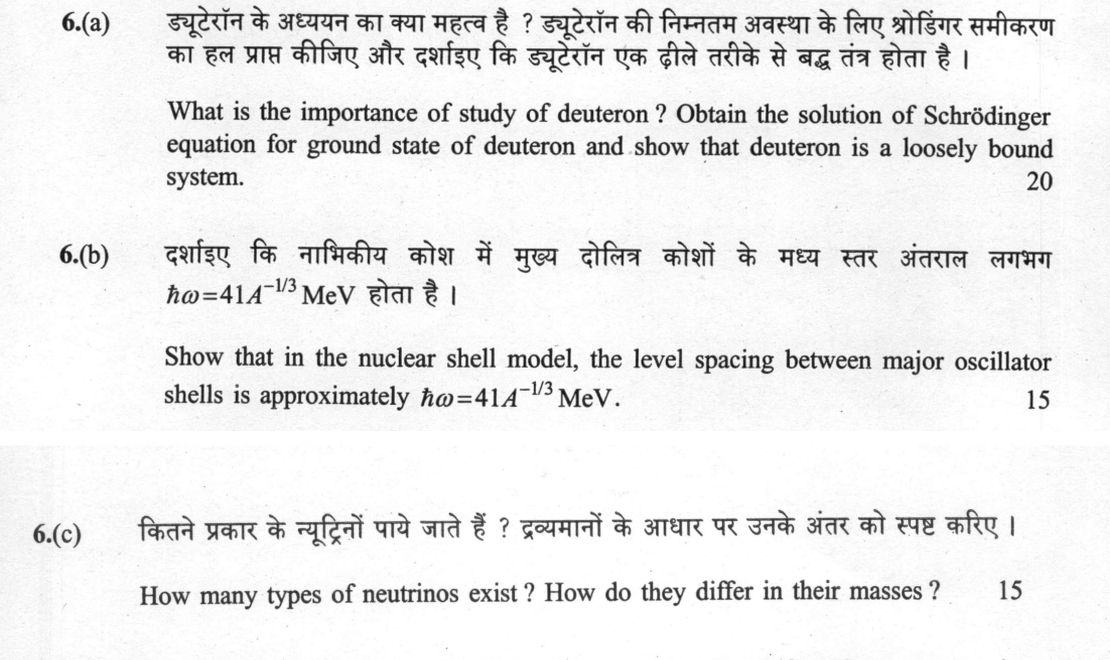
(a) What is the importance of study of deuteron ? Obtain the solution of Schrödinger equation for ground state of deuteron and…
What is the importance of study of deuteron ? Obtain the solution of Schrödinger equation for ground state of deuteron and show that deuteron is a loosely bound system. 20 marks
Show that in the nuclear shell model, the level spacing between major oscillator shells is approximately ℏω=41A^-1/3 MeV. 15 marks
How many types of neutrinos exist ? How do they differ in their masses ? 15 marks
हिंदी में प्रश्न पढ़ें
ड्यूटेरॉन के अध्ययन का क्या महत्व है ? ड्यूटेरॉन की निम्नतम अवस्था के लिए श्रोडिंगर समीकरण का हल प्राप्त कीजिए और दर्शाइए कि ड्यूटेरॉन एक ढीले तरीके से बद्ध तंत्र होता है । (20 अंक)
दर्शाइए कि नाभिकीय कोश में मुख्य दोलित्र कोशों के मध्य स्तर अंतराल लगभग ℏω=41A^-1/3 MeV होता है । (15 अंक)
कितने प्रकार के न्यूट्रिनो पाये जाते हैं ? द्रव्यमानों के आधार पर उनके अंतर को स्पष्ट करिए । (15 अंक)
Model answer
Written by UPSC Answer Check against this question's marking rubric, to the expected length. UPSC does not publish answers for Mains — this is one way to score well, not an official key.
(a) The deuteron is the simplest bound two-nucleon system. It tests the neutron–proton interaction, spin dependence, tensor force, iso-singlet character, and the fact that pp and nn are unbound. Its binding energy, magnetic moment, quadrupole moment and size constrain nuclear-force models and are important in stellar fusion and nuclear astrophysics.
In the central-force approximation, the deuteron ground state is L = 0, S = 1, J^π = 1⁺. Let u(r) = rR(r). With reduced mass μ = m_p m_n/(m_p + m_n) ≈ M/2, the radial Schrödinger equation is −ℏ²/(2μ) d²u/dr² + V(r)u = E u, E = −B, where B = 2.224 MeV is the binding energy. Take a square well: V(r) = −V₀ for r < R, V(r) = 0 for r > R. For r < R: d²u/dr² = −k²u, k² = 2μ(V₀ − B)/ℏ², so u(r) = A sin(kr), since u(0) = 0. For r > R: d²u/dr² = κ²u, κ² = 2μB/ℏ², so u(r) = C exp(−κr). Continuity of u and u′ at r = R gives the eigenvalue condition k cot(kR) = −κ. Normalising ∫₀^∞ |u(r)|² dr = 1 gives the deuteron wavefunction ψ(r) = [u(r)/r] χ(S=1,M), with u(r) = A sin(kr) for r < R and u(r) = A sin(kR) exp[−κ(r − R)] for r > R. Here A = [∫₀^R sin²(kr) dr + sin²(kR) ∫_R^∞ exp(−2κ(r − R)) dr]^(−1/2).
To show loose binding, use μc² ≈ 469.5 MeV, B = 2.224 MeV, ℏc = 197.3 MeV fm: κ = √(2μc²B)/(ℏc) = √(2×469.5×2.224)/(197.3) fm⁻¹ ≈ 0.232 fm⁻¹. Hence the exponential tail falls over 1/κ ≈ 4.3 fm, while the nuclear-force range is only R ≈ 2 fm. Also V₀ ≈ 35 MeV, so B/V₀ ≈ 0.064. Binding per nucleon is only about 1.11 MeV, much smaller than the usual ~8 MeV. The deuteron has no bound excited state. These facts show it is a loosely bound system. The actual deuteron also has a small D-state admixture due to the tensor force; the central-force model above gives the dominant S-state.
(b) In the nuclear shell model, nucleons move in an isotropic harmonic oscillator potential V(r) = ½ Mω²r². The energy levels are E_N = (N + 3/2)ℏω, where N = 2n + l. Thus the spacing between major oscillator shells is ℏω.
Including spin and isospin, the degeneracy of level N is g_N = 2(N + 1)(N + 2). The number of nucleons up to the highest filled shell N is A = Σ(n=0 to N) g_n = (2/3)(N + 1)(N + 2)(N + 3) ≈ 2N³/3. Therefore N ≈ (3A/2)^(1/3).
For a state with N oscillator quanta, ⟨r²⟩_N = (N + 3/2)ℏ/(Mω) = (N + 3/2)b², where b² = ℏ/(Mω). Averaging over all filled shells, ⟨r²⟩ = [Σ(n=0 to N) g_n (n + 3/2)b²]/A. Since Σ n g_n/A = 3N/4 exactly for filled shells, we get ⟨r²⟩ ≈ (3N/4)b².
Equate this to a uniform nuclear sphere: ⟨r²⟩ = (3/5)R² = (3/5)R₀²A^(2/3), with R₀ ≈ 1.2 fm. So (3N/4)b² = (3/5)R₀²A^(2/3). Using N = (3A/2)^(1/3), b² = (4/5)R₀²(2/3)^(1/3)A^(1/3) ≈ 1.006A^(1/3) fm². Then ℏω = ℏ²/(M b²) = (ℏc)²/(Mc² b²). With ℏc = 197.3 MeV fm and Mc² ≈ 938 MeV, ℏω ≈ (197.3)²/(938×1.006A^(1/3)) MeV ≈ 41A^(−1/3) MeV. Hence the major oscillator shell spacing is approximately ℏω ≈ 41A^(−1/3) MeV.
(c) In the standard three-neutrino oscillation framework, there are three active neutrino flavours: ν_e, ν_μ and ν_τ, with their corresponding antineutrinos. The invisible Z-boson width gives the number of light active neutrino species as N_ν = 2.984 ± 0.008, confirming three. Sterile neutrinos may exist, but they are not required and are not active.
These flavour states are not mass eigenstates. They are quantum superpositions of three mass eigenstates ν₁, ν₂ and ν₃. Neutrino oscillations measure mass-squared differences:
- Solar: Δm²₂₁ = m₂² − m₁² ≈ 7.5×10⁻⁵ eV².
- Atmospheric: |Δm²₃₁| ≈ 2.5×10⁻³ eV².
Thus the mass eigenstates differ by very small amounts. The absolute masses are not yet known, only differences. The sign of Δm²₃₁ is also unknown, giving two possible orderings:
- Normal hierarchy: m₃ > m₂ > m₁.
- Inverted hierarchy: m₂ > m₁ > m₃.
If the lightest mass is very small, the heavier states are around √(2.5×10⁻³) eV ≈ 0.05 eV. Cosmology gives Σm_ν < 0.12 eV, so quasi-degenerate masses must each be less than about 0.04 eV; direct beta-decay experiments give an effective electron-neutrino mass below about 0.8 eV. Neutrino masses are extremely small compared with charged-lepton masses.
What "Derive" is asking you to do
Reach the stated expression from a starting relation, justifying every step. The destination is printed in the question, so only the route earns marks, and the assumptions you work under are part of that route.
Structure that answers it
Assumptions and notation defined → starting relation or governing equation → each step with its justification → the required expression → limiting case or boundary check
Where marks are lost
Writing the standard result first and fitting three lines to it, which an examiner reads at a glance. Marks also go on assumptions left unstated — lossless medium, small amplitude, errors independent with zero mean — and on symbols used before they are defined, even when the question says usual notations.
How this answer will be evaluated
Approach
(a) derive: given > assumptions > stepwise derivation > result > check | (b) derive: given > assumptions > stepwise derivation > result > check | (c) explain: definition/context > points in order > small example > short close Full marks: Rigorous derivations with clear physical interpretation and correct constants.
Key points expected
- State importance: simplest nucleus, tests nuclear force
- Set up Schrödinger equation for two-body system
- Reduce to one-body problem using reduced mass
- Solve radial equation for ground state (l=0)
- Assume harmonic oscillator potential for nucleons
- Relate oscillator frequency ω to nuclear radius R
- Use R = R₀A¹/³ to express ω in terms of A
- Substitute constants to obtain 41A⁻¹/³ MeV
Evaluation rubric
Each sub-part is marked on its own, against the marks and word limit printed on the paper.
- (a) Importance of deuteron study and derivation of ground state solution showing loose binding. 20 marks
derive— given → assumptions → stepwise derivation → result → check
Must cover
- State importance: simplest nucleus, tests nuclear force
- Set up Schrödinger equation for two-body system
- Reduce to one-body problem using reduced mass
- Solve radial equation for ground state (l=0)
Loses marks
- Treating as point particles without reduced mass
- Ignoring the tensor force component
- Failing to connect solution to 'loose binding' claim
Earns more
- Calculate binding energy from wavefunction
- Compare calculated vs experimental binding energy
- Discuss role of tensor force
- Mention absence of excited states
Extra mark
- Explicit calculation of reduced mass value
- Reference to specific experimental binding energy value
- (b) Derivation of level spacing formula ℏω = 41A⁻¹/³ MeV in shell model. 15 marks
derive— given → assumptions → stepwise derivation → result → check
Must cover
- Assume harmonic oscillator potential for nucleons
- Relate oscillator frequency ω to nuclear radius R
- Use R = R₀A¹/³ to express ω in terms of A
- Substitute constants to obtain 41A⁻¹/³ MeV
Loses marks
- Using a different potential without justification
- Failing to relate ω to nuclear radius
- Arithmetic errors in constant substitution
Earns more
- Explicitly state the potential form V(r)
- Show the relation between ω and R
- Mention the value of R₀ used
- Discuss the physical meaning of the spacing
Extra mark
- Comparison with experimental shell gaps
- Mention of the specific value of R₀ (e.g., 1.2 fm)
- (c) Number of neutrino types and their mass differences. 15 marks
explain— definition/context → points in order → small example → short close
Must cover
- Identify the three neutrino flavors (electron, muon, tau)
- Explain neutrino oscillations as evidence for mass
- Distinguish between flavor and mass eigenstates
- Discuss the mass hierarchy (normal vs inverted)
Loses marks
- Confusing flavor and mass eigenstates
- Failing to mention oscillations as evidence
- Incorrect number of neutrino types
Earns more
- Mention the mass-squared differences Δm²
- Reference to specific experiments (e.g., Super-K, SNO)
- Explain the mixing matrix (PMNS matrix)
- Mention the upper limit on absolute mass
Extra mark
- Specific values of Δm²
- Mention of the specific experiments by name
Practice this exact question
Write your answer and it is marked point by point against the model answer above — what you covered, what you missed, what you got wrong.
Evaluate my answer →More from Physics 2021 Paper II
- Q3 (a) In observing the Raman spectrum of a sample using 3637Å as the exciting line, one get…
- Q4 (a) A particle of rest mass m₀ has a kinetic energy K, show that its de Broglie wavelengt…
- Q5 (a) An X-ray beam of wavelength (λ₁) undergoes a first order Bragg reflection at a Bragg…
- Q6 (a) What is the importance of study of deuteron ? Obtain the solution of Schrödinger equa…
- Q7 (a) An n-p-n transistor with β = 49 is used in common-emitter amplifier mode with Vcc = 1…
- Q8 (a) Sketch the dc load line for the circuit shown. (10 marks) (b) A solid contains a dilu…