Paper II — Q2
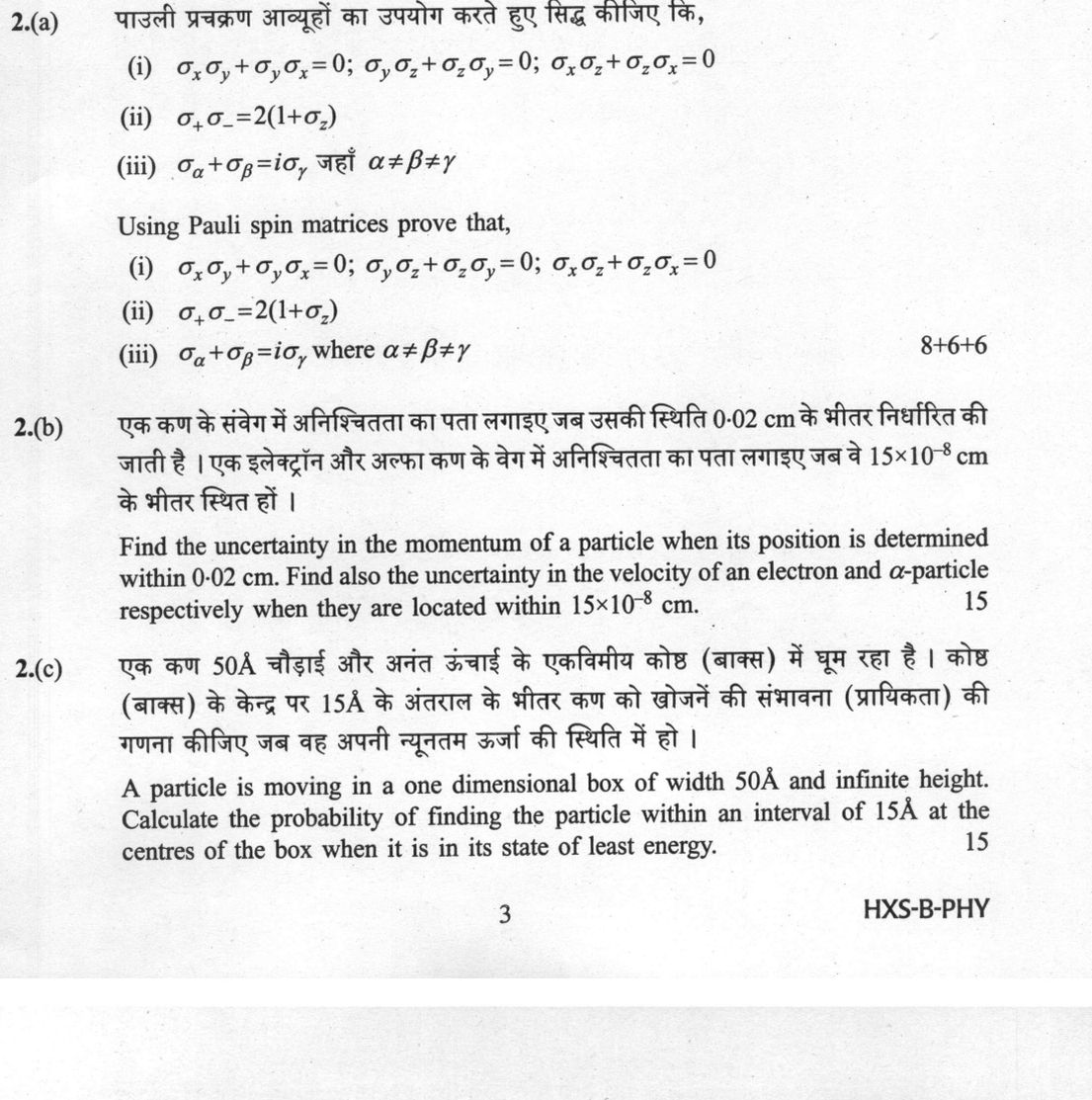
(a) Using Pauli spin matrices prove that, (i) σₓσᵧ + σᵧσₓ = 0; σᵧσᵤ + σᵤσᵧ = 0; σₓσᵤ + σᵤσₓ = 0 (ii) σ₊σ₋ = 2(1+σᵤ) (iii) σₐ + σᵦ…
Using Pauli spin matrices prove that, σₓσᵧ + σᵧσₓ = 0; σᵧσᵤ + σᵤσᵧ = 0; σₓσᵤ + σᵤσₓ = 0
σ₊σ₋ = 2(1+σᵤ)
σₐ + σᵦ = iσᵧ where α ≠ β ≠ γ 8+6+6 marks
Find the uncertainty in the momentum of a particle when its position is determined within 0·02 cm. Find also the uncertainty in the velocity of an electron and α-particle respectively when they are located within 15×10⁻⁸ cm. 15 marks
A particle is moving in a one dimensional box of width 50Å and infinite height. Calculate the probability of finding the particle within an interval of 15Å at the centres of the box when it is in its state of least energy. 15 marks
हिंदी में प्रश्न पढ़ें
पाउली प्रचक्रण आव्यूहों का उपयोग करते हुए सिद्ध कीजिए कि, σₓσᵧ + σᵧσₓ = 0; σᵧσᵤ + σᵤσᵧ = 0; σₓσᵤ + σᵤσₓ = 0
σ₊σ₋ = 2(1+σᵤ)
σₐ + σᵦ = iσᵧ जहाँ α ≠ β ≠ γ 8+6+6 अंक
एक कण के संवेग में अनिश्चितता का पता लगाइए जब उसकी स्थिति 0·02 cm के भीतर निर्धारित की जाती है। एक इलेक्ट्रॉन और अल्फा कण के वेग में अनिश्चितता का पता लगाइए जब वे 15×10⁻⁸ cm के भीतर स्थित हों। 15 अंक
एक कण 50Å चौड़ाई और अनंत ऊँचाई के एकविमीय कोष (बाक्स) में घूम रहा है। कोष (बाक्स) के केंद्र पर 15Å के अंतराल के भीतर कण को खोजने की संभावना (प्रायिकता) की गणना कीजिए जब वह अपनी न्यूनतम ऊर्जा की स्थिति में हो। 15 अंक
Model answer
Written by UPSC Answer Check against this question's marking rubric, to the expected length. UPSC does not publish answers for Mains — this is one way to score well, not an official key.
(a)(i) Take σᵤ = σ_z, the third Pauli matrix. Let σₓ = [[0,1],[1,0]], σᵧ = [[0,−i],[i,0]], σᵤ = [[1,0],[0,−1]], I = [[1,0],[0,1]].
Then σₓσᵧ = [[i,0],[0,−i]] = iσᵤ, σᵧσₓ = [[−i,0],[0,i]] = −iσᵤ, so σₓσᵧ + σᵧσₓ = 0.
Also σᵧσᵤ = [[0,i],[i,0]], σᵤσᵧ = [[0,−i],[−i,0]], so σᵧσᵤ + σᵤσᵧ = 0.
And σₓσᵤ = [[0,−1],[1,0]], σᵤσₓ = [[0,1],[−1,0]], so σₓσᵤ + σᵤσₓ = 0. Thus the Pauli matrices anticommute in pairs.
(a)(ii) Use σ₊ = σₓ + iσᵧ and σ₋ = σₓ − iσᵧ. Then σ₊σ₋ = (σₓ + iσᵧ)(σₓ − iσᵧ) = σₓ² + σᵧ² + i(σᵧσₓ − σₓσᵧ).
Now σₓ² = σᵧ² = I, and σₓσᵧ = iσᵤ, σᵧσₓ = −iσᵤ. Hence σ₊σ₋ = 2I + i(−iσᵤ − iσᵤ) = 2I + 2σᵤ = 2(1 + σᵤ). So σ₊σ₋ = 2(1 + σᵤ).
(a)(iii) As printed with a plus sign, the statement σₐ + σᵦ = iσᵧ is false. For example, for α = x, β = y, γ = u, σₓ + σᵧ = [[0, 1−i],[1+i, 0]], while iσᵤ = [[i,0],[0,−i]], so they are not equal.
The standard Pauli identity is the cyclic product relation σₐσᵦ = iσᵧ for α, β, γ cyclic. Indeed, σₓσᵧ = iσᵤ, σᵧσᵤ = iσₓ, σᵤσₓ = iσᵧ. Thus, if the intended statement is multiplication rather than addition, the proof is this cyclic product relation.
(b) By Heisenberg’s uncertainty principle, Δx Δp ≥ ħ/2, so Δp_min = ħ/(2Δx).
Given Δx = 0·02 cm = 2·0 × 10⁻⁴ m, Δp_min = (1·0545718 × 10⁻³⁴ J s)/(2 × 2·0 × 10⁻⁴ m) = 2·64 × 10⁻³¹ kg m s⁻¹.
For an electron and an α-particle located within Δx = 15 × 10⁻⁸ cm = 1·5 × 10⁻⁹ m, Δv = ħ/(2mΔx).
Electron: mₑ = 9·11 × 10⁻³¹ kg. Δvₑ = (1·0545718 × 10⁻³⁴)/(2 × 9·11 × 10⁻³¹ × 1·5 × 10⁻⁹) = 3·86 × 10⁴ m s⁻¹.
α-particle: m_α ≈ 6·64 × 10⁻²⁷ kg. Δv_α = (1·0545718 × 10⁻³⁴)/(2 × 6·64 × 10⁻²⁷ × 1·5 × 10⁻⁹) = 5·29 m s⁻¹.
These are minimum uncertainties; the actual uncertainties satisfy the corresponding ≥ inequalities.
(c) For an infinite one-dimensional box of width L = 50 Å, the normalized ground-state wavefunction is ψ₁(x) = √(2/L) sin(πx/L), 0 ≤ x ≤ L.
The interval of width 15 Å at the centre is from x = 25 − 7·5 = 17·5 Å to x = 25 + 7·5 = 32·5 Å. Hence P = ∫₁₇·₅³²·₅ (2/50) sin²(πx/50) dx.
Put y = πx/50. Then dx = (50/π)dy, and the limits become y₁ = 0·35π = 7π/20, y₂ = 0·65π = 13π/20. Thus P = (2/π)∫₇π/₂₀¹³π/₂₀ sin²y dy = (1/π)[y − (1/2) sin 2y]₇π/₂₀¹³π/₂₀ = 3/10 + (1 + √5)/(4π) ≈ 0·5575 = 55·75%.
So the probability is 3/10 + (1 + √5)/(4π) ≈ 0·5575.
What "Prove" is asking you to do
Establish that the statement holds for every case it claims, not for one representative case. The argument must be closed: each line follows from a definition, a hypothesis, or a named theorem you are entitled to use.
Structure that answers it
Given and to prove, restated → theorem or construction to be used, named → the argument line by line → conclusion stated as proved
Where marks are lost
Testing one example, which illustrates but proves nothing. On an if and only if claim, proving one direction and stopping forfeits that half outright, and degenerate cases — zero, the empty set, the equality case — have to be disposed of rather than assumed away.
How this answer will be evaluated
Approach
(a(i)) derive: given > assumptions > stepwise derivation > result > check | (a(ii)) derive: given > assumptions > stepwise derivation > result > check | (a(iii)) derive: given > assumptions > stepwise derivation > result > check | (b) calculate: given > formula > substitution > result with units > interpretation | (c) calculate: given > formula > substitution > result with units > interpretation Full marks: Rigorous derivations with all steps shown; correct unit conversions; clear physical interpretation.
Key points expected
- Write explicit 2x2 matrix forms for σx, σy, σz
- Perform explicit matrix multiplication for σxσy and σyσx
- Show sum of products is zero matrix
- Repeat for yz and zx pairs
- Define σ+ and σ- in terms of σx, σy
- Substitute definitions into product σ+σ-
- Simplify using σx² = σy² = I
- Show result equals 2(1+σz)
Evaluation rubric
Each sub-part is marked on its own, against the marks and word limit printed on the paper.
- (a(i)) Prove the anticommutation relations for Pauli matrices. 8 marks
derive— given → assumptions → stepwise derivation → result → check
Must cover
- Write explicit 2x2 matrix forms for σx, σy, σz
- Perform explicit matrix multiplication for σxσy and σyσx
- Show sum of products is zero matrix
- Repeat for yz and zx pairs
Loses marks
- Asserting result without matrix multiplication
- Confusing commutator with anticommutator
Earns more
- Mention trace properties
- Use index notation
Extra mark
- Link to Clifford algebra
- (a(ii)) Prove the identity for σ+σ-. 6 marks
derive— given → assumptions → stepwise derivation → result → check
Must cover
- Define σ+ and σ- in terms of σx, σy
- Substitute definitions into product σ+σ-
- Simplify using σx² = σy² = I
- Show result equals 2(1+σz)
Loses marks
- Incorrect definition of σ±
- Algebraic errors in simplification
Earns more
- Show intermediate step σxσy = iσz
Extra mark
- Physical interpretation of raising/lowering
- (a(iii)) Prove the product rule for distinct Pauli matrices. 6 marks
derive— given → assumptions → stepwise derivation → result → check
Must cover
- Identify α, β, γ as distinct indices
- Use cyclic property of Pauli matrices
- Show product equals iσγ
- Verify with one specific example (e.g., x,y,z)
Loses marks
- Missing the factor of i
- Confusing order of indices
Earns more
- Mention Levi-Civita symbol
Extra mark
- Generalization to 3D vectors
- (b) Calculate momentum and velocity uncertainties using Heisenberg principle. 15 marks
calculate— given → formula → substitution → result with units → interpretation
Must cover
- State Heisenberg Uncertainty Principle ΔxΔp ≥ ħ/2
- Calculate Δp for Δx = 0.02 cm
- Calculate Δv for electron (m=9.1e-31 kg) and alpha (m=6.6e-27 kg)
- Use Δx = 15×10⁻⁸ cm for velocity part
Loses marks
- Using h instead of ħ
- Unit conversion errors (cm to m)
Earns more
- Convert units to SI (meters, kg)
- Show numerical substitution clearly
Extra mark
- Compare magnitude of Δv for e vs alpha
- (c) Calculate probability of finding particle in central region of box. 15 marks
calculate— given → formula → substitution → result with units → interpretation
Must cover
- Write wavefunction for ground state (n=1) in 1D box
- Set up integral for probability over interval [-7.5Å, +7.5Å]
- Evaluate integral of sin²(πx/L)
- Calculate final numerical probability
Loses marks
- Using n=2 or higher state
- Incorrect limits of integration
Earns more
- Sketch of wavefunction and integration limits
- Use symmetry to simplify integral
Extra mark
- Physical interpretation of probability density
Practice this exact question
Write your answer and it is marked point by point against the model answer above — what you covered, what you missed, what you got wrong.
Evaluate my answer →More from Physics 2021 Paper II
- Q1 (a) Find the minimum magnetic field needed for the Zeeman effect to be observed in a spec…
- Q2 (a) Using Pauli spin matrices prove that, (i) σₓσᵧ + σᵧσₓ = 0; σᵧσᵤ + σᵤσᵧ = 0; σₓσᵤ + σᵤ…
- Q3 (a) In observing the Raman spectrum of a sample using 3637Å as the exciting line, one get…
- Q4 (a) A particle of rest mass m₀ has a kinetic energy K, show that its de Broglie wavelengt…
- Q5 (a) An X-ray beam of wavelength (λ₁) undergoes a first order Bragg reflection at a Bragg…