Paper I — Q1
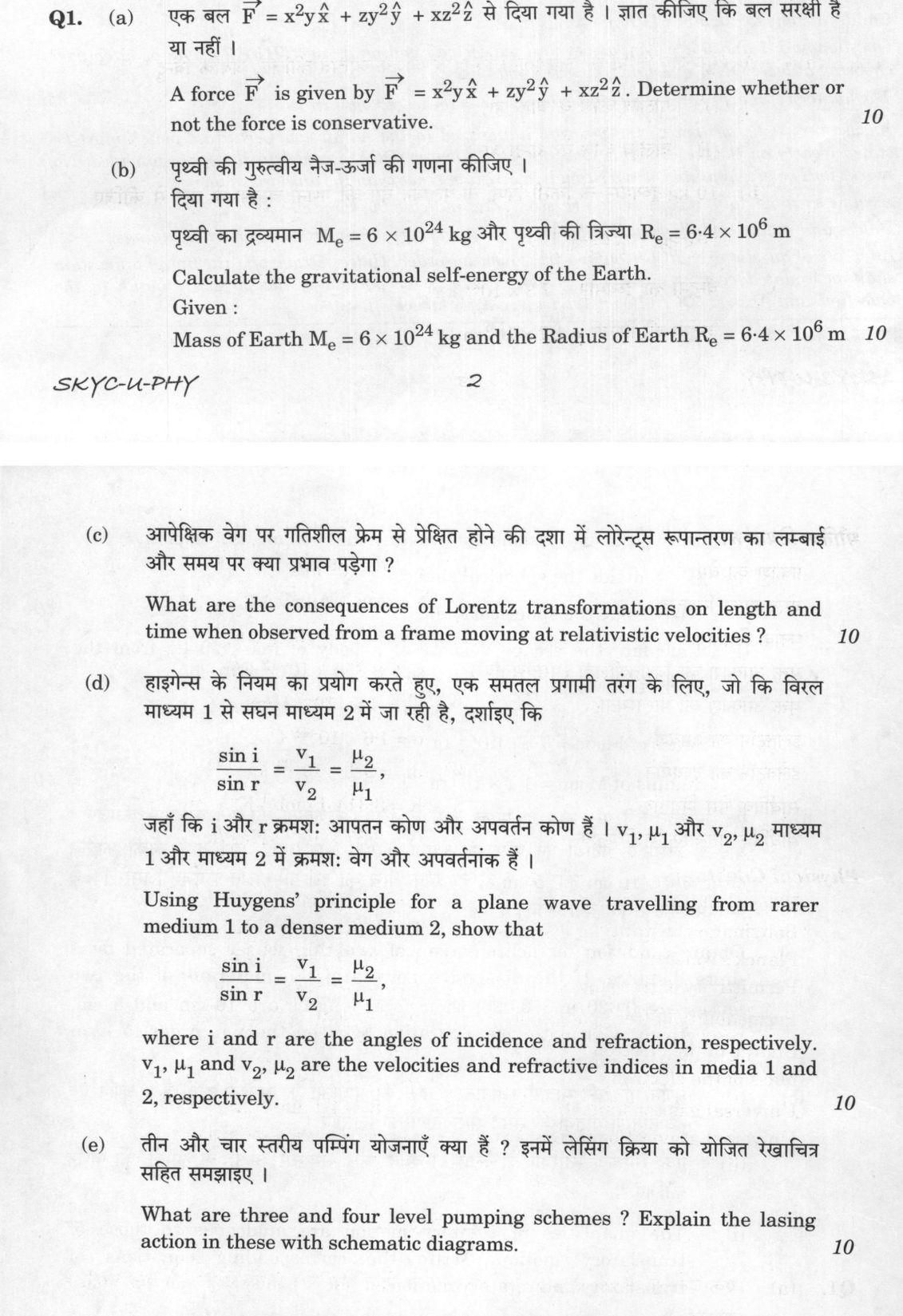
(a) A force F⃗ is given by F⃗ = x²y x̂ + zy² ŷ + xz² ẑ. Determine whether or not the force is conservative. 10 marks (b)…
A force F⃗ is given by F⃗ = x²y x̂ + zy² ŷ + xz² ẑ. Determine whether or not the force is conservative. 10 marks
Calculate the gravitational self-energy of the Earth. Given : Mass of Earth Mₑ = 6 × 10²⁴ kg and the Radius of Earth Rₑ = 6·4 × 10⁶ m 10 marks
What are the consequences of Lorentz transformations on length and time when observed from a frame moving at relativistic velocities ? 10 marks
Using Huygens' principle for a plane wave travelling from rarer medium 1 to a denser medium 2, show that
(sin i)/(sin r) = (v₁)/(v₂) = (μ₂)/(μ₁),
where i and r are the angles of incidence and refraction, respectively. v₁, μ₁ and v₂, μ₂ are the velocities and refractive indices in media 1 and 2, respectively. 10 marks
What are three and four level pumping schemes ? Explain the lasing action in these with schematic diagrams. 10 marks
हिंदी में प्रश्न पढ़ें
एक बल F⃗ = x²y x̂ + zy² ŷ + xz² ẑ से दिया गया है । ज्ञात कीजिए कि बल संरक्षी है या नहीं । 10
पृथ्वी की गुरुत्वीय नैज-ऊर्जा की गणना कीजिए । दिया गया है : पृथ्वी का द्रव्यमान Mₑ = 6 × 10²⁴ kg और पृथ्वी की त्रिज्या Rₑ = 6·4 × 10⁶ m 10
अपेक्षिक वेग पर गतिशील फ्रेम से प्रेक्षित होने की दशा में लोरेंट्ज़ रूपांतरण का लंबाई और समय पर क्या प्रभाव पड़ेगा ? 10 marks
हाइगेंस के नियम का प्रयोग करते हुए, एक समतल प्रगामी तरंग के लिए, जो कि विरल माध्यम 1 से सघन माध्यम 2 में जा रही है, दर्शाइए कि
(sin i)/(sin r) = (v₁)/(v₂) = (μ₂)/(μ₁),
जहाँ कि i और r क्रमशः आपतन कोण और अपवर्तन कोण हैं । v₁, μ₁ और v₂, μ₂ माध्यम 1 और माध्यम 2 में क्रमशः वेग और अपवर्तनांक हैं । 10
तीन और चार स्तरीय पम्पिंग योजनाएँ क्या हैं ? इनमें लेज़िंग क्रिया को योजित रेखाचित्र सहित समझाइए । 10
Model answer
Written by UPSC Answer Check against this question's marking rubric, to the expected length. UPSC does not publish answers for Mains — this is one way to score well, not an official key.
(a) A force is conservative if its curl vanishes everywhere in a simply connected region, i.e. if ∇×F = 0. Here
F = x²y x̂ + zy² ŷ + xz² ẑ.
So the components are:
Fₓ = x²y, F_y = zy², F_z = xz².
Using the curl formula,
(∇×F)ₓ = ∂F_z/∂y - ∂F_y/∂z = ∂(xz²)/∂y - ∂(zy²)/∂z = 0 - y² = -y².
The y-component is
(∇×F)_y = ∂Fₓ/∂z - ∂F_z/∂x = ∂(x²y)/∂z - ∂(xz²)/∂x = 0 - z² = -z².
The z-component is
(∇×F)_z = ∂F_y/∂x - ∂Fₓ/∂y = ∂(zy²)/∂x - ∂(x²y)/∂y = 0 - x² = -x².
Hence
∇×F = -y² x̂ - z² ŷ - x² ẑ.
This is not zero for general x, y, z. Therefore the force is not conservative. The test is valid in the simply connected domain of all space; since the curl does not vanish, no scalar potential V can exist such that F = -∇V.
(b) The gravitational self-energy of a uniform sphere of mass M and radius R is obtained by assembling the sphere shell by shell.
Let the density be uniform:
ρ = M/(4πR³/3).
When mass has been assembled up to radius r, the mass inside is
m(r) = (4πr³/3)ρ = M r³/R³.
Now bring a thin shell of thickness dr at radius r. Its mass is
dm = 4πr²ρ dr = 3M r²/R³ dr.
The work done in bringing this shell from infinity to radius r against the gravitational field of the already assembled mass m(r) is
dU = -G m(r) dm / r.
Thus
dU = -G (M r³/R³)(3M r²/R³ dr)/r = -(3GM²/R⁶) r⁴ dr.
Integrating from r = 0 to r = R,
U = -(3GM²/R⁶) ∫₀ᴿ r⁴ dr = -(3GM²/R⁶)(R⁵/5) = -3GM²/(5R).
Using G = 6.67×10⁻¹¹ N m² kg⁻², M = 6×10²⁴ kg, R = 6.4×10⁶ m,
U = -3(6.67×10⁻¹¹)(6×10²⁴)²/[5(6.4×10⁶)] = -2.25×10³² J.
Final answer: gravitational self-energy of the Earth = -2.25×10³² J. The magnitude or binding energy is 2.25×10³² J. This assumes a spherically symmetric Earth of uniform density and Newtonian gravitation.
(c) Let S′ be a frame moving with velocity v along the x-axis relative to S. The Lorentz transformation is
x′ = γ(x - vt), t′ = γ(t - vx/c²), y′ = y, z′ = z,
where γ = 1/√(1 - v²/c²). Its consequences for length and time are:
- Time dilation: A clock at rest in S measures proper time Δτ. An observer in S′ measures
Δt′ = γ Δτ = Δτ/√(1 - v²/c²).
Since γ > 1, moving clocks run slower. This is observed in the increased lifetime of fast-moving muons.
- Length contraction: A rod at rest in S has proper length L₀ along the direction of motion. An observer in S′ measures
L = L₀/γ = L₀√(1 - v²/c²).
Thus moving lengths contract along the direction of relative motion. Transverse dimensions are unchanged.
- Relativity of simultaneity: If two events are simultaneous in S, with Δt = 0 but separated by Δx, then in S′
Δt′ = -γvΔx/c².
So simultaneity is not absolute. Events simultaneous in one inertial frame may not be simultaneous in another.
- Limiting behaviour: For v << c, γ ≈ 1, and the classical Galilean results are recovered. For v → c, γ → ∞, so time dilation and length contraction become extreme.
These effects are symmetric: each observer sees the other’s clock running slow and the other’s rod contracted. The results are valid for inertial frames moving at constant relativistic velocity, with v < c.
(d) Huygens’ principle states that every point on a wavefront acts as a source of secondary spherical wavelets, and the new wavefront is the common tangent envelope of these wavelets.
Let XY be the plane interface between medium 1 and medium 2. Let AB be the incident plane wavefront, with A on the interface. Let the disturbance from B reach C on the interface in time t. Then
BC = v₁t,
where v₁ is the wave velocity in medium 1.
During the same time t, the secondary wavelet from A travels into medium 2 a distance
AD = v₂t,
where v₂ is the wave velocity in medium 2. Draw CD tangent to this secondary wavelet. Then CD is the refracted wavefront.
Let i be the angle of incidence and r the angle of refraction. From the geometry of the incident wavefront, in triangle ABC,
BC = AC sin i.
Therefore
v₁t = AC sin i.
From the geometry of the refracted wavefront, in triangle ACD,
AD = AC sin r.
Therefore
v₂t = AC sin r.
Dividing the two equations,
(v₁t)/(v₂t) = (AC sin i)/(AC sin r),
so
sin i/sin r = v₁/v₂.
Now the refractive index of a medium is μ = c/v, where c is the speed of light in vacuum. Hence
v₁/v₂ = (c/μ₁)/(c/μ₂) = μ₂/μ₁.
Therefore,
sin i/sin r = v₁/v₂ = μ₂/μ₁.
For medium 2 denser than medium 1, μ₂ > μ₁ and v₂ < v₁, so sin r < sin i, giving r < i. Thus the refracted ray bends towards the normal. This derivation assumes a plane interface, isotropic media, and a monochromatic plane wave.
(e) In a laser, lasing requires a population inversion: the number of atoms in the upper laser level must exceed that in the lower laser level. Pumping raises atoms to higher levels; fast non-radiative decays then populate a metastable upper laser level.
Three-level pumping scheme: The levels are the ground level E₀, a metastable upper laser level E₁, and a pump band E₂. Atoms are pumped from E₀ to E₂. They decay rapidly and non-radiatively to E₁. Lasing occurs from E₁ to E₀.
Schematic:
E₂ (pump band) ───────────── ↑ pump ↓ fast non-radiative E₁ (metastable upper) ───────────── → laser E₀ (ground/lower) ─────────────
Here the lower laser level is the ground state. Therefore more than half the atoms must be raised to E₁ to achieve inversion. This requires a high pump threshold. Ruby laser is a common example.
Four-level pumping scheme: The levels are ground level E₀, lower laser level E₁, metastable upper laser level E₂, and pump band E₃. Atoms are pumped from E₀ to E₃, decay rapidly to E₂, lase from E₂ to E₁, and then E₁ decays rapidly to E₀.
Schematic:
E₃ (pump band) ───────────── ↑ pump ↓ fast non-radiative E₂ (metastable upper) ───────────── → laser E₁ (lower laser level) ───────────── ↓ fast non-radiative E₀ (ground) ─────────────
Because E₁ empties rapidly, its population remains small. Hence population inversion between E₂ and E₁ is easily maintained, and the pump threshold is much lower than in a three-level system. Nd:YAG and He-Ne lasers are examples.
In both schemes, after inversion is established, a spontaneously emitted photon stimulates further emission from the upper level. The emitted photons have the same frequency, phase, direction, and polarization. Optical feedback by mirrors causes amplification, and when gain exceeds losses, coherent laser output is obtained. The upper laser level must be metastable, and the non-radiative decays must be fast for efficient pumping.
What "Derive" is asking you to do
Reach the stated expression from a starting relation, justifying every step. The destination is printed in the question, so only the route earns marks, and the assumptions you work under are part of that route.
Structure that answers it
Assumptions and notation defined → starting relation or governing equation → each step with its justification → the required expression → limiting case or boundary check
Where marks are lost
Writing the standard result first and fitting three lines to it, which an examiner reads at a glance. Marks also go on assumptions left unstated — lossless medium, small amplitude, errors independent with zero mean — and on symbols used before they are defined, even when the question says usual notations.
How this answer will be evaluated
Approach
(a) calculate: given > formula > substitution > result with units > interpretation | (b) calculate: given > formula > substitution > result with units > interpretation | (c) explain: definition/context > points in order > small example > short close | (d) derive: given > assumptions > stepwise derivation > result > check | (e) explain: definition/context > points in order > small example > short close Full marks: Complete derivations with clear diagrams, correct units, and physical interpretation
Key points expected
- State condition for conservative force (curl F = 0)
- Calculate partial derivatives of components
- Compute curl components explicitly
- Conclude based on non-zero curl
- State formula U = -3GM²/5R
- Substitute given values for M and R
- Perform calculation with correct powers of 10
- State final answer in Joules
Evaluation rubric
Each sub-part is marked on its own, against the marks and word limit printed on the paper.
- (a) Verify if the force field is conservative by checking the curl. 10 marks
calculate— given → formula → substitution → result with units → interpretation
Must cover
- State condition for conservative force (curl F = 0)
- Calculate partial derivatives of components
- Compute curl components explicitly
- Conclude based on non-zero curl
Loses marks
- Assuming conservative without checking curl
- Arithmetic errors in partial derivatives
Earns more
- Identify specific non-zero component of curl
- Mention path independence of work
Extra mark
- Calculate work done along a specific closed path
- (b) Compute gravitational self-energy of Earth using the standard formula. 10 marks
calculate— given → formula → substitution → result with units → interpretation
Must cover
- State formula U = -3GM²/5R
- Substitute given values for M and R
- Perform calculation with correct powers of 10
- State final answer in Joules
Loses marks
- Using wrong formula (e.g., -GM²/R)
- Dropping units in final answer
Earns more
- Derive formula from shell integration
- Check dimensional consistency
Extra mark
- Compare with binding energy of other celestial bodies
- (c) Describe length contraction and time dilation consequences of Lorentz transformations. 10 marks
explain— definition/context → points in order → small example → short close
Must cover
- Define Lorentz factor gamma
- Explain length contraction (L = L0/gamma)
- Explain time dilation (t = gamma*t0)
- Mention relativity of simultaneity
Loses marks
- Confusing proper length with observed length
- Ignoring the role of relative velocity
Earns more
- Provide physical interpretation of effects
- Mention experimental evidence (muons)
Extra mark
- Discuss twin paradox implications
- (d) Derive Snell's law using Huygens' principle for refraction. 10 marks
derive— given → assumptions → stepwise derivation → result → check
Must cover
- Draw diagram of wavefronts at interface
- Apply Huygens' principle to secondary wavelets
- Relate path lengths to velocities v1 and v2
- Derive sin i / sin r = v1 / v2
Loses marks
- Missing diagram or unclear labels
- Skipping geometric steps in derivation
Earns more
- Show geometric construction clearly
- Define refractive index relation
Extra mark
- Discuss limiting case of normal incidence
- (e) Explain 3-level and 4-level laser pumping schemes with diagrams. 10 marks
explain— definition/context → points in order → small example → short close
Must cover
- Draw energy level diagrams for both schemes
- Explain population inversion mechanism
- Describe lasing action (stimulated emission)
- Compare efficiency of 3 vs 4 level schemes
Loses marks
- Confusing 3-level and 4-level diagrams
- Failing to show population inversion
Earns more
- Label energy levels and transitions clearly
- Mention specific laser examples (He-Ne, Nd:YAG)
Extra mark
- Discuss thermal population effects
Practice this exact question
Write your answer and it is marked point by point against the model answer above — what you covered, what you missed, what you got wrong.
Evaluate my answer →More from Physics 2023 Paper I
- Q1 (a) A force F⃗ is given by F⃗ = x²y x̂ + zy² ŷ + xz² ẑ. Determine whether or not the fo…
- Q2 (a) (i) Derive the expressions for gravitational potentials at a point (I) outside the sp…
- Q3 (a) (i) What are the requisite conditions for observation of interference pattern on a sc…
- Q4 (a) Write conditions for working of a step-index optical fiber. In a step-index fiber, th…