Paper I — Q2
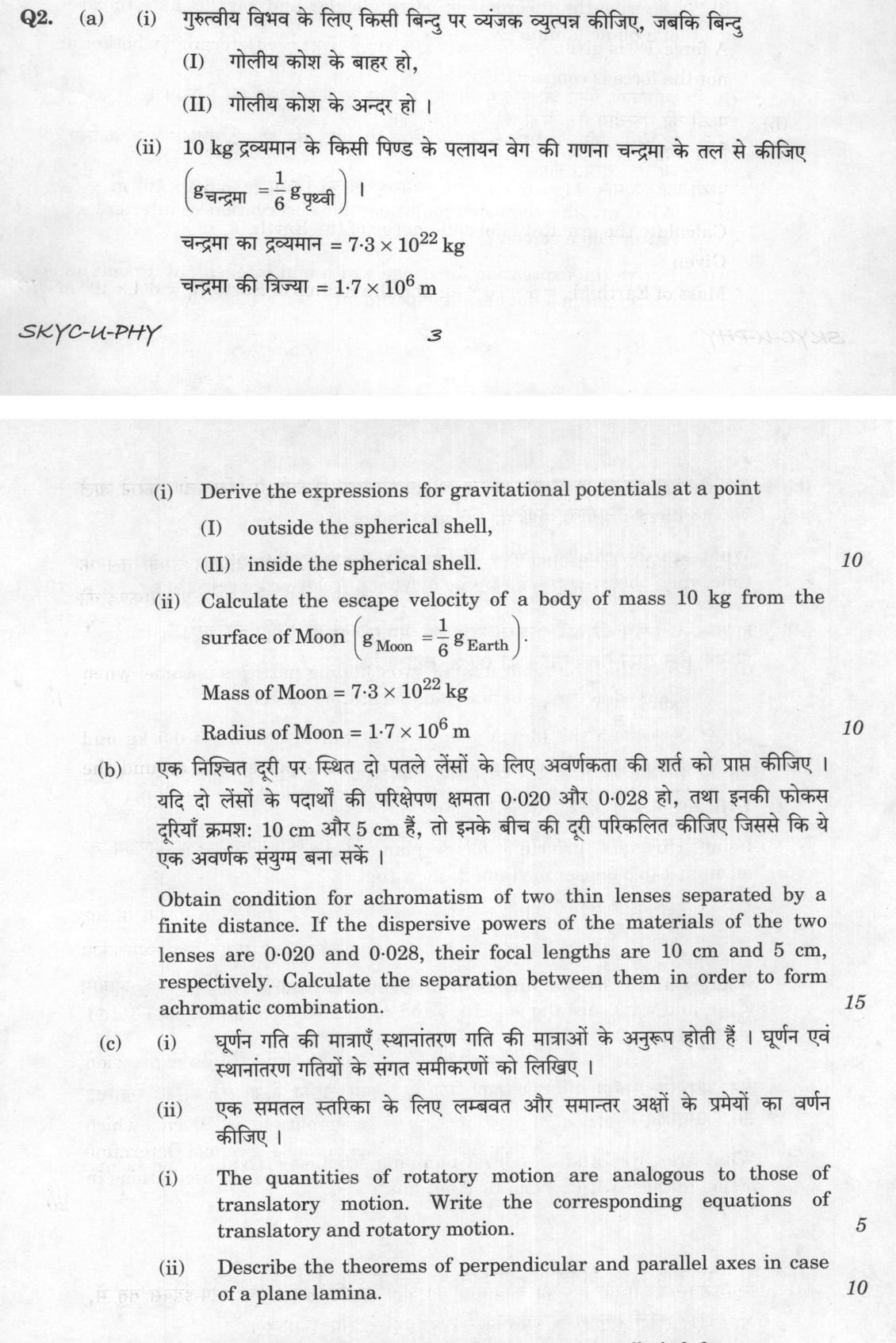
(a) (i) Derive the expressions for gravitational potentials at a point (I) outside the spherical shell, (II) inside the spherical…
Derive the expressions for gravitational potentials at a point (I) outside the spherical shell, (II) inside the spherical shell. 10 marks
Calculate the escape velocity of a body of mass 10 kg from the surface of Moon (g_Moon = 1/6 g_Earth).
Mass of Moon = 7·3 × 10^22 kg Radius of Moon = 1·7 × 10^6 m 10 marks
Obtain condition for achromatism of two thin lenses separated by a finite distance. If the dispersive powers of the materials of the two lenses are 0·020 and 0·028, their focal lengths are 10 cm and 5 cm, respectively. Calculate the separation between them in order to form achromatic combination. 15 marks
The quantities of rotatory motion are analogous to those of translatory motion. Write the corresponding equations of translatory and rotatory motion. 5 marks
Describe the theorems of perpendicular and parallel axes in case of a plane lamina. 10 marks
हिंदी में प्रश्न पढ़ें
गुरुत्वीय विभव के लिए किसी बिंदु पर व्यंजक व्युत्पन्न कीजिए, जबकि बिंदु (I) गोलीय कोश के बाहर हो, (II) गोलीय कोश के अंदर हो । 10
10 kg द्रव्यमान के किसी पिंड के पलायन वेग की गणना चंद्रमा के तल से कीजिए (g_चंद्रमा = 1/6 g_पृथ्वी) चंद्रमा का द्रव्यमान = 7.3 × 10²² kg चंद्रमा की त्रिज्या = 1.7 × 10⁶ m 10
एक निश्चित दूरी पर स्थित दो पतले लेंसों के लिए अवर्णकता की शर्त को प्राप्त कीजिए । यदि दो लेंसों के पदार्थों की परिक्षेपण क्षमता 0·020 और 0·028 हो, तथा इनकी फोकस दूरियाँ क्रमशः 10 cm और 5 cm हैं, तो इनके बीच की दूरी परिकलित कीजिए जिससे कि ये एक अवर्णक संयुग्म बना सकें । 15
घूर्णन गति की मात्राएँ स्थानांतरण गति की मात्राओं के अनुरूप होती हैं । घूर्णन एवं स्थानांतरण गतियों के संगत समीकरणों को लिखिए । 5
एक समतल स्तरीका के लिए लम्बवत और समांतर अक्षों के प्रमेयों का वर्णन कीजिए । 10
Model answer
Written by UPSC Answer Check against this question's marking rubric, to the expected length. UPSC does not publish answers for Mains — this is one way to score well, not an official key.
(a)(i) Let a uniform spherical shell have radius R, mass M and surface density σ = M/(4πR²). By the shell/ring method, take a ring at angle θ from OP, where OP = r. Its mass is dm = σ(2πR sinθ)(R dθ) = (M/2) sinθ dθ. Distance of the ring from P is s = √(R² + r² − 2Rr cosθ). Its gravitational potential at P is dV = −G dm/s. Hence V(r) = −(GM/2) ∫₀^π sinθ dθ /√(R² + r² − 2Rr cosθ). Put u = cosθ, du = −sinθ dθ: V(r) = −(GM/2) ∫₋₁¹ du /√(R² + r² − 2Rr u). Evaluating the integral:
- for r > R, integral = 2/r;
- for r < R, integral = 2/R. Therefore, (I) outside the shell, r ≥ R: V(r) = −GM/r. (II) inside the shell, r ≤ R: V(r) = −GM/R. Inside the shell the field is zero and the potential is constant; at r = R both expressions give V = −GM/R. The convention V(∞) = 0 is used.
(a)(ii) Escape velocity is found from total energy = 0: (1/2)m vₑ² − GMm/R = 0, so vₑ = √(2GM/R). The mass 10 kg cancels.
Using G = 6.67 × 10⁻¹¹ N m² kg⁻², M = 7.3 × 10²² kg, R = 1.7 × 10⁶ m: vₑ = √(2 × 6.67 × 10⁻¹¹ × 7.3 × 10²² / 1.7 × 10⁶) = √(5.728 × 10⁶) m/s = 2.39 × 10³ m/s. Escape velocity ≈ 2.39 km/s.
(b) For two thin lenses of focal lengths f₁, f₂ separated by distance d in air, the equivalent power is P = 1/F = 1/f₁ + 1/f₂ − d/(f₁ f₂). Let the dispersive power of lens i be ωᵢ = δPᵢ/Pᵢ. For achromatism, δP = 0 for a small wavelength interval. Therefore, δP = ω₁P₁ + ω₂P₂ − d(ω₁P₁P₂ + ω₂P₁P₂) = 0. Substituting P₁ = 1/f₁, P₂ = 1/f₂: ω₁/f₁ + ω₂/f₂ = d(ω₁ + ω₂)/(f₁ f₂). Hence the achromatism condition is d = (ω₁ f₂ + ω₂ f₁)/(ω₁ + ω₂). Given ω₁ = 0.020, ω₂ = 0.028, f₁ = 10 cm, f₂ = 5 cm: d = (0.020 × 5 + 0.028 × 10)/(0.020 + 0.028) = (0.10 + 0.28)/0.048 = 0.38/0.048 = 7.9167 cm. Separation d ≈ 7.92 cm. Valid for thin lenses, paraxial rays, small dispersion, and d measured between optical centres.
(c)(i) Translatory motion ↔ Rotatory motion:
- mass m ↔ moment of inertia I
- velocity v ↔ angular velocity ω
- acceleration a ↔ angular acceleration α
- force F ↔ torque τ
- momentum p = mv ↔ angular momentum L = Iω
- impulse F Δt ↔ angular impulse τ Δt
- work W = ∫F dx ↔ W = ∫τ dθ
- kinetic energy (1/2)mv² ↔ (1/2)Iω²
- power P = Fv ↔ P = τω
Corresponding equations:
- F = ma ↔ τ = Iα
- v = u + at ↔ ω = ω₀ + αt
- s = ut + (1/2)at² ↔ θ = ω₀t + (1/2)αt²
- v² = u² + 2as ↔ ω² = ω₀² + 2αθ.
(c)(ii) Perpendicular axes theorem: For a plane lamina lying in the xy-plane, if x and y are two mutually perpendicular axes in the plane and z is the axis perpendicular to the lamina through their intersection, then I_z = I_x + I_y. Proof: take an element dm at (x, y). Then I_z = ∫(x² + y²)dm = ∫x²dm + ∫y²dm = I_y + I_x = I_x + I_y.
Parallel axes theorem: The moment of inertia about any axis is equal to the moment of inertia about a parallel axis through the centre of mass plus M d², where M is the mass and d is the perpendicular distance between the axes: I = I_cm + M d². Proof for a plane lamina: let the centre of mass be the origin and the old axis be the z-axis. Let the new parallel axis pass through (a, b, 0), so d² = a² + b². For an element mᵢ at (xᵢ, yᵢ, 0), distance squared to the old axis is xᵢ² + yᵢ², and to the new axis is (xᵢ − a)² + (yᵢ − b)². Therefore I = Σ mᵢ[(xᵢ − a)² + (yᵢ − b)²] = Σ mᵢ(xᵢ² + yᵢ²) + (a² + b²)Σ mᵢ − 2aΣ mᵢxᵢ − 2bΣ mᵢyᵢ. Since the origin is the centre of mass, Σ mᵢxᵢ = 0 and Σ mᵢyᵢ = 0. Also Σ mᵢ = M. Hence I = I_cm + M d². This theorem applies to any rigid body, including a plane lamina.
What "Derive" is asking you to do
Reach the stated expression from a starting relation, justifying every step. The destination is printed in the question, so only the route earns marks, and the assumptions you work under are part of that route.
Structure that answers it
Assumptions and notation defined → starting relation or governing equation → each step with its justification → the required expression → limiting case or boundary check
Where marks are lost
Writing the standard result first and fitting three lines to it, which an examiner reads at a glance. Marks also go on assumptions left unstated — lossless medium, small amplitude, errors independent with zero mean — and on symbols used before they are defined, even when the question says usual notations.
How this answer will be evaluated
Approach
Framework: Principle > Setup and diagram > Derivation > Result and limiting case. (a) derive: given > assumptions > stepwise derivation > result > check | (b) derive: given > assumptions > stepwise derivation > result > check | (c) explain: definition/context > points in order > small example > short close Full marks: Complete derivations with physical interpretation and correct units.
Key points expected
- Gravitational potential derivation
- Escape velocity calculation
- Achromatism condition derivation
- Translatory-rotatory analogies
- Axis theorems for plane lamina
Evaluation rubric
Each sub-part is marked on its own, against the marks and word limit printed on the paper.
- (a) Derive potential for shell (inside/outside) and calculate Moon's escape velocity.
derive— given → assumptions → stepwise derivation → result → check
Must cover
- Shell potential derivation via integration
- Potential inside shell is constant
- Escape velocity formula derivation
- Substitution of Moon's mass and radius
Loses marks
- Formula substitution without derivation
- Dropping units in calculation
Earns more
- Dimensional check of potential
- Physical interpretation of constant potential
- Correct unit for escape velocity
Extra mark
- Comparison with Earth's escape velocity
- (b) Derive achromatism condition for separated lenses and calculate separation. 15 marks
derive— given → assumptions → stepwise derivation → result → check
Must cover
- Condition for achromatism derivation
- Use of dispersive powers
- Calculation of separation distance
- Correct sign convention for lenses
Loses marks
- Missing derivation of condition
- Incorrect sign in separation formula
Earns more
- Diagram of separated lens system
- Explanation of chromatic aberration
- Verification of achromatic condition
Extra mark
- Note on material selection
- (c) List translatory-rotatory analogies and describe axis theorems.
explain— definition/context → points in order → small example → short close
Must cover
- Table of translatory-rotatory analogies
- Statement of perpendicular axis theorem
- Statement of parallel axis theorem
- Application to plane lamina
Loses marks
- Listing without explanation
- Missing mathematical form
Earns more
- Mathematical form of theorems
- Example of lamina application
- Physical interpretation of theorems
Extra mark
- Diagram of axis theorems
Practice this exact question
Write your answer and it is marked point by point against the model answer above — what you covered, what you missed, what you got wrong.
Evaluate my answer →More from Physics 2023 Paper I
- Q1 (a) A force F⃗ is given by F⃗ = x²y x̂ + zy² ŷ + xz² ẑ. Determine whether or not the fo…
- Q2 (a) (i) Derive the expressions for gravitational potentials at a point (I) outside the sp…
- Q3 (a) (i) What are the requisite conditions for observation of interference pattern on a sc…
- Q4 (a) Write conditions for working of a step-index optical fiber. In a step-index fiber, th…
- Q5 (a) Find the energy stored in a system of four charges Q₁ = 1 nC, Q₂ = 2 nC, Q₃ = 3 nC an…