Paper I — Q6
(a) Two inductors having inductances L₁ and L₂ are connected in parallel. The inductors have a mutual inductance M. Derive the…
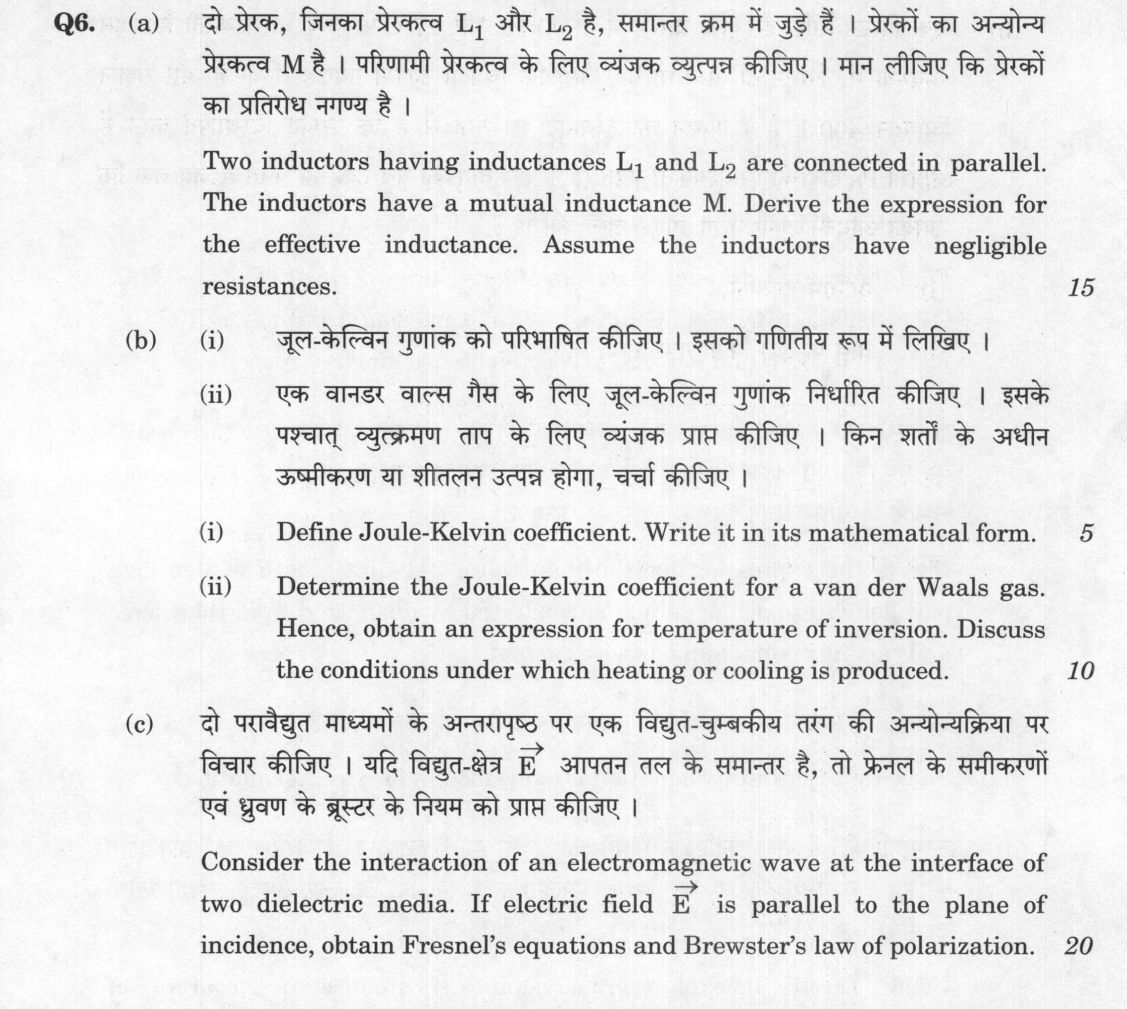
Two inductors having inductances L₁ and L₂ are connected in parallel. The inductors have a mutual inductance M. Derive the expression for the effective inductance. Assume the inductors have negligible resistances. 15 marks
Define Joule-Kelvin coefficient. Write it in its mathematical form. 5 marks
Determine the Joule-Kelvin coefficient for a van der Waals gas. Hence, obtain an expression for temperature of inversion. Discuss the conditions under which heating or cooling is produced. 10 marks
Consider the interaction of an electromagnetic wave at the interface of two dielectric media. If electric field E⃗ is parallel to the plane of incidence, obtain Fresnel's equations and Brewster's law of polarization. 20 marks
हिंदी में प्रश्न पढ़ें
दो प्रेरक, जिनका प्रेरकत्व L₁ और L₂ है, समांतर क्रम में जुड़े हैं । प्रेरकों का अन्योन्य प्रेरकत्व M है । परिणामी प्रेरकत्व के लिए व्यंजक व्युत्पन्न कीजिए । मान लीजिए कि प्रेरकों का प्रतिरोध नगण्य है । 15 अंक
जूल-केल्विन गुणांक को परिभाषित कीजिए । इसको गणितीय रूप में लिखिए । 5 अंक
एक वान्डर वाल्स गैस के लिए जूल-केल्विन गुणांक निर्धारित कीजिए । इसके पश्चात् व्युत्क्रमण ताप के लिए व्यंजक प्राप्त कीजिए । किन शर्तों के अधीन उष्मीकरण या शीतलन उत्पन्न होगा, चर्चा कीजिए । 10 अंक
दो परावैद्युत माध्यमों के अंतरापृष्ठ पर एक विद्युत-चुंबकीय तरंग की अन्योन्यक्रिया पर विचार कीजिए । यदि विद्युत-क्षेत्र E⃗ आपतन तल के समांतर है, तो फ्रेनल के समीकरणों एवं ध्रुवण के ब्रूस्टर के नियम को प्राप्त कीजिए । 20 अंक
Model answer
Written by UPSC Answer Check against this question's marking rubric, to the expected length. UPSC does not publish answers for Mains — this is one way to score well, not an official key.
(a) Let the terminal voltage be V and the instantaneous branch currents be I₁ and I₂, so I = I₁ + I₂. Neglect resistance. For the aiding connection, take M positive with the usual dot convention. Then V = L₁ dI₁/dt + M dI₂/dt, V = L₂ dI₂/dt + M dI₁/dt. Writing D = d/dt, these become L₁ I₁′ + M I₂′ = V, M I₁′ + L₂ I₂′ = V. The determinant is Δ = L₁L₂ − M². By Cramer’s rule, I₁′ = (L₂ − M)V/Δ, I₂′ = (L₁ − M)V/Δ. Hence I′ = I₁′ + I₂′ = [(L₁ + L₂ − 2M)/Δ] V. Therefore V = [Δ/(L₁ + L₂ − 2M)] I′, so L(effective) = (L₁L₂ − M²)/(L₁ + L₂ − 2M) for aiding. For the opposing connection, replace M by −M: L(effective) = (L₁L₂ − M²)/(L₁ + L₂ + 2M). With M as magnitude, L(effective) = (L₁L₂ − M²)/(L₁ + L₂ ∓ 2M), where the upper sign (−2M) is for aiding and the lower sign (+2M) is for opposing. This holds for linear inductors with negligible resistance and M² < L₁L₂ in the non-singular case.
(b)(i) The Joule-Kelvin coefficient is the change in temperature per unit pressure change during throttling at constant enthalpy: μⱼₖ = (∂T/∂P)_H. If μⱼₖ > 0, expansion (dP < 0) gives dT < 0, i.e. cooling; if μⱼₖ < 0, expansion gives heating.
(b)(ii) For one mole, μⱼₖ = (∂T/∂P)_H = −(∂H/∂P)_T / Cₚ. Using (∂H/∂P)_T = V − T(∂V/∂T)_P, μⱼₖ = [T(∂V/∂T)_P − V]/Cₚ. For a van der Waals gas, (P + a/V²)(V − b) = RT. Differentiating at constant P: R/(V − b) dT + [−RT/(V − b)² + 2a/V³] dV = 0. Thus (∂V/∂T)_P = R/(V − b) / [RT/(V − b)² − 2a/V³]. Substituting, μⱼₖ = V[2a(V − b)² − RT b V²] / [Cₚ (RT V³ − 2a(V − b)²)]. Inversion occurs when μⱼₖ = 0: 2a(V − b)² = RT b V², so the exact inversion curve is Tᵢ = (2a/(R b))(1 − b/V)². For large V, this reduces to the usual result Tᵢ ≈ 2a/(R b), and the approximate coefficient is μⱼₖ ≈ (2a/(R T) − b)/Cₚ. If T < Tᵢ, μⱼₖ > 0, so throttling produces cooling. If T > Tᵢ, μⱼₖ < 0, so throttling produces heating. At T = Tᵢ, there is no temperature change.
(c) Let the interface be z = 0 and the plane of incidence be xz. Medium 1 has refractive index n₁, medium 2 has n₂, and both are nonmagnetic. Snell’s law is n₁ sinθ₁ = n₂ sinθ₂, where θ₁ is the angle of incidence and θ₂ is the angle of refraction.
For E parallel to the plane of incidence (p-polarization), H is along y. Using the standard sign convention, continuity of tangential E and tangential H at z = 0 gives Eᵢ cosθ₁ − Eᵣ cosθ₁ = Eₜ cosθ₂, (1) (n₁ Eᵢ + n₁ Eᵣ)/Z₀ = (n₂ Eₜ)/Z₀. (2) Let r∥ = Eᵣ/Eᵢ and t∥ = Eₜ/Eᵢ. From (1), cosθ₁(1 − r∥) = cosθ₂ t∥. From (2), n₁(1 + r∥) = n₂ t∥. Eliminating t∥ gives n₂ cosθ₁(1 − r∥) = n₁ cosθ₂(1 + r∥), hence r∥ = (n₂ cosθ₁ − n₁ cosθ₂)/(n₂ cosθ₁ + n₁ cosθ₂). Substituting back gives t∥ = (2n₁ cosθ₁)/(n₂ cosθ₁ + n₁ cosθ₂). These are Fresnel’s equations for E parallel to the plane of incidence.
Brewster’s law follows by setting r∥ = 0: n₂ cosθ₁ = n₁ cosθ₂. Using Snell’s law, this gives θ₁ + θ₂ = π/2, and therefore tan θ_B = n₂/n₁. At the Brewster angle, the reflected and refracted rays are perpendicular. The parallel component of E is not reflected; hence, for unpolarized incident light, the reflected light is completely polarized with E perpendicular to the plane of incidence. This requires lossless dielectrics with n₁ ≠ n₂.
What "Derive" is asking you to do
Reach the stated expression from a starting relation, justifying every step. The destination is printed in the question, so only the route earns marks, and the assumptions you work under are part of that route.
Structure that answers it
Assumptions and notation defined → starting relation or governing equation → each step with its justification → the required expression → limiting case or boundary check
Where marks are lost
Writing the standard result first and fitting three lines to it, which an examiner reads at a glance. Marks also go on assumptions left unstated — lossless medium, small amplitude, errors independent with zero mean — and on symbols used before they are defined, even when the question says usual notations.
How this answer will be evaluated
Approach
Framework: Principle > Setup and diagram > Derivation > Result and limiting case. (a) derive: given > assumptions > stepwise derivation > result > check | (b) derive: given > assumptions > stepwise derivation > result > check | (c) derive: given > assumptions > stepwise derivation > result > check Full marks: Complete derivations with diagrams, all steps shown, physical interpretation included
Key points expected
- L_eff = (L1L2 - M^2)/(L1+L2) for parallel inductors
- μ_JK = (1/C_P)(T(∂V/∂T)_P - V)
- T_i = 2a/(Rb) for van der Waals gas
- Fresnel equations for p-polarization
- Brewster's law: tan θ_B = n2/n1
Evaluation rubric
Each sub-part is marked on its own, against the marks and word limit printed on the paper.
- (a) Derive effective inductance for parallel inductors with mutual inductance M. 15 marks
derive— given → assumptions → stepwise derivation → result → check
Must cover
- Labelled diagram of parallel inductors with M
- KVL equations for both loops
- Solve for total current in terms of V
- Final expression L_eff = (L1L2 - M^2)/(L1+L2)
Loses marks
- Formula substitution without derivation
- Dropping units or dimensions
- No diagram or unlabelled diagram
Earns more
- Assumption of negligible resistance stated
- Sign convention for mutual inductance defined
- Limiting case M=0 checked
- Dimensional check of final expression
Extra mark
- Physical interpretation of M effect
- Comparison with series case
- (b) Define Joule-Kelvin coefficient, derive for van der Waals gas, find inversion temperature. 10 marks
derive— given → assumptions → stepwise derivation → result → check
Must cover
- Definition: μ_JK = (∂T/∂P)_H
- Mathematical form: μ_JK = (1/C_P)(T(∂V/∂T)_P - V)
- Derivation using van der Waals equation
- Inversion temperature T_i = 2a/(Rb)
Loses marks
- Definition without mathematical form
- No derivation for van der Waals case
- Missing inversion temperature expression
Earns more
- Conditions for cooling (T < T_i) stated
- Conditions for heating (T > T_i) stated
- Physical interpretation of inversion
- Limiting case for ideal gas (μ=0)
Extra mark
- Graph of μ_JK vs T
- Comparison with ideal gas behavior
- (c) Derive Fresnel's equations for E parallel to plane of incidence and Brewster's law. 20 marks
derive— given → assumptions → stepwise derivation → result → check
Must cover
- Diagram showing incidence, reflection, refraction
- Boundary conditions: E_t and H_t continuous
- Fresnel equations for r_p and t_p
- Brewster's law: tan θ_B = n2/n1
Loses marks
- No diagram or unlabelled diagram
- Boundary conditions not stated
- Brewster's law without derivation
Earns more
- Definition of plane of incidence
- Derivation of Brewster angle from r_p=0
- Physical interpretation of polarization
- Limiting case n1=n2 checked
Extra mark
- Graph of r_p vs θ
- Comparison with s-polarization case
Practice this exact question
Write your answer and it is marked point by point against the model answer above — what you covered, what you missed, what you got wrong.
Evaluate my answer →More from Physics 2023 Paper I
- Q3 (a) (i) What are the requisite conditions for observation of interference pattern on a sc…
- Q4 (a) Write conditions for working of a step-index optical fiber. In a step-index fiber, th…
- Q5 (a) Find the energy stored in a system of four charges Q₁ = 1 nC, Q₂ = 2 nC, Q₃ = 3 nC an…
- Q6 (a) Two inductors having inductances L₁ and L₂ are connected in parallel. The inductors h…
- Q7 (a) A neutral atom consists of a point nucleus +q surrounded by a uniformly charged spher…
- Q8 (a) A circular ring of radius R lying on the x-y plane and centred at the origin, carries…