Paper I — Q5
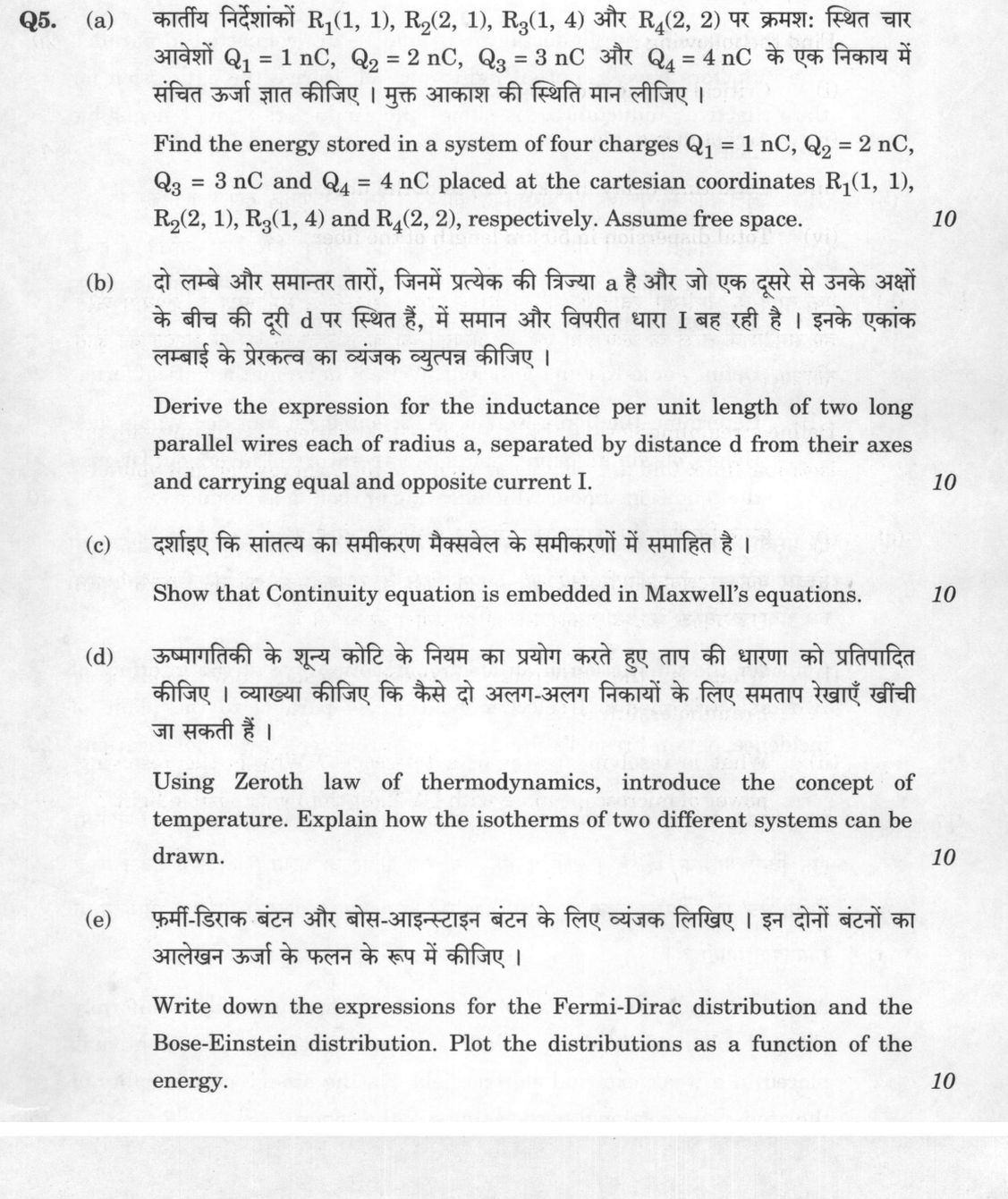
(a) Find the energy stored in a system of four charges Q₁ = 1 nC, Q₂ = 2 nC, Q₃ = 3 nC and Q₄ = 4 nC placed at the cartesian…
Find the energy stored in a system of four charges Q₁ = 1 nC, Q₂ = 2 nC, Q₃ = 3 nC and Q₄ = 4 nC placed at the cartesian coordinates R₁(1, 1), R₂(2, 1), R₃(1, 4) and R₄(2, 2), respectively. Assume free space. 10 marks
Derive the expression for the inductance per unit length of two long parallel wires each of radius a, separated by distance d from their axes and carrying equal and opposite current I. 10 marks
Show that Continuity equation is embedded in Maxwell's equations. 10 marks
Using Zeroth law of thermodynamics, introduce the concept of temperature. Explain how the isotherms of two different systems can be drawn. 10 marks
Write down the expressions for the Fermi-Dirac distribution and the Bose-Einstein distribution. Plot the distributions as a function of the energy. 10 marks
हिंदी में प्रश्न पढ़ें
कार्तीय निर्देशांकों R₁(1, 1), R₂(2, 1), R₃(1, 4) और R₄(2, 2) पर क्रमशः स्थित चार आवेशों Q₁ = 1 nC, Q₂ = 2 nC, Q₃ = 3 nC और Q₄ = 4 nC के एक निकाय में संचित ऊर्जा ज्ञात कीजिए । मुक्त आकाश की स्थिति मान लीजिए । 10 अंक
दो लम्बे और समांतर तारों, जिनमें प्रत्येक की त्रिज्या a है और जो एक दूसरे से उनके अक्षों के बीच की दूरी d पर स्थित हैं, में समान और विपरीत धारा I बह रही है । इनके एकांक लम्बाई के प्रेरकत्व का व्यंजक न्यूतन कीजिए । 10 अंक
दर्शाइए कि सांतत्य का समीकरण मैक्सवेल के समीकरणों में समाहित है । 10 अंक
ऊष्मागतिकी के शून्य कोटि के नियम का प्रयोग करते हुए ताप की धारणा को प्रतिपादित कीजिए । व्याख्या कीजिए कि कैसे दो अलग-अलग निकायों के लिए समताप रेखाएँ खींची जा सकती हैं । 10 अंक
फर्मी-डिराक बंटन और बोस-आइंस्टाइन बंटन के लिए व्यंजक लिखिए । इन दोनों बंटनों का आलेखन ऊर्जा के फलन के रूप में कीजिए । 10 अंक
Model answer
Written by UPSC Answer Check against this question's marking rubric, to the expected length. UPSC does not publish answers for Mains — this is one way to score well, not an official key.
(a) The electrostatic energy of a system of point charges is U = (1/(4πϵ₀)) Σ over pairs i<j of qᵢ qⱼ / r_ij. There is no self-energy. Taking the given coordinates in metres and k = 1/(4πϵ₀) ≈ 8.9875517923×10⁹ N m² C⁻²:
- r₁₂ = |R₂ − R₁| = √((2−1)² + (1−1)²) = 1 m
- r₁₃ = |R₃ − R₁| = √((1−1)² + (4−1)²) = 3 m
- r₁₄ = |R₄ − R₁| = √((2−1)² + (2−1)²) = √2 m
- r₂₃ = |R₃ − R₂| = √((1−2)² + (4−1)²) = √10 m
- r₂₄ = |R₄ − R₂| = √((2−2)² + (2−1)²) = 1 m
- r₃₄ = |R₄ − R₃| = √((2−1)² + (2−4)²) = √5 m
Using Q₁ = 1 nC, Q₂ = 2 nC, Q₃ = 3 nC, Q₄ = 4 nC, each product qᵢ qⱼ carries 10⁻¹⁸ C². Therefore U = k×10⁻¹⁸ [ (1×2)/1 + (1×3)/3 + (1×4)/√2 + (2×3)/√10 + (2×4)/1 + (3×4)/√5 ] J = k×10⁻¹⁸ [ 2 + 1 + 4/√2 + 6/√10 + 8 + 12/√5 ] J. Since 4/√2 = 2√2, U = k×10⁻¹⁸ [ 11 + 2√2 + 6/√10 + 12/√5 ] J. The bracket equals 11 + 2.8284271247 + 1.8973665961 + 5.3665631460 = 21.0923568668. Thus U = 8.9875517923×10⁹ × 10⁻¹⁸ × 21.0923568668 J = 1.8956865×10⁻⁷ J. U ≈ 1.89569×10⁻⁷ J ≈ 0.1896 μJ. The positive sign means work must be done to assemble the system because all charges have the same sign.
(b) Let the two long parallel wires have radii a and axes separated by d. Assume d > 2a, free space permeability μ₀, and uniformly distributed currents +I and −I. Use cylindrical symmetry and Ampere’s law. At a distance r from the axis of wire 1, its field is B₁ = μ₀ I/(2π r). The second wire is at distance d − r from the same point and carries current −I, so its field has the same direction in the region between the wires: B₂ = μ₀ I/(2π(d − r)). Thus the total field between the wires is B = (μ₀ I/(2π)) [ 1/r + 1/(d − r) ]. The external flux per unit length through the rectangle between the wire surfaces r = a and r = d − a is Φ_ext = ∫ from a to d−a of B dr = (μ₀ I/(2π)) [ ∫ from a to d−a dr/r + ∫ from a to d−a dr/(d − r) ]. Both integrals give ln((d − a)/a). Hence Φ_ext = (μ₀ I/π) ln((d − a)/a). Therefore the external inductance per unit length is L_ext = Φ_ext/I = (μ₀/π) ln((d − a)/a).
Now include internal inductance. Inside one wire, Ampere’s law gives B(r) = μ₀ I r/(2π a²), 0 ≤ r ≤ a. The magnetic energy per unit length inside one wire is U_int,one = ∫ from 0 to a of B²/(2μ₀) × 2π r dr = μ₀ I²/(16π). Since U = 1/2 L I², the internal inductance of one wire is L_int,one = μ₀/(8π). For two wires, L_int = 2 × μ₀/(8π) = μ₀/(4π). Hence the total inductance per unit length is L = (μ₀/π) [ ln((d − a)/a) + 1/4 ] H/m. For d ≫ a this reduces to L ≈ (μ₀/π) [ ln(d/a) + 1/4 ] H/m. This assumes no skin effect; at high frequencies the internal term is modified.
(c) Maxwell’s differential equations in the presence of charge density ρ and current density J are
- ∇·E = ρ/ϵ₀
- ∇·B = 0
- ∇×E = −∂B/∂t
- ∇×B = μ₀ J + μ₀ ϵ₀ ∂E/∂t.
Take the divergence of the Ampere–Maxwell law: ∇·(∇×B) = μ₀ ∇·J + μ₀ ϵ₀ ∂/∂t (∇·E). But the divergence of a curl is identically zero: ∇·(∇×B) = 0. Using Gauss’s law ∇·E = ρ/ϵ₀, 0 = μ₀ ∇·J + μ₀ ϵ₀ ∂/∂t (ρ/ϵ₀) = μ₀ ( ∇·J + ∂ρ/∂t ). Since μ₀ is nonzero, ∇·J + ∂ρ/∂t = 0. This is the continuity equation expressing conservation of electric charge. In integral form, ∮ J·da + d/dt ∫ ρ dV = 0. Thus the continuity equation is embedded in Maxwell’s equations. The displacement-current term μ₀ϵ₀ ∂E/∂t is essential; without it, taking the divergence would give ∇·J = 0, which fails for time-varying charge density.
(d) Two systems are in thermal equilibrium when, after being connected by a diathermal wall, their macroscopic state variables no longer change with time. The Zeroth law states: if system A is in thermal equilibrium with system C, and system B is also in thermal equilibrium with C, then A and B are in thermal equilibrium with each other. Therefore thermal equilibrium is transitive and behaves like an equivalence relation. All states that are mutually in thermal equilibrium can be placed in one equivalence class. We assign a scalar label θ to each equivalence class. This label is called empirical temperature. Two systems have the same temperature if and only if they are in thermal equilibrium.
Operationally, choose a thermometer C with a measurable thermometric property X, such as volume, pressure, resistance, or emf. Define θ by a suitable calibration, for example θ = 100 (X − X_ice)/(X_steam − X_ice) °C, where X_ice and X_steam are the values at ice point and steam point. When C is in thermal equilibrium with a system, the system is assigned the temperature θ read by C.
An isotherm is the locus of states of a system having the same temperature. For a simple system described by pressure P and volume V, the equation of state f(P,V,θ) = 0 defines isotherms θ = constant. For an ideal gas, PV = nRθ, so isotherms are hyperbolas on a P–V diagram.
To draw isotherms of two different systems A and B:
- Use the same thermometer C and choose fixed readings θ₁, θ₂, θ₃, …
- For system A, keep C at θ₁ and adjust the state of A until A and C are in thermal equilibrium. Mark that state. Repeat for many states of A while C remains at θ₁. Join these points to obtain the θ₁ isotherm of A. Repeat for θ₂, θ₃, …
- Do the same for system B using the same thermometer and the same θ values. By the Zeroth law, any state on the θ₁ isotherm of A and any state on the θ₁ isotherm of B would be in mutual thermal equilibrium if connected by a diathermal wall. Thus isotherms of different systems can be labelled by a common empirical temperature, although their shapes may differ because their equations of state differ.
(e) The Fermi–Dirac distribution gives the average occupation number for fermions: f_FD(E) = 1/[ exp((E − μ)/(k_B T)) + 1 ]. The Bose–Einstein distribution gives the average occupation number for bosons: f_BE(E) = 1/[ exp((E − μ)/(k_B T)) − 1 ], with the condition E > μ; for photons μ = 0, so f_BE(E) = 1/[exp(E/k_B T) − 1].
For the Fermi–Dirac case, at T = 0 the distribution is a step function: f_FD = 1 for E < μ and f_FD = 0 for E > μ. At T > 0 the step is smoothed over an energy width of order k_B T. At E = μ, f_FD = 1/2. For E − μ ≫ k_B T, f_FD ≈ exp(−(E − μ)/(k_B T)), while for μ − E ≫ k_B T, f_FD ≈ 1.
For the Bose–Einstein case, f_BE diverges as E → μ⁺. For E − μ ≫ k_B T, it also tends to exp(−(E − μ)/(k_B T)). For photons with μ = 0, f_BE diverges at E = 0 and decreases monotonically to zero as E increases.
Schematic plots versus energy E are:
Fermi–Dirac: `` f(E) 1 | ________ | ___ 1/2| • at E = μ | ____ 0 | ____ +--------|--------------> E μ ``
Bose–Einstein: `` f(E) ^ | diverges as E → μ⁺ | \ | ___ | ____ | ______ +--------|--------------> E μ ``
For both distributions, when E − μ ≫ k_B T, the exponential term dominates and both reduce to the classical Maxwell–Boltzmann form f ≈ exp(−(E − μ)/(k_B T)). The difference is that Fermi–Dirac suppresses occupation because of the Pauli exclusion principle, while Bose–Einstein enhances occupation at low energy.
What "Solve" is asking you to do
Choose the method, then carry it through to a final answer. Identifying what kind of problem this is and why that method applies is the first thing marked; a correct figure arrived at invisibly earns almost nothing.
Structure that answers it
Given data and what is required → method chosen, with the reason it applies → set-up (equation, circuit, free body, trial balance) → working, step by step → answer with units and any condition of validity
Where marks are lost
Doing the middle steps mentally and writing only the result. In mathematics papers, a further loss comes from giving a decimal where the exact value in surds or fractions was wanted, or from skipping the justification a part explicitly asks for.
How this answer will be evaluated
Approach
(a) calculate: given > formula > substitution > result with units > interpretation | (b) derive: given > assumptions > stepwise derivation > result > check | (c) explain: definition/context > points in order > small example > short close | (d) explain: definition/context > points in order > small example > short close | (e) describe: define > structure or process in order > labelled diagram > significance Full marks: Complete derivations with all steps, correct units, and physical interpretation.
Key points expected
- List all six pairwise distances between charges
- Apply superposition principle for energy summation
- Substitute values with correct units (nC, m)
- Final result in Joules with correct sign
- Apply Ampere's Law to find magnetic field
- Integrate flux density over the region between wires
- Include internal and external inductance terms
- Final expression in terms of a and d
Evaluation rubric
Each sub-part is marked on its own, against the marks and word limit printed on the paper.
- (a) Total electrostatic potential energy of the four-charge system. 10 marks
calculate— given → formula → substitution → result with units → interpretation
Must cover
- List all six pairwise distances between charges
- Apply superposition principle for energy summation
- Substitute values with correct units (nC, m)
- Final result in Joules with correct sign
Loses marks
- Missing any of the six pairwise terms
- Unit conversion errors (nC to C)
Earns more
- Explicit calculation of each pair's contribution
- Use of permittivity of free space constant
Extra mark
- Dimensional check of the final energy value
- (b) Inductance per unit length for two parallel wires. 10 marks
derive— given → assumptions → stepwise derivation → result → check
Must cover
- Apply Ampere's Law to find magnetic field
- Integrate flux density over the region between wires
- Include internal and external inductance terms
- Final expression in terms of a and d
Loses marks
- Ignoring internal inductance of the wires
- Incorrect integration limits for the flux
Earns more
- Labelled diagram of the two-wire geometry
- Explicit integration limits for the flux calculation
Extra mark
- Limiting case analysis for d >> a
- (c) Derivation of continuity equation from Maxwell's equations. 10 marks
explain— definition/context → points in order → small example → short close
Must cover
- Take divergence of the Ampere-Maxwell law
- Use vector identity for divergence of curl
- Substitute Gauss's law for electric field
- Arrive at the continuity equation form
Loses marks
- Skipping the divergence of curl step
- Incorrect application of vector identities
Earns more
- Step-by-step vector calculus manipulation
- Clear identification of each Maxwell equation used
Extra mark
- Physical interpretation of charge conservation
- (d) Concept of temperature and isotherms via Zeroth Law. 10 marks
explain— definition/context → points in order → small example → short close
Must cover
- State the Zeroth Law of thermodynamics
- Define thermal equilibrium and temperature
- Explain the construction of isotherms
- Describe how two systems' isotherms are drawn
Loses marks
- Confusing Zeroth Law with First Law
- Failing to define temperature operationally
Earns more
- Diagram showing two systems in equilibrium
- Explanation of the transitive property of equilibrium
Extra mark
- Example of a specific thermodynamic system
- (e) Fermi-Dirac and Bose-Einstein distribution expressions and plots. 10 marks
describe— define → structure or process in order → labelled diagram → significance
Must cover
- Write the Fermi-Dirac distribution function
- Write the Bose-Einstein distribution function
- Plot both distributions vs energy
- Identify the chemical potential on the plots
Loses marks
- Incorrect signs in the distribution exponents
- Missing or unlabelled plots
Earns more
- Labelled axes on the distribution plots
- Comparison of the two distribution shapes
Extra mark
- Mention of the classical limit (Maxwell-Boltzmann)
Practice this exact question
Write your answer and it is marked point by point against the model answer above — what you covered, what you missed, what you got wrong.
Evaluate my answer →More from Physics 2023 Paper I
- Q2 (a) (i) Derive the expressions for gravitational potentials at a point (I) outside the sp…
- Q3 (a) (i) What are the requisite conditions for observation of interference pattern on a sc…
- Q4 (a) Write conditions for working of a step-index optical fiber. In a step-index fiber, th…
- Q5 (a) Find the energy stored in a system of four charges Q₁ = 1 nC, Q₂ = 2 nC, Q₃ = 3 nC an…
- Q6 (a) Two inductors having inductances L₁ and L₂ are connected in parallel. The inductors h…
- Q7 (a) A neutral atom consists of a point nucleus +q surrounded by a uniformly charged spher…
- Q8 (a) A circular ring of radius R lying on the x-y plane and centred at the origin, carries…