Paper I — Q4
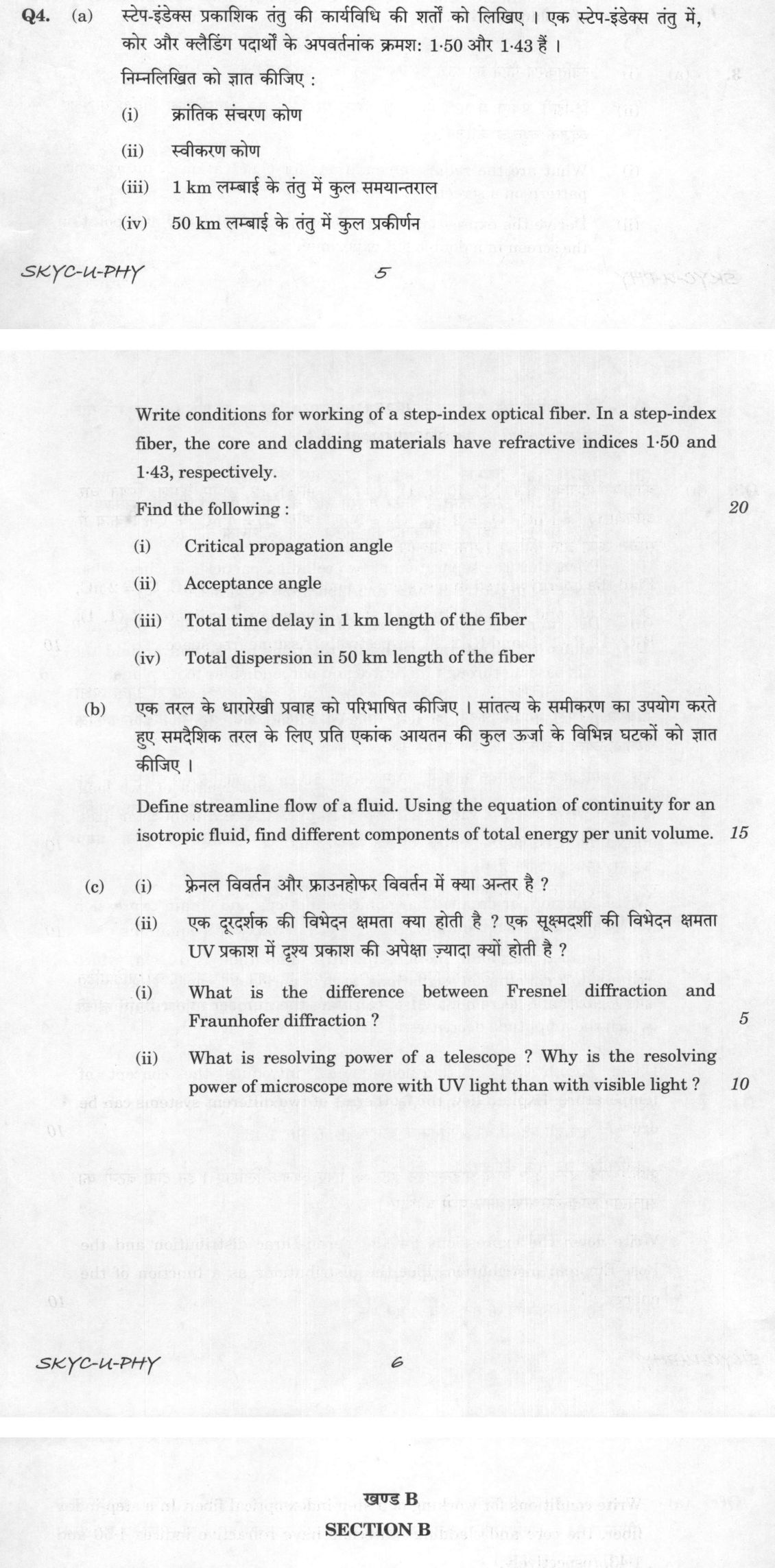
(a) Write conditions for working of a step-index optical fiber. In a step-index fiber, the core and cladding materials have…
Write conditions for working of a step-index optical fiber. In a step-index fiber, the core and cladding materials have refractive indices 1·50 and 1·43, respectively.
Find the following :
Critical propagation angle
Acceptance angle
Total time delay in 1 km length of the fiber
Total dispersion in 50 km length of the fiber
Define streamline flow of a fluid. Using the equation of continuity for an isotropic fluid, find different components of total energy per unit volume.
What is the difference between Fresnel diffraction and Fraunhofer diffraction ?
What is resolving power of a telescope ? Why is the resolving power of microscope more with UV light than with visible light ?
हिंदी में प्रश्न पढ़ें
स्टेप-इण्डेक्स प्रकाशिक तन्तु की कार्यविधि की शर्तों को लिखिए । एक स्टेप-इण्डेक्स तन्तु में, कोर और क्लैडिंग पदार्थों के अपवर्तनांक क्रमशः 1·50 और 1·43 हैं ।
निम्नलिखित को ज्ञात कीजिए :
कांतिक संचरण कोण
स्वीकरण कोण
1 km लम्बाई के तन्तु में कुल समयान्तराल
50 km लम्बाई के तन्तु में कुल प्रकीर्णन
एक तरल के धाररेखी प्रवाह को परिभाषित कीजिए । सांतत्य के समीकरण का उपयोग करते हुए समदैशिक तरल के लिए प्रति एकांक आयतन की कुल ऊर्जा के विभिन्न घटकों को ज्ञात कीजिए ।
फ्रेनल विवर्तन और फ्राउनहोफर विवर्तन में क्या अंतर है ?
एक दूरदर्शक की विभेदन क्षमता क्या होती है ? एक सूक्ष्मदर्शी की विभेदन क्षमता UV प्रकाश में दृश्य प्रकाश की अपेक्षा ज्यादा क्यों होती है ?
Model answer
Written by UPSC Answer Check against this question's marking rubric, to the expected length. UPSC does not publish answers for Mains — this is one way to score well, not an official key.
(a) Conditions for working of a step-index optical fibre: the core refractive index must exceed the cladding refractive index, n₁ > n₂; light must enter the core within the acceptance cone; at the core–cladding boundary the angle of incidence must exceed the critical angle so that total internal reflection occurs; the boundary must be smooth and absorption/scattering small. Given n₁ = 1.50, n₂ = 1.43.
(i) At the core–cladding interface, the critical angle is θc = arcsin(n₂/n₁) = arcsin(1.43/1.50) = arcsin(0.953333) = 72.43°. The maximum propagation angle with the fibre axis (critical propagation angle) is θp = 90° − θc = 17.57°. Equivalently, θp = arcsin(√(n₁² − n₂²)/n₁). Critical propagation angle = 17.57°; interface critical angle = 72.43°.
(ii) Numerical aperture: NA = √(n₁² − n₂²) = √(1.50² − 1.43²) = √(2.25 − 2.0449) = √0.2051 = 0.4529. Acceptance angle in air: θa = arcsin(NA) = arcsin(0.4529) = 26.93°. θa = 26.93°.
(iii) Time for the axial ray over length L: t_min = L n₁/c. The extreme total-internal-reflection ray has path length L/cosθp and speed c/n₁, so t_max = L n₁/(c cosθp). Since cosθp = n₂/n₁, t_max = L n₁²/(c n₂). Therefore total time delay: Δt = t_max − t_min = (L n₁/c)(n₁/n₂ − 1). For L = 1 km = 1000 m, c = 3 × 10⁸ m/s: L n₁/c = 1000 × 1.50/(3 × 10⁸) = 5.00 × 10⁻⁶ s = 5.00 μs. n₁/n₂ − 1 = 1.50/1.43 − 1 = 0.07/1.43 = 0.048951. So Δt = 5.00 μs × 0.048951 = 0.2448 μs = 2.448 × 10⁻⁷ s. Δt ≈ 0.245 μs.
(iv) Delay is proportional to length. For L = 50 km = 50000 m: Δt = (50000 × 1.50/(3 × 10⁸)) × 0.048951 = 2.50 × 10⁻⁴ s × 0.048951 = 1.2238 × 10⁻⁵ s = 12.24 μs. Total dispersion in 50 km ≈ 12.24 μs.
(b) Streamline flow is a steady flow in which the velocity at any fixed point is independent of time. The streamlines are tangent to the velocity at every point, they do not cross, and the path of a fluid particle coincides with a streamline.
For an isotropic fluid, the equation of continuity is ∂ρ/∂t + ∇·(ρv) = 0. For steady flow, ∂ρ/∂t = 0, so ∇·(ρv) = 0. For an incompressible isotropic fluid, ρ is constant, hence ∇·v = 0. Using Euler’s equation for an inviscid isotropic fluid, ρ(∂v/∂t + (v·∇)v) = −∇P − ρ∇Φ. For steady flow and integration along a streamline, P + 1/2 ρv² + ρΦ = constant. Taking gravity as the body force, Φ = gh, so E/V = P + 1/2 ρv² + ρgh. Thus the total energy per unit volume has three components:
- pressure energy per unit volume = P, in J/m³ or Pa;
- kinetic energy per unit volume = 1/2 ρv²;
- potential energy per unit volume = ρgh. This holds for steady, inviscid, incompressible flow along a streamline.
(c)(i) In Fresnel diffraction, the source and/or screen are at finite distances from the aperture or obstacle. The incident and diffracted wavefronts are spherical or cylindrical, and the pattern is observed in the near field. No lenses are necessary, and the fringe pattern is generally irregular. In Fraunhofer diffraction, the source and screen are effectively at infinity, so the wavefronts are plane. It is observed in the far field and is usually produced with lenses or a distant source. The pattern is regular with sharp maxima and minima and is treated by Fourier transforms.
(c)(ii) The resolving power of a telescope is its ability to form separate images of two nearby point objects. By the Rayleigh criterion, the minimum angular separation is θ_min = 1.22λ/D, so resolving power = 1/θ_min = D/(1.22λ). Thus a larger aperture D or shorter wavelength λ gives better resolution. For a microscope, resolving power = 1/d_min = 2n sinθ/λ = 2NA/λ. Since resolving power is inversely proportional to wavelength, UV light has shorter λ than visible light, so it gives a smaller resolvable distance d_min and hence greater resolving power. Visible light has longer wavelength and therefore poorer resolution.
What "Calculate" is asking you to do
Apply the standard formula or schedule to data the question has already supplied — a table of readings, cost records, a balance sheet — and produce the number. The method is rarely in doubt; the marks sit in the named intermediate quantities, each of which has to appear as a labelled line.
Structure that answers it
Data as given → formula or standard treatment, named → substitution → each intermediate, labelled → result with units
Where marks are lost
Omitting an intermediate the marking scheme pays for separately, or rounding at an intermediate line so the final figure drifts. In commerce and accountancy, any figure in a statement that no numbered working note supports is treated as unearned.
How this answer will be evaluated
Approach
(a) calculate: given > formula > substitution > result with units > interpretation | (b) derive: given > assumptions > stepwise derivation > result > check | (c(i)) compare: paired headings or table > key differences > significance > conclusion | (c(ii)) explain: definition/context > points in order > small example > short close Full marks: Complete derivations with units, clear definitions, and physical interpretation.
Key points expected
- State condition n_core > n_cladding
- Derive critical angle using Snell's law
- Derive acceptance angle/NA formula
- Calculate time delay and dispersion with units
- Define streamline flow
- State equation of continuity for isotropic fluid
- Derive pressure, kinetic, and potential energy terms
- Express total energy per unit volume
Evaluation rubric
Each sub-part is marked on its own, against the marks and word limit printed on the paper.
- (a) State working conditions and calculate fiber parameters (angles, delay, dispersion). 20 marks
calculate— given → formula → substitution → result with units → interpretation
Must cover
- State condition n_core > n_cladding
- Derive critical angle using Snell's law
- Derive acceptance angle/NA formula
- Calculate time delay and dispersion with units
Loses marks
- Formula substitution without derivation
- Dropping units in final answers
Earns more
- Labelled diagram of step-index fiber
- Correct substitution of n=1.50 and 1.43
- Dimensional check on time/delay
Extra mark
- Physical interpretation of total internal reflection
- (b) Define streamline flow and derive energy components from continuity equation. 15 marks
derive— given → assumptions → stepwise derivation → result → check
Must cover
- Define streamline flow
- State equation of continuity for isotropic fluid
- Derive pressure, kinetic, and potential energy terms
- Express total energy per unit volume
Loses marks
- Missing definition of streamline flow
- Skipping derivation steps
Earns more
- Assumptions stated (incompressible, non-viscous)
- Stepwise logical derivation
Extra mark
- Connection to Bernoulli's theorem
- (c(i)) Distinguish between Fresnel and Fraunhofer diffraction. 5 marks
compare— paired headings or table → key differences → significance → conclusion
Must cover
- Define Fresnel diffraction (near field)
- Define Fraunhofer diffraction (far field)
- State key difference in source/screen distance
Loses marks
- Confusing near and far field definitions
- No mention of source/screen distance
Earns more
- Mention of lens usage in Fraunhofer
- Comparison of wavefront curvature
Extra mark
- Example of application for each
- (c(ii)) Define telescope resolving power and explain UV advantage in microscopes. 10 marks
explain— definition/context → points in order → small example → short close
Must cover
- Define resolving power of telescope
- State Rayleigh criterion formula
- Explain wavelength dependence of resolution
- Link shorter UV wavelength to higher resolution
Loses marks
- Defining magnification instead of resolving power
- Failing to link wavelength to resolution
Earns more
- Formula: 1.22 λ / D
- Comparison of UV vs visible wavelengths
Extra mark
- Mention of diffraction limit
Practice this exact question
Write your answer and it is marked point by point against the model answer above — what you covered, what you missed, what you got wrong.
Evaluate my answer →More from Physics 2023 Paper I
- Q1 (a) A force F⃗ is given by F⃗ = x²y x̂ + zy² ŷ + xz² ẑ. Determine whether or not the fo…
- Q2 (a) (i) Derive the expressions for gravitational potentials at a point (I) outside the sp…
- Q3 (a) (i) What are the requisite conditions for observation of interference pattern on a sc…
- Q4 (a) Write conditions for working of a step-index optical fiber. In a step-index fiber, th…
- Q5 (a) Find the energy stored in a system of four charges Q₁ = 1 nC, Q₂ = 2 nC, Q₃ = 3 nC an…
- Q6 (a) Two inductors having inductances L₁ and L₂ are connected in parallel. The inductors h…
- Q7 (a) A neutral atom consists of a point nucleus +q surrounded by a uniformly charged spher…