Paper I — Q8
(a) A circular ring of radius R lying on the x-y plane and centred at the origin, carries a uniform line charge λ. Find the first…
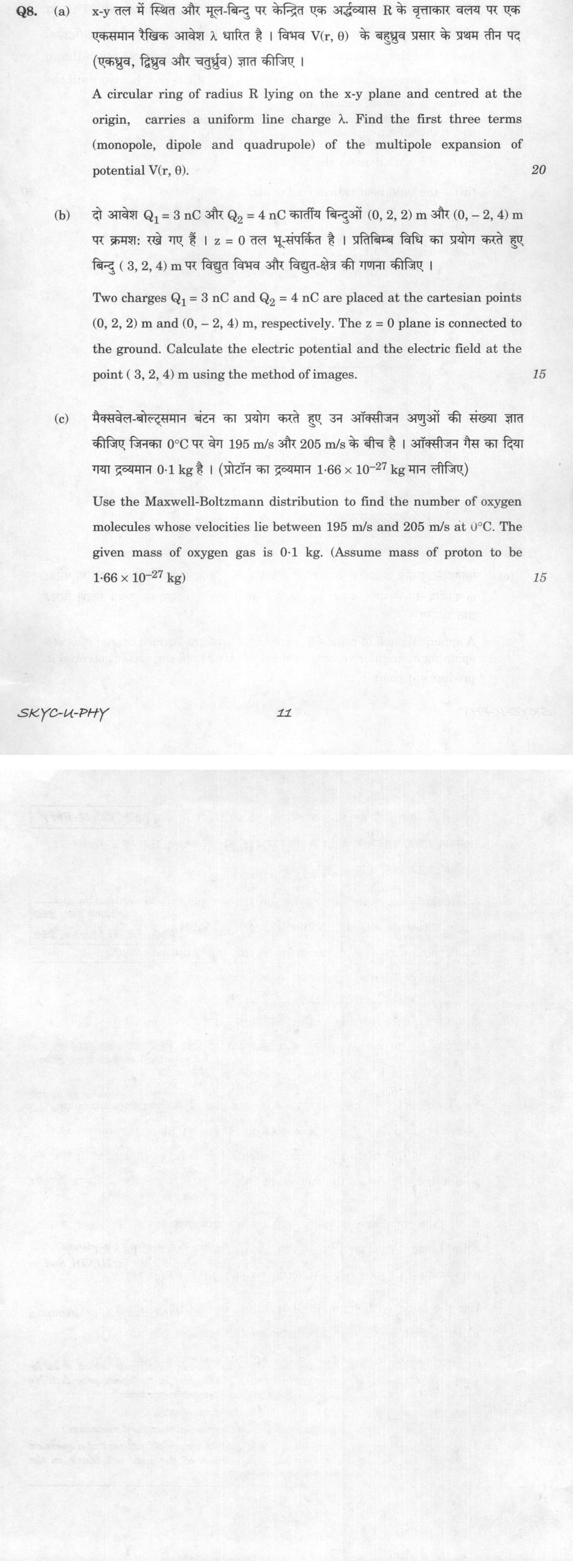
A circular ring of radius R lying on the x-y plane and centred at the origin, carries a uniform line charge λ. Find the first three terms (monopole, dipole and quadrupole) of the multipole expansion of potential V(r, θ). 20 marks
Two charges Q₁ = 3 nC and Q₂ = 4 nC are placed at the cartesian points (0, 2, 2) m and (0, – 2, 4) m, respectively. The z = 0 plane is connected to the ground. Calculate the electric potential and the electric field at the point (3, 2, 4) m using the method of images. 15 marks
Use the Maxwell-Boltzmann distribution to find the number of oxygen molecules whose velocities lie between 195 m/s and 205 m/s at 0°C. The given mass of oxygen gas is 0·1 kg. (Assume mass of proton to be 1·66 × 10⁻²⁷ kg) 15 marks
हिंदी में प्रश्न पढ़ें
x-y तल में स्थित और मूल-बिंदु पर केंद्रित एक अर्ध्व्यास R के वृत्ताकार वलय पर एक एकसमान रैखिक आवेश λ धारित है । विभव V(r, θ) के बहुध्रुव प्रसार के प्रथम तीन पद (एकध्रुव, द्विध्रुव और चतुर्ध्रुव) ज्ञात कीजिए । 20
दो आवेश Q₁ = 3 nC और Q₂ = 4 nC कार्तीय बिंदुओं (0, 2, 2) m और (0, – 2, 4) m पर क्रमशः रखे गए हैं । z = 0 तल भू-संपर्कित है । प्रतिबिंब विधि का प्रयोग करते हुए बिंदु (3, 2, 4) m पर विद्युत विभव और विद्युत-क्षेत्र की गणना कीजिए । 15
मैक्सवेल-बोल्ट्ज़मान बंटन का प्रयोग करते हुए उन ऑक्सीजन अणुओं की संख्या ज्ञात कीजिए जिनका 0°C पर वेग 195 m/s और 205 m/s के बीच है । ऑक्सीजन गैस का दिया गया द्रव्यमान 0·1 kg है । (प्रोटॉन का द्रव्यमान 1·66 × 10⁻²⁷ kg मान लीजिए) 15 marks
Model answer
Written by UPSC Answer Check against this question's marking rubric, to the expected length. UPSC does not publish answers for Mains — this is one way to score well, not an official key.
(a) Use the multipole expansion in spherical coordinates, with θ measured from the z-axis. For a charge distribution,
V(r,θ) = 1/(4πε₀) Σₙ ∫ ρ(r') (r'ⁿ/rⁿ⁺¹) Pₙ(cos γ) dτ'.
For the ring, ρ dτ' = λ dl' = λ R dφ', r' = R. Total charge Q = 2πλR.
Monopole term, n = 0: V₀ = 1/(4πε₀) Q/r = 1/(4πε₀) 2πλR/r = λR/(2ε₀ r).
Dipole term, n = 1: p = ∫ r' λ dl' = λ ∫₀²π R(cos φ', sin φ', 0) R dφ' = 0 by symmetry. So V₁ = 0.
Quadrupole term, n = 2: V₂ = 1/(4πε₀) (1/r³) ∫ λ R³ P₂(cos γ) dφ', where cos γ = sinθ cos(φ' − φ). Now P₂(x) = (3x² − 1)/2. Hence ∫₀²π P₂(sinθ cos(φ' − φ)) dφ' = (1/2)∫₀²π [3 sin²θ cos²(φ' − φ) − 1] dφ' = (π/2)(3 sin²θ − 2).
Therefore V₂ = 1/(4πε₀) (λπR³/2)(3 sin²θ − 2)/r³ = 1/(4πε₀) (Q R²/4)(3 sin²θ − 2)/r³, since Q = 2πλR.
Thus the first three terms are V(r,θ) = 1/(4πε₀)[ Q/r + 0 + (Q R²/4)(3 sin²θ − 2)/r³ + … ] = 1/(4πε₀)[ 2πλR/r + (πλR³/2)(3 sin²θ − 2)/r³ + … ], valid for r ≫ R.
(b) Use the method of images for a grounded plane z = 0. For each charge q at z = a > 0, place an image charge −q at z = −a.
Images are: Q₁' = −3 nC at (0, 2, −2) m; Q₂' = −4 nC at (0, −2, −4) m.
At P = (3, 2, 4) m, distances are: r₁ = √[(3−0)² + (2−2)² + (4−2)²] = √13 m, r₁' = √[(3−0)² + (2−2)² + (4+2)²] = √45 m, r₂ = √[(3−0)² + (2+2)² + (4−4)²] = 5 m, r₂' = √[(3−0)² + (2+2)² + (4+4)²] = √89 m.
Potential: V = 1/(4πε₀)[ Q₁/r₁ + Q₁'/r₁' + Q₂/r₂ + Q₂'/r₂' ]. Taking 1/(4πε₀) = 9.0×10⁹ N m² C⁻², V = 9.0×10⁹[ 3×10⁻⁹/√13 − 3×10⁻⁹/√45 + 4×10⁻⁹/5 − 4×10⁻⁹/√89 ] V = 9.0[ 3/√13 − 3/√45 + 4/5 − 4/√89 ] V = 6.85 V.
So V(P) ≈ 6.85 V.
Electric field: E = 1/(4πε₀) Σ qᵢ rᵢ/rᵢ³, where rᵢ is the vector from source to P.
Vectors and cubes: Q₁: (3, 0, 2) m, r₁³ = 13√13 m³. Q₁': (3, 0, 6) m, r₁'³ = 45√45 m³. Q₂: (3, 4, 0) m, r₂³ = 125 m³. Q₂': (3, 4, 8) m, r₂'³ = 89√89 m³.
Thus E = 9.0×10⁹[ (3×10⁻⁹)(3,0,2)/(13√13) − (3×10⁻⁹)(3,0,6)/(45√45) + (4×10⁻⁹)(3,4,0)/125 − (4×10⁻⁹)(3,4,8)/(89√89) ] V/m.
Evaluating, E ≈ (2.20 i + 0.98 j + 0.27 k) V/m, with magnitude |E| ≈ 2.42 V/m.
(c) For oxygen, O₂ has 32 nucleons, so m = 32 × 1.66×10⁻²⁷ = 5.312×10⁻²⁶ kg.
Total number of molecules: N = 0.1/(5.312×10⁻²⁶) = 1.8825×10²⁴.
Temperature T = 0°C = 273 K. The Maxwell-Boltzmann speed distribution is f(v) = 4π (m/(2π k_B T))^(3/2) v² exp(−m v²/(2 k_B T)).
Using k_B = 1.38×10⁻²³ J/K, m/(2 k_B T) = 5.312×10⁻²⁶/(2 × 1.38×10⁻²³ × 273) = 7.05×10⁻⁶ s² m⁻².
For the narrow interval 195–205 m/s, take v ≈ 200 m/s and Δv = 10 m/s. Then m v²/(2 k_B T) = 7.05×10⁻⁶ × 200² = 0.282, exp(−0.282) = 0.754.
Also, 4π (m/(2π k_B T))^(3/2) = 4.224×10⁻⁸ s/m. Therefore f(200) = 4.224×10⁻⁸ × 200² × 0.754 = 1.274×10⁻³ s/m.
Number of molecules in the interval: ΔN = N f(200) Δv = 1.8825×10²⁴ × 1.274×10⁻³ × 10 = 2.40×10²².
ΔN ≈ 2.40×10²² oxygen molecules, assuming ideal Maxwellian oxygen gas at 273 K.
What "Derive" is asking you to do
Reach the stated expression from a starting relation, justifying every step. The destination is printed in the question, so only the route earns marks, and the assumptions you work under are part of that route.
Structure that answers it
Assumptions and notation defined → starting relation or governing equation → each step with its justification → the required expression → limiting case or boundary check
Where marks are lost
Writing the standard result first and fitting three lines to it, which an examiner reads at a glance. Marks also go on assumptions left unstated — lossless medium, small amplitude, errors independent with zero mean — and on symbols used before they are defined, even when the question says usual notations.
How this answer will be evaluated
Approach
Framework: Principle > Setup and diagram > Derivation > Result and limiting case. (a) derive: given > assumptions > stepwise derivation > result > check | (b) calculate: given > formula > substitution > result with units > interpretation | (c) calculate: given > formula > substitution > result with units > interpretation Full marks: Complete derivation with all steps, correct units, and physical interpretation.
Key points expected
- State multipole expansion formula for potential V(r, θ)
- Identify monopole term as total charge Q = 2πRλ
- Show dipole term vanishes due to symmetry
- Derive quadrupole term using Legendre polynomial P₂(cos θ)
- Identify image charges at (0, 2, -2) and (0, -2, -4)
- Calculate potential V as sum of contributions from 4 charges
- Calculate electric field E as vector sum of 4 fields
- State final values with correct units (V and N/C)
Evaluation rubric
Each sub-part is marked on its own, against the marks and word limit printed on the paper.
- (a) First three terms of multipole expansion of potential V(r, θ) for a charged ring. 20 marks
derive— given → assumptions → stepwise derivation → result → check
Must cover
- State multipole expansion formula for potential V(r, θ)
- Identify monopole term as total charge Q = 2πRλ
- Show dipole term vanishes due to symmetry
- Derive quadrupole term using Legendre polynomial P₂(cos θ)
Loses marks
- Writing final formula without derivation steps
- Incorrect identification of quadrupole moment Q₂₂
- Dropping units or constants like 1/4πε₀
Earns more
- Explicit integration over the ring to find moments
- Correct use of 1/r expansion for r > R
- Dimensional check of each term
- Mention of axial symmetry simplification
Extra mark
- Comparison with exact potential on the axis
- Sketch of potential profile vs θ
- (b) Electric potential and field at (3, 2, 4) m using method of images. 15 marks
calculate— given → formula → substitution → result with units → interpretation
Must cover
- Identify image charges at (0, 2, -2) and (0, -2, -4)
- Calculate potential V as sum of contributions from 4 charges
- Calculate electric field E as vector sum of 4 fields
- State final values with correct units (V and N/C)
Loses marks
- Forgetting to include image charges in calculation
- Incorrect sign for image charges (should be -Q)
- Confusing potential (scalar) with field (vector) addition
Earns more
- Correct application of superposition principle
- Explicit calculation of distance vectors r_i
- Verification that potential is zero on z=0 plane
- Clear labeling of real and image charges
Extra mark
- Diagram showing real and image charge positions
- Numerical check of field direction
- (c) Number of oxygen molecules with velocities between 195 and 205 m/s at 0°C. 15 marks
calculate— given → formula → substitution → result with units → interpretation
Must cover
- State Maxwell-Boltzmann velocity distribution function f(v)
- Calculate mass of one O₂ molecule using given proton mass
- Integrate f(v) from 195 to 205 m/s to find fraction
- Multiply fraction by total number of molecules in 0.1 kg
Loses marks
- Using mass of atom instead of molecule (O vs O₂)
- Incorrect integration limits or missing Δv factor
- Forgetting to convert total mass to number of molecules
Earns more
- Correct conversion of temperature to Kelvin (273 K)
- Accurate calculation of molecular mass (32 × 1.66 × 10⁻²⁷ kg)
- Use of approximation for small velocity interval Δv
- Clear statement of assumptions (ideal gas, non-relativistic)
Extra mark
- Graph of MB distribution showing the interval
- Comparison with most probable velocity v_p
Practice this exact question
Write your answer and it is marked point by point against the model answer above — what you covered, what you missed, what you got wrong.
Evaluate my answer →More from Physics 2023 Paper I
- Q5 (a) Find the energy stored in a system of four charges Q₁ = 1 nC, Q₂ = 2 nC, Q₃ = 3 nC an…
- Q6 (a) Two inductors having inductances L₁ and L₂ are connected in parallel. The inductors h…
- Q7 (a) A neutral atom consists of a point nucleus +q surrounded by a uniformly charged spher…
- Q8 (a) A circular ring of radius R lying on the x-y plane and centred at the origin, carries…