Paper I — Q7
(a) A neutral atom consists of a point nucleus +q surrounded by a uniformly charged spherical cloud (-q) of radius r. Show that…
A neutral atom consists of a point nucleus +q surrounded by a uniformly charged spherical cloud (-q) of radius r. Show that when such an atom is placed in a weak external electric field E⃗, the atomic polarizability of the atom is proportional to the volume of the sphere. 15 marks
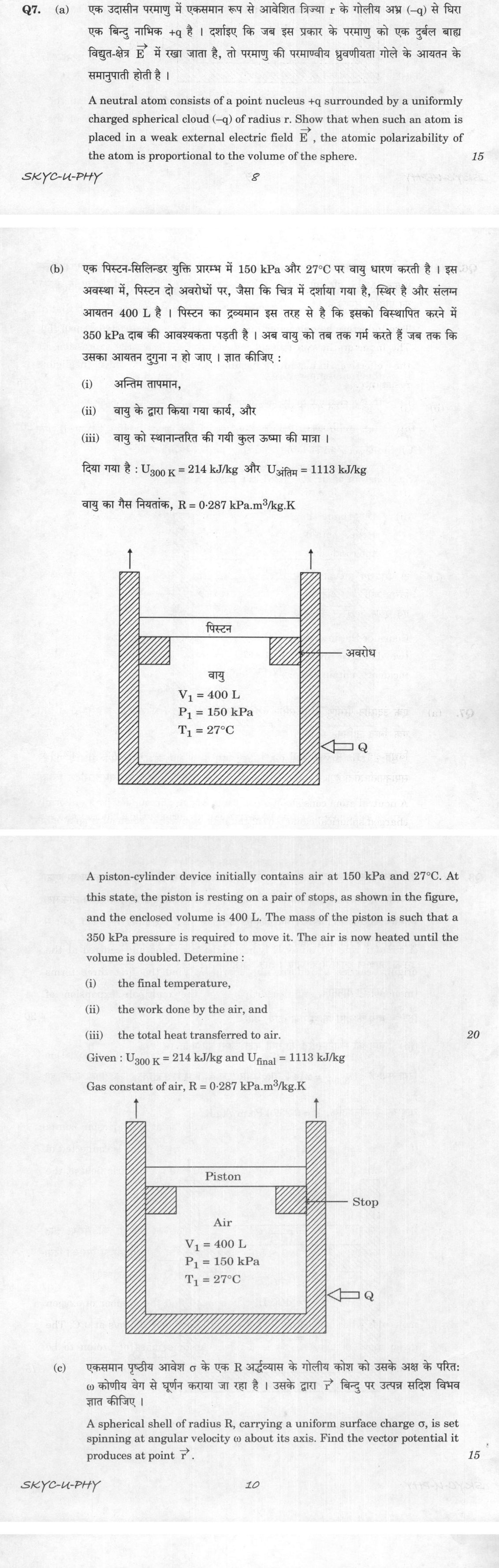
A piston-cylinder device initially contains air at 150 kPa and 27°C. At this state, the piston is resting on a pair of stops, as shown in the figure, and the enclosed volume is 400 L. The mass of the piston is such that a 350 kPa pressure is required to move it. The air is now heated until the volume is doubled. Determine: the final temperature,
the work done by the air, and
the total heat transferred to air. 20 marks Given: U₃₀₀ ₖ = 214 kJ/kg and U_final = 1113 kJ/kg Gas constant of air, R = 0·287 kPa.m³/kg.K
A spherical shell of radius R, carrying a uniform surface charge σ, is set spinning at angular velocity ω about its axis. Find the vector potential it produces at point r⃗ . 15 marks
हिंदी में प्रश्न पढ़ें
एक उदासीन परमाणु में एकसमान रूप से आवेशित त्रिज्या r के गोलीय अभ्र (-q) से घिरा एक बिंदु नाभिक +q है । दर्शाइए कि जब इस प्रकार के परमाणु को एक दुर्बल बाह्य विद्युत-क्षेत्र E⃗ में रखा जाता है, तो परमाणु की परमाण्वीय ध्रुवणीयता गोले के आयतन के समानुपाती होती है । 15
एक पिस्टन-सिलिंडर युक्ति प्रारंभ में 150 kPa और 27°C पर वायु धारण करती है। इस अवस्था में, पिस्टन दो अवरोधों पर, जैसा कि चित्र में दर्शाया गया है, स्थिर है और संलग्न आयतन 400 L है। पिस्टन का द्रव्यमान इस तरह से है कि इसको विस्थापित करने में 350 kPa दाब की आवश्यकता पड़ती है। अब वायु को तब तक गर्म करते हैं जब तक कि उसका आयतन दुगुना न हो जाए। ज्ञात कीजिए : अंतिम तापमान,
वायु के द्वारा किया गया कार्य, और
वायु को स्थानांतरित की गई कुल ऊष्मा की मात्रा। 20 दिया गया है : U₃₀₀ K = 214 kJ/kg और Uअंतिम = 1113 kJ/kg वायु का गैस नियतांक, R = 0·287 kPa.m³/kg.K
एकसमान पृष्ठीय आवेश σ के एक R अर्ध्व्यास के गोलीय कोश को उसके अक्ष के परितः ω कोणीय वेग से घूर्णन कराया जा रहा है । उसके द्वारा r⃗ बिन्दु पर उत्पन्न सदिश विभव ज्ञात कीजिए । 15
The figure this question refers to, in words
The question paper is a scan and the diagram did not survive as text. This is the figure as read from the original page — every component, value and label — so the question can be worked from the text below.
(b) A cross-sectional schematic of a vertical piston-cylinder device. A piston labelled 'Piston' is seated horizontally inside a cylinder, resting on a pair of stops projecting inward from the left and right cylinder walls, with a leader line pointing to the right stop labelled 'Stop'. The chamber below the piston contains air, labelled 'Air', with initial parameters given as: 'V1 = 400 L', 'P1 = 150 kPa', and 'T1 = 27°C'. An open block arrow labelled 'Q' points into the bottom right wall of the cylinder, indicating heat transfer into the air. Two upward-pointing vertical arrows are drawn above the top rims of the cylinder walls.
Model answer
Written by UPSC Answer Check against this question's marking rubric, to the expected length. UPSC does not publish answers for Mains — this is one way to score well, not an official key.
(a) Let the nucleus +q be displaced by x relative to the centre of the negative cloud. By Gauss’s law, the field inside a uniformly charged sphere of total charge −q at distance x from its centre is E_cloud = − q x/(4π ε₀ r³). So the restoring force on the nucleus is F = qE_cloud = − q² x/(4π ε₀ r³). In equilibrium under the external field E⃗, qE − q² x/(4π ε₀ r³) = 0 ⇒ x = 4π ε₀ r³ E/q. The induced dipole moment is p = qx = 4π ε₀ r³ E. Hence α = p/E = 4π ε₀ r³ = 3ε₀(4π r³/3) = 3ε₀ V. Thus α ∝ V, the volume of the spherical cloud. Validity: weak field, so x ≪ r and response is linear.
(b) Take air as an ideal gas. T₁ = 27°C = 300 K, V₁ = 400 L = 0.400 m³, P₁ = 150 kPa. The piston lifts when P reaches 350 kPa at constant volume, then expansion occurs at P = 350 kPa until V₃ = 2V₁ = 0.800 m³. Mass of air: m = P₁V₁/(R T₁) = (150)(0.400)/(0.287×300) = 200/287 kg = 0.6969 kg. Also mR = P₁V₁/T₁ = 0.200 kJ/K.
(b)(i) At the final state P₃ = 350 kPa, V₃ = 0.800 m³. T₃ = P₃V₃/(mR) = (350×0.800)/0.200 = 1400 K. Final temperature = 1400 K = 1127°C.
(b)(ii) Work done by air: W = ∫P dV = 0 + P₂(V₃−V₂) W = 350 kPa × (0.800−0.400) m³ = 140 kJ. Work done by the air = 140 kJ.
(b)(iii) Internal-energy change: ΔU = m(U_final − U₃₀₀ K) ΔU = (200/287)(1113 − 214) kJ = 179800/287 kJ = 626.48 kJ. First law: Q = ΔU + W. Q = 626.48 + 140 = 766.48 kJ = 219980/287 kJ. Total heat transferred to air ≈ 766.48 kJ.
(c) Let ω⃗ = ω ẑ. The surface current density is K = σ v = σ(ω⃗ × R⃗′) = σωR sinθ′ φ̂′. By symmetry, A⃗ has only a φ component: A⃗ = A_φ(r,θ) φ̂ = F(r) sinθ φ̂. Away from the shell, ∇²A⃗ = 0. The φ-component, for this azimuthal form, gives F″ + (2/r)F′ − (2/r²)F = 0. Solutions are F = C r inside and F = D/r² outside. Continuity at r = R gives C R = D/R² ⇒ D = C R³.
The magnetic field components are B_r = 2F cosθ/r, B_θ = −(1/r)(rF)′ sinθ. At r = R: B_in,θ = −2C sinθ, B_out,θ = D/R³ sinθ = C sinθ. The boundary condition across the current sheet is B_out,θ − B_in,θ = μ₀ K_φ = μ₀ σωR sinθ. Thus C sinθ + 2C sinθ = μ₀ σωR sinθ ⇒ C = μ₀ σωR/3. Hence D = C R³ = μ₀ σωR⁴/3.
Therefore A⃗(r) = (μ₀ σωR r sinθ/3) φ̂, for r < R, A⃗(r) = (μ₀ σωR⁴ sinθ/(3r²)) φ̂, for r > R. Equivalently, A⃗ = (μ₀ σR/3)(ω⃗ × r⃗) for r < R, A⃗ = (μ₀ σR⁴/(3r³))(ω⃗ × r⃗) for r > R.
What "Derive" is asking you to do
Reach the stated expression from a starting relation, justifying every step. The destination is printed in the question, so only the route earns marks, and the assumptions you work under are part of that route.
Structure that answers it
Assumptions and notation defined → starting relation or governing equation → each step with its justification → the required expression → limiting case or boundary check
Where marks are lost
Writing the standard result first and fitting three lines to it, which an examiner reads at a glance. Marks also go on assumptions left unstated — lossless medium, small amplitude, errors independent with zero mean — and on symbols used before they are defined, even when the question says usual notations.
How this answer will be evaluated
Approach
Framework: Principle > Setup and diagram > Derivation > Result and limiting case. (a) derive: given > assumptions > stepwise derivation > result > check | (b) calculate: given > formula > substitution > result with units > interpretation | (c) derive: given > assumptions > stepwise derivation > result > check Full marks: Rigorous derivation with clear diagrams, correct units, and physical interpretation.
Key points expected
- State equilibrium condition: external force equals restoring force.
- Calculate electric field inside uniformly charged sphere.
- Solve for displacement x in terms of E and r.
- Show polarizability alpha is proportional to r cubed.
- Identify two-stage process: constant volume then constant pressure.
- Calculate mass of air using ideal gas law.
- Compute work done using P-delta-V for expansion phase.
- Apply first law of thermodynamics for heat transfer.
Evaluation rubric
Each sub-part is marked on its own, against the marks and word limit printed on the paper.
- (a) Derive atomic polarizability proportional to sphere volume in weak field. 15 marks
derive— given → assumptions → stepwise derivation → result → check
Must cover
- State equilibrium condition: external force equals restoring force.
- Calculate electric field inside uniformly charged sphere.
- Solve for displacement x in terms of E and r.
- Show polarizability alpha is proportional to r cubed.
Loses marks
- Formula substitution without deriving field inside sphere.
- Dropping units or dimensional check.
Earns more
- Draws labelled diagram of nucleus and cloud.
- Explicitly states weak field approximation.
Extra mark
- One line on physical interpretation of polarizability.
- (b) Calculate final temperature, work done, and heat transfer for air. 20 marks
calculate— given → formula → substitution → result with units → interpretation
Must cover
- Identify two-stage process: constant volume then constant pressure.
- Calculate mass of air using ideal gas law.
- Compute work done using P-delta-V for expansion phase.
- Apply first law of thermodynamics for heat transfer.
Loses marks
- Assumes single-stage process ignoring the stops.
- Incorrect use of internal energy values provided.
Earns more
- Draws P-V diagram showing the process path.
- Carries units through all calculation steps.
Extra mark
- Checks limiting case or consistency of results.
- (c) Find vector potential of spinning charged spherical shell. 15 marks
derive— given → assumptions → stepwise derivation → result → check
Must cover
- Define surface current density K from charge and velocity.
- Set up the integral for vector potential A.
- Evaluate the integral for the potential.
- State the result in terms of R, sigma, and omega.
Loses marks
- Confusing surface charge with volume charge.
- Incorrect limits of integration for the shell.
Earns more
- Uses spherical coordinates for the integration.
- Identifies the dipole nature of the field.
Extra mark
- Mention of magnetic moment of the shell.
Practice this exact question
Write your answer and it is marked point by point against the model answer above — what you covered, what you missed, what you got wrong.
Evaluate my answer →More from Physics 2023 Paper I
- Q4 (a) Write conditions for working of a step-index optical fiber. In a step-index fiber, th…
- Q5 (a) Find the energy stored in a system of four charges Q₁ = 1 nC, Q₂ = 2 nC, Q₃ = 3 nC an…
- Q6 (a) Two inductors having inductances L₁ and L₂ are connected in parallel. The inductors h…
- Q7 (a) A neutral atom consists of a point nucleus +q surrounded by a uniformly charged spher…
- Q8 (a) A circular ring of radius R lying on the x-y plane and centred at the origin, carries…