Paper I — Q3
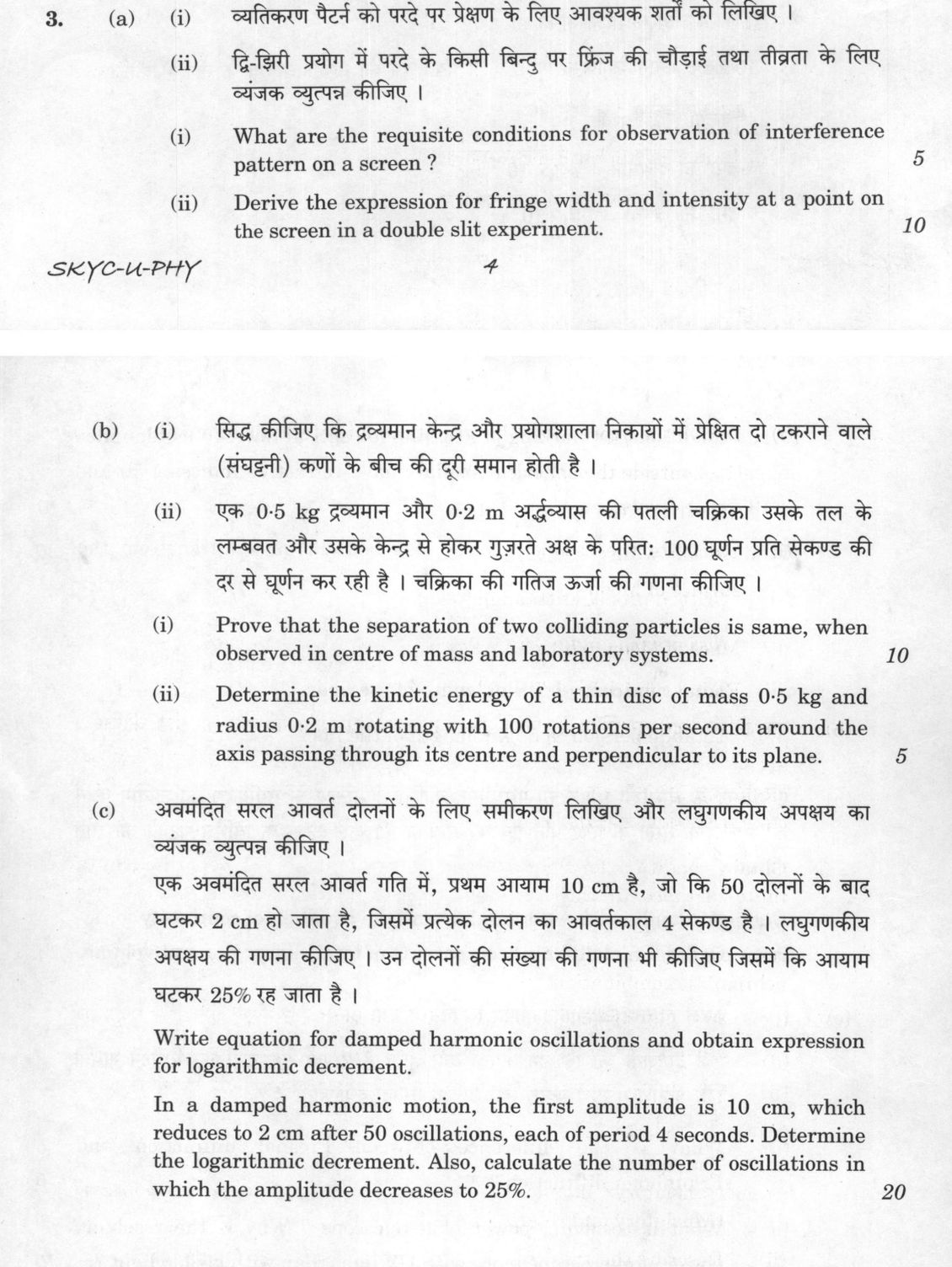
(a) (i) What are the requisite conditions for observation of interference pattern on a screen ? (5 marks) (ii) Derive the…
What are the requisite conditions for observation of interference pattern on a screen ? 5 marks
Derive the expression for fringe width and intensity at a point on the screen in a double slit experiment. 10 marks
Prove that the separation of two colliding particles is same, when observed in centre of mass and laboratory systems. 10 marks
Determine the kinetic energy of a thin disc of mass 0·5 kg and radius 0·2 m rotating with 100 rotations per second around the axis passing through its centre and perpendicular to its plane. 5 marks
Write equation for damped harmonic oscillations and obtain expression for logarithmic decrement.
In a damped harmonic motion, the first amplitude is 10 cm, which reduces to 2 cm after 50 oscillations, each of period 4 seconds. Determine the logarithmic decrement. Also, calculate the number of oscillations in which the amplitude decreases to 25%. 20 marks
हिंदी में प्रश्न पढ़ें
व्यतिकरण पैटर्न को पर्दे पर प्रेक्षण के लिए आवश्यक शर्तों को लिखिए । (5 अंक)
द्वि-झिरी प्रयोग में पर्दे के किसी बिंदु पर फ्रिंज की चौड़ाई तथा तीव्रता के लिए व्यंजक व्युत्पन्न कीजिए । (10 अंक)
सिद्ध कीजिए कि द्रव्यमान केन्द्र और प्रयोगशाला निकायों में प्रेक्षित दो टकराने वाले (संघनी) कणों के बीच की दूरी समान होती है । (10 अंक)
एक 0·5 kg द्रव्यमान और 0·2 m अर्ध्व्यास की पतली चक्रिका उसके तल के लम्बवत् और उसके केन्द्र से होकर गुजरते अक्ष के परितः 100 घूर्णन प्रति सेकण्ड की दर से घूर्णन कर रही है । चक्रिका की गतिज ऊर्जा की गणना कीजिए । (5 अंक)
अवमंदित सरल आवर्त दोलनों के लिए समीकरण लिखिए और लघुगणकीय अपक्षय का व्यंजक व्युत्पन्न कीजिए ।
एक अवमंदित सरल आवर्त गति में, प्रथम आयाम 10 cm है, जो कि 50 दोलनों के बाद घटकर 2 cm हो जाता है, जिसमें प्रत्येक दोलन का आवर्तकाल 4 सेकण्ड है । लघुगणकीय अपक्षय की गणना कीजिए । उन दोलनों की संख्या की गणना भी कीजिए जिसमें कि आयाम घटकर 25% रह जाता है । (20 अंक)
Model answer
Written by UPSC Answer Check against this question's marking rubric, to the expected length. UPSC does not publish answers for Mains — this is one way to score well, not an official key.
(a)(i) For a sustained interference pattern on a screen, the following conditions are necessary:
- The two sources must be coherent: they must have the same frequency and a constant phase difference.
- The waves must overlap at the screen, and the path difference must lie within the coherence length of the source.
- The amplitudes or intensities of the interfering waves should be nearly equal for good fringe contrast; unequal amplitudes reduce visibility.
- The interfering waves must have the same state of polarization. Mutually orthogonal polarizations do not interfere.
- The source should be sufficiently monochromatic, and the slits narrow and close enough that the fringe width λD/d is resolvable.
- The screen distance D should be large compared with the slit separation d, so that d sinθ ≈ d y/D is valid.
(a)(ii) Let slits S₁ and S₂ be separated by d, and let the screen be at distance D. At a point P on the screen at distance y from the central maximum, the path difference is Δ = S₂P − S₁P ≈ d sinθ ≈ dy/D. The corresponding phase difference is φ = (2π/λ)Δ = 2πdy/(λD). For two equal-amplitude waves of amplitude a, the resultant displacement is E = a cos(ωt) + a cos(ωt + φ) = 2a cos(φ/2) cos(ωt + φ/2). Thus the resultant amplitude is A = 2a cos(φ/2), so the intensity is I ∝ A² = 4a² cos²(φ/2). If Iₘ = 4a² is the maximum intensity, I = Iₘ cos²(φ/2) = Iₘ cos²(πdy/(λD)). Bright fringes occur when φ = 2nπ, i.e. d sinθ = nλ, so yₙ = nλD/d. Dark fringes occur when φ = (2n+1)π, i.e. d sinθ = (n+1/2)λ. Therefore the fringe width is β = yₙ₊₁ − yₙ = λD/d. In a medium of refractive index μ, λ is replaced by λ/μ, so β = λD/(μd).
(b)(i) Let the laboratory positions of the two particles be r₁ and r₂, with masses m₁ and m₂. The centre-of-mass position is R = (m₁r₁ + m₂r₂)/(m₁ + m₂). In the centre-of-mass frame, the positions are r₁′ = r₁ − R, r₂′ = r₂ − R. Their separation vector is r₁′ − r₂′ = (r₁ − R) − (r₂ − R) = r₁ − r₂. Hence |r₁′ − r₂′| = |r₁ − r₂|. Thus the separation of the two colliding particles is the same in the centre-of-mass and laboratory systems. The relative velocity is also unchanged, and the relative motion depends only on the reduced mass μ = m₁m₂/(m₁ + m₂). This proof assumes non-relativistic inertial frames related by a Galilean transformation.
(b)(ii) For a thin disc rotating about the axis through its centre and perpendicular to its plane, I = (1/2)MR². Given M = 0.5 kg, R = 0.2 m, I = (1/2)(0.5)(0.2)² = 0.01 kg m². Angular velocity ω = 2πn = 2π(100) = 200π rad s⁻¹. Rotational kinetic energy is K = (1/2)Iω² = (1/2)(0.01)(200π)² = 200π² J ≈ 1.97 × 10³ J. K ≈ 1974 J ≈ 1.97 × 10³ J.
(c) The equation of damped harmonic motion is m d²x/dt² + b dx/dt + kx = 0, or d²x/dt² + 2γ dx/dt + ω₀²x = 0, where 2γ = b/m and ω₀² = k/m. For underdamping, γ < ω₀. Trying x = e^(λt), λ² + 2γλ + ω₀² = 0 ⇒ λ = −γ ± iω, where ω = sqrt(ω₀² − γ²). Thus x = A e^(−γt) cos(ωt + φ), so the amplitude decays as A(t) = A e^(−γt). For two successive maxima separated by one period T = 2π/ω, Aₙ/Aₙ₊₁ = e^(γT). Therefore the logarithmic decrement is δ = ln(Aₙ/Aₙ₊₁) = γT = 2πγ/ω = 2πγ/sqrt(ω₀² − γ²). For n oscillations, δ = (1/n) ln(A₀/Aₙ).
Given A₀ = 10 cm and A₅₀ = 2 cm after 50 oscillations, δ = (1/50) ln(10/2) = (1/50) ln 5 = 0.03219. δ ≈ 0.0322.
For the amplitude to fall to 25% of its initial value, Aₙ = 0.25A₀. Then 0.25A₀ = A₀ e^(−δn) ⇒ e^(δn) = 4 ⇒ n = ln4/δ = ln4/(ln5/50) = 50 ln4/ln5 = 43.07. Thus n ≈ 43.1 oscillations. After 43 complete oscillations the amplitude is about 25.06%, so it reaches 25% during the 44th oscillation. If an integer number of complete oscillations is required, it is 44 oscillations.
What "Derive" is asking you to do
Reach the stated expression from a starting relation, justifying every step. The destination is printed in the question, so only the route earns marks, and the assumptions you work under are part of that route.
Structure that answers it
Assumptions and notation defined → starting relation or governing equation → each step with its justification → the required expression → limiting case or boundary check
Where marks are lost
Writing the standard result first and fitting three lines to it, which an examiner reads at a glance. Marks also go on assumptions left unstated — lossless medium, small amplitude, errors independent with zero mean — and on symbols used before they are defined, even when the question says usual notations.
How this answer will be evaluated
Approach
(a(i)) enumerate: list the items in order > one line each > no commentary | (a(ii)) derive: given > assumptions > stepwise derivation > result > check | (b(i)) justify: claim > 3-4 reasons > evidence > conclusion | (b(ii)) calculate: given > formula > substitution > result with units > interpretation | (c) derive: given > assumptions > stepwise derivation > result > check Full marks: Complete derivations with all steps, correct calculations with units, clear physical interpretation
Key points expected
- Coherent sources of light
- Monochromatic light source
- Equal amplitudes of waves
- Small separation between slits
- Path difference expression Δx = d sin θ
- Fringe width formula β = λD/d
- Intensity formula I = 4I₀ cos²(πd sin θ/λ)
- Step-by-step derivation from wave superposition
Evaluation rubric
Each sub-part is marked on its own, against the marks and word limit printed on the paper.
- (a(i)) List the requisite conditions for observing an interference pattern. 5 marks
enumerate— list the items in order → one line each → no commentary
Must cover
- Coherent sources of light
- Monochromatic light source
- Equal amplitudes of waves
- Small separation between slits
Loses marks
- Listing incoherent sources as a condition
- Vague statements without specific physical criteria
Earns more
- Mention of stable phase difference
- Screen at large distance
Extra mark
- Reference to Young's double slit setup
- (a(ii)) Derive expressions for fringe width and intensity at a point on the screen. 10 marks
derive— given → assumptions → stepwise derivation → result → check
Must cover
- Path difference expression Δx = d sin θ
- Fringe width formula β = λD/d
- Intensity formula I = 4I₀ cos²(πd sin θ/λ)
- Step-by-step derivation from wave superposition
Loses marks
- Formula substitution without derivation
- Dropping units in final expressions
Earns more
- Labelled diagram of double slit setup
- Discussion of maxima and minima conditions
Extra mark
- Mention of small angle approximation
- (b(i)) Prove that separation of two colliding particles is invariant in COM and lab frames. 10 marks
justify— claim → 3-4 reasons → evidence → conclusion
Must cover
- Define separation vector r = r₁ - r₂
- Show r' = r in COM frame
- Use Galilean transformation for positions
- Demonstrate invariance of relative position
Loses marks
- Assuming invariance without proof
- Confusing separation with velocity
Earns more
- Explicit coordinate transformation steps
- Mention of inertial frame assumption
Extra mark
- Numerical example with specific particle positions
- (b(ii)) Determine kinetic energy of a rotating thin disc. 5 marks
calculate— given → formula → substitution → result with units → interpretation
Must cover
- Moment of inertia I = ½MR²
- Angular velocity ω = 2πf
- Kinetic energy KE = ½Iω²
- Substitution with given values
Loses marks
- Using wrong moment of inertia formula
- Forgetting to convert frequency to angular velocity
Earns more
- Carrying units through calculation
- Final answer in joules
Extra mark
- Mention of rotational kinetic energy formula
- (c) Write damped oscillation equation, derive logarithmic decrement, and calculate values. 20 marks
derive— given → assumptions → stepwise derivation → result → check
Must cover
- Damped oscillation equation x = A₀e^(-bt/2m)cos(ω't + φ)
- Logarithmic decrement δ = ln(Aₙ/Aₙ₊₁)
- Calculation of δ from given amplitudes
- Number of oscillations for 25% amplitude
Loses marks
- Missing derivation of logarithmic decrement
- Incorrect calculation of number of oscillations
Earns more
- Derivation of damping factor from equation of motion
- Step-by-step calculation with units
Extra mark
- Mention of quality factor Q
- Graph of damped oscillation
Practice this exact question
Write your answer and it is marked point by point against the model answer above — what you covered, what you missed, what you got wrong.
Evaluate my answer →More from Physics 2023 Paper I
- Q1 (a) A force F⃗ is given by F⃗ = x²y x̂ + zy² ŷ + xz² ẑ. Determine whether or not the fo…
- Q2 (a) (i) Derive the expressions for gravitational potentials at a point (I) outside the sp…
- Q3 (a) (i) What are the requisite conditions for observation of interference pattern on a sc…
- Q4 (a) Write conditions for working of a step-index optical fiber. In a step-index fiber, th…
- Q5 (a) Find the energy stored in a system of four charges Q₁ = 1 nC, Q₂ = 2 nC, Q₃ = 3 nC an…
- Q6 (a) Two inductors having inductances L₁ and L₂ are connected in parallel. The inductors h…