Paper II — Q1
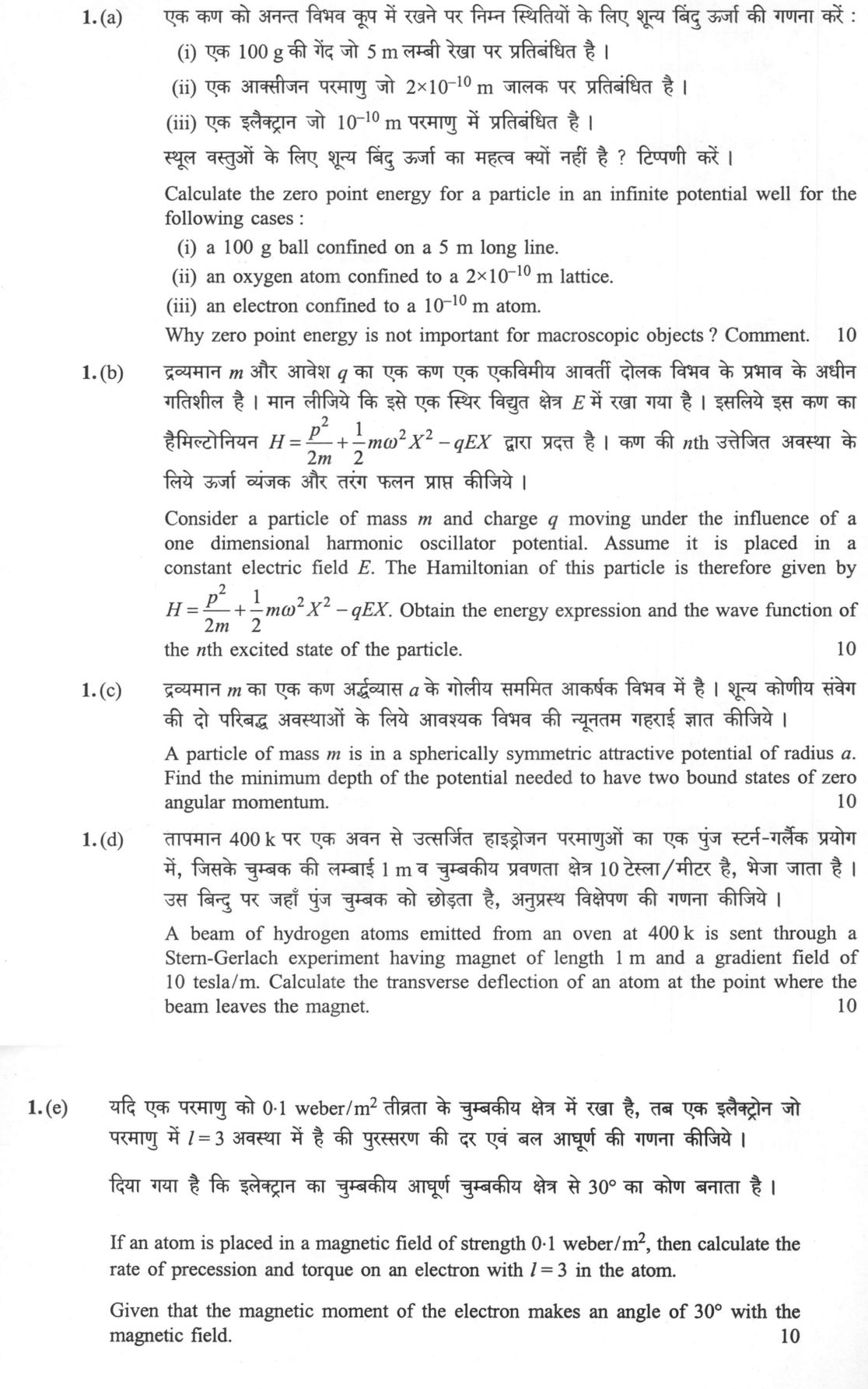
(a) Calculate the zero point energy for a particle in an infinite potential well for the following cases : (i) a 100 g ball…
Calculate the zero point energy for a particle in an infinite potential well for the following cases : (i) a 100 g ball confined on a 5 m long line. (ii) an oxygen atom confined to a 2×10⁻¹⁰ m lattice. (iii) an electron confined to a 10⁻¹⁰ m atom. Why zero point energy is not important for macroscopic objects ? Comment. 10 marks
Consider a particle of mass m and charge q moving under the influence of a one dimensional harmonic oscillator potential. Assume it is placed in a constant electric field E. The Hamiltonian of this particle is therefore given by H = p²/2m + ½mω²X² - qEX. Obtain the energy expression and the wave function of the nth excited state of the particle. 10 marks
A particle of mass m is in a spherically symmetric attractive potential of radius a. Find the minimum depth of the potential needed to have two bound states of zero angular momentum. 10 marks
A beam of hydrogen atoms emitted from an oven at 400 k is sent through a Stern-Gerlach experiment having magnet of length 1 m and a gradient field of 10 tesla/m. Calculate the transverse deflection of an atom at the point where the beam leaves the magnet. 10 marks
If an atom is placed in a magnetic field of strength 0·1 weber/m², then calculate the rate of precession and torque on an electron with l = 3 in the atom. Given that the magnetic moment of the electron makes an angle of 30° with the magnetic field. 10 marks
हिंदी में प्रश्न पढ़ें
एक कण को अनंत विभव कूप में रखने पर निम्न स्थितियों के लिए शून्य बिंदु ऊर्जा की गणना करें : (i) एक 100 g की गेंद जो 5 m लंबी रेखा पर प्रतिबंधित है । (ii) एक ऑक्सीजन परमाणु जो 2×10⁻¹⁰ m जालक पर प्रतिबंधित है । (iii) एक इलेक्ट्रॉन जो 10⁻¹⁰ m परमाणु में प्रतिबंधित है । स्थूल वस्तुओं के लिए शून्य बिंदु ऊर्जा का महत्व क्यों नहीं है ? टिप्पणी करें । 10 अंक
द्रव्यमान m और आवेश q का एक कण एक एकविमीय आवर्ती दोलक विभव के प्रभाव के अधीन गतिशील है । मान लीजिये कि इसे एक स्थिर विद्युत क्षेत्र E में रखा गया है । इसलिये इस कण का हैमिल्टोनियन H = p²/2m + ½mω²X² - qEX द्वारा प्रदत है । कण की nth उत्तेजित अवस्था के लिये ऊर्जा व्यंजक और तरंग फलन प्राप्त कीजिये । 10 अंक
द्रव्यमान m का एक कण अर्धव्यास a के गोलीय सममित आकर्षक विभव में है । शून्य कोणीय संवेग की दो परिबद्ध अवस्थाओं के लिये आवश्यक विभव की न्यूनतम गहराई ज्ञात कीजिये । 10 अंक
तापमान 400 k पर एक अवन से उत्सर्जित हाइड्रोजन परमाणुओं का एक पुंज स्टर्न-गर्लैक प्रयोग में, जिसके चुंबक की लंबाई 1 m व चुंबकीय प्रवणता क्षेत्र 10 टेस्ला/मीटर है, भेजा जाता है । उस बिंदु पर जहाँ पुंज चुंबक को छोड़ता है, अनुप्रस्थ विषेषण की गणना कीजिये । 10 अंक
यदि एक परमाणु को 0·1 weber/m² तीव्रता के चुंबकीय क्षेत्र में रखा है, तब एक इलेक्ट्रॉन जो परमाणु में l = 3 अवस्था में है की पुरस्सरण की दर एवं बल आघूर्ण की गणना कीजिये। दिया गया है कि इलेक्ट्रॉन का चुंबकीय आघूर्ण चुंबकीय क्षेत्र से 30° का कोण बनाता है। 10 अंक
Model answer
Written by UPSC Answer Check against this question's marking rubric, to the expected length. UPSC does not publish answers for Mains — this is one way to score well, not an official key.
(a) For a particle in an infinite potential well of width L, the energy levels are Eₙ = n²h²/(8mL²), n=1,2,3,… The zero-point energy is E₁ = h²/(8mL²). Take h=6.626×10⁻³⁴ J s.
(i) m=100 g=0.100 kg, L=5 m. E₁ = (6.626×10⁻³⁴)²/[8×0.100×(5)²] = 4.390×10⁻⁶⁷/(20.0) = 2.20×10⁻⁶⁸ J = 1.37×10⁻⁴⁹ eV.
(ii) For an oxygen atom, m_O≈16 u=16×1.6605×10⁻²⁷=2.657×10⁻²⁶ kg, L=2×10⁻¹⁰ m. E₁ = (6.626×10⁻³⁴)²/[8×2.657×10⁻²⁶×(2×10⁻¹⁰)²] = 4.390×10⁻⁶⁷/(8.502×10⁻⁴⁵) = 5.16×10⁻²³ J = 3.22×10⁻⁴ eV = 0.322 meV.
(iii) For an electron, mₑ=9.109×10⁻³¹ kg, L=10⁻¹⁰ m. E₁ = (6.626×10⁻³⁴)²/[8×9.109×10⁻³¹×(10⁻¹⁰)²] = 4.390×10⁻⁶⁷/(7.288×10⁻⁵⁰) = 6.02×10⁻¹⁸ J = 37.6 eV.
Why zero-point energy is unimportant for macroscopic objects: E₁ ∝ h²/(mL²). Since h is extremely small, while m and L are large for macroscopic bodies, E₁ is utterly negligible compared with thermal or mechanical energies. For example, the 100 g ball has E₁≈10⁻⁶⁸ J, whereas thermal energy at room temperature is of order kT≈10⁻²¹ J. For electrons or atoms confined to atomic dimensions, L is small and m is small, so E₁ becomes comparable to eV energies and is physically important. Condition of validity: non-relativistic quantum mechanics, ideal infinite walls.
(b) The Hamiltonian is H = p²/(2m) + ½mω²X² − qEX. Use the method of completing the square. Let X₀ = qE/(mω²). Then ½mω²(X−X₀)² = ½mω²X² − qEX + q²E²/(2mω²). Therefore H = p²/(2m) + ½mω²(X−X₀)² − q²E²/(2mω²). This is a harmonic oscillator whose centre of oscillation is shifted from X=0 to X=X₀, with a constant energy shift. Hence the energy eigenvalues are Eₙ = (n+½)ħω − q²E²/(2mω²), n=0,1,2,… For the state with quantum number n, n=0 is the ground state and n=1 the first excited state. If the phrase “nth excited state” is used in the convention where the ground state is the zeroth state, this expression is the required one; if it means n quanta above the ground state, replace n by n+1.
The corresponding normalized wave functions are ψₙ(x) = Nₙ exp[−mω(x−x₀)²/(2ħ)] Hₙ(√(mω/ħ)(x−x₀)) where Nₙ = (1/√(2ⁿ n!))(mω/(πħ))¹ᐟ⁴ and Hₙ is the Hermite polynomial of degree n. The electric field does not change the shape of the oscillator wave functions; it only displaces the centre to x₀=qE/(mω²) and lowers every level by q²E²/(2mω²). Condition of validity: constant uniform electric field, non-relativistic motion.
(c) Let the attractive spherical well be V(r)=−V₀ for r<a, and V(r)=0 for r>a. For zero angular momentum, l=0. Put u(r)=rR(r). The radial equation is −ħ²/(2m) d²u/dr² + V(r)u = Eu, E<0. Inside r<a, define k² = 2m(V₀+E)/ħ². Since u(0)=0, u=A sin(kr). Outside r>a, define κ² = −2mE/ħ². The normalizable solution is u=B exp(−κr). Continuity of u and u′ at r=a gives the standard finite-well condition k cot(ka) = −κ. Let ξ=ka and η=κa. Then ξ cot ξ = −η. A new bound state appears when E→0⁻, i.e. η→0. Thus ξ cot ξ = 0 ⟹ cos ξ = 0 ⟹ ξ = π/2, 3π/2, 5π/2, … The first l=0 bound state appears at ξ=π/2. The second l=0 bound state appears at ξ=3π/2. Therefore, to have two bound s-states, we require k₀a > 3π/2, where k₀²=2mV₀/ħ². The minimum depth is obtained at equality: √(2mV₀/ħ²) a = 3π/2. Hence V₀,min = 9π²ħ²/(8ma²). Condition: finite spherical square well, l=0, non-relativistic, no spin-orbit coupling.
(d) In a Stern-Gerlach magnet, the transverse force on an atom with magnetic moment component μ_z is F_z = μ_z dB/dz. For hydrogen in its ground state, orbital magnetic moment is zero, and the electron spin gives μ_z = ±μ_B. Thus the magnitude of the force is F = μ_B dB/dz = 9.274×10⁻²⁴×10 = 9.274×10⁻²³ N. The atom spends time t=L/v in the magnet, where L=1 m. Taking the thermal speed as the rms speed, v² = 3kT/m_H. The transverse deflection is y = ½(F/m_H)t² = μ_B(dB/dz)L²/(2m_Hv²) = μ_B(dB/dz)L²/(6kT). Substitute μ_B=9.274×10⁻²⁴ J/T, dB/dz=10 T/m, L=1 m, k=1.381×10⁻²³ J/K, T=400 K: y = (9.274×10⁻²⁴×10×1)/(6×1.381×10⁻²³×400) = 9.274×10⁻²³/(3.314×10⁻²⁰) = 2.80×10⁻³ m = 2.8 mm. The two spin states are deflected in opposite directions, so the deflections are ±2.8 mm. Condition: classical transverse motion, negligible collisions after the oven, and v taken as the rms thermal speed.
(e) For an orbital electron, the magnetic moment is μ = −(e/2mₑ)L = −μ_B L/ħ. The Larmor precession angular frequency in a magnetic field B is ω_L = eB/(2mₑ) = μ_B B/ħ. Given B=0.1 Wb/m²=0.1 T, ω_L = (9.274×10⁻²⁴×0.1)/(1.054×10⁻³⁴) = 8.80×10⁹ rad/s. The precession frequency is ν = ω_L/(2π) = 1.40×10⁹ Hz.
For l=3, the magnitude of the orbital magnetic moment is μ = μ_B√(l(l+1)) = μ_B√12 = 2√3 μ_B. The torque is τ = μB sinθ. With θ=30°, sin30°=1/2, so τ = 2√3 μ_B B × 1/2 = √3 μ_B B. Thus τ = √3×9.274×10⁻²⁴×0.1 = 1.61×10⁻²⁴ N m. The torque direction is given by τ = μ × B. Condition: weak-field Zeeman regime, orbital contribution only, and negligible spin-orbit mixing.
What "Calculate" is asking you to do
Apply the standard formula or schedule to data the question has already supplied — a table of readings, cost records, a balance sheet — and produce the number. The method is rarely in doubt; the marks sit in the named intermediate quantities, each of which has to appear as a labelled line.
Structure that answers it
Data as given → formula or standard treatment, named → substitution → each intermediate, labelled → result with units
Where marks are lost
Omitting an intermediate the marking scheme pays for separately, or rounding at an intermediate line so the final figure drifts. In commerce and accountancy, any figure in a statement that no numbered working note supports is treated as unearned.
How this answer will be evaluated
Approach
(a) calculate: given > formula > substitution > result with units > interpretation | (b) derive: given > assumptions > stepwise derivation > result > check | (c) calculate: given > formula > substitution > result with units > interpretation | (d) calculate: given > formula > substitution > result with units > interpretation | (e) calculate: given > formula > substitution > result with units > interpretation Full marks: Rigorous derivation with correct units, physical interpretation, and error analysis.
Key points expected
- State infinite well ground state energy formula E = h²/8mL²
- Calculate energy for 100 g ball in 5 m well
- Calculate energy for oxygen atom in 2×10⁻¹⁰ m lattice
- Calculate energy for electron in 10⁻¹⁰ m atom
- Complete the square to shift coordinate origin
- Identify new equilibrium position x₀ = qE/mω²
- State shifted energy eigenvalues Eₙ = (n+1/2)ℏω - q²E²/2mω²
- Express wave function as shifted Hermite-Gaussian
Evaluation rubric
Each sub-part is marked on its own, against the marks and word limit printed on the paper.
- (a) Compute zero point energy for three systems and comment on macroscopic irrelevance. 10 marks
calculate— given → formula → substitution → result with units → interpretation
Must cover
- State infinite well ground state energy formula E = h²/8mL²
- Calculate energy for 100 g ball in 5 m well
- Calculate energy for oxygen atom in 2×10⁻¹⁰ m lattice
- Calculate energy for electron in 10⁻¹⁰ m atom
Loses marks
- Using n=2 or higher for zero point energy
- Omitting units in final answers
- Failing to comment on macroscopic case
Earns more
- Compare magnitudes of the three calculated energies
- Explain why E is negligible for macroscopic mass
- Use correct SI units (Joules) for all results
- Mention Heisenberg uncertainty principle as origin
Extra mark
- Express results in eV for atomic cases
- Explicitly state L = 5m, 2×10⁻¹⁰m, 10⁻¹⁰m in working
- (b) Derive energy and wave function for charged harmonic oscillator in electric field. 10 marks
derive— given → assumptions → stepwise derivation → result → check
Must cover
- Complete the square to shift coordinate origin
- Identify new equilibrium position x₀ = qE/mω²
- State shifted energy eigenvalues Eₙ = (n+1/2)ℏω - q²E²/2mω²
- Express wave function as shifted Hermite-Gaussian
Loses marks
- Treating -qEX as a perturbation instead of exact solution
- Forgetting the constant energy shift term
- Writing wave function without the spatial shift
Earns more
- Show explicit Hamiltonian transformation steps
- Define the new coordinate variable clearly
- Mention the constant energy shift term
- Verify dimensions of the shift term
Extra mark
- Draw potential diagram showing shifted minimum
- State that spectrum remains equally spaced
- (c) Find minimum potential depth for two s-wave bound states. 10 marks
calculate— given → formula → substitution → result with units → interpretation
Must cover
- Write radial Schrödinger equation for l=0
- Define dimensionless parameter for well depth
- Identify condition for first bound state (π/2)
- Identify condition for second bound state (3π/2)
Loses marks
- Confusing 1D well with 3D spherical well
- Using l=1 or higher angular momentum
- Failing to identify the specific root for 2nd state
Earns more
- Show the transcendental equation for bound states
- Solve for minimum V₀ explicitly
- Use correct boundary conditions at r=a
- State result in terms of ℏ, m, a
Extra mark
- Sketch the potential well and wave functions
- Mention that l=0 has no centrifugal barrier
- (d) Calculate transverse deflection in Stern-Gerlach experiment. 10 marks
calculate— given → formula → substitution → result with units → interpretation
Must cover
- Calculate mean velocity from oven temperature (400 K)
- Determine force F = μ ∇B using Bohr magneton
- Calculate time of flight t = L/v
- Compute deflection y = ½at²
Loses marks
- Using electron mass instead of atom mass
- Forgetting the ½ in kinematic equation
- Using wrong value for Bohr magneton
Earns more
- Use correct mass of hydrogen atom
- State assumption of thermal equilibrium velocity
- Show calculation of acceleration a = F/m
- Provide final answer in meters
Extra mark
- Mention splitting into two beams (spin up/down)
- Check order of magnitude of result
- (e) Calculate precession rate and torque for electron in magnetic field. 10 marks
calculate— given → formula → substitution → result with units → interpretation
Must cover
- Calculate torque τ = μ × B
- Use given angle 30° in torque calculation
- Calculate precession frequency ω = γB
- Use correct gyromagnetic ratio for electron
Loses marks
- Using wrong angle (60° instead of 30°)
- Confusing precession frequency with cyclotron frequency
- Omitting the cross product magnitude formula
Earns more
- State vector nature of torque and precession
- Show numerical substitution for B = 0.1 T
- Distinguish between orbital and spin precession if applicable
- Provide units for torque (N m) and frequency (rad/s)
Extra mark
- Mention Larmor precession explicitly
- Calculate magnitude of μ for l=3 state
Practice this exact question
Write your answer and it is marked point by point against the model answer above — what you covered, what you missed, what you got wrong.
Evaluate my answer →More from Physics 2023 Paper II
- Q1 (a) Calculate the zero point energy for a particle in an infinite potential well for the…
- Q2 (a) An operator P describing the interaction of two spin 1/2 particles is P = a + bσ⃗₁·σ⃗…
- Q3 (a) What is vector atom model ? How the principal features of vector atom model were expl…
- Q4 (a) A particle constrained to move along x-axis in the domain 0 ≤ x ≤ L has a wave functi…