Paper II — Q3
(a) What is vector atom model ? How the principal features of vector atom model were explained by Stern-Gerlach experiment ?…
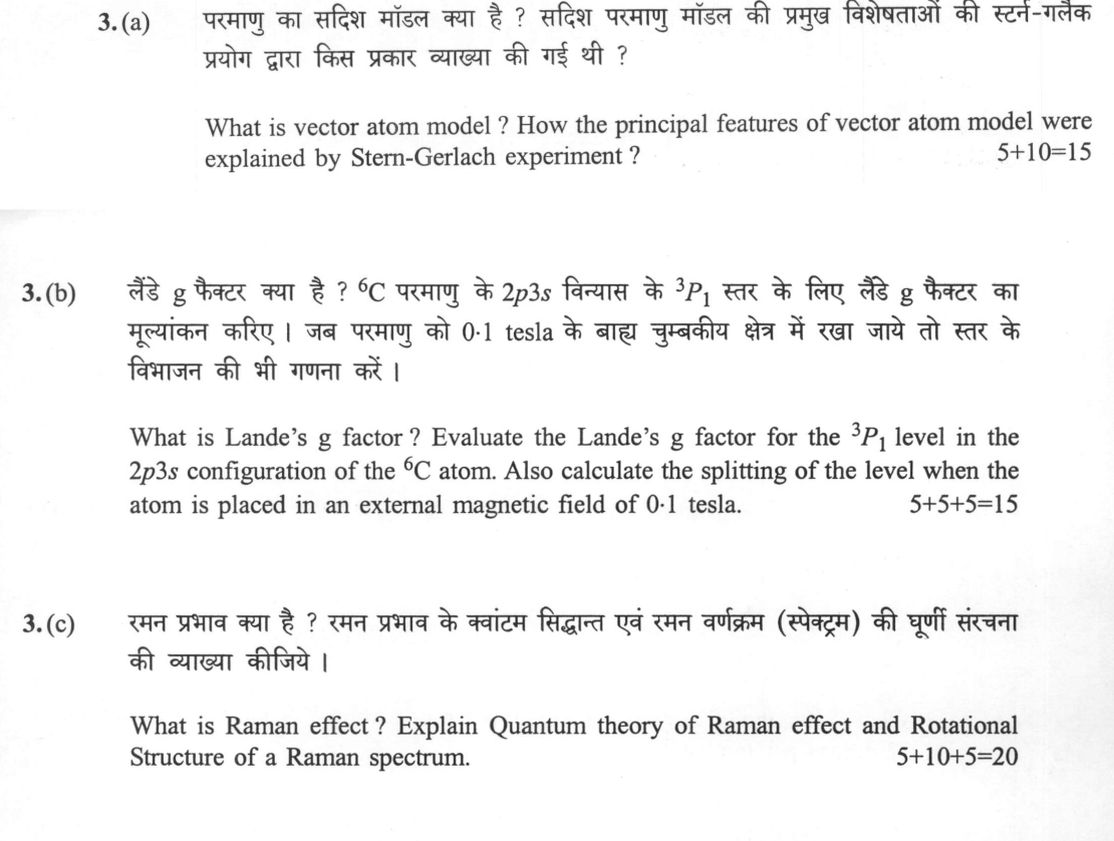
What is vector atom model ? How the principal features of vector atom model were explained by Stern-Gerlach experiment ? (5+10=15 marks)
What is Lande's g factor ? Evaluate the Lande's g factor for the ³P₁ level in the 2p3s configuration of the ⁶C atom. Also calculate the splitting of the level when the atom is placed in an external magnetic field of 0·1 tesla. (5+5+5=15 marks)
What is Raman effect ? Explain Quantum theory of Raman effect and Rotational Structure of a Raman spectrum. (5+10+5=20 marks)
हिंदी में प्रश्न पढ़ें
परमाणु का सदिश मॉडल क्या है ? सदिश परमाणु मॉडल की प्रमुख विशेषताओं की स्टर्न-गर्लाक प्रयोग द्वारा किस प्रकार व्याख्या की गई थी ? (5+10=15)
लैंडे g फैक्टर क्या है ? ⁶C परमाणु के 2p3s विन्यास के ³P₁ स्तर के लिए लैंडे g फैक्टर का मूल्यांकन कीजिए । जब परमाणु को 0·1 tesla के बाह्य चुंबकीय क्षेत्र में रखा जाये तो स्तर के विभाजन की भी गणना करें । (5+5+5=15)
रमन प्रभाव क्या है ? रमन प्रभाव के क्वांटम सिद्धांत एवं रमन वर्णक्रम (स्पेक्ट्रम) की घूर्णी संरचना की व्याख्या कीजिये । (5+10+5=20)
Model answer
Written by UPSC Answer Check against this question's marking rubric, to the expected length. UPSC does not publish answers for Mains — this is one way to score well, not an official key.
Spectroscopy reveals that atomic and molecular energy levels are discrete and spatially quantised. The three phenomena asked here are linked by the quantum treatment of angular momentum and light–matter interaction.
Vector atom model and Stern–Gerlach. In the vector atom model, the orbital, spin and total angular momenta of an atom are represented by vectors. For an electron, |L| = √[l(l+1)]ħ and |S| = √[s(s+1)]ħ; for many-electron atoms the individual lᵢ and sᵢ couple to total L and S, and in LS coupling L and S precess about a resultant J, |J| = √[J(J+1)]ħ. The magnetic moment is not parallel to J because the orbital and spin gyromagnetic ratios differ; its projection on a field direction is quantised, m_J = -J,...,+J. The Stern–Gerlach experiment passed a collimated beam of neutral atoms through a strongly inhomogeneous field. The force F_z = μ_z ∂B_z/∂z separates atoms according to the allowed values of μ_z. A beam of silver atoms (4s¹, L=0, S=1/2, J=1/2) split into two components, not one continuous spread. This confirmed space quantisation of the magnetic moment and, because L=0, proved the existence of intrinsic electron spin. The two-beam result also showed that the allowed projections of angular momentum, and hence magnetic moment, are discrete rather than classical continuous orientations. It removed the limitation of the Bohr–Sommerfeld model, which could not account for spin or the observed fine-structure and anomalous Zeeman effects.
Lande g-factor and Zeeman splitting. In LS coupling the magnetic interaction energy is ΔE = μ_B g_J B m_J, where μ_B is the Bohr magneton and m_J = -J,...,+J. The Landé g-factor follows by projecting the orbital and spin magnetic moments on J, with g_L=1 and g_S≈2:
g_J = 1 + [J(J+1)+S(S+1)-L(L+1)]/[2J(J+1)].
For carbon’s 2p3s ³P₁ level, L=1, S=1, J=1. Hence g_J = 1 + [1(2)+1(2)-1(2)]/[2·1·2] = 1 + 2/4 = 3/2. For B = 0.1 T, μ_B g_J B = (9.274×10⁻²⁴ J T⁻¹)(1.5)(0.1) = 1.39×10⁻²⁴ J per unit m_J. The three sublevels m_J = -1,0,+1 are shifted by -1.39×10⁻²⁴, 0 and +1.39×10⁻²⁴ J. Thus the adjacent splitting is 1.39×10⁻²⁴ J = 8.68×10⁻⁶ eV, and the total spread from m_J=-1 to +1 is 2.78×10⁻²⁴ J = 1.74×10⁻⁵ eV.
Raman effect, quantum theory and rotational structure. The Raman effect is inelastic scattering of monochromatic light by molecules. Most photons are Rayleigh scattered with unchanged frequency; a small fraction emerge at lower frequency (Stokes) or higher frequency (anti-Stokes). Quantum mechanically, an incident photon of energy hν₀ raises the molecule to a short-lived virtual state; it then emits a photon and returns to a real initial or final state. If the final molecular energy is higher, the scattered photon loses energy: hνₛ = hν₀ - ΔE (Stokes). If the molecule starts in an excited state and falls to a lower state, hν_as = hν₀ + ΔE (anti-Stokes). The Rayleigh line marks the incident frequency; Stokes lines lie to lower frequency and anti-Stokes lines to higher frequency. The scattering intensity is governed by the change in molecular polarizability, represented by a polarizability tensor, which also determines selection rules.
For a rigid rotor, E_J = B J(J+1), with B the rotational constant. Rotational Raman scattering is allowed when ΔJ = ±2, because the polarizability is a rank-2 tensor. For a Stokes transition J → J+2, the shift is E_J+2-E_J = (4J+6)B, giving lines at 6B, 10B, 14B,... from the Rayleigh line. The anti-Stokes branch J → J-2 gives the same set of shifts on the other side of the Rayleigh line. Successive lines are separated by 4B. In homonuclear diatomics, nuclear spin statistics modify the intensities: for N₂ the even-J lines are about twice as intense as odd-J lines, while for O₂ (I=0) only odd-J levels are populated in the ground state. Thus Rayleigh, Stokes and anti-Stokes lines, with the 6B,10B,... rotational pattern, provide direct evidence of quantised rotational levels. Together with Stern–Gerlach and Zeeman splitting, these phenomena demonstrate space quantisation and the quantum mechanical treatment of atomic and molecular systems.
What "Explain" is asking you to do
Make the working of something clear — what sets it off, what follows from what, and what it produces. Explain is the Commission's mechanism word: it dominates the technical papers and the “explain why” stems, where the marks sit in the causal chain and not in the label.
Structure that answers it
State what it is → the initiating condition → the chain of cause, step by step → an instance where it plays out → what the chain produces
Where marks are lost
Describing what something looks like instead of why it works that way. Naming the stages without linking them reads as description too.
How this answer will be evaluated
Approach
Framework: Quantum Mechanics: Angular Momentum Coupling and Spectroscopy. (a) explain: definition/context > points in order > small example > short close | (b) evaluate: criteria > evidence > balanced judgment | (c) explain: definition/context > points in order > small example > short close Full marks: Clear definitions, correct derivations, accurate calculations, and detailed explanations of physical phenomena.
Key points expected
- Vector atom model and space quantization
- Stern-Gerlach experiment and beam splitting
- Lande's g-factor formula and calculation
- Energy splitting in magnetic field
- Raman effect and inelastic scattering
- Quantum theory of Raman effect
- Rotational Raman selection rules and structure
Evaluation rubric
Each sub-part is marked on its own, against the marks and word limit printed on the paper.
- (a) Define vector atom model and link its features to Stern-Gerlach results. 15 marks
explain— definition/context → points in order → small example → short close
Must cover
- Define vector atom model (space quantization)
- Describe Stern-Gerlach setup (inhomogeneous B-field)
- Explain splitting of beam into discrete lines
- Link splitting to magnetic quantum number m
Loses marks
- Describing SG experiment without linking to model
- Confusing vector model with Bohr model
Earns more
- Mention spin angular momentum
- Draw labelled diagram of SG apparatus
- Mention Zeeman effect connection
Extra mark
- Mention specific element used (e.g., Silver)
- (b) Define Lande's g-factor, calculate it for ³P₁, and find energy splitting. 15 marks
evaluate— criteria → evidence → balanced judgment
Must cover
- State Lande's g-factor formula
- Identify L, S, J for ³P₁ term
- Calculate g-factor value (1/2)
- Calculate splitting using ΔE = g μB B
Loses marks
- Using wrong L, S, J values
- Forgetting to convert units in final answer
Earns more
- Show step-by-step substitution
- State units for energy (Joules or eV)
- Mention normal Zeeman effect context
Extra mark
- Mention Bohr magneton value explicitly
- (c) Define Raman effect, explain quantum theory, and describe rotational structure. 20 marks
explain— definition/context → points in order → small example → short close
Must cover
- Define Raman effect (inelastic scattering)
- Explain quantum theory (virtual states)
- Describe rotational Raman selection rules
- Explain rotational structure (doublet spacing)
Loses marks
- Confusing Raman with fluorescence
- Ignoring rotational structure part
Earns more
- Draw energy level diagram for Raman
- Mention Stokes and anti-Stokes lines
- Mention polarizability requirement
Extra mark
- Mention specific molecule used in experiment
Practice this exact question
Write your answer and it is marked point by point against the model answer above — what you covered, what you missed, what you got wrong.
Evaluate my answer →More from Physics 2023 Paper II
- Q1 (a) Calculate the zero point energy for a particle in an infinite potential well for the…
- Q2 (a) An operator P describing the interaction of two spin 1/2 particles is P = a + bσ⃗₁·σ⃗…
- Q3 (a) What is vector atom model ? How the principal features of vector atom model were expl…
- Q4 (a) A particle constrained to move along x-axis in the domain 0 ≤ x ≤ L has a wave functi…
- Q5 (a) How could you establish that νₑ and ν̄ₑ are two different particles ? 10 marks (b) Wh…
- Q6 (a) Establish the Rutherford's scattering cross section formula for α-particle by conside…