Paper II — Q8
(a) What do you understand by the critical size of a reactor ? Explain the main features of nuclear reactors. 5+15=20 (b) What…
What do you understand by the critical size of a reactor ? Explain the main features of nuclear reactors. 5+15=20
What is superconductivity ? Explain Meissner effect. Why superconductors should be a diamagnetic material ? 15 marks
Determine the input and output impedances of the amplifier in given figure. The op-amp datasheet gives Z_in = 2 MΩ, Z_out = 75 Ω and A_OL = 200,000 (open loop voltage gain). 10 marks
Find the closed-loop voltage gain. 5 marks
हिंदी में प्रश्न पढ़ें
रिएक्टर के क्रांतिक आकार से आप का क्या अभिप्राय है ? नाभिकीय रिएक्टरों की मुख्य विशेषताओं का वर्णन कीजिए । 5+15=20
अतिचालकता क्या है ? माइसनर प्रभाव की व्याख्या कीजिए । अतिचालक पदार्थ क्यों एक प्रतिचुंबकीय पदार्थ होते हैं ? 15 marks
दर्शाए गए चित्र में प्रवर्धक का निवेशी और निर्गत प्रतिबाधाओं का मान निर्धारित कीजिए । संक्रियात्मक प्रवर्धक के डेटाशीट के अनुसार Z_in = 2 MΩ, Z_out = 75 Ω और A_OL (खुला पाश वोल्टता गेन) = 200,000 है । 10
संयुक्त पाश वोल्टता गेन का मान प्राप्त कीजिए । 5
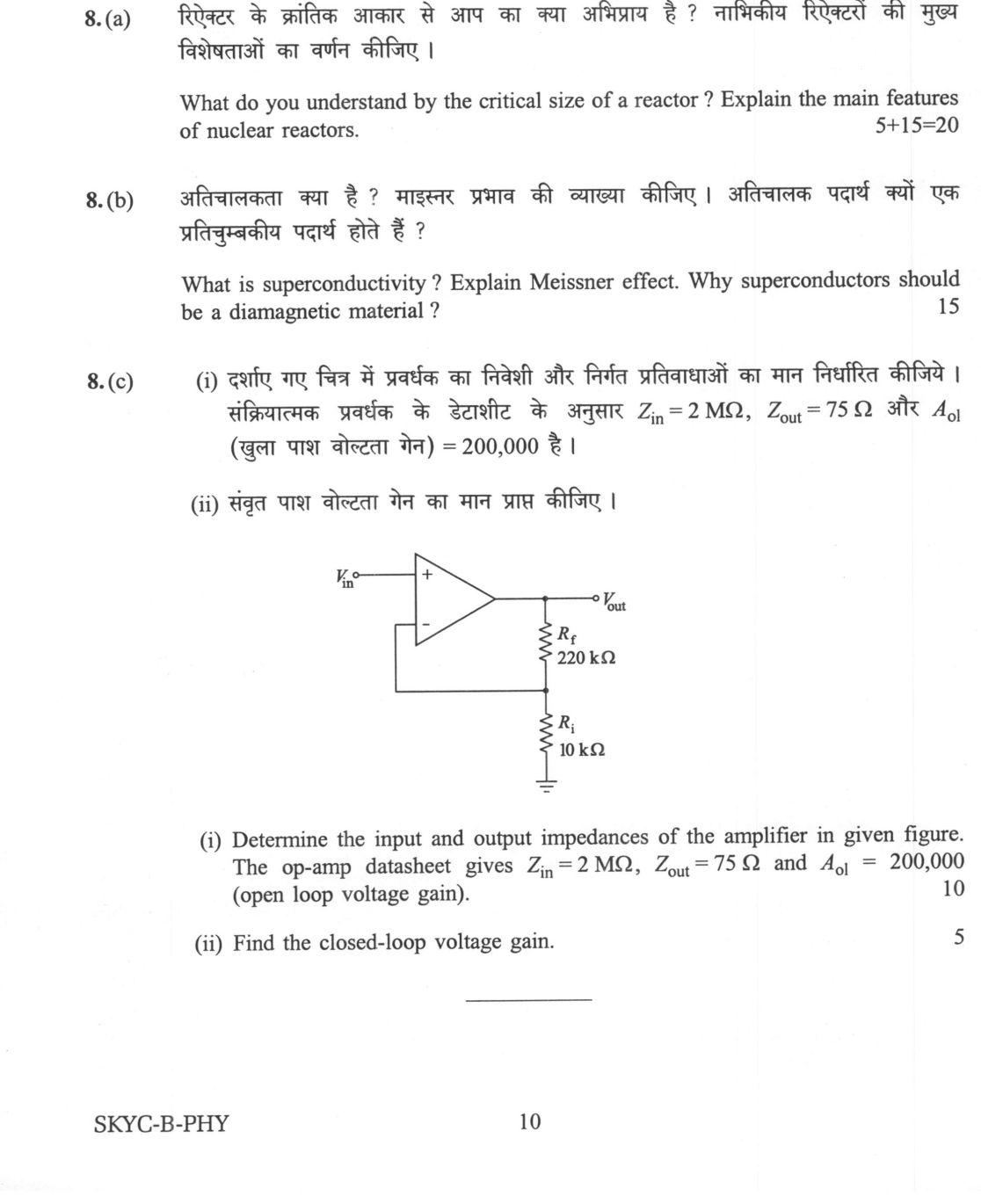
The figure this question refers to, in words
The question paper is a scan and the diagram did not survive as text. This is the figure as read from the original page — every component, value and label — so the question can be worked from the text below.
(c) Circuit diagram of an operational amplifier (op-amp) in a non-inverting configuration. The op-amp is represented by a triangle with a non-inverting input terminal labeled '+' and an inverting input terminal labeled '-'. The input voltage source Vin is connected to the non-inverting terminal. The output terminal is labeled Vout. A feedback network is connected to the inverting terminal, consisting of two resistors in series connected between the output terminal and ground. The upper resistor is labeled Rf with a value of 220 kΩ, and the lower resistor is labeled R1 with a value of 10 kΩ. The inverting input terminal is connected to the junction between Rf and R1.
Model answer
Written by UPSC Answer Check against this question's marking rubric, to the expected length. UPSC does not publish answers for Mains — this is one way to score well, not an official key.
Critical size and reactor features. Critical size is the minimum size of a reactor core for which neutron production equals neutron loss by leakage and absorption, so the effective multiplication factor k_eff is unity. If k_eff is below one, the chain reaction dies away; if above one, power rises. For a given fuel composition, geometry and reflector, there is a corresponding critical mass and critical volume, with critical mass equal to density times critical volume. A sphere minimises surface-to-volume leakage, so it has the lowest critical mass for the same material. A reactor is a controlled fission system. In the fuel, enriched U-235 or Pu-239, fission releases heat and fast neutrons. A moderator, such as heavy water or graphite, slows neutrons to thermal energies where fission probability is higher; Indian heavy-water reactors such as CIRUS and Dhruva, and the PHWR fleet, use heavy water moderator, while PHWRs also use heavy water coolant with natural uranium fuel. Control rods of cadmium or boron absorb neutrons to keep k_eff at unity or shut down the chain reaction. A coolant carries heat to a steam generator or turbine, while biological shielding and containment protect against gamma and neutron radiation. Thus the essential features are fuel, moderator, control system, coolant, shielding and safety systems arranged to maintain a stable, controllable k=1.
Superconductivity and Meissner effect. Superconductivity is a phase below a critical temperature Tc in which DC resistance becomes zero and persistent currents can flow without voltage. The Meissner effect is the expulsion of magnetic flux from the interior when a material enters the superconducting state, so B≈0 inside except within a London penetration depth. The effect is observed whether the field is applied before or after cooling, showing that flux expulsion is a property of the superconducting state rather than a memory of the normal state. Type-I superconductors expel flux completely until a critical field Hc, above which superconductivity is destroyed; Type-II superconductors have Hc1 and Hc2, expelling flux below Hc1 and allowing quantised vortices between Hc1 and Hc2. A superconductor is diamagnetic not because zero resistance alone forbids flux, but because the Meissner state is the thermodynamically stable state: in a weak field, surface screening currents predicted by the London equations lower the magnetic free energy by expelling flux. A perfect conductor could trap pre-existing flux, but a true superconductor minimises Gibbs free energy and therefore shows perfect diamagnetism.
Op-amp feedback analysis. For the given non-inverting amplifier, the feedback network samples the output voltage and returns a fraction to the inverting input. The feedback fraction is β = R1/(R1+Rf) = 10/(10+220) = 0.04348. The loop gain is βAOL = 0.04348 × 200,000 = 8695.65, so 1+βAOL = 8696.65. Since the inverting input is at βVout and the differential input is Vd = Vin − βVout, while Vout = AOL Vd, solving gives Vout/Vin = AOL/(1+βAOL). Voltage-series feedback therefore increases input impedance: the current drawn from the source is Vd/Zin(OL), so Zin(CL)=Zin(OL)(1+βAOL)=2×10^6×8696.65≈1.74×10^10 Ω, i.e. 17.4 GΩ. It reduces output impedance: with the input source shorted, the feedback loop makes the output appear lower by the same loop factor, Zout(CL)=Zout(OL)/(1+βAOL)=75/8696.65≈8.6×10^-3 Ω. The closed-loop gain is ACL=AOL/(1+βAOL)=200,000/8696.65≈23.0, which agrees with the ideal non-inverting result 1+Rf/R1=23. The large loop gain means the finite-gain correction is small: the exact gain is 22.997, only about 0.013 per cent below the ideal value. This is why the datasheet values are transformed by feedback: the source sees a much larger resistance than the bare op-amp, and the load sees a much smaller source resistance. Hence negative feedback makes the amplifier’s gain set by the passive network while making its input very high and output very low.
What "Explain" is asking you to do
Make the working of something clear — what sets it off, what follows from what, and what it produces. Explain is the Commission's mechanism word: it dominates the technical papers and the “explain why” stems, where the marks sit in the causal chain and not in the label.
Structure that answers it
State what it is → the initiating condition → the chain of cause, step by step → an instance where it plays out → what the chain produces
Where marks are lost
Describing what something looks like instead of why it works that way. Naming the stages without linking them reads as description too.
How this answer will be evaluated
Approach
(a) explain: definition/context > points in order > small example > short close | (b) explain: definition/context > points in order > small example > short close | (c) derive: given > assumptions > stepwise derivation > result > check Full marks: Precise definitions, correct derivations with units, clear physical interpretation.
Key points expected
- Critical size definition via k_eff
- Meissner effect explanation
- Non-inverting amplifier gain formula
- Feedback effect on impedances
Evaluation rubric
Each sub-part is marked on its own, against the marks and word limit printed on the paper.
- (a) Define critical size and list main features of nuclear reactors. 20 marks
explain— definition/context → points in order → small example → short close
Must cover
- Define critical size via k_eff = 1
- Explain neutron balance (production vs loss)
- List 4+ main features of nuclear reactors
- Mention role of moderator and control rods
Loses marks
- Vague definition without k_eff
- Listing features without explanation
Earns more
- Distinguish critical, sub-critical, super-critical states
- Mention specific reactor types (PWR, BWR)
- Reference neutron multiplication factor
Extra mark
- Simple diagram of reactor core
- Mention specific fuel isotopes (U-235)
- (b) Define superconductivity, explain Meissner effect, and justify diamagnetism. 15 marks
explain— definition/context → points in order → small example → short close
Must cover
- Define superconductivity (zero resistance below Tc)
- Explain Meissner effect (expulsion of B field)
- Link Meissner effect to perfect diamagnetism
- Mention critical temperature Tc
Loses marks
- Confusing superconductivity with perfect conductivity
- Failing to link Meissner to diamagnetism
Earns more
- Distinguish perfect conductor from superconductor
- Mention London equations
- Reference Type I vs Type II
Extra mark
- Diagram of flux expulsion
- Mention specific superconductors (Hg, Nb)
- (c) Calculate input/output impedances and closed-loop gain for the given op-amp circuit. 15 marks
derive— given → assumptions → stepwise derivation → result → check
Must cover
- Identify circuit as non-inverting amplifier
- Calculate closed-loop gain A_cl = 1 + Rf/R1
- Calculate Z_in with feedback (Z_in * (1 + A_OL * beta))
- Calculate Z_out with feedback (Z_out / (1 + A_OL * beta))
Loses marks
- Using ideal gain formula without feedback correction
- Dropping units in impedance calculations
Earns more
- Show calculation of feedback factor beta
- State assumptions (ideal op-amp limits)
- Carry units in all steps
Extra mark
- Mention effect of finite A_OL
- Compare with ideal values
Practice this exact question
Write your answer and it is marked point by point against the model answer above — what you covered, what you missed, what you got wrong.
Evaluate my answer →More from Physics 2023 Paper II
- Q5 (a) How could you establish that νₑ and ν̄ₑ are two different particles ? 10 marks (b) Wh…
- Q6 (a) Establish the Rutherford's scattering cross section formula for α-particle by conside…
- Q7 (a) Explain classical theory of diamagnetism. Show that the susceptibility of diamagnetic…
- Q8 (a) What do you understand by the critical size of a reactor ? Explain the main features…