Paper II — Q4
(a) A particle constrained to move along x-axis in the domain 0 ≤ x ≤ L has a wave function ψ(x) = sin(nπx/L), where n is an…
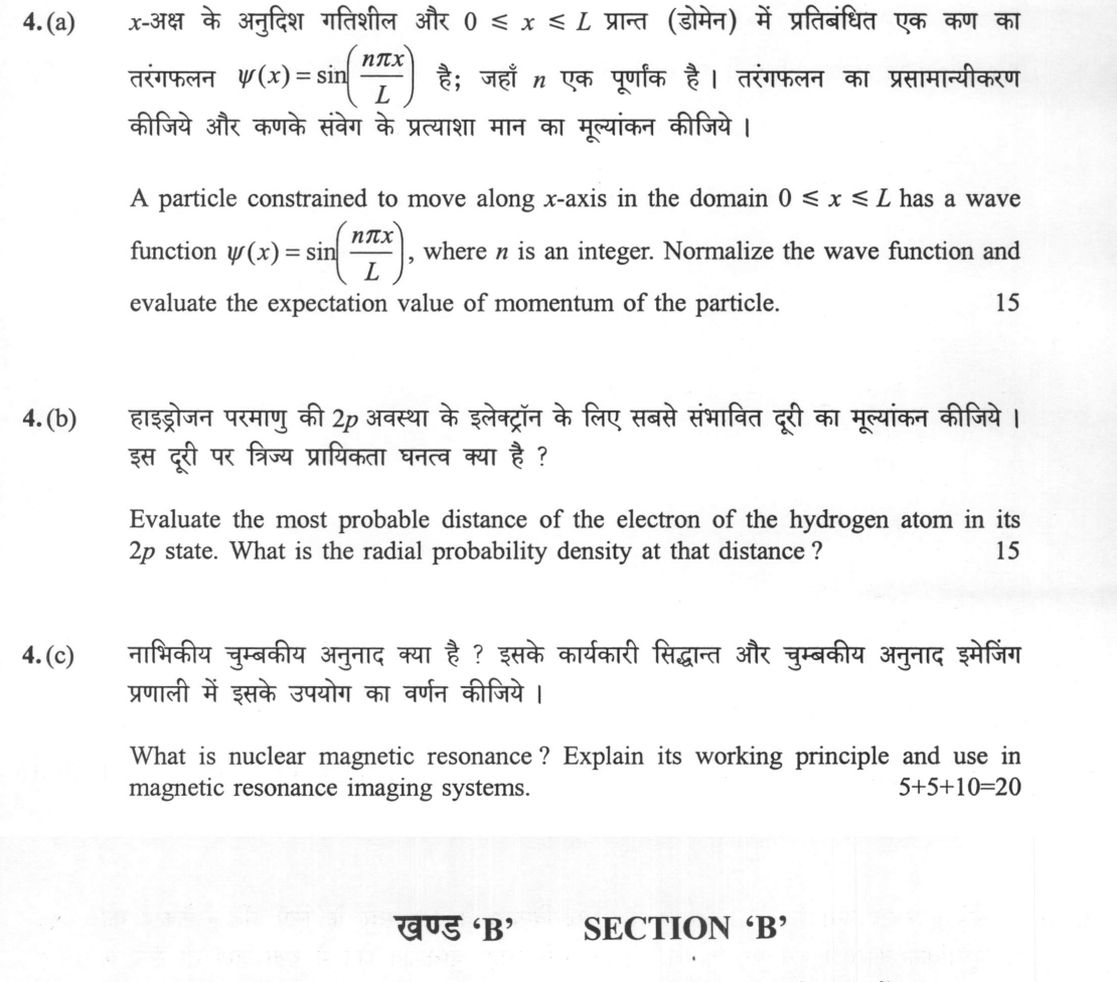
A particle constrained to move along x-axis in the domain 0 ≤ x ≤ L has a wave function ψ(x) = sin(nπx/L), where n is an integer. Normalize the wave function and evaluate the expectation value of momentum of the particle. 15 marks
Evaluate the most probable distance of the electron of the hydrogen atom in its 2p state. What is the radial probability density at that distance ? 15 marks
What is nuclear magnetic resonance ? Explain its working principle and use in magnetic resonance imaging systems. (5+5+10=20 marks)
हिंदी में प्रश्न पढ़ें
x-अक्ष के अनुदिश गतिशील और 0 ≤ x ≤ L प्रांत (डोमेन) में प्रतिबंधित एक कण का तरंगफलन ψ(x) = sin(nπx/L) है; जहाँ n एक पूर्णांक है । तरंगफलन का प्रसामान्यीकरण कीजिये और कणके संवेग के प्रत्याशा मान का मूल्यांकन कीजिये । 15 marks
हाइड्रोजन परमाणु की 2p अवस्था के इलेक्ट्रॉन के लिए सबसे संभावित दूरी का मूल्यांकन कीजिये । इस दूरी पर त्रिज्य प्रायिकता घनत्व क्या है ? 15 marks
नाभिकीय चुंबकीय अनुनाद क्या है ? इसके कार्यकारी सिद्धांत और चुंबकीय अनुनाद इमेजिंग प्रणाली में इसके उपयोग का वर्णन कीजिये । (5+5+10=20)
Model answer
Written by UPSC Answer Check against this question's marking rubric, to the expected length. UPSC does not publish answers for Mains — this is one way to score well, not an official key.
(a)(i) Normalization: Let ψ(x) = A sin(nπx/L). The particle is confined to 0 ≤ x ≤ L, so ψ(0) = ψ(L) = 0, which holds for integer n. The normalization condition is 1 = ∫₀^L |ψ(x)|² dx = |A|² ∫₀^L sin²(nπx/L) dx. Using sin²θ = (1 − cos2θ)/2, ∫₀^L sin²(nπx/L) dx = L/2, for any nonzero integer n. Thus |A|² L/2 = 1, so A = √(2/L). Hence ψ(x) = √(2/L) sin(nπx/L), n = ±1, ±2, … (If n = 0, ψ = 0 and cannot be normalized.)
(a)(ii) Expectation value of momentum: The momentum operator is pₓ = −iħ d/dx. dψ/dx = √(2/L)(nπ/L) cos(nπx/L). Therefore ⟨pₓ⟩ = ∫₀^L ψ* pₓ ψ dx = −iħ(2/L)(nπ/L) ∫₀^L sin(nπx/L) cos(nπx/L) dx. Using sinθ cosθ = (1/2) sin2θ, ∫₀^L sin(nπx/L) cos(nπx/L) dx = (1/2) ∫₀^L sin(2nπx/L) dx = (1/2)[−L/(2nπ) cos(2nπx/L)]₀^L = 0, since cos(2nπ) = cos0 = 1. Thus ⟨pₓ⟩ = 0. Condition: n is a nonzero integer; the wave function is real, so the two opposite momentum components cancel.
(b)(i) Most probable distance in hydrogen 2p state: For hydrogen, the 2p radial wave function is R₂₁(r) = [1/(2√6 a₀√a₀)] (r/a₀) exp(−r/(2a₀)), where a₀ is the Bohr radius. The radial probability density is P(r) = r² |R₂₁(r)|² = r² [1/(24 a₀³)] (r²/a₀²) exp(−r/a₀) = r⁴/(24 a₀⁵) exp(−r/a₀). For the most probable distance, set dP/dr = 0: dP/dr = [1/(24 a₀⁵)] [4r³ exp(−r/a₀) − (r⁴/a₀) exp(−r/a₀)] = [r³ exp(−r/a₀)/(24 a₀⁵)] (4 − r/a₀). Thus r = 0 or r = 4a₀. Since r = 0 and infinity give P = 0, the maximum occurs at r_max = 4a₀.
(b)(ii) Radial probability density at that distance: At r = 4a₀, P(4a₀) = (4a₀)⁴/(24 a₀⁵) e⁻⁴ = 256/(24 a₀) e⁻⁴ = 32/(3 a₀ e⁴). Numerically, P(4a₀) = 0.1954/a₀. If by “radial density” the volume density |R₂₁|² is meant, then |R₂₁(4a₀)|² = 2e⁻⁴/(3a₀³). This result is independent of the magnetic quantum number m.
(c)(i) What is nuclear magnetic resonance? Nuclear magnetic resonance (NMR) is the resonant absorption (or emission during relaxation) of radiofrequency radiation by atomic nuclei that possess nonzero spin and hence a magnetic moment, when placed in a static magnetic field B₀. Examples include ¹H, ¹³C, and ³¹P. In the absence of B₀, the nuclear spin states are degenerate; the static field lifts this degeneracy.
(c)(ii) Working principle: For a spin-1/2 nucleus, the magnetic moment is μ = γ S, where γ is the gyromagnetic ratio. In a static field B₀ along z, the energy is E = −μ·B = −γ S_z B₀. The eigenvalues of S_z are ±ħ/2, so the two energy levels are E_± = ∓(1/2)γħB₀. The energy splitting is ΔE = γħB₀. Resonance occurs when the photon energy matches this splitting: hν = γħB₀, so ν = γB₀/(2π). The corresponding angular Larmor frequency is ω₀ = γB₀. In thermal equilibrium, the population difference between the two levels produces a net magnetization M aligned along B₀. The nuclear moments precess about B₀ at ω₀. A radiofrequency pulse at the Larmor frequency tips M away from B₀; after the pulse, the transverse component of M precesses and induces an oscillating voltage in a receiver coil. This is the free induction decay (FID) signal. The return to equilibrium is described by the longitudinal relaxation time T₁ and the transverse relaxation time T₂. The local electronic environment shifts the effective field, giving chemical shift and J-coupling, which are the basis of NMR spectroscopy. Conditions: the nucleus must have nonzero spin, and a static magnetic field must be present.
(c)(iii) Use in magnetic resonance imaging: MRI applies NMR to protons in water and lipids in tissue. The patient is placed in a strong static field B₀. Gradient coils add a controlled position-dependent field, so that the local Larmor frequency is ω(r) = γ[B₀ + G·r]. A narrow-band RF pulse then excites only a selected slice where the resonance condition is met. Within the slice, phase-encoding and frequency-encoding gradients give the signal a spatial dependence. The received MR signal is a sum of contributions from different positions; Fourier transformation of the encoded data reconstructs the image. Contrast is governed by proton density, T₁, and T₂. By choosing different repetition times TR and echo times TE, one obtains T₁-weighted (TR short, TE short), T₂-weighted (TR long, TE long), or proton-density (TR long, TE short) images. MRI is non-ionizing, provides excellent soft-tissue contrast, and is widely used for imaging the brain, spine, joints, tumors, and for functional brain imaging.
What "Solve" is asking you to do
Choose the method, then carry it through to a final answer. Identifying what kind of problem this is and why that method applies is the first thing marked; a correct figure arrived at invisibly earns almost nothing.
Structure that answers it
Given data and what is required → method chosen, with the reason it applies → set-up (equation, circuit, free body, trial balance) → working, step by step → answer with units and any condition of validity
Where marks are lost
Doing the middle steps mentally and writing only the result. In mathematics papers, a further loss comes from giving a decimal where the exact value in surds or fractions was wanted, or from skipping the justification a part explicitly asks for.
How this answer will be evaluated
Approach
Framework: Principle > Setup and diagram > Derivation > Result and limiting case. (a) calculate: given > formula > substitution > result with units > interpretation | (b) calculate: given > formula > substitution > result with units > interpretation | (c) explain: definition/context > points in order > small example > short close Full marks: Rigorous derivations with correct units and physical interpretation.
Key points expected
- Set up normalization integral ∫|ψ|²dx = 1
- Evaluate integral to find normalization constant N
- State expectation value formula <p> = ∫ψ* (-iħ d/dx) ψ dx
- Show <p> = 0 via integration by parts or symmetry
- Write radial wave function R_21(r) for 2p state
- Define radial probability density P(r) = r²|R_21(r)|²
- Differentiate P(r) and set dP/dr = 0 to find r_max
- Calculate P(r_max) value
Evaluation rubric
Each sub-part is marked on its own, against the marks and word limit printed on the paper.
- (a) Normalized wave function and expectation value of momentum for a particle in a box. 15 marks
calculate— given → formula → substitution → result with units → interpretation
Must cover
- Set up normalization integral ∫|ψ|²dx = 1
- Evaluate integral to find normalization constant N
- State expectation value formula <p> = ∫ψ* (-iħ d/dx) ψ dx
- Show <p> = 0 via integration by parts or symmetry
Loses marks
- Writing <p> = p without integration
- Forgetting the complex conjugate in expectation value
Earns more
- Explicitly state boundary conditions ψ(0)=ψ(L)=0
- Mention that <p²> is non-zero (uncertainty principle)
Extra mark
- Calculate <p²> = (nπħ/L)²
- (b) Most probable distance for 2p electron and radial probability density at that distance. 15 marks
calculate— given → formula → substitution → result with units → interpretation
Must cover
- Write radial wave function R_21(r) for 2p state
- Define radial probability density P(r) = r²|R_21(r)|²
- Differentiate P(r) and set dP/dr = 0 to find r_max
- Calculate P(r_max) value
Loses marks
- Confusing radial probability density with probability density
- Using 2s wave function instead of 2p
Earns more
- Identify r_max = 6a₀ (or 6 Bohr radii)
- Show the specific value of P(r_max)
Extra mark
- Compare with 1s most probable distance (a₀)
- (c) Definition of NMR, working principle, and application in MRI systems. 20 marks
explain— definition/context → points in order → small example → short close
Must cover
- Define NMR as resonance of nuclear spins in magnetic field
- Explain Larmor precession and energy splitting (Zeeman effect)
- Describe RF pulse excitation and relaxation (T1/T2)
- Explain spatial encoding (gradient fields) in MRI
Loses marks
- Confusing NMR with electron spin resonance
- Omitting the role of magnetic field gradients in imaging
Earns more
- Mention specific nuclei (e.g., ¹H) used in MRI
- Describe signal detection via induction in receiver coil
Extra mark
- Mention specific MRI sequences (e.g., spin echo)
Practice this exact question
Write your answer and it is marked point by point against the model answer above — what you covered, what you missed, what you got wrong.
Evaluate my answer →More from Physics 2023 Paper II
- Q1 (a) Calculate the zero point energy for a particle in an infinite potential well for the…
- Q2 (a) An operator P describing the interaction of two spin 1/2 particles is P = a + bσ⃗₁·σ⃗…
- Q3 (a) What is vector atom model ? How the principal features of vector atom model were expl…
- Q4 (a) A particle constrained to move along x-axis in the domain 0 ≤ x ≤ L has a wave functi…
- Q5 (a) How could you establish that νₑ and ν̄ₑ are two different particles ? 10 marks (b) Wh…
- Q6 (a) Establish the Rutherford's scattering cross section formula for α-particle by conside…
- Q7 (a) Explain classical theory of diamagnetism. Show that the susceptibility of diamagnetic…