Paper II — Q2
(a) An operator P describing the interaction of two spin 1/2 particles is P = a + bσ⃗₁·σ⃗₂, where a and b are constants, and σ⃗₁…
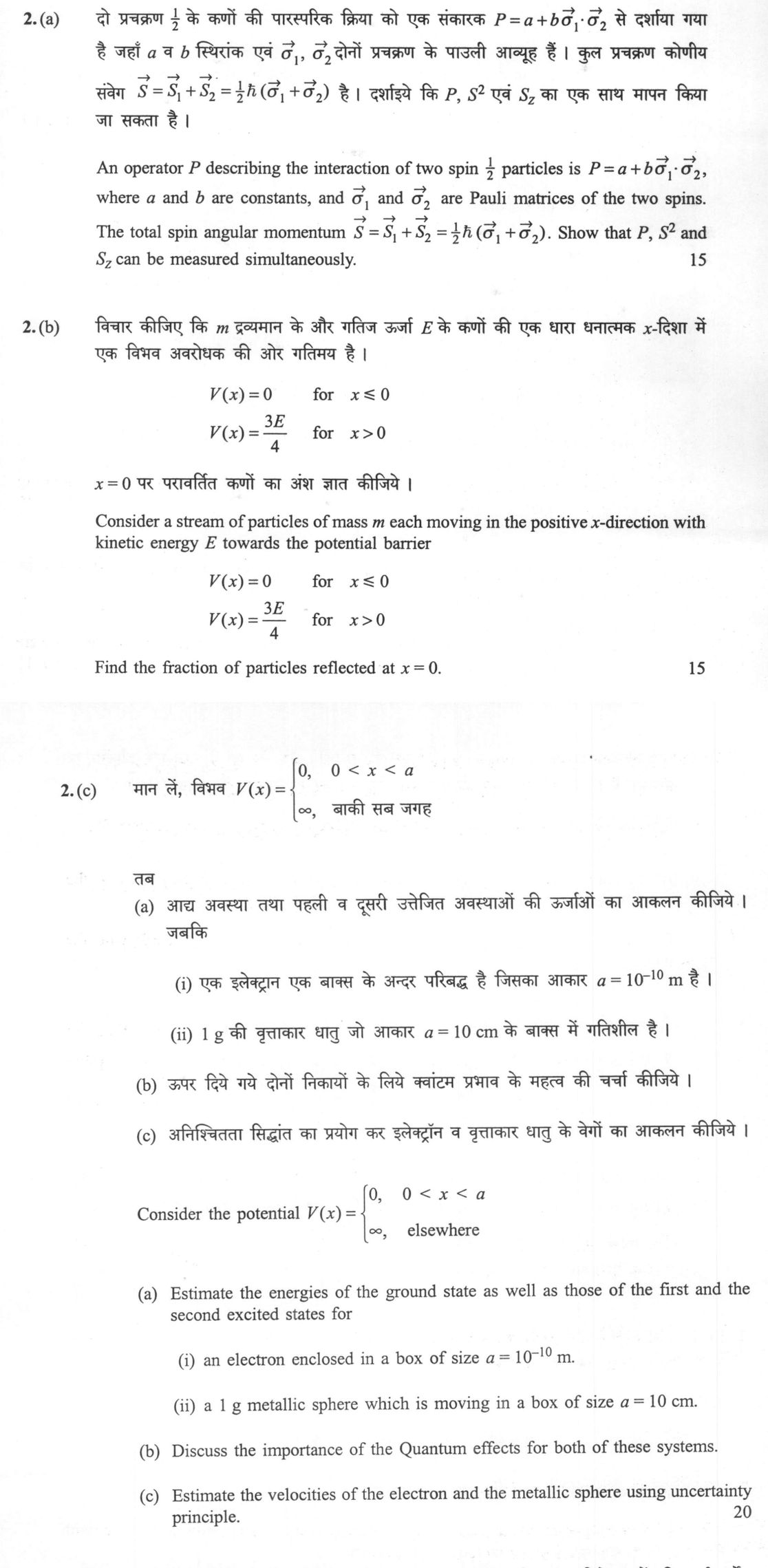
An operator P describing the interaction of two spin 1/2 particles is P = a + bσ⃗₁·σ⃗₂, where a and b are constants, and σ⃗₁ and σ⃗₂ are Pauli matrices of the two spins. The total spin angular momentum S⃗ = S⃗₁ + S⃗₂ = 1/2 ℏ(σ⃗₁ + σ⃗₂). Show that P, S² and Sz can be measured simultaneously. 15 marks
Consider a stream of particles of mass m each moving in the positive x-direction with kinetic energy E towards the potential barrier V(x) = 0 for x ≤ 0, V(x) = 3E/4 for x > 0. Find the fraction of particles reflected at x = 0. 15 marks
Consider the potential V(x) = { 0, 0 < x < a; ∞, elsewhere } (a) Estimate the energies of the ground state as well as those of the first and the second excited states for (i) an electron enclosed in a box of size a = 10⁻¹⁰ m. (ii) a 1 g metallic sphere which is moving in a box of size a = 10 cm.
Discuss the importance of the Quantum effects for both of these systems.
Estimate the velocities of the electron and the metallic sphere using uncertainty principle. 20 marks
हिंदी में प्रश्न पढ़ें
दो प्रचक्रण 1/2 के कणों की पारस्परिक क्रिया को एक संकारक P = a + bσ⃗₁·σ⃗₂ से दर्शाया गया है जहाँ a व b स्थिरांक एवं σ⃗₁, σ⃗₂ दोनों प्रचक्रण के पाउली आव्यूह हैं। कुल प्रचक्रण कोणीय संवेग S⃗ = S⃗₁ + S⃗₂ = 1/2 ℏ(σ⃗₁ + σ⃗₂) है। दर्शाइये कि P, S² एवं Sz का एक साथ मापन किया जा सकता है। 15 अंक
विचार कीजिए कि m द्रव्यमान के और गतिज ऊर्जा E के कणों की एक धारा धनात्मक x-दिशा में एक विभव अवरोधक की ओर गतिमय है। V(x) = 0 for x ≤ 0, V(x) = 3E/4 for x > 0. x = 0 पर परावर्तित कणों का अंश ज्ञात कीजिए। 15 अंक
मान लें, विभव V(x) = { 0, 0 < x < a; ∞, बाकी सब जगह } तब (a) आर्य अवस्था तथा पहली व दूसरी उत्तेजित अवस्थाओं की ऊर्जाओं का आकलन कीजिए। जबकि (i) एक इलेक्ट्रॉन एक बाक्स के अंदर परिबद्ध है जिसका आकार a = 10⁻¹⁰ m है। (ii) 1 g की बृत्ताकार धातु जो आकार a = 10 cm के बाक्स में गतिशील है। (b) ऊपर दिये गये दोनों निकायों के लिये क्वांटम प्रभाव के महत्व की चर्चा कीजिए। (c) अनिश्चितता सिद्धांत का प्रयोग कर इलेक्ट्रॉन व बृत्ताकार धातु के वेगों का आकलन कीजिए। 20 अंक
Model answer
Written by UPSC Answer Check against this question's marking rubric, to the expected length. UPSC does not publish answers for Mains — this is one way to score well, not an official key.
(a) For two spin-1/2 particles, S⃗ = (ℏ/2)(σ⃗₁ + σ⃗₂). Hence S² = (ℏ²/4)(σ⃗₁ + σ⃗₂)² = (ℏ²/4)(σ₁² + σ₂² + 2σ⃗₁·σ⃗₂). Since σ₁² = σ₂² = 3I, S² = (ℏ²/4)(6I + 2σ⃗₁·σ⃗₂) = (ℏ²/2)(3I + σ⃗₁·σ⃗₂). Therefore σ⃗₁·σ⃗₂ = (2/ℏ²)S² − 3I. Thus P = aI + bσ⃗₁·σ⃗₂ = aI + b[(2/ℏ²)S² − 3I] = (a − 3b)I + (2b/ℏ²)S². So P is a function of S². Hence [P, S²] = 0. Also S² commutes with Sz because S² is rotationally invariant and Sz is a component of the same total spin. Therefore [P, Sz] = 0. Thus P, S² and Sz are mutually commuting observables and can be measured simultaneously.
Their simultaneous eigenstates are total-spin states:
- Singlet, S = 0: P = a − 3b, Sz = 0.
- Triplet, S = 1: P = a + b, Sz = ℏ, 0, −ℏ.
(b) Let k = √(2mE)/ℏ. In region x ≤ 0, ψ = A e^ikx + B e^−ikx. For x > 0, V = 3E/4, so kinetic energy is E − 3E/4 = E/4. Thus q = √(2m(E/4))/ℏ = k/2, and ψ = C e^iqx. Matching ψ and ψ′ at x = 0: A + B = C, ik(A − B) = iqC. Using q = k/2: k(A − B) = (k/2)C, so A − B = C/2. Substitute C = A + B: A − B = (A + B)/2 ⟹ 2A − 2B = A + B ⟹ A = 3B. Hence B/A = 1/3. Reflection fraction R = |B/A|² = 1/9. Transmission fraction is 8/9. This holds because E > V₀ = 3E/4.
(c)(a)(i) For an infinite well, Eₙ = n²π²ℏ²/(2ma²). For electron, m = 9.109 × 10⁻³¹ kg, a = 10⁻¹⁰ m: E₁ = π²(1.0546 × 10⁻³⁴)²/(2 × 9.109 × 10⁻³¹ × 10⁻²⁰) = 6.03 × 10⁻¹⁸ J = 37.6 eV. Ground state: E₁ ≈ 37.6 eV. First excited state: E₂ = 4E₁ = 2.41 × 10⁻¹⁷ J = 150.5 eV. Second excited state: E₃ = 9E₁ = 5.42 × 10⁻¹⁷ J = 338.6 eV.
(c)(a)(ii) For metallic sphere, m = 1 g = 10⁻³ kg, a = 10 cm = 0.10 m: E₁ = π²(1.0546 × 10⁻³⁴)²/(2 × 10⁻³ × 0.10²) = 5.49 × 10⁻⁶³ J = 3.43 × 10⁻⁴⁴ eV. Ground state: E₁ ≈ 5.49 × 10⁻⁶³ J. First excited: E₂ = 4E₁ = 2.20 × 10⁻⁶² J. Second excited: E₃ = 9E₁ = 4.94 × 10⁻⁶² J.
(c)(b) For the electron, spacing between levels is of order eV, and the de Broglie wavelength is comparable to the box size. Quantum effects are therefore dominant and the energy spectrum is strongly quantized. For the 1 g sphere, level spacing is about 10⁻⁶² J, while thermal energy at 300 K is about 4 × 10⁻²¹ J. The levels are so closely spaced that the spectrum is effectively continuous. Thus quantum effects are negligible for the macroscopic metallic sphere, while they are essential for the electron.
(c)(c) Using the uncertainty principle, take Δx ≈ a, so Δp ≈ ℏ/a. Then v ≈ Δp/m ≈ ℏ/(ma). For the electron: v ≈ 1.0546 × 10⁻³⁴/(9.109 × 10⁻³¹ × 10⁻¹⁰) = 1.16 × 10⁶ m/s ≈ 10⁶ m/s. Using the exact ground-state energy gives a more precise rms speed ≈ 3.6 × 10⁶ m/s, still nonrelativistic.
For the metallic sphere: v ≈ 1.0546 × 10⁻³⁴/(10⁻³ × 0.10) = 1.05 × 10⁻³⁰ m/s ≈ 10⁻³⁰ m/s. This is practically unobservable, confirming that quantum effects are negligible for the macroscopic sphere.
What "Solve" is asking you to do
Choose the method, then carry it through to a final answer. Identifying what kind of problem this is and why that method applies is the first thing marked; a correct figure arrived at invisibly earns almost nothing.
Structure that answers it
Given data and what is required → method chosen, with the reason it applies → set-up (equation, circuit, free body, trial balance) → working, step by step → answer with units and any condition of validity
Where marks are lost
Doing the middle steps mentally and writing only the result. In mathematics papers, a further loss comes from giving a decimal where the exact value in surds or fractions was wanted, or from skipping the justification a part explicitly asks for.
How this answer will be evaluated
Approach
(a) justify: claim > 3-4 reasons > evidence > conclusion | (b) calculate: given > formula > substitution > result with units > interpretation | (c) calculate: given > formula > substitution > result with units > interpretation Full marks: Rigorous derivations with correct physical interpretation and units.
Key points expected
- State condition [A,B]=0 for simultaneous measurement
- Express P in terms of S² using σ₁·σ₂
- Show [P, S²] = 0
- Show [P, Sz] = 0 and [S², Sz] = 0
- Write wavefunctions for x<0 and x>0
- Apply boundary conditions at x=0
- Derive reflection coefficient R = |B/A|²
- Substitute k values to find R = 1/9
Evaluation rubric
Each sub-part is marked on its own, against the marks and word limit printed on the paper.
- (a) Prove simultaneous measurability of P, S², and Sz via commutators. 15 marks
justify— claim → 3-4 reasons → evidence → conclusion
Must cover
- State condition [A,B]=0 for simultaneous measurement
- Express P in terms of S² using σ₁·σ₂
- Show [P, S²] = 0
- Show [P, Sz] = 0 and [S², Sz] = 0
Loses marks
- Assuming commutation without proof
- Confusing S² with Sz
Earns more
- Explicit calculation of Pauli matrix commutators
- Identification of P as a function of S²
Extra mark
- Mention of common eigenstates (singlet/triplet)
- (b) Determine the reflection coefficient for the potential step. 15 marks
calculate— given → formula → substitution → result with units → interpretation
Must cover
- Write wavefunctions for x<0 and x>0
- Apply boundary conditions at x=0
- Derive reflection coefficient R = |B/A|²
- Substitute k values to find R = 1/9
Loses marks
- Ignoring continuity of derivative
- Incorrect wave number for x>0
Earns more
- Correct identification of k₁ and k₂
- Physical interpretation of partial reflection
Extra mark
- Calculation of transmission coefficient T
- (c) Compute energy levels and velocities for electron and sphere in a box. 20 marks
calculate— given → formula → substitution → result with units → interpretation
Must cover
- State E_n formula for infinite potential well
- Calculate E for electron (n=1,2,3)
- Calculate E for sphere (n=1,2,3)
- Estimate velocities using uncertainty principle
Loses marks
- Using wrong mass for electron
- Neglecting uncertainty principle for velocity
Earns more
- Comparison of quantum vs classical scales
- Correct unit conversion for mass and length
Extra mark
- Discussion of de Broglie wavelength
Practice this exact question
Write your answer and it is marked point by point against the model answer above — what you covered, what you missed, what you got wrong.
Evaluate my answer →More from Physics 2023 Paper II
- Q1 (a) Calculate the zero point energy for a particle in an infinite potential well for the…
- Q2 (a) An operator P describing the interaction of two spin 1/2 particles is P = a + bσ⃗₁·σ⃗…
- Q3 (a) What is vector atom model ? How the principal features of vector atom model were expl…
- Q4 (a) A particle constrained to move along x-axis in the domain 0 ≤ x ≤ L has a wave functi…
- Q5 (a) How could you establish that νₑ and ν̄ₑ are two different particles ? 10 marks (b) Wh…