Paper II — Q6
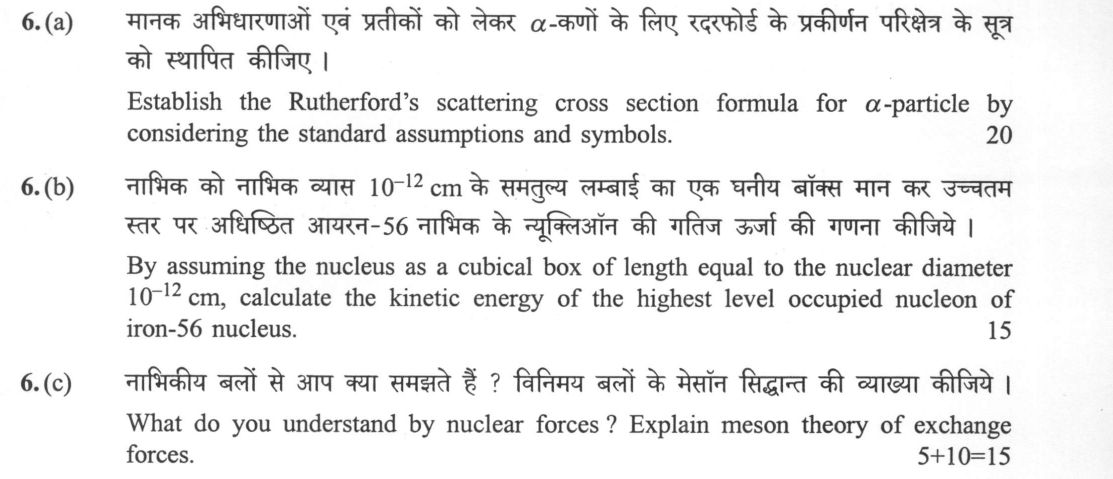
(a) Establish the Rutherford's scattering cross section formula for α-particle by considering the standard assumptions and…
Establish the Rutherford's scattering cross section formula for α-particle by considering the standard assumptions and symbols. 20 marks
By assuming the nucleus as a cubical box of length equal to the nuclear diameter 10⁻¹² cm, calculate the kinetic energy of the highest level occupied nucleon of iron-56 nucleus. 15 marks
What do you understand by nuclear forces ? Explain meson theory of exchange forces. 5+10=15 marks
हिंदी में प्रश्न पढ़ें
मानक अभिधारणाओं एवं प्रतीकों को लेकर α-कणों के लिए रदरफोर्ड के प्रकीर्णन परिछेत्र के सूत्र को स्थापित कीजिए । 20
नाभिक को नाभिक व्यास 10⁻¹² cm के समतुल्य लम्बाई का एक घनीय बॉक्स मान कर उच्चतम स्तर पर अधिष्ठित आयरन-56 नाभिक के न्यूक्लिऑन की गतिज ऊर्जा की गणना कीजिये । 15
नाभिकीय बलों से आप क्या समझते हैं ? विनिमय बलों के मेसॉन सिद्धांत की व्याख्या कीजिये । 5+10=15
Model answer
Written by UPSC Answer Check against this question's marking rubric, to the expected length. UPSC does not publish answers for Mains — this is one way to score well, not an official key.
(a) Let the α-particle have charge q₁ = z e and the nucleus q₂ = Z e. Assume a point Coulomb field V(r) = k q₁q₂/r, with k = 1/(4π ε₀), target infinitely heavy, non-relativistic single scattering, impact parameter b, incident kinetic energy E = ½ m v₀². Angular momentum is L = m v₀ b = m r²(dφ/dt).
Use the Binet orbit equation for a central force: u'' + u = - m F(1/u)/(L² u²), u = 1/r. For the repulsive Coulomb force F = k q₁q₂/r² = k q₁q₂ u², so u'' + u = - m k q₁q₂/L². Put α = m k q₁q₂/L². The solution is u = α(ε cos φ − 1), where ε is the eccentricity. At infinity u = 0, so ε cos φ₀ = 1, where φ₀ is the asymptote angle. For repulsive scattering, θ = π − 2φ₀, hence sin(θ/2) = cos φ₀ = 1/ε.
The energy is E = (L²/2m)(u'² + u²) + k q₁q₂ u. Substituting u = α(ε cos φ − 1) and simplifying gives ε² − 1 = 2 E L²/(m (k q₁q₂)²). Since E = ½ m v₀² and L = m v₀ b, ε² − 1 = (m v₀² b/(k q₁q₂))². Therefore cot(θ/2) = √(ε² − 1) = m v₀² b/(k q₁q₂), so b = k q₁q₂/(m v₀²) cot(θ/2) = q₁q₂/(8π ε₀ E) cot(θ/2).
For central scattering, dσ/dΩ = (b/sinθ)|db/dθ|. With A = q₁q₂/(8π ε₀ E), b = A cot(θ/2), db/dθ = −(A/2)csc²(θ/2). Thus dσ/dΩ = [A cot(θ/2)/sinθ]·[(A/2)csc²(θ/2)] = A²/(4 sin⁴(θ/2)). Hence dσ/dΩ = [q₁q₂/(16π ε₀ E)]² csc⁴(θ/2). For α-particle q₁ = 2e, q₂ = Z e: dσ/dΩ = [Z e²/(8π ε₀ E)]² csc⁴(θ/2). This is Rutherford’s scattering cross-section formula. It is valid for classical, non-relativistic, single Coulomb scattering by a very heavy nucleus.
(b) For a particle in a cubical box of side L, E(n₁,n₂,n₃) = [π² ħ²/(2mL²)](n₁² + n₂² + n₃²), n₁,n₂,n₃ = 1,2,3,… Let E₀ = π² ħ²/(2mL²). Given L = 10⁻¹² cm = 10⁻¹⁴ m. Using m ≈ 1.67×10⁻²⁷ kg, E₀ = [π²(1.055×10⁻³⁴)²]/[2(1.67×10⁻²⁷)(10⁻¹⁴)²] J ≈ 3.28×10⁻¹³ J = 2.05 MeV.
For iron-56, Z = 26 protons and N = 30 neutrons. Protons and neutrons are distinct; each spatial level accepts two spin orientations. Order levels by S = n₁² + n₂² + n₃²:
- S = 3: 1 state, capacity 2, cumulative 2
- S = 6: 3 states, capacity 6, cumulative 8
- S = 9: 3 states, capacity 6, cumulative 14
- S = 11: 3 states, capacity 6, cumulative 20
- S = 12: 1 state, capacity 2, cumulative 22
- S = 14: 6 states, capacity 12. For 26 protons, 4 states of S = 14 are filled; for 30 neutrons, 8 states of S = 14 are filled. Hence the highest occupied level has S = 14. The highest energy is E = 14E₀ = 14 × 2.05 MeV ≈ 28.7 MeV. This assumes independent nucleons in an infinite square well and neglects residual nuclear interaction.
(c)(i) Nuclear forces are the strong residual interactions between nucleons that bind protons and neutrons inside the nucleus. Their main features are: short range of order 10⁻¹⁵ m; strong attraction at intermediate distances; a very short-range repulsive core; charge independence and charge symmetry; spin dependence and tensor character; saturation, so nuclear density and binding energy per nucleon remain nearly constant; and exchange character, since they arise from exchange of mesons.
(c)(ii) Yukawa’s meson theory explains nuclear forces as exchange forces. A nucleon emits a virtual meson and another absorbs it, producing an exchange interaction. The range R is fixed by the uncertainty principle: R ≈ ħ/(m c), where m is the exchanged meson mass. For R ≈ 1.4 fm, m c² ≈ 140 MeV, corresponding to the pion. Thus charged pions π⁺ and π⁻ give charge-exchange reactions such as n → p + π⁻, p + π⁻ → n, while neutral pion exchange gives p–p or n–n interactions. The resulting Yukawa potential is V(r) = −(g²/4π) exp(−μr)/r, μ = mπ c/ħ, which gives the correct long-range tail of the nuclear force. Because pions are pseudoscalar particles, their coupling involves spin and isospin operators, yielding spin-dependent and tensor components essential for the deuteron quadrupole moment. Heavy mesons such as ρ and ω exchange account for shorter-range attraction and the strong repulsive core, ensuring nuclear saturation. In this way the exchange of mesons explains both the attractive long-range part and the short-range repulsive behavior of nuclear forces.
What "Derive" is asking you to do
Reach the stated expression from a starting relation, justifying every step. The destination is printed in the question, so only the route earns marks, and the assumptions you work under are part of that route.
Structure that answers it
Assumptions and notation defined → starting relation or governing equation → each step with its justification → the required expression → limiting case or boundary check
Where marks are lost
Writing the standard result first and fitting three lines to it, which an examiner reads at a glance. Marks also go on assumptions left unstated — lossless medium, small amplitude, errors independent with zero mean — and on symbols used before they are defined, even when the question says usual notations.
How this answer will be evaluated
Approach
Framework: Principle > Setup and diagram > Derivation > Result and limiting case. (a) derive: given > assumptions > stepwise derivation > result > check | (b) calculate: given > formula > substitution > result with units > interpretation | (c) explain: definition/context > points in order > small example > short close Full marks: Complete derivation with diagram, correct units, physical interpretation, and limiting cases discussed.
Key points expected
- State standard assumptions (Coulomb force, point nucleus, non-relativistic)
- Draw labelled diagram of scattering geometry
- Derive relation between impact parameter and scattering angle
- Derive final cross section formula dσ/dΩ
- State given: nuclear diameter 10⁻¹² cm, cubical box model
- Use particle-in-a-box energy formula E = (h²/8mL²)(n_x²+n_y²+n_z²)
- Substitute values with correct units (convert cm to m)
- Calculate final kinetic energy in eV or MeV
Evaluation rubric
Each sub-part is marked on its own, against the marks and word limit printed on the paper.
- (a) Derive Rutherford's scattering cross section formula for α-particle. 20 marks
derive— given → assumptions → stepwise derivation → result → check
Must cover
- State standard assumptions (Coulomb force, point nucleus, non-relativistic)
- Draw labelled diagram of scattering geometry
- Derive relation between impact parameter and scattering angle
- Derive final cross section formula dσ/dΩ
Loses marks
- Formula substitution without derivation
- Dropping units or dimensional check
- Missing diagram or unclear geometry
Earns more
- Show conservation of energy and angular momentum
- Define all symbols used in the derivation
- Discuss limiting case of small angle scattering
Extra mark
- Mention experimental verification by Geiger-Marsden
- (b) Calculate kinetic energy of highest occupied nucleon in iron-56 nucleus. 15 marks
calculate— given → formula → substitution → result with units → interpretation
Must cover
- State given: nuclear diameter 10⁻¹² cm, cubical box model
- Use particle-in-a-box energy formula E = (h²/8mL²)(n_x²+n_y²+n_z²)
- Substitute values with correct units (convert cm to m)
- Calculate final kinetic energy in eV or MeV
Loses marks
- Incorrect unit conversion (cm to m)
- Missing quantum number justification
- No final answer with units
Earns more
- Justify choice of quantum numbers for highest occupied level
- Show unit conversion steps explicitly
- Compare result with typical nuclear binding energy
Extra mark
- Mention Fermi gas model as alternative approach
- (c) Define nuclear forces and explain meson theory of exchange forces. 15 marks
explain— definition/context → points in order → small example → short close
Must cover
- Define nuclear forces (short-range, strong, charge-independent)
- Explain Yukawa's meson theory (π-meson exchange)
- Describe potential form V(r) = -g²e⁻ᵐᶜʳ/ℏ / r
- Explain range r = ℏ/(mc) and its physical meaning
Loses marks
- Confusing nuclear force with strong force
- Missing range formula or its derivation
- No mention of meson exchange mechanism
Earns more
- Mention tensor force component
- Compare with electromagnetic force range
- Note that nuclear force is residual strong force
Extra mark
- Reference to Yukawa's 1935 paper or Nobel Prize
Practice this exact question
Write your answer and it is marked point by point against the model answer above — what you covered, what you missed, what you got wrong.
Evaluate my answer →More from Physics 2023 Paper II
- Q3 (a) What is vector atom model ? How the principal features of vector atom model were expl…
- Q4 (a) A particle constrained to move along x-axis in the domain 0 ≤ x ≤ L has a wave functi…
- Q5 (a) How could you establish that νₑ and ν̄ₑ are two different particles ? 10 marks (b) Wh…
- Q6 (a) Establish the Rutherford's scattering cross section formula for α-particle by conside…
- Q7 (a) Explain classical theory of diamagnetism. Show that the susceptibility of diamagnetic…
- Q8 (a) What do you understand by the critical size of a reactor ? Explain the main features…