Paper II — Q5
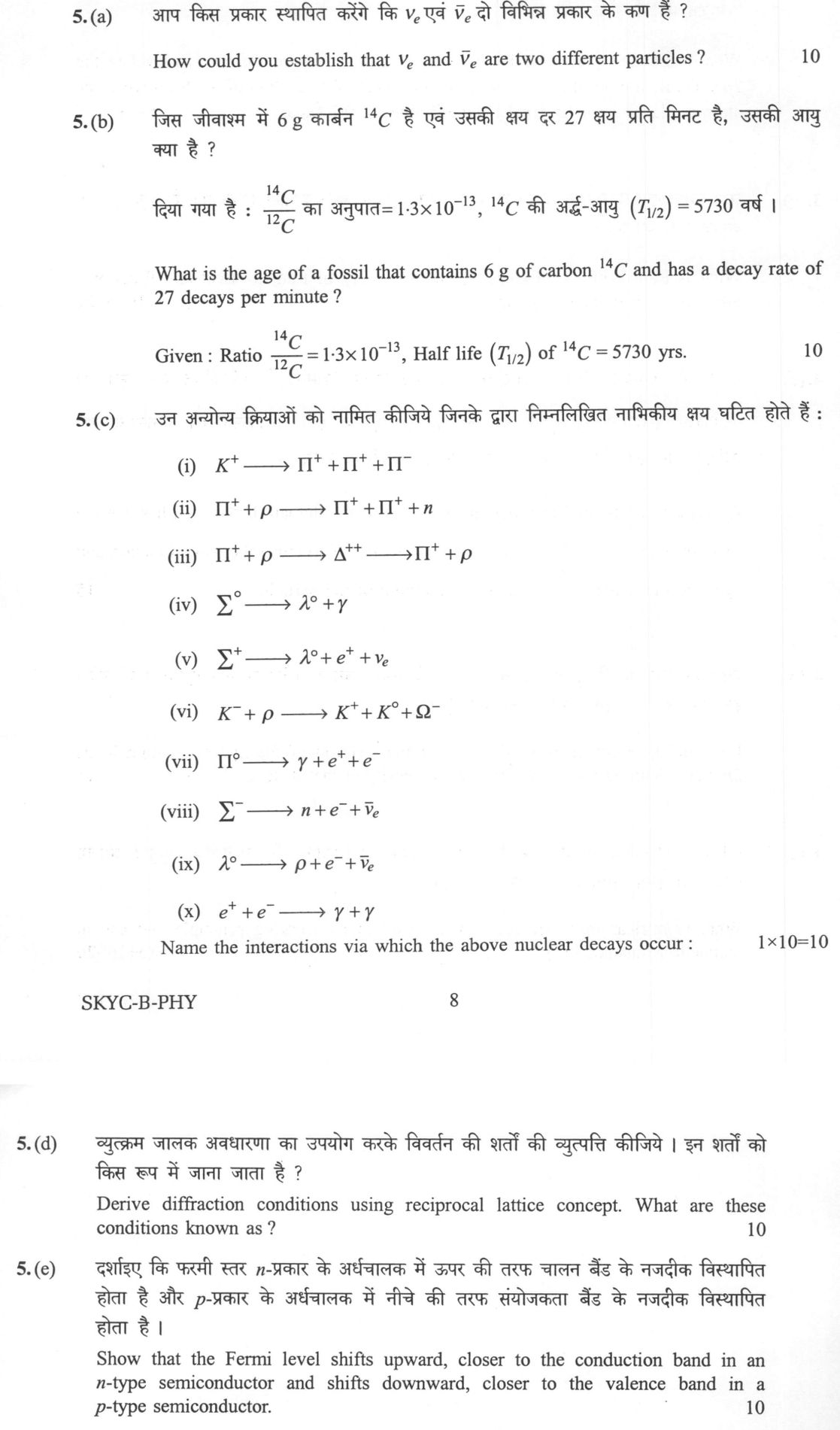
(a) How could you establish that νₑ and ν̄ₑ are two different particles ? 10 marks (b) What is the age of a fossil that contains…
How could you establish that νₑ and ν̄ₑ are two different particles ? 10 marks
What is the age of a fossil that contains 6 g of carbon ¹⁴C and has a decay rate of 27 decays per minute ?
Given : Ratio (¹⁴C)/(¹²C)=1.3×10⁻¹³, Half life(T₁/2)of¹⁴C = 5730 yrs. 10 marks
Name the interactions via which the above nuclear decays occur :
K⁺ → Π⁺ + Π⁺ + Π⁻
Π⁺ + p → Π⁺ + Π⁺ + n
Π⁺ + p → Δ⁺⁺ → Π⁺ + p
Σ^° → Λ^° + γ
Σ⁺ → Λ^° + e⁺ + νₑ
K⁻ + p → K⁺ + K^° + Ω⁻
Π^° → γ + e⁺ + e⁻
Σ⁻ → n + e⁻ + ν̄ₑ
Λ^° → p + e⁻ + ν̄ₑ
e⁺ + e⁻ → γ + γ 10 marks
Derive diffraction conditions using reciprocal lattice concept. What are these conditions known as ? 10 marks
Show that the Fermi level shifts upward, closer to the conduction band in an n-type semiconductor and shifts downward, closer to the valence band in a p-type semiconductor. 10 marks
हिंदी में प्रश्न पढ़ें
आप किस प्रकार स्थापित करेंगे कि νₑ एवं ν̄ₑ दो विभिन्न प्रकार के कण हैं ? 10 marks
जिस जीवाश्म में 6 g कार्बन ¹⁴C है एवं उसकी क्षय दर 27 क्षय प्रति मिनट है, उसकी आयु क्या है ?
दिया गया है : (¹⁴C)/(¹²C) का अनुपात=1.3×10⁻¹³,¹⁴Cकी अर्ध-आयु(T₁/2) = 5730 वर्ष । 10
उन अन्योन्य क्रियाओं को नामित कीजिए जिनके द्वारा निम्नलिखित नाभिकीय क्षय घटित होते हैं :
K⁺ → Π⁺ + Π⁺ + Π⁻
Π⁺ + p → Π⁺ + Π⁺ + n
Π⁺ + p → Δ⁺⁺ → Π⁺ + p
Σ^° → Λ^° + γ
Σ⁺ → Λ^° + e⁺ + νₑ
K⁻ + p → K⁺ + K^° + Ω⁻
Π^° → γ + e⁺ + e⁻
Σ⁻ → n + e⁻ + ν̄ₑ
Λ^° → p + e⁻ + ν̄ₑ
e⁺ + e⁻ → γ + γ 10
व्युत्क्रम जालक अवधारणा का उपयोग करके विवर्तन की शर्तों की व्युत्पत्ति कीजिये । इन शर्तों को किस रूप में जाना जाता है ? 10 marks
दर्शाइए कि फर्मी स्तर n-प्रकार के अर्धचालक में ऊपर की तरफ चालन बैंड के नजदीक विस्थापित होता है और p-प्रकार के अर्धचालक में नीचे की तरफ संयोजकता बैंड के नजदीक विस्थापित होता है । 10
Model answer
Written by UPSC Answer Check against this question's marking rubric, to the expected length. UPSC does not publish answers for Mains — this is one way to score well, not an official key.
(a) The electron neutrino νₑ and electron antineutrino ν̄ₑ are established to be two distinct particles by lepton-number conservation and by their opposite helicities and different weak reactions.
- Lepton number: assign Lₑ(νₑ)=+1 and Lₑ(ν̄ₑ)=−1. In all observed weak processes, total electron lepton number is conserved. Therefore a reaction that produces νₑ cannot be replaced by one producing ν̄ₑ without violating Lₑ conservation.
- Helicity: in the massless limit, νₑ is left-handed, i.e. spin opposite to momentum, while ν̄ₑ is right-handed. The charged weak current couples to left-handed neutrinos and right-handed antineutrinos.
- Charge-current reactions distinguish them. νₑ can initiate νₑ + n → p + e⁻, while ν̄ₑ can initiate ν̄ₑ + p → n + e⁺. The Reines–Cowan experiment detected reactor ν̄ₑ through the second reaction by observing positron–neutron coincidences. Solar νₑ are detected by radiochemical experiments such as νₑ + ³⁷Cl → ³⁷Ar + e⁻.
- If νₑ and ν̄ₑ were the same particle, both inverse-beta reactions would be allowed for the same particle and lepton number would not be conserved. Thus νₑ and ν̄ₑ are distinct particle and antiparticle.
(b) Use the radioactive-decay law A = A₀ exp(−λt), with λ = ln2 / T₁/₂. The half-life is T₁/₂ = 5730 yr = 5730 × 3.156 × 10⁷ s = 1.808 × 10¹¹ s. Hence λ = 0.693 / (1.808 × 10¹¹) = 3.835 × 10⁻¹² s⁻¹.
For 6 g of carbon, the number of ¹²C atoms is N(¹²C) = (6 / 12) × 6.022 × 10²³ = 3.011 × 10²³. Using the printed ratio ¹⁴C/¹²C = 1.3 × 10⁻¹³, N₀(¹⁴C) = 3.011 × 10²³ × 1.3 × 10⁻¹³ = 3.914 × 10¹⁰. Initial activity: A₀ = λN₀ = 3.835 × 10⁻¹² × 3.914 × 10¹⁰ = 0.150 s⁻¹ = 9.0 decays/min. But the stated current activity is 27 decays/min, which is larger than this A₀. The current number of ¹⁴C atoms implied by 27 decays/min is N = A/λ = (27/60) / (3.835 × 10⁻¹²) = 1.173 × 10¹¹. This is larger than the initial number 3.914 × 10¹⁰ computed from the printed ratio. Therefore the printed ratio 1.3 × 10⁻¹³ is inconsistent with the other data for a 6 g carbon sample; no physically positive age follows from it.
If the standard living ratio ¹⁴C/¹²C = 1.3 × 10⁻¹² is intended, then N₀ = 3.914 × 10¹¹, so A₀ = 90 decays/min. Then t = (1/λ) ln(A₀/A) = (T₁/₂ / ln2) ln(A₀/A) = (5730 / 0.693) ln(90 / 27) = 8268 × ln(3.333) = 8268 × 1.204 = 9.95 × 10³ yr. Age ≈ 9.95 × 10³ years using the ratio required for consistency with the measured activity. This assumes a closed system, no contamination, and a constant initial ¹⁴C/¹²C ratio.
(c) (i) K⁺ → Π⁺ + Π⁺ + Π⁻ : weak interaction, since strangeness changes, ΔS = 1. (ii) Π⁺ + p → Π⁺ + Π⁺ + n : strong interaction, no strangeness change. (iii) Π⁺ + p → Δ⁺⁺ → Π⁺ + p : strong interaction, through the Δ⁺⁺ resonance. (iv) Σ⁰ → Λ⁰ + γ : electromagnetic interaction. (v) Σ⁺ → Λ⁰ + e⁺ + νₑ : weak interaction, semileptonic charged-current decay, with ΔS = 0. (vi) K⁻ + p → K⁺ + K⁰ + Ω⁻ : strong interaction, associated production with strangeness conserved. (vii) Π⁰ → γ + e⁺ + e⁻ : electromagnetic interaction, Dalitz decay of Π⁰. (viii) Σ⁻ → n + e⁻ + ν̄ₑ : weak interaction, ΔS = 1 semileptonic decay. (ix) Λ⁰ → p + e⁻ + ν̄ₑ : weak interaction, ΔS = 1 semileptonic decay. (x) e⁺ + e⁻ → γ + γ : electromagnetic interaction, electron–positron annihilation.
(d) Let the direct lattice be generated by a, b, c. The reciprocal lattice is defined by a* = 2π (b × c) / [a · (b × c)], b* = 2π (c × a) / [a · (b × c)], c* = 2π (a × b) / [a · (b × c)]. Thus a · a* = 2π, b · b* = 2π, c · c* = 2π, while a · b* = a · c* = 0, etc. Any reciprocal lattice vector is G = h a* + m b* + n c*, where h, m, n are integers.
Let the incident wave vector be k₀ and the scattered wave vector be k₁. For elastic scattering, |k₀| = |k₁| = 2π / λ. The phase difference between waves scattered from two lattice points separated by R = n₁a + n₂b + n₃c is φ = (k₁ − k₀) · R. For constructive interference from the entire lattice, φ must be 2π times an integer for every lattice vector R. Therefore (k₁ − k₀) · R = 2π × integer. Taking R = a, b, c separately gives the Laue equations: (k₁ − k₀) · a = 2πh, (k₁ − k₀) · b = 2πm, (k₁ − k₀) · c = 2πn. These are satisfied precisely when k₁ − k₀ = h a* + m b* + n c* = G. Hence the diffraction condition in reciprocal-lattice form is k₁ = k₀ + G. This is the Laue diffraction condition.
For the Bragg form, let the incident and scattered beams make angle θ with a set of lattice planes. Then |G| = |k₁ − k₀| = 2|k₀| sinθ = 4π sinθ / λ. For planes of spacing d, the reciprocal lattice vector magnitude is |G| = 2πN / d, where N is the order. Equating gives 4π sinθ / λ = 2πN / d, so 2d sinθ = Nλ. Thus the conditions are known as the Laue diffraction conditions; the equivalent angle form is Bragg’s law.
(e) For a semiconductor, the electron and hole concentrations are n = N_c exp[−(E_c − E_F) / k_B T], p = N_v exp[−(E_F − E_v) / k_B T]. The intrinsic carrier concentration nᵢ satisfies nᵢ = N_c exp[−(E_c − E_i) / k_B T] = N_v exp[−(E_i − E_v) / k_B T], where E_i is the intrinsic Fermi level. Therefore n = nᵢ exp[(E_F − E_i) / k_B T], p = nᵢ exp[(E_i − E_F) / k_B T], and the mass-action law gives np = nᵢ².
For an n-type semiconductor, donor impurities supply conduction electrons. When donors are fully ionized and N_D ≫ nᵢ, charge neutrality gives approximately n ≈ N_D. Thus n > nᵢ. From n / nᵢ = exp[(E_F − E_i) / k_B T] > 1, we get E_F > E_i. Therefore the Fermi level shifts upward from the intrinsic level toward the conduction band. Equivalently, E_c − E_F = k_B T ln(N_c / N_D). Since N_D > nᵢ, this separation is smaller than the intrinsic separation E_c − E_i, so E_F lies closer to E_c.
For a p-type semiconductor, acceptor impurities create holes. When acceptors are fully ionized and N_A ≫ nᵢ, p ≈ N_A > nᵢ. From p / nᵢ = exp[(E_i − E_F) / k_B T] > 1, we get E_i > E_F. Thus the Fermi level shifts downward from the intrinsic level toward the valence band. Equivalently, E_F − E_v = k_B T ln(N_v / N_A). Since N_A > nᵢ, this separation is smaller than the intrinsic separation E_i − E_v, so E_F lies closer to E_v. In heavily doped cases, E_F can even enter the conduction or valence band.
What "Derive" is asking you to do
Reach the stated expression from a starting relation, justifying every step. The destination is printed in the question, so only the route earns marks, and the assumptions you work under are part of that route.
Structure that answers it
Assumptions and notation defined → starting relation or governing equation → each step with its justification → the required expression → limiting case or boundary check
Where marks are lost
Writing the standard result first and fitting three lines to it, which an examiner reads at a glance. Marks also go on assumptions left unstated — lossless medium, small amplitude, errors independent with zero mean — and on symbols used before they are defined, even when the question says usual notations.
How this answer will be evaluated
Approach
Framework: Conservation laws and quantum field theory. (a) explain: definition/context > points in order > small example > short close | (b) derive: given > assumptions > stepwise derivation > result > check | (c) explain: definition/context > points in order > small example > short close | (d) derive: given > assumptions > stepwise derivation > result > check | (e) explain: definition/context > points in order > small example > short close Full marks: Complete derivations with all steps, correct units, and physical interpretation.
Key points expected
- Lepton number conservation distinguishes νₑ and ν̄ₑ
- Radioactive decay law R = λN with λ = ln2/T₁/₂
- Strong, electromagnetic, and weak interactions identified by conservation laws
- Reciprocal lattice vector G and Laue condition lead to Bragg's law
- Fermi level shifts due to charge neutrality in doped semiconductors
Evaluation rubric
Each sub-part is marked on its own, against the marks and word limit printed on the paper.
- (a) Distinguish neutrino and antineutrino via lepton number and decay products. 10 marks
explain— definition/context → points in order → small example → short close
Must cover
- Define lepton number L for νₑ and ν̄ₑ
- Cite β⁻ decay producing ν̄ₑ
- Cite β⁺ decay producing νₑ
- State lepton number conservation law
Loses marks
- Confusing neutrino with antineutrino
- Ignoring lepton number conservation
Earns more
- Mention neutrino-antineutrino annihilation
- Reference Pauli's original hypothesis
Extra mark
- Mention neutrino oscillation experiments
- (b) Calculate fossil age using radioactive decay law and given half-life. 10 marks
derive— given → assumptions → stepwise derivation → result → check
Must cover
- Calculate total carbon mass from ratio
- Determine number of ¹⁴C atoms N
- Use decay rate R = λN
- Solve for age t using half-life
Loses marks
- Skipping atom number calculation
- Incorrect unit conversion
Earns more
- Show unit conversions explicitly
- State decay constant λ = ln2/T₁/₂
Extra mark
- Mention carbon dating limitations
- (c) Identify interaction type for each of the ten nuclear decays. 10 marks
explain— definition/context → points in order → small example → short close
Must cover
- Identify strong interaction decays
- Identify electromagnetic interaction decays
- Identify weak interaction decays
- Justify each via conservation laws
Loses marks
- Misidentifying weak as strong
- Ignoring charge conservation
Earns more
- Mention strangeness conservation
- Note baryon number conservation
Extra mark
- Mention typical timescales for each interaction
- (d) Derive Bragg's law using reciprocal lattice vectors. 10 marks
derive— given → assumptions → stepwise derivation → result → check
Must cover
- Define reciprocal lattice vector G
- State Laue condition k' - k = G
- Derive 2d sinθ = nλ
- Name as Bragg's law
Loses marks
- Skipping reciprocal lattice definition
- Not naming Bragg's law
Earns more
- Show Ewald sphere construction
- Relate G to Miller indices
Extra mark
- Mention structure factor
- (e) Show Fermi level shift in n-type and p-type semiconductors. 10 marks
explain— definition/context → points in order → small example → short close
Must cover
- Define Fermi level position
- Show n-type shifts toward conduction band
- Show p-type shifts toward valence band
- Use charge neutrality condition
Loses marks
- Confusing n-type and p-type shifts
- Ignoring charge neutrality
Earns more
- Draw energy band diagrams
- Mention donor/acceptor levels
Extra mark
- Mention temperature dependence
Practice this exact question
Write your answer and it is marked point by point against the model answer above — what you covered, what you missed, what you got wrong.
Evaluate my answer →More from Physics 2023 Paper II
- Q2 (a) An operator P describing the interaction of two spin 1/2 particles is P = a + bσ⃗₁·σ⃗…
- Q3 (a) What is vector atom model ? How the principal features of vector atom model were expl…
- Q4 (a) A particle constrained to move along x-axis in the domain 0 ≤ x ≤ L has a wave functi…
- Q5 (a) How could you establish that νₑ and ν̄ₑ are two different particles ? 10 marks (b) Wh…
- Q6 (a) Establish the Rutherford's scattering cross section formula for α-particle by conside…
- Q7 (a) Explain classical theory of diamagnetism. Show that the susceptibility of diamagnetic…
- Q8 (a) What do you understand by the critical size of a reactor ? Explain the main features…