Paper II — Q7
(a) Explain classical theory of diamagnetism. Show that the susceptibility of diamagnetic substances is directly proportional to…
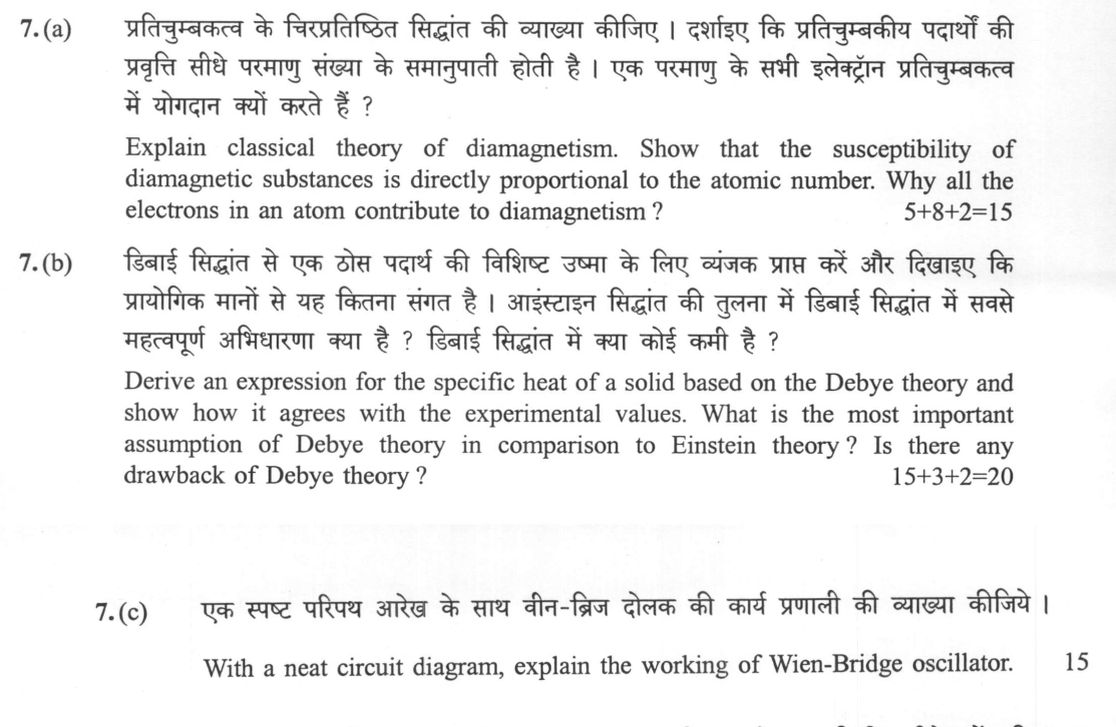
Explain classical theory of diamagnetism. Show that the susceptibility of diamagnetic substances is directly proportional to the atomic number. Why all the electrons in an atom contribute to diamagnetism ? 5+8+2=15
Derive an expression for the specific heat of a solid based on the Debye theory and show how it agrees with the experimental values. What is the most important assumption of Debye theory in comparison to Einstein theory ? Is there any drawback of Debye theory ? 15+3+2=20
With a neat circuit diagram, explain the working of Wien-Bridge oscillator. 15 marks
हिंदी में प्रश्न पढ़ें
प्रतिचुंबकत्व के चिरप्रतिष्ठित सिद्धांत की व्याख्या कीजिए । दर्शाइए कि प्रतिचुंबकीय पदार्थों की प्रवृत्ति सीधे परमाणु संख्या के समानुपाती होती है । एक परमाणु के सभी इलेक्ट्रॉन प्रतिचुंबकत्व में योगदान क्यों करते हैं ? 5+8+2=15
डिबाई सिद्धांत से एक ठोस पदार्थ की विशिष्ट ऊष्मा के लिए व्यंजक प्राप्त करें और दिखाइए कि प्रायोगिक मानों से यह कितना संगत है । आइंस्टाइन सिद्धांत की तुलना में डिबाई सिद्धांत में सबसे महत्वपूर्ण अभिधारणा क्या है ? डिबाई सिद्धांत में क्या कोई कमी है ? 15+3+2=20
एक स्पष्ट परिपथ आरेख के साथ वीन-ब्रिज दोलक की कार्य प्रणाली की व्याख्या कीजिए । 15
Model answer
Written by UPSC Answer Check against this question's marking rubric, to the expected length. UPSC does not publish answers for Mains — this is one way to score well, not an official key.
Part (a): Classical diamagnetism. In a magnetic field B, each bound electron’s orbital motion is slightly altered by the Lorentz force. The orbit acquires a Larmor precession about the field axis with angular velocity Ω = −eB/2mₑ. For an electron, the induced magnetic moment is opposite to B. Using the perpendicular radius ρ to the field and averaging over an isotropic atom, ⟨ρ²⟩ = (2/3)⟨r²⟩, the change in moment per electron is Δμ = −(e²B/6mₑ)⟨r²⟩. For a neutral atom with Z electrons, Δμ_atom = −(e²B/6mₑ)Σᵢ⟨rᵢ²⟩. If N atoms per unit volume, M = NΔμ_atom and B = μ0H, so χ = M/H = −μ0N e²/(6mₑ)Σᵢ⟨rᵢ²⟩. For comparable mean-square radii, Σᵢ⟨rᵢ²⟩ ≈ Z⟨r²⟩, giving χ = −μ0NZ e²⟨r²⟩/(6mₑ). The negative sign is the defining feature of diamagnetism, and for similar atoms the magnitude is directly proportional to Z. All electrons contribute because the Larmor term depends only on charge, mass and orbital radius, not on the shell’s permanent moment; in closed shells permanent orbital and spin moments cancel, so the induced moments of every electron add rather than cancel. Even in partially filled shells, the induced term exists for every electron, though paramagnetism may mask it.
Part (b): Debye theory. Debye treats the solid as 3N harmonic oscillators whose low-frequency acoustic phonons have linear dispersion ω = vₛ k. The density of states is taken as g(ω)=9Nω²/ω_D³, normalized so ∫0^ωD g(ω)dω=3N. The thermal energy is U=∫0^ωD ℏω/(e^ℏω/kT−1)g(ω)dω. Differentiating, C_V=dU/dT. With x=ℏω/kT and θ_D=ℏω_D/k, C_V=9Nk_B(T/θ_D)³∫0^θ_D/T x⁴e^x/(e^x−1)²dx; for one mole, replace 9Nk_B by 9R. At high T, θ_D/T≪1; expanding the integrand gives C_V≈3Nk_B=3R, the Dulong–Petit law. At low T, θ_D/T≫1; the integral tends to 4π⁴/15, so C_V≈(12π⁴/5)Nk_B(T/θ_D)³, the T³ law. The integral is the Debye function, and a universal plot of C_V/3R against T/θ_D matches data. Copper, lead and diamond show a linear C_V versus T³ region at low temperatures, from which θ_D is extracted (about 340 K for Cu, 105 K for Pb, 2200 K for diamond), and approach 3R at high T. The key assumption, unlike Einstein’s single-frequency model, is a continuous acoustic-phonon spectrum up to a cutoff, which supplies the missing low-frequency modes; Einstein’s model instead gives an exponential low-temperature fall-off. Its drawbacks are the isotropic-solid and linear-dispersion assumptions, use of one average sound velocity, and neglect of optical phonons, so it is not exact at intermediate temperatures or in crystals with strong optical modes.
Part (c): Wien-Bridge oscillator. The circuit is a bridge whose two arms are frequency-dependent: Z1 is R1 in series with C1, and Z2 is R2 in parallel with C2; the other two arms are resistors R3 and R4. In the diagram, the amplifier output drives the bridge nodes, and the junction of R3 and R4 returns to the non-inverting input. At balance, Z1Z4=Z2Z3. For R1=R2=R and C1=C2=C, this condition is satisfied at ω=1/RC, so f=1/(2πRC), and the bridge output is in phase with the input. The phase shifts of the two RC arms make the bridge output in phase with the input only at this frequency, so the Barkhausen phase condition is met only at the Wien frequency. The voltage division in the resistive arms gives a feedback fraction of 1/3 when R3/R4=2, so the amplifier must have a gain of 3; this is the Barkhausen amplitude condition. In practice the gain is made slightly larger than 3 to start oscillations. As the output grows, a nonlinear element such as an incandescent lamp or diodes in the feedback path changes its resistance, reducing the loop gain to unity and stabilizing the amplitude. The result is a sustained sinusoid at f=1/(2πRC). Thus the explanations rest on clear causal chains: field-induced Larmor precession, the Debye acoustic-phonon spectrum, and frequency-selective positive feedback.
What "Explain" is asking you to do
Make the working of something clear — what sets it off, what follows from what, and what it produces. Explain is the Commission's mechanism word: it dominates the technical papers and the “explain why” stems, where the marks sit in the causal chain and not in the label.
Structure that answers it
State what it is → the initiating condition → the chain of cause, step by step → an instance where it plays out → what the chain produces
Where marks are lost
Describing what something looks like instead of why it works that way. Naming the stages without linking them reads as description too.
How this answer will be evaluated
Approach
Framework: Classical Electrodynamics & Solid State Physics. (a) explain: definition/context > points in order > small example > short close | (b) derive: given > assumptions > stepwise derivation > result > check | (c) explain: definition/context > points in order > small example > short close Full marks: Complete derivations with correct limits and clear diagrams.
Key points expected
- Larmor precession
- Debye density of states
- Barkhausen criterion
- Wien-Bridge circuit
Evaluation rubric
Each sub-part is marked on its own, against the marks and word limit printed on the paper.
- (a) Larmor precession derivation and susceptibility proportionality to Z. 15 marks
explain— definition/context → points in order → small example → short close
Must cover
- Larmor precession frequency derivation
- Induced magnetic moment expression
- Susceptibility proportional to atomic number Z
- Reason for all-electron contribution
Loses marks
- Missing derivation of precession
- Confusing with paramagnetism
Earns more
- Distinction from paramagnetism
- Sign of susceptibility (negative)
Extra mark
- Mention of Langevin diamagnetism
- (b) Debye specific heat derivation, experimental agreement, and comparison with Einstein. 20 marks
derive— given → assumptions → stepwise derivation → result → check
Must cover
- Debye density of states function
- Specific heat integral expression
- High and low temperature limits
- Comparison with Einstein theory
Loses marks
- Skipping the integral derivation
- Ignoring low-temperature limit
Earns more
- Debye temperature definition
- Graphical comparison with experiment
Extra mark
- Mention of Debye cutoff frequency
- (c) Wien-Bridge oscillator circuit diagram and working principle. 15 marks
explain— definition/context → points in order → small example → short close
Must cover
- Neat circuit diagram
- Barkhausen criterion application
- Frequency of oscillation formula
- Role of feedback network
Loses marks
- Missing circuit diagram
- Incorrect frequency formula
Earns more
- Phase shift analysis
- Stability conditions
Extra mark
- Mention of Q-factor
Practice this exact question
Write your answer and it is marked point by point against the model answer above — what you covered, what you missed, what you got wrong.
Evaluate my answer →More from Physics 2023 Paper II
- Q4 (a) A particle constrained to move along x-axis in the domain 0 ≤ x ≤ L has a wave functi…
- Q5 (a) How could you establish that νₑ and ν̄ₑ are two different particles ? 10 marks (b) Wh…
- Q6 (a) Establish the Rutherford's scattering cross section formula for α-particle by conside…
- Q7 (a) Explain classical theory of diamagnetism. Show that the susceptibility of diamagnetic…
- Q8 (a) What do you understand by the critical size of a reactor ? Explain the main features…