Paper I — Q1
(a) A particle of mass m kg having an initial velocity V₀ is subjected to a retarding force proportional to its instantaneous…
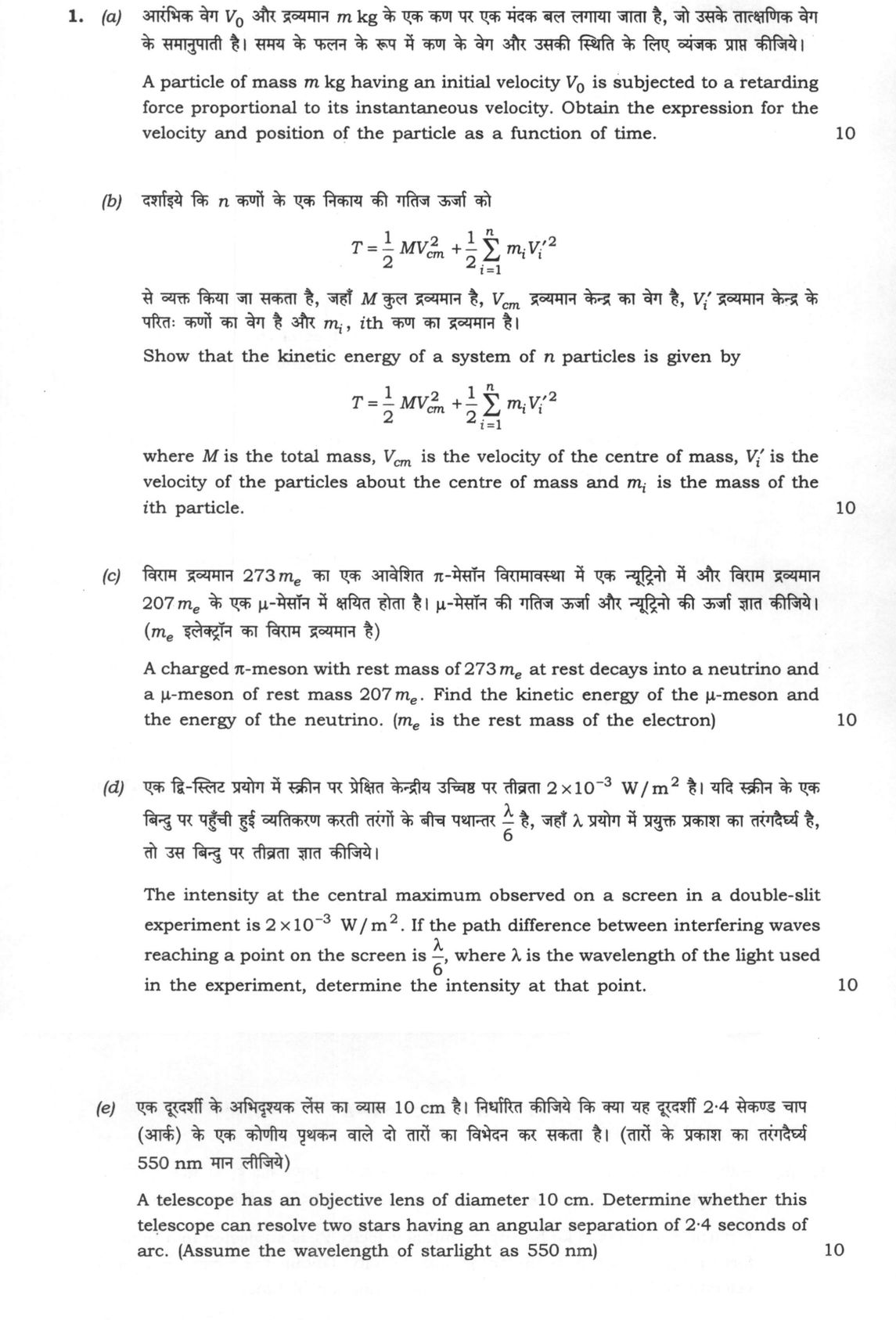
A particle of mass m kg having an initial velocity V₀ is subjected to a retarding force proportional to its instantaneous velocity. Obtain the expression for the velocity and position of the particle as a function of time. 10 marks
Show that the kinetic energy of a system of n particles is given by T = ½ MV²_cm + ½ Σⁿᵢ₌₁ mᵢV'²ᵢ where M is the total mass, V_cm is the velocity of the centre of mass, V'ᵢ is the velocity of the particles about the centre of mass and mᵢ is the mass of the ith particle. 10 marks
A charged π-meson with rest mass of 273mₑ at rest decays into a neutrino and a μ-meson of rest mass 207mₑ. Find the kinetic energy of the μ-meson and the energy of the neutrino. (mₑ is the rest mass of the electron) 10 marks
The intensity at the central maximum observed on a screen in a double-slit experiment is 2×10⁻³ W/m². If the path difference between interfering waves reaching a point on the screen is λ/6, where λ is the wavelength of the light used in the experiment, determine the intensity at that point. 10 marks
A telescope has an objective lens of diameter 10 cm. Determine whether this telescope can resolve two stars having an angular separation of 2·4 seconds of arc. (Assume the wavelength of starlight as 550 nm) 10 marks
हिंदी में प्रश्न पढ़ें
आरंभिक वेग V₀ और द्रव्यमान m kg के एक कण पर एक मंदक बल लगाया जाता है, जो उसके तात्क्षणिक वेग के समानुपाती है। समय के फलन के रूप में कण के वेग और उसकी स्थिति के लिए व्यंजक प्राप्त कीजिए। 10 अंक
दर्शाइये कि n कणों के एक निकाय की गतिज ऊर्जा को T = ½ MV²_cm + ½ Σⁿᵢ₌₁ mᵢV'²ᵢ से व्यक्त किया जा सकता है, जहाँ M कुल द्रव्यमान है, V_cm द्रव्यमान केंद्र का वेग है, V'ᵢ द्रव्यमान केंद्र के परितः कणों का वेग है और mᵢ, ith कण का द्रव्यमान है। 10 अंक
विराम द्रव्यमान 273mₑ का एक आवेशित π-मेसॉन विरामावस्था में एक न्यूट्रिनो में और विराम द्रव्यमान 207mₑ के एक μ-मेसॉन में क्षयित होता है। μ-मेसॉन की गतिज ऊर्जा और न्यूट्रिनो की ऊर्जा ज्ञात कीजिए। (mₑ इलेक्ट्रॉन का विराम द्रव्यमान है) 10 अंक
एक द्वि-स्लिट प्रयोग में स्क्रीन पर प्रेक्षित केंद्रीय उच्चिष्ठ पर तीव्रता 2×10⁻³ W/m² है। यदि स्क्रीन के एक बिंदु पर पहुँची हुई व्यतिकरण करती तरंगों के बीच पथांतर λ/6 है, जहाँ λ प्रयोग में प्रयुक्त प्रकाश का तरंगदैर्घ्य है, तो उस बिंदु पर तीव्रता ज्ञात कीजिए। 10 अंक
एक दूरदर्शी के अभिदृश्यक लेंस का व्यास 10 cm है। निर्धारित कीजिये कि क्या यह दूरदर्शी 2·4 सेकंड चाप (आर्क) के एक कोणीय पृथक्कन वाले दो तारों का विभेदन कर सकता है। (तारों के प्रकाश का तरंगदैर्ध्य 550 nm मान लीजिये) 10 अंक
Model answer
Written by UPSC Answer Check against this question's marking rubric, to the expected length. UPSC does not publish answers for Mains — this is one way to score well, not an official key.
(a) Let the retarding force be F = −k v, where k > 0 is a constant of proportionality. This is the standard linear drag model. Newton’s second law for the particle of mass m gives m dv/dt = −k v. Separating the variables, dv/v = −(k/m) dt. Integrating from t = 0, when the velocity is V₀, to time t, when the velocity is v: ∫_V₀^v dv′/v′ = −(k/m) ∫_0^t dt′. This gives ln(v/V₀) = −(k/m)t. Taking exponentials, v(t) = V₀ exp(−kt/m). The velocity decays exponentially with time. As t → ∞, v → 0, which is consistent with a purely retarding force. The constant k has units kg/s, so kt/m is dimensionless. If V₀ were negative, the same expression holds with the direction reversed, because the force always opposes the instantaneous velocity.
For the position, use v = dx/dt: dx/dt = V₀ exp(−kt/m). Integrating from the initial position x₀ at t = 0 to position x at time t: x(t) − x₀ = ∫_0^t V₀ exp(−kt′/m) dt′ = V₀ [ −(m/k) exp(−kt′/m) ]_0^t = (m V₀/k) [1 − exp(−kt/m)]. Therefore, x(t) = x₀ + (m V₀/k) [1 − exp(−kt/m)]. At large time, the particle approaches the limiting displacement x₀ + m V₀/k. This solution assumes the force remains linear in velocity throughout the motion and that no other forces act.
(b) This is König’s theorem for kinetic energy. Let the system consist of n particles with masses mᵢ, positions rᵢ, and velocities vᵢ. The total mass is M = Σᵢ₌₁ⁿ mᵢ. The centre of mass is at R = (1/M) Σᵢ₌₁ⁿ mᵢ rᵢ. Differentiating with respect to time gives the centre-of-mass velocity: V_cm = Ṙ = (1/M) Σᵢ₌₁ⁿ mᵢ vᵢ. Thus, Σᵢ₌₁ⁿ mᵢ vᵢ = M V_cm. Now define the velocity of each particle relative to the centre of mass: v′ᵢ = vᵢ − V_cm. Then, Σᵢ₌₁ⁿ mᵢ v′ᵢ = Σᵢ₌₁ⁿ mᵢ vᵢ − V_cm Σᵢ₌₁ⁿ mᵢ = M V_cm − M V_cm = 0. The total kinetic energy is T = ½ Σᵢ₌₁ⁿ mᵢ vᵢ² = ½ Σᵢ₌₁ⁿ mᵢ (V_cm + v′ᵢ)·(V_cm + v′ᵢ). Expanding, T = ½ Σᵢ₌₁ⁿ mᵢ V_cm² + V_cm · Σᵢ₌₁ⁿ mᵢ v′ᵢ + ½ Σᵢ₌₁ⁿ mᵢ v′ᵢ². The cross term vanishes because Σᵢ₌₁ⁿ mᵢ v′ᵢ = 0. Also, ½ Σᵢ₌₁ⁿ mᵢ V_cm² = ½ (Σᵢ₌₁ⁿ mᵢ) V_cm² = ½ M V_cm². Hence, T = ½ M V_cm² + ½ Σᵢ₌₁ⁿ mᵢ v′ᵢ². This decomposition is valid in any inertial frame. The first term is the kinetic energy associated with the translational motion of the centre of mass, and the second term is the internal kinetic energy of the particles relative to the centre of mass. The theorem is useful because it separates the overall motion of the system from its internal motion.
(c) Let mπ = 273 mₑ, mμ = 207 mₑ, and mν ≈ 0. The pion is initially at rest, so its total energy is E_initial = mπ c² = 273 mₑ c². After decay, let the magnitude of the momentum of each final particle be p. Momentum conservation requires the muon and neutrino to have equal and opposite momenta. For the massless neutrino, Eν = pν c = p c. For the muon, the relativistic energy-momentum relation gives Eμ = √(p² c² + mμ² c⁴). Energy conservation gives mπ c² = Eμ + Eν. Let x = Eν = p c. Then, √(x² + mμ² c⁴) + x = mπ c². Write a = mμ c² and b = mπ c². Then, √(x² + a²) = b − x. Squaring both sides, x² + a² = b² − 2 b x + x², so 2 b x = b² − a², and therefore, x = (b² − a²)/(2 b) = (mπ² − mμ²) c² / (2 mπ). Substituting the masses: Eν = [(273² − 207²) / (2 × 273)] mₑ c² = (31680 / 546) mₑ c² = 5280/91 mₑ c² ≈ 58.02 mₑ c² ≈ 29.65 MeV. The muon total energy is Eμ = mπ c² − Eν = (mπ² + mμ²) c² / (2 mπ). Its kinetic energy is Kμ = Eμ − mμ c² = [(mπ − mμ)² / (2 mπ)] c². Substituting, Kμ = [(273 − 207)² / (2 × 273)] mₑ c² = (66² / 546) mₑ c² = (4356 / 546) mₑ c² = 726/91 mₑ c² ≈ 7.98 mₑ c² ≈ 4.08 MeV. As a check, Kμ + Eν = (726/91 + 5280/91) mₑ c² = (6006/91) mₑ c² = 66 mₑ c², and adding the muon rest energy 207 mₑ c² gives 273 mₑ c², the original pion rest energy. Here the neutrino is treated as massless, which is an excellent approximation for this decay.
(d) In a double-slit experiment, the intensity at a point is given by I = I₀ cos²(δ/2), where I₀ is the intensity at the central maximum and δ is the phase difference between the two interfering waves. The phase difference is related to the path difference Δ by δ = (2π/λ) Δ. Given Δ = λ/6, δ = (2π/λ)(λ/6) = π/3. Therefore, I = I₀ cos²(π/6) = I₀ (√3/2)² = I₀ × 3/4. With I₀ = 2 × 10⁻³ W/m², I = (3/4) × 2 × 10⁻³ W/m² = 1.5 × 10⁻³ W/m². This assumes the two slits have equal intensities and that the diffraction envelope and background light are negligible.
(e) By Rayleigh’s criterion, the minimum angular separation that a telescope can resolve is θ_min = 1.22 λ / D, where λ is the wavelength of light and D is the diameter of the objective lens. Here, D = 10 cm = 0.10 m, λ = 550 nm = 5.50 × 10⁻⁷ m. Thus, θ_min = (1.22 × 5.50 × 10⁻⁷ m) / 0.10 m = 6.71 × 10⁻⁶ rad. To convert radians to seconds of arc, use 1 rad = (180/π) × 3600 arcsec ≈ 206265 arcsec. Hence, θ_min ≈ 6.71 × 10⁻⁶ × 206265 arcsec ≈ 1.38 arcsec. The given angular separation of the two stars is 2.4 arcsec, which is greater than the minimum resolvable angle 1.38 arcsec. Therefore, the telescope can resolve the two stars. This conclusion assumes diffraction-limited performance; atmospheric turbulence and optical aberrations are ignored.
What "Derive" is asking you to do
Reach the stated expression from a starting relation, justifying every step. The destination is printed in the question, so only the route earns marks, and the assumptions you work under are part of that route.
Structure that answers it
Assumptions and notation defined → starting relation or governing equation → each step with its justification → the required expression → limiting case or boundary check
Where marks are lost
Writing the standard result first and fitting three lines to it, which an examiner reads at a glance. Marks also go on assumptions left unstated — lossless medium, small amplitude, errors independent with zero mean — and on symbols used before they are defined, even when the question says usual notations.
How this answer will be evaluated
Approach
(a) derive: given > assumptions > stepwise derivation > result > check | (b) derive: given > assumptions > stepwise derivation > result > check | (c) calculate: given > formula > substitution > result with units > interpretation | (d) calculate: given > formula > substitution > result with units > interpretation | (e) calculate: given > formula > substitution > result with units > interpretation Full marks: Complete derivations with all steps, correct units, and physical interpretation
Key points expected
- State Newton's second law with F = -kv
- Solve differential equation for v(t)
- Integrate v(t) to find x(t)
- Apply initial conditions v(0)=V0, x(0)=0
- Define velocity of each particle relative to CM
- Expand square of velocity vector
- Show cross term vanishes using CM definition
- Identify M as total mass
Evaluation rubric
Each sub-part is marked on its own, against the marks and word limit printed on the paper.
- (a) Derive expressions for velocity and position as functions of time for a particle under a retarding force proportional to velocity. 10 marks
derive— given → assumptions → stepwise derivation → result → check
Must cover
- State Newton's second law with F = -kv
- Solve differential equation for v(t)
- Integrate v(t) to find x(t)
- Apply initial conditions v(0)=V0, x(0)=0
Loses marks
- Missing integration constant
- Incorrect sign in force equation
- No units carried through derivation
Earns more
- Identify exponential decay of velocity
- Discuss limiting case as t approaches infinity
- Define the constant of proportionality k
Extra mark
- Mention physical interpretation of time constant
- (b) Show that kinetic energy of n-particle system equals CM kinetic energy plus internal kinetic energy. 10 marks
derive— given → assumptions → stepwise derivation → result → check
Must cover
- Define velocity of each particle relative to CM
- Expand square of velocity vector
- Show cross term vanishes using CM definition
- Identify M as total mass
Loses marks
- Skipping the cross-term cancellation
- Confusing particle velocity with relative velocity
- No clear definition of V'_i
Earns more
- Use vector notation clearly
- State definition of center of mass
- Show summation steps explicitly
Extra mark
- Mention physical significance of separation
- (c) Calculate kinetic energy of mu-meson and energy of neutrino from pi-meson decay. 10 marks
calculate— given → formula → substitution → result with units → interpretation
Must cover
- Apply conservation of energy
- Apply conservation of momentum
- Use relativistic energy-momentum relation
- Substitute given mass values in m_e units
Loses marks
- Using non-relativistic kinetic energy formula
- Ignoring momentum conservation
- Arithmetic errors in mass ratios
Earns more
- State that neutrino has zero rest mass
- Show intermediate algebraic steps
- Express final answers in terms of m_e c^2
Extra mark
- Mention that this is a two-body decay
- (d) Determine intensity at a point with path difference lambda/6 in double-slit experiment. 10 marks
calculate— given → formula → substitution → result with units → interpretation
Must cover
- State intensity formula I = I_max cos^2(delta/2)
- Calculate phase difference from path difference
- Substitute delta = 2pi/6 = pi/3
- Compute final intensity value
Loses marks
- Using wrong phase difference formula
- Confusing path difference with phase difference
- Forgetting to square the cosine
Earns more
- Show relationship between path difference and phase
- State that central maximum has I_max = 2x10^-3 W/m^2
- Carry units in final answer
Extra mark
- Mention that this is a secondary maximum
- (e) Determine if telescope can resolve two stars with given angular separation. 10 marks
calculate— given → formula → substitution → result with units → interpretation
Must cover
- State Rayleigh criterion theta_min = 1.22 lambda/D
- Convert angular separation to radians
- Calculate minimum resolvable angle
- Compare with given separation
Loses marks
- Using wrong Rayleigh criterion constant
- Unit conversion errors in seconds of arc
- Not comparing the two angles explicitly
Earns more
- Show unit conversions clearly
- State that resolution is possible if theta_min < given separation
- Use correct values for lambda and D
Extra mark
- Mention that this is the diffraction limit
Practice this exact question
Write your answer and it is marked point by point against the model answer above — what you covered, what you missed, what you got wrong.
Evaluate my answer →More from Physics 2024 Paper I
- Q1 (a) A particle of mass m kg having an initial velocity V₀ is subjected to a retarding for…
- Q2 (a) (i) Briefly discuss the Kepler's laws of planetary motion. 5 marks (ii) Show that the…
- Q3 (a) (i) Explain the phenomenon of double refraction. What are positive and negative cryst…
- Q4 (a) (i) Write down the system matrix for a combination of two thin lenses in paraxial app…