Paper I — Q8
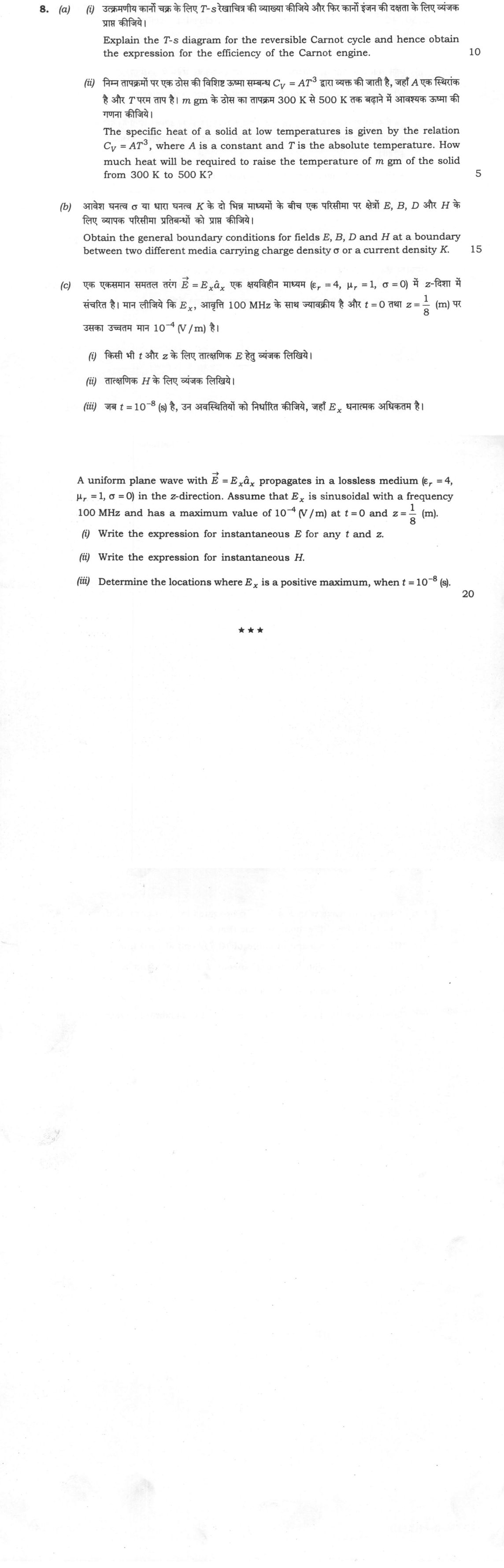
(a) (i) Explain the T-s diagram for the reversible Carnot cycle and hence obtain the expression for the efficiency of the Carnot…
Explain the T-s diagram for the reversible Carnot cycle and hence obtain the expression for the efficiency of the Carnot engine. 10 marks
The specific heat of a solid at low temperatures is given by the relation Cᵥ = AT³, where A is a constant and T is the absolute temperature. How much heat will be required to raise the temperature of m gm of the solid from 300 K to 500 K? 5 marks
Obtain the general boundary conditions for fields E, B, D and H at a boundary between two different media carrying charge density σ or a current density K. 15 marks
A uniform plane wave with E⃗ = Eₓ âₓ propagates in a lossless medium (εᵣ = 4, μᵣ = 1, σ = 0) in the z-direction. Assume that Eₓ is sinusoidal with a frequency 100 MHz and has a maximum value of 10⁻⁴(V/m) att = 0andz = 1/8 (m). Write the expression for instantaneous E for any t and z.
Write the expression for instantaneous H.
Determine the locations where Eₓ is a positive maximum, when t = 10⁻⁸ (s). 20 marks
हिंदी में प्रश्न पढ़ें
उत्क्रमणीय कार्नो चक्र के लिए T-s रेखाचित्र की व्याख्या कीजिये और फिर कार्नो इंजन की दक्षता के लिए व्यंजक प्राप्त कीजिये। (10 अंक)
निम्न तापक्रमों पर एक ठोस की विशिष्ट ऊष्मा सामर्थ्य Cᵥ = AT³ द्वारा व्यक्त की जाती है, जहाँ A एक स्थिरांक है और T परम ताप है। m gm के ठोस का तापक्रम 300 K से 500 K तक बढ़ाने में आवश्यक ऊष्मा की गणना कीजिये। (5 अंक)
आवेश घनत्व σ या धारा घनत्व K के दो भिन्न माध्यमों के बीच एक परिसीमा पर क्षेत्रों E, B, D और H के लिए व्यापक परिसीमा प्रतिबंधों को प्राप्त कीजिये। (15 अंक)
एक एकसमान समतल तरंग E⃗ = Eₓ âₓ एक क्षयविहीन माध्यम (εᵣ = 4, μᵣ = 1, σ = 0) में z-दिशा में संचरित है। मान लीजिये कि Eₓ, आवृत्ति 100 MHz के साथ ज्यावक्रीय है और t = 0 तथा z = 1/8 (m) पर उसका उच्चतम मान 10⁻⁴ (V/m) है। किसी भी t और z के लिए तात्क्षणिक E हेतु व्यंजक लिखिये।
तात्क्षणिक H के लिए व्यंजक लिखिये।
जब t = 10⁻⁸ (s) है, उन अवस्थितियों को निर्धारित कीजिये, जहाँ Eₓ धनात्मक अधिकतम है। (20 अंक)
Model answer
Written by UPSC Answer Check against this question's marking rubric, to the expected length. UPSC does not publish answers for Mains — this is one way to score well, not an official key.
(a)(i) On a T-s diagram, the reversible Carnot cycle appears as two horizontal isotherms and two vertical isentropes.
- 1→2: isothermal reversible expansion at T_H; entropy increases from s₁ to s₂; heat absorbed Q_H = T_H(s₂ - s₁).
- 2→3: adiabatic reversible expansion; entropy constant, so s₃ = s₂, temperature falls T_H to T_C.
- 3→4: isothermal reversible compression at T_C; entropy decreases from s₂ to s₁; heat rejected Q_C = T_C(s₂ - s₁).
- 4→1: adiabatic reversible compression; entropy constant, temperature rises T_C to T_H.
Net work: W = Q_H - Q_C = (T_H - T_C)(s₂ - s₁). Efficiency: η = W/Q_H = [(T_H - T_C)(s₂ - s₁)]/[T_H(s₂ - s₁)] = 1 - T_C/T_H. Thus η = 1 - T_C/T_H, valid for a reversible Carnot engine with Kelvin temperatures.
(a)(ii) For m gram of solid, dQ = m Cᵥ dT = m A T³ dT. Q = ∫₃₀₀⁵⁰⁰ m A T³ dT = m A [T⁴/4]₃₀₀⁵⁰⁰ = (m A/4)(500⁴ - 300⁴) = (m A/4)(6.25×10¹⁰ - 8.1×10⁹) = (m A/4)(5.44×10¹⁰) = 1.36×10¹⁰ m A. So Q = 1.36×10¹⁰ m A, in the same energy unit as Cᵥ, if A is per gram per K⁴.
(b) Let n̂ be the unit normal directed from medium 1 to medium 2, σ the free surface charge density, and K the free surface current density. Use Maxwell’s integral laws. For a pillbox of vanishing thickness, Gauss’s law for D gives ∮ D·dA = Q_f ⟹ n̂·(D₂ - D₁) = σ. Similarly, ∮ B·dA = 0 gives n̂·(B₂ - B₁) = 0. For a small rectangular loop crossing the boundary, Faraday’s law gives, as area → 0, n̂ × (E₂ - E₁) = 0. Ampere–Maxwell’s law gives, with displacement-current flux vanishing as area → 0, n̂ × (H₂ - H₁) = K. Therefore the general boundary conditions are:
- n̂·(D₂ - D₁) = σ, so D₂n - D₁n = σ.
- n̂·(B₂ - B₁) = 0, so B₂n = B₁n.
- n̂ × (E₂ - E₁) = 0, so E₂t = E₁t.
- n̂ × (H₂ - H₁) = K, equivalently H₂t - H₁t = K × n̂. Thus normal D jumps by σ, normal B is continuous, tangential E is continuous, and tangential H jumps by K. If σ = 0 and K = 0, D_n and H_t are also continuous.
(c)(i) Given εᵣ = 4, μᵣ = 1, σ = 0. v = 1/√(με) = c/√(εᵣ μᵣ) = c/2 = 1.5×10⁸ m/s. ω = 2πf = 2π×10⁸ rad/s. β = ω/v = (2π×10⁸)/(1.5×10⁸) = 4π/3 rad/m. Take Eₓ = E₀ cos(ωt - βz + φ) aₓ. At t = 0, z = 1/8 m, Eₓ = +10⁻⁴ V/m = maximum. So -β/8 + φ = 2πn. Since β/8 = π/6, choose φ = π/6. Thus E = 10⁻⁴ cos(2π×10⁸ t - (4π/3)z + π/6) aₓ V/m.
(c)(ii) Intrinsic impedance: η = √(μ/ε) = √(μ₀/(4ε₀)) = η₀/2 = 60π Ω. For propagation along a_z, H = (1/η) a_z × E = (Eₓ/η) a_y. Hence H = (10⁻⁴/(60π)) cos(2π×10⁸ t - (4π/3)z + π/6) a_y A/m. The magnetic-field amplitude is 10⁻⁴/(60π) A/m ≈ 5.31×10⁻⁷ A/m.
(c)(iii) At t = 10⁻⁸ s, ωt = (2π×10⁸)(10⁻⁸) = 2π rad. For positive maximum, cos(phase) = 1: 2π - (4π/3)z + π/6 = 2πn. This gives z = 13/8 - (3/2)n m, n integer. For positive z, the locations are z = 1/8 + (3/2)k m, k = 0, 1, 2, … i.e. z = 1/8, 13/8, 25/8, … m. The spacing is the wavelength λ = 2π/β = 3/2 m.
What "Derive" is asking you to do
Reach the stated expression from a starting relation, justifying every step. The destination is printed in the question, so only the route earns marks, and the assumptions you work under are part of that route.
Structure that answers it
Assumptions and notation defined → starting relation or governing equation → each step with its justification → the required expression → limiting case or boundary check
Where marks are lost
Writing the standard result first and fitting three lines to it, which an examiner reads at a glance. Marks also go on assumptions left unstated — lossless medium, small amplitude, errors independent with zero mean — and on symbols used before they are defined, even when the question says usual notations.
How this answer will be evaluated
Approach
(a(i)) explain: definition/context > points in order > small example > short close | (a(ii)) calculate: given > formula > substitution > result with units > interpretation | (b) derive: given > assumptions > stepwise derivation > result > check | (c(i)) explain: definition/context > points in order > small example > short close | (c(ii)) explain: definition/context > points in order > small example > short close | (c(iii)) calculate: given > formula > substitution > result with units > interpretation Full marks: Complete derivations with all steps shown, correct units, physical interpretation, and no arithmetic errors.
Key points expected
- Labelled T-s diagram with four reversible processes
- Identification of isothermal and adiabatic segments
- Derivation of efficiency η = 1 - T_c/T_h
- Statement of Carnot theorem or second law context
- Integration of C_v dT from 300 K to 500 K
- Correct evaluation of integral (A/4)(T_2^4 - T_1^4)
- Inclusion of mass m in final expression
- Units carried through calculation
Evaluation rubric
Each sub-part is marked on its own, against the marks and word limit printed on the paper.
- (a(i)) T-s diagram of Carnot cycle and derivation of efficiency expression. 10 marks
explain— definition/context → points in order → small example → short close
Must cover
- Labelled T-s diagram with four reversible processes
- Identification of isothermal and adiabatic segments
- Derivation of efficiency η = 1 - T_c/T_h
- Statement of Carnot theorem or second law context
Loses marks
- Missing diagram or unlabelled axes
- Efficiency stated without derivation
- Confusing T-s with P-v diagram
Earns more
- Mention of maximum possible efficiency
- Note on reversibility requirement
Extra mark
- Comparison with other cycles
- (a(ii)) Heat required to raise temperature from 300 K to 500 K using C_v = AT^3. 5 marks
calculate— given → formula → substitution → result with units → interpretation
Must cover
- Integration of C_v dT from 300 K to 500 K
- Correct evaluation of integral (A/4)(T_2^4 - T_1^4)
- Inclusion of mass m in final expression
- Units carried through calculation
Loses marks
- Missing mass factor m
- Incorrect power in integration
- No units in final answer
Earns more
- Explicit statement of integration limits
- Numerical evaluation of T^4 terms
Extra mark
- Physical interpretation of T^3 dependence
- (b) General boundary conditions for E, B, D, H at interface with σ and K. 15 marks
derive— given → assumptions → stepwise derivation → result → check
Must cover
- Derivation using Maxwell's equations in integral form
- Normal component conditions for D and B
- Tangential component conditions for E and H
- Inclusion of surface charge σ and current K
Loses marks
- Missing derivation steps
- Confusing normal and tangential components
- Omitting σ or K terms
Earns more
- Use of pillbox and Amperian loop diagrams
- Explicit statement of assumptions (no magnetic monopoles)
Extra mark
- Special case for perfect conductor
- Connection to electromagnetic wave reflection
- (c(i)) Expression for instantaneous E field for any t and z.
explain— definition/context → points in order → small example → short close
Must cover
- Correct wave equation form E = E_0 cos(ωt - kz + φ)
- Determination of wave number k from ε_r and μ_r
- Calculation of angular frequency ω from 100 MHz
- Phase constant φ from given initial conditions
Loses marks
- Incorrect sign in phase term
- Missing phase constant determination
- Wrong units for k or ω
Earns more
- Explicit calculation of k and ω values
- Statement of propagation direction
Extra mark
- Verification of initial condition satisfaction
- (c(ii)) Expression for instantaneous H field.
explain— definition/context → points in order → small example → short close
Must cover
- Relation H = E/η for plane wave
- Calculation of intrinsic impedance η from ε_r and μ_r
- Correct direction using right-hand rule
- Same phase as E field
Loses marks
- Wrong impedance formula
- Incorrect H direction
- Phase difference between E and H
Earns more
- Explicit calculation of η value
- Vector direction notation
Extra mark
- Poynting vector direction check
- (c(iii)) Locations where E_x is positive maximum at t = 10^-8 s.
calculate— given → formula → substitution → result with units → interpretation
Must cover
- Setting phase term to 2πn for maximum
- Substitution of t = 10^-8 s into phase equation
- Solving for z positions
- General solution with integer n
Loses marks
- Missing general solution form
- Arithmetic errors in phase calculation
- Confusing maximum with zero crossing
Earns more
- Numerical evaluation of specific positions
- Verification of positive maximum condition
Extra mark
- Physical interpretation of standing wave pattern
Practice this exact question
Write your answer and it is marked point by point against the model answer above — what you covered, what you missed, what you got wrong.
Evaluate my answer →More from Physics 2024 Paper I
- Q5 (a) In spherical coordinates, V = –25 V on a conductor at r = 2 cm and V = 150 V on anoth…
- Q6 (a) Using Maxwell's equations, obtain Poisson's equation and Laplace's equation. The regi…
- Q7 (a) How does Planck's law resolve the ultraviolet catastrophe predicted by classical phys…
- Q8 (a) (i) Explain the T-s diagram for the reversible Carnot cycle and hence obtain the expr…