Paper I — Q2
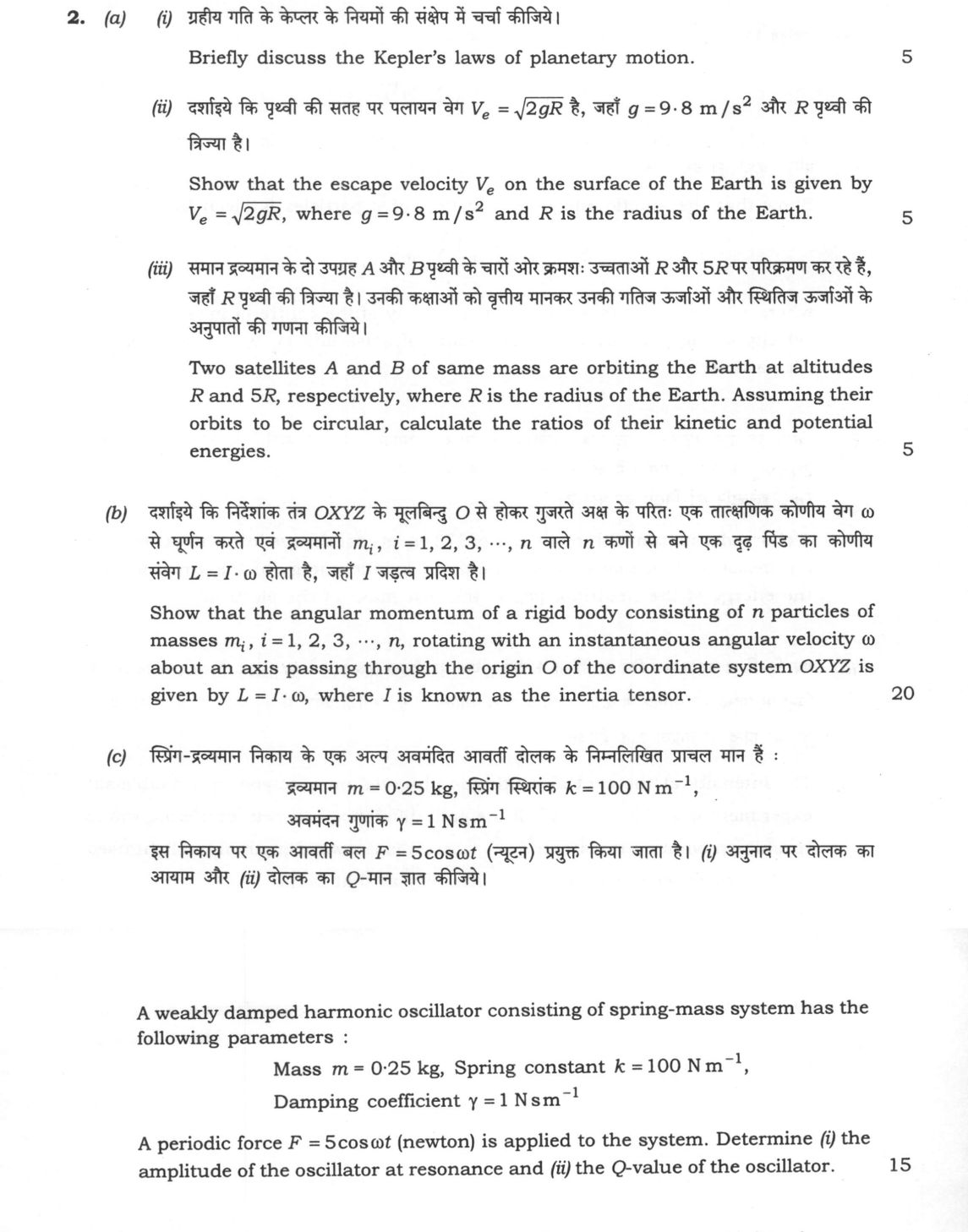
(a) (i) Briefly discuss the Kepler's laws of planetary motion. 5 marks (ii) Show that the escape velocity V_e on the surface of…
Briefly discuss the Kepler's laws of planetary motion. 5 marks
Show that the escape velocity V_e on the surface of the Earth is given by V_e = √(2gR), where g = 9·8 m/s² and R is the radius of the Earth. 5 marks
Two satellites A and B of same mass are orbiting the Earth at altitudes R and 5R, respectively, where R is the radius of the Earth. Assuming their orbits to be circular, calculate the ratios of their kinetic and potential energies. 5 marks
Show that the angular momentum of a rigid body consisting of n particles of masses m_i, i = 1, 2, 3, ..., n, rotating with an instantaneous angular velocity ω about an axis passing through the origin O of the coordinate system OXYZ is given by L = I·ω, where I is known as the inertia tensor. 20 marks
A weakly damped harmonic oscillator consisting of spring-mass system has the following parameters: Mass m = 0·25 kg, Spring constant k = 100 N m⁻¹, Damping coefficient γ = 1 N s m⁻¹. A periodic force F = 5cos ωt (newton) is applied to the system. Determine (i) the amplitude of the oscillator at resonance and (ii) the Q-value of the oscillator. 15 marks
हिंदी में प्रश्न पढ़ें
ग्रहीय गति के केप्लर के नियमों की संक्षेप में चर्चा कीजिये। 5 अंक
दर्शाइये कि पृथ्वी की सतह पर पलायन वेग V_e = √(2gR) है, जहाँ g = 9·8 m/s² और R पृथ्वी की त्रिज्या है। 5 अंक
समान द्रव्यमान के दो उपग्रह A और B पृथ्वी के चारों ओर क्रमशः ऊँचताओं R और 5R पर परिक्रमण कर रहे हैं, जहाँ R पृथ्वी की त्रिज्या है। उनकी कक्षाओं को वृत्तीय मानकर उनकी गतिज ऊर्जाओं और स्थितिज ऊर्जाओं के अनुपातों की गणना कीजिये। 5 अंक
दर्शाइये कि निर्देशांक तंत्र OXYZ के मूलबिंदु O से होकर गुजरते अक्ष के परितः एक तात्क्षणिक कोणीय वेग ω से घूर्णन करते एवं द्रव्यमानों m_i, i = 1, 2, 3, ..., n वाले n कणों से बने एक दृढ़ पिंड का कोणीय संवेग L = I·ω होता है, जहाँ I जड़त्व प्रदिश है। 20 अंक
स्प्रिंग-द्रव्यमान निकाय के एक अल्प अवमंदित आवर्ती दोलक के निम्नलिखित प्राचल मान हैं: द्रव्यमान m = 0·25 kg, स्प्रिंग स्थिरांक k = 100 N m⁻¹, अवमंदन गुणांक γ = 1 N s m⁻¹। इस निकाय पर एक आवर्ती बल F = 5cos ωt (न्यूटन) प्रयुक्त किया जाता है। (i) अनुनाद पर दोलक का आयाम और (ii) दोलक का Q-मान ज्ञात कीजिये। 15 अंक
Model answer
Written by UPSC Answer Check against this question's marking rubric, to the expected length. UPSC does not publish answers for Mains — this is one way to score well, not an official key.
(a)(i) Kepler’s three laws are:
- Law of orbits: every planet moves in an ellipse with the Sun at one focus.
- Law of areas: the radius vector from the Sun to a planet sweeps equal areas in equal times; equivalently, dA/dt = L/(2m) is constant, so planetary angular momentum is conserved.
- Law of periods: T² ∝ a³, where a is the semi-major axis. For a circular orbit of radius r, T² = 4π²r³/(GM). These laws follow from the inverse-square gravitational force, with the Sun assumed much heavier than the planet.
(a)(ii) Let a body of mass m be projected from Earth’s surface with escape speed V_e. Using conservation of mechanical energy, the total energy at the surface is E = (1/2)mV_e² − GMm/R. At infinity, for the minimum escape speed, the body just reaches rest, so E = 0. Hence (1/2)mV_e² − GMm/R = 0, so V_e² = 2GM/R. At the Earth’s surface, g = GM/R², hence GM = gR². Therefore V_e² = 2gR²/R = 2gR, so V_e = √(2gR). Numerically, V_e = √(2 × 9.8 × 6.4 × 10⁶) ≈ 1.12 × 10⁴ m s⁻¹. This ignores air resistance, Earth’s rotation, and other bodies.
(a)(iii) For a circular orbit of radius r, gravity supplies the centripetal force: GMm/r² = mv²/r, so v² = GM/r. Thus kinetic energy K = (1/2)mv² = GMm/(2r), and gravitational potential energy U = −GMm/r. For satellite A, altitude R, so r_A = R + R = 2R. For satellite B, altitude 5R, so r_B = R + 5R = 6R. Therefore K_A/K_B = (GMm/(2 × 2R))/(GMm/(2 × 6R)) = 6R/2R = 3. Similarly, U_A/U_B = (−GMm/2R)/(−GMm/6R) = 6R/2R = 3. So K_A : K_B = 3 : 1 and U_A : U_B = 3 : 1; equivalently B : A = 1 : 3. For each satellite separately, K/U = −1/2.
(b) Let the rigid body consist of n particles of masses m_i at position vectors r_i from O. Its angular momentum about O is L = Σ m_i r_i × v_i. Since the body rotates with instantaneous angular velocity ω about an axis through O, the velocity of each particle is v_i = ω × r_i. Hence L = Σ m_i r_i × (ω × r_i). Using the vector identity a × (b × c) = b(a·c) − c(a·b), with a = r_i, b = ω, c = r_i, r_i × (ω × r_i) = ω(r_i·r_i) − r_i(r_i·ω). Therefore L = Σ m_i[r_i²ω − r_i(r_i·ω)]. Writing r_i = (x_i, y_i, z_i) and ω = (ω_x, ω_y, ω_z), the components are L_x = Σ m_i[(y_i² + z_i²)ω_x − x_i y_i ω_y − x_i z_i ω_z], L_y = Σ m_i[−y_i x_i ω_x + (x_i² + z_i²)ω_y − y_i z_i ω_z], L_z = Σ m_i[−z_i x_i ω_x − z_i y_i ω_y + (x_i² + y_i²)ω_z]. Define the inertia tensor I about O by I_xx = Σ m_i(y_i² + z_i²), I_yy = Σ m_i(x_i² + z_i²), I_zz = Σ m_i(x_i² + y_i²), I_xy = I_yx = −Σ m_i x_i y_i, I_xz = I_zx = −Σ m_i x_i z_i, I_yz = I_zy = −Σ m_i y_i z_i. Then L_x = I_xx ω_x + I_xy ω_y + I_xz ω_z, and similarly for L_y and L_z. Thus L_α = Σ_β I_αβ ω_β, i.e. L = I·ω. The tensor is symmetric. For a continuous body, the sums become integrals. If ω is along a principal axis, L = Iω.
(c)(i) The equation of motion is m d²x/dt² + γ dx/dt + kx = F₀ cosωt, F₀ = 5 N. Using the phasor method, the steady-state amplitude is A(ω) = F₀/√[(k − mω²)² + (γω)²]. Here ω₀ = √(k/m) = √(100/0.25) = 20 rad s⁻¹. At the standard resonance condition for a weakly damped oscillator, ω = ω₀ = 20 rad s⁻¹: A_res = F₀/(γω₀) = 5/(1 × 20) = 0.25 m. If by resonance one means the exact displacement maximum, then ω_r = √(ω₀² − γ²/(2m²)) = √392 = 14√2 rad s⁻¹, and A_max = F₀/[γ√(ω₀² − γ²/(4m²))] = 5/(6√11) m ≈ 0.251 m. Thus A_res = 0.25 m for the standard resonance condition, with exact maximum 5/(6√11) m.
(c)(ii) The Q-value is Q = ω₀m/γ = (20 × 0.25)/1 = 5. Equivalently, Q = √(mk)/γ = √(0.25 × 100)/1 = 5. Therefore Q = 5, dimensionless.
What "Derive" is asking you to do
Reach the stated expression from a starting relation, justifying every step. The destination is printed in the question, so only the route earns marks, and the assumptions you work under are part of that route.
Structure that answers it
Assumptions and notation defined → starting relation or governing equation → each step with its justification → the required expression → limiting case or boundary check
Where marks are lost
Writing the standard result first and fitting three lines to it, which an examiner reads at a glance. Marks also go on assumptions left unstated — lossless medium, small amplitude, errors independent with zero mean — and on symbols used before they are defined, even when the question says usual notations.
How this answer will be evaluated
Approach
(a(i)) discuss: intro > 3-4 dimensions > example > balanced close | (a(ii)) derive: given > assumptions > stepwise derivation > result > check | (a(iii)) calculate: given > formula > substitution > result with units > interpretation | (b) derive: given > assumptions > stepwise derivation > result > check | (c) calculate: given > formula > substitution > result with units > interpretation Full marks: Complete derivations with all steps, correct units, physical interpretation, and accurate calculations.
Key points expected
- State Law 1 (Elliptical orbits)
- State Law 2 (Equal areas in equal time)
- State Law 3 (T² proportional to a³)
- Brief physical interpretation of each law
- Use conservation of energy principle
- Set total energy at infinity to zero
- Substitute g = GM/R²
- Arrive at Ve = √(2gR)
Evaluation rubric
Each sub-part is marked on its own, against the marks and word limit printed on the paper.
- (a(i)) State and explain the three laws of planetary motion. 5 marks
discuss— intro → 3-4 dimensions → example → balanced close
Must cover
- State Law 1 (Elliptical orbits)
- State Law 2 (Equal areas in equal time)
- State Law 3 (T² proportional to a³)
- Brief physical interpretation of each law
Loses marks
- Listing laws without explanation
- Confusing semi-major axis with radius
Earns more
- Mention Kepler's name and context
- Link Law 2 to conservation of angular momentum
Extra mark
- Mention Newton's derivation of these laws
- (a(ii)) Derive the expression for escape velocity on Earth's surface. 5 marks
derive— given → assumptions → stepwise derivation → result → check
Must cover
- Use conservation of energy principle
- Set total energy at infinity to zero
- Substitute g = GM/R²
- Arrive at Ve = √(2gR)
Loses marks
- Writing formula without derivation
- Dropping units in intermediate steps
Earns more
- Show intermediate steps clearly
- Mention units of velocity
Extra mark
- Numerical calculation using given g and R
- (a(iii)) Calculate ratios of kinetic and potential energies for two satellites. 5 marks
calculate— given → formula → substitution → result with units → interpretation
Must cover
- Identify orbital radii as 2R and 6R
- Use KE = GMm/2r and PE = -GMm/r
- Calculate KE ratio (rB/rA)
- Calculate PE ratio (rA/rB)
Loses marks
- Using altitude instead of orbital radius
- Confusing kinetic and potential energy formulas
Earns more
- Show substitution of radii
- State final ratios clearly
Extra mark
- Mention that total energy is negative
- (b) Derive L = I·ω for a rigid body of n particles. 20 marks
derive— given → assumptions → stepwise derivation → result → check
Must cover
- Define angular momentum L = Σ ri × pi
- Express pi = mi(vi) = mi(ω × ri)
- Expand cross product using vector triple product
- Define inertia tensor I with components Iij
Loses marks
- Skipping vector triple product step
- Not defining inertia tensor components
- Confusing moment of inertia with inertia tensor
Earns more
- Show summation over all particles
- Define diagonal and off-diagonal terms of I
- Mention symmetry of inertia tensor
Extra mark
- Write explicit matrix form of I
- Mention principal axes of inertia
- (c) Determine amplitude at resonance and Q-value for damped oscillator. 15 marks
calculate— given → formula → substitution → result with units → interpretation
Must cover
- Write equation of motion for damped driven oscillator
- Find resonance frequency ωr = √(ω₀² - γ²/2m²)
- Calculate amplitude at resonance A = F₀/(mγωr)
- Calculate Q = ω₀/γ
Loses marks
- Using undamped resonance frequency for amplitude
- Confusing damping coefficient with damping ratio
- Dropping units in calculations
Earns more
- Substitute given values correctly
- Show units in final answers
- Mention that γ is small so ωr ≈ ω₀
Extra mark
- Calculate numerical values for ω₀ and ωr
- Mention physical meaning of Q-value
Practice this exact question
Write your answer and it is marked point by point against the model answer above — what you covered, what you missed, what you got wrong.
Evaluate my answer →More from Physics 2024 Paper I
- Q1 (a) A particle of mass m kg having an initial velocity V₀ is subjected to a retarding for…
- Q2 (a) (i) Briefly discuss the Kepler's laws of planetary motion. 5 marks (ii) Show that the…
- Q3 (a) (i) Explain the phenomenon of double refraction. What are positive and negative cryst…
- Q4 (a) (i) Write down the system matrix for a combination of two thin lenses in paraxial app…
- Q5 (a) In spherical coordinates, V = –25 V on a conductor at r = 2 cm and V = 150 V on anoth…