Paper I — Q7
(a) How does Planck's law resolve the ultraviolet catastrophe predicted by classical physics? Calculate the average energy ε̄ of…
How does Planck's law resolve the ultraviolet catastrophe predicted by classical physics? Calculate the average energy ε̄ of an oscillator of frequency 0·60×10¹⁴ s⁻¹ at T = 1800 K, treating it as (i) classical oscillator and (ii) Planck's oscillator. 15 marks
What do you understand by macrostates and microstates? Briefly explain. 5 marks
A three-level laser system emits laser light at a wavelength of 550 nm. If the population of the upper level exceeds that of the lower level by 25%, determine the negative temperature characterizing the system. 10 marks
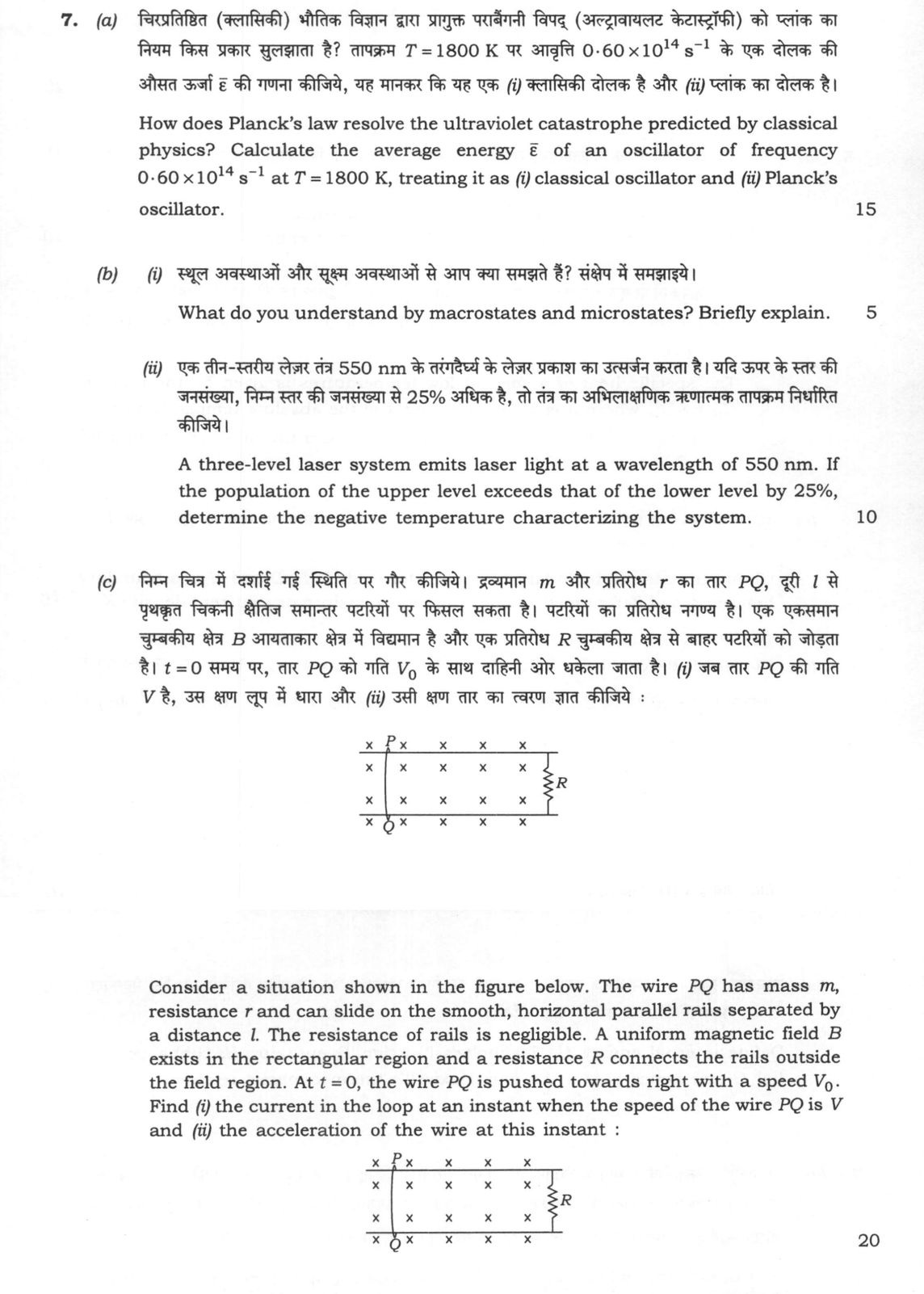
Consider a situation shown in the figure below. The wire PQ has mass m, resistance r and can slide on the smooth, horizontal parallel rails separated by a distance l. The resistance of rails is negligible. A uniform magnetic field B exists in the rectangular region and a resistance R connects the rails outside the field region. At t = 0, the wire PQ is pushed towards right with a speed V₀. Find (i) the current in the loop at an instant when the speed of the wire PQ is V and (ii) the acceleration of the wire at this instant. 20 marks
हिंदी में प्रश्न पढ़ें
चिरप्रतिष्ठित (क्लासिकी) भौतिक विज्ञान द्वारा प्रागुक्त पराबैंगनी विपद (अल्ट्रावायलेट कैटास्ट्रॉफी) को प्लांक का नियम किस प्रकार सुलझाता है? तापक्रम T = 1800 K पर आवृत्ति 0·60×10¹⁴ s⁻¹ के एक दोलक की औसत ऊर्जा ε̄ की गणना कीजिये, यह मानकर कि यह एक (i) क्लासिकी दोलक है और (ii) प्लांक का दोलक है। (15 अंक)
स्थूल अवस्थाओं और सूक्ष्म अवस्थाओं से आप क्या समझते हैं? संक्षेप में समझाइये। (5 अंक)
एक तीन-स्तरीय लेजर तंत्र 550 nm के तरंगदैर्ध्य के लेजर प्रकाश का उत्सर्जन करता है। यदि ऊपर के स्तर की जनसंख्या, निम्न स्तर की जनसंख्या से 25% अधिक है, तो तंत्र का अभिलाक्षणिक ऋणात्मक तापक्रम निर्धारित कीजिये। (10 अंक)
निम्न चित्र में दर्शाई गई स्थिति पर गौर कीजिये। द्रव्यमान m और प्रतिरोध r का तार PQ, दूरी l से पृथक्कृत चिकनी क्षैतिज समांतर पट्टियों पर फिसल सकता है। पट्टियों का प्रतिरोध नगण्य है। एक एकसमान चुंबकीय क्षेत्र B आयताकार क्षेत्र में विद्यमान है और एक प्रतिरोध R चुंबकीय क्षेत्र से बाहर पट्टियों को जोड़ता है। t = 0 समय पर, तार PQ को गति V₀ के साथ दाहिनी ओर धकेला जाता है। (i) जब तार PQ की गति V है, उस क्षण लूप में धारा और (ii) उसी क्षण तार का त्वरण ज्ञात कीजिये। (20 अंक)
The figure this question refers to, in words
The question paper is a scan and the diagram did not survive as text. This is the figure as read from the original page — every component, value and label — so the question can be worked from the text below.
(c) Two parallel horizontal conducting rails are connected at their right ends by a vertical resistor labeled R. A vertical conducting rod PQ bridges the top and bottom rails, with end P on the top rail and end Q on the bottom rail. A uniform magnetic field directed into the page is represented by a rectangular array of cross (x) marks covering the area around and between the rails up to, but not including, the resistor R. The rod PQ is inside the magnetic field region, while the resistor R lies outside the magnetic field.
A schematic diagram showing two parallel horizontal rails separated by a vertical distance l. A vertical conducting wire labeled PQ connects the two rails, with end P on the top rail and end Q on the bottom rail. The wire PQ is situated in a rectangular region with a uniform magnetic field directed into the page, indicated by a grid of 'x' marks (5 columns and 4 rows of crosses). Wire PQ is positioned between the first and second columns of crosses. To the right, outside the magnetic field region, the rails are terminated by a resistor of resistance R connected across them.
Model answer
Written by UPSC Answer Check against this question's marking rubric, to the expected length. UPSC does not publish answers for Mains — this is one way to score well, not an official key.
(a) Classical physics treats each oscillator as having continuous energy and, by equipartition, average energy ε̄ = kT. The number of radiation modes per unit volume in the frequency interval ν to ν+dν is proportional to ν², so the Rayleigh–Jeans energy density becomes u(ν)dν = (8πν²/c³) kT dν. This increases without limit as ν → ∞, predicting infinite high-frequency energy emission—the ultraviolet catastrophe.
Planck resolved this by assuming that an oscillator of frequency ν can have only discrete energies E_n = n hν, n = 0, 1, 2, … . Using Boltzmann weighting, the partition function is Z = Σ e^(−n hν/kT) = 1/[1 − e^(−hν/kT)]. The average energy is ε̄ = Σ n hν e^(−n hν/kT) / Z = hν/[e^(hν/kT) − 1]. The resulting Planck spectral energy density is u(ν)dν = (8πhν³/c³) [1/(e^(hν/kT) − 1)] dν. For large ν, e^(hν/kT) grows rapidly, so high-frequency oscillators have very small average energy. Hence u(ν) → 0 as ν → ∞, the spectral distribution has a finite peak, and the ultraviolet catastrophe disappears. At low ν it reduces to the Rayleigh–Jeans law.
Given ν = 0.60×10¹⁴ s⁻¹ = 6.0×10¹³ Hz, T = 1800 K. Take h = 6.626×10⁻³⁴ J s, k = 1.381×10⁻²³ J K⁻¹.
(i) Classical oscillator: ε̄_cl = kT = 1.381×10⁻²³ × 1800 = 2.486×10⁻²⁰ J = 0.155 eV.
(ii) Planck oscillator: hν = 6.626×10⁻³⁴ × 6.0×10¹³ = 3.976×10⁻²⁰ J. kT = 2.486×10⁻²⁰ J. Thus hν/kT = 3.976×10⁻²⁰ / 2.486×10⁻²⁰ = 1.600. ε̄_P = hν/[e^(hν/kT) − 1] = 3.976×10⁻²⁰/[e^(1.600) − 1]. Since e^(1.600) = 4.953, ε̄_P = 3.976×10⁻²⁰/(4.953 − 1) = 1.006×10⁻²⁰ J = 0.0628 eV. So ε̄_cl ≈ 2.49×10⁻²⁰ J and ε̄_P ≈ 1.01×10⁻²⁰ J.
(b)(i) A macrostate specifies the observable macroscopic properties of a system, such as total energy U, volume V, number of particles N, pressure P and temperature T. It does not specify which particle is in which state. A microstate specifies the complete microscopic description of every particle, such as all positions and momenta in classical mechanics or all quantum numbers in quantum mechanics. Many microstates correspond to one macrostate. If Ω is the number of microstates belonging to a macrostate, the entropy is S = k ln Ω. Equilibrium corresponds to the macrostate with the largest Ω.
(b)(ii) For two levels with energies E₂ > E₁, the Boltzmann population ratio is N₂/N₁ = e^[−(E₂ − E₁)/kT]. For population inversion, N₂ > N₁, so the effective temperature T is negative. The emitted photon energy is ΔE = hν = hc/λ. Given λ = 550 nm = 550×10⁻⁹ m, ΔE = (6.626×10⁻³⁴ × 3.00×10⁸)/(550×10⁻⁹) = 3.61×10⁻¹⁹ J. The condition is N₂ = 1.25 N₁, so ln(N₂/N₁) = ln(1.25) = 0.2231. Therefore T = −ΔE/[k ln(N₂/N₁)] = −3.61×10⁻¹⁹/[1.381×10⁻²³ × 0.2231] = −1.17×10⁵ K. So T ≈ −1.17×10⁵ K. A negative temperature here does not mean colder than absolute zero; it means a population-inverted state, hotter than infinite temperature.
(c)(i) Let the rails be horizontal, P on the top rail and Q on the bottom rail, separated by distance l. The magnetic field B is into the page. When the rod PQ moves to the right with speed V, the magnetic flux through the loop changes because the area of the loop lying in the field changes at rate lV. By Faraday’s law, ε = −dΦ/dt = B l V. The total resistance of the loop is R + r, since the rails have negligible resistance. Hence the induced current is I = ε/(R + r) = B l V/(R + r). By Lenz’s law, the current opposes the change in flux. For the given field into the page and motion to the right, the current is clockwise in the loop; in the rod PQ it flows from Q to P. Thus I = B l V/(R + r), clockwise, i.e. Q → P in the rod.
(c)(ii) The current-carrying rod of length l in the magnetic field B experiences a force F = I l B. Using I = B l V/(R + r), F = (B l V/(R + r)) l B = B² l² V/(R + r). By Fleming’s left-hand rule, this force is directed to the left, opposite to the velocity. Therefore the acceleration is a = F/m = B² l² V/[m(R + r)]. So a = B² l² V/[m(R + r)] directed opposite to V, i.e. to the left. This result is valid at instants when the rod PQ is still inside the magnetic-field region and self-inductance is neglected.
What "Solve" is asking you to do
Choose the method, then carry it through to a final answer. Identifying what kind of problem this is and why that method applies is the first thing marked; a correct figure arrived at invisibly earns almost nothing.
Structure that answers it
Given data and what is required → method chosen, with the reason it applies → set-up (equation, circuit, free body, trial balance) → working, step by step → answer with units and any condition of validity
Where marks are lost
Doing the middle steps mentally and writing only the result. In mathematics papers, a further loss comes from giving a decimal where the exact value in surds or fractions was wanted, or from skipping the justification a part explicitly asks for.
How this answer will be evaluated
Approach
(a) calculate: given > formula > substitution > result with units > interpretation | (b(i)) explain: definition/context > points in order > small example > short close | (b(ii)) calculate: given > formula > substitution > result with units > interpretation | (c) calculate: given > formula > substitution > result with units > interpretation Full marks: Complete derivations with correct units, clear diagrams, and physical interpretation for all parts.
Key points expected
- State classical Rayleigh-Jeans law divergence
- State Planck's quantization hypothesis
- Calculate classical energy using kT
- Calculate Planck energy using hν/(e^(hν/kT)-1)
- Define macrostate by macroscopic variables
- Define microstate by specific configuration
- Explain the relationship between them
- State Boltzmann distribution for population ratio
Evaluation rubric
Each sub-part is marked on its own, against the marks and word limit printed on the paper.
- (a) Explain UV catastrophe resolution and calculate average energy for classical and Planck oscillators. 15 marks
calculate— given → formula → substitution → result with units → interpretation
Must cover
- State classical Rayleigh-Jeans law divergence
- State Planck's quantization hypothesis
- Calculate classical energy using kT
- Calculate Planck energy using hν/(e^(hν/kT)-1)
Loses marks
- Using wrong frequency or temperature values
- Omitting the classical calculation
- Confusing frequency with angular frequency
Earns more
- Show numerical substitution for both cases
- Compare the two calculated values
- Mention high frequency limit behavior
Extra mark
- Sketch of spectral energy density curves
- (b(i)) Define macrostates and microstates with a brief explanation. 5 marks
explain— definition/context → points in order → small example → short close
Must cover
- Define macrostate by macroscopic variables
- Define microstate by specific configuration
- Explain the relationship between them
Loses marks
- Confusing macrostate with microstate
- No example or illustration
- Vague definitions without physical meaning
Earns more
- Give a simple example (e.g., gas in a box)
- Mention multiplicity or number of microstates
Extra mark
- Link to entropy definition
- (b(ii)) Determine the negative temperature for a three-level laser system with 25% population inversion. 10 marks
calculate— given → formula → substitution → result with units → interpretation
Must cover
- State Boltzmann distribution for population ratio
- Use given wavelength to find energy difference
- Set up equation with 25% excess population
- Solve for negative temperature T
Loses marks
- Using positive temperature in final answer
- Incorrect energy calculation from wavelength
- Misinterpreting the 25% population difference
Earns more
- Show unit conversion for wavelength to energy
- Explicitly state the negative sign in T
- Verify the result is physically meaningful
Extra mark
- Discuss physical meaning of negative temperature
- (c) Find current and acceleration of sliding wire in magnetic field at speed V. 20 marks
calculate— given → formula → substitution → result with units → interpretation
Must cover
- Draw labelled diagram with B, l, R, r, V
- Calculate induced EMF as BlV
- Find current using total resistance (R+r)
- Calculate force as BIl and acceleration as F/m
Loses marks
- Forgetting to include wire resistance r
- Wrong direction of induced current
- Not relating force to acceleration correctly
Earns more
- Show direction of current using Lenz's law
- Express acceleration in terms of given variables
- Mention energy dissipation in resistors
Extra mark
- Derive velocity as function of time
- Discuss terminal velocity if applicable
Practice this exact question
Write your answer and it is marked point by point against the model answer above — what you covered, what you missed, what you got wrong.
Evaluate my answer →More from Physics 2024 Paper I
- Q4 (a) (i) Write down the system matrix for a combination of two thin lenses in paraxial app…
- Q5 (a) In spherical coordinates, V = –25 V on a conductor at r = 2 cm and V = 150 V on anoth…
- Q6 (a) Using Maxwell's equations, obtain Poisson's equation and Laplace's equation. The regi…
- Q7 (a) How does Planck's law resolve the ultraviolet catastrophe predicted by classical phys…
- Q8 (a) (i) Explain the T-s diagram for the reversible Carnot cycle and hence obtain the expr…