Paper I — Q3
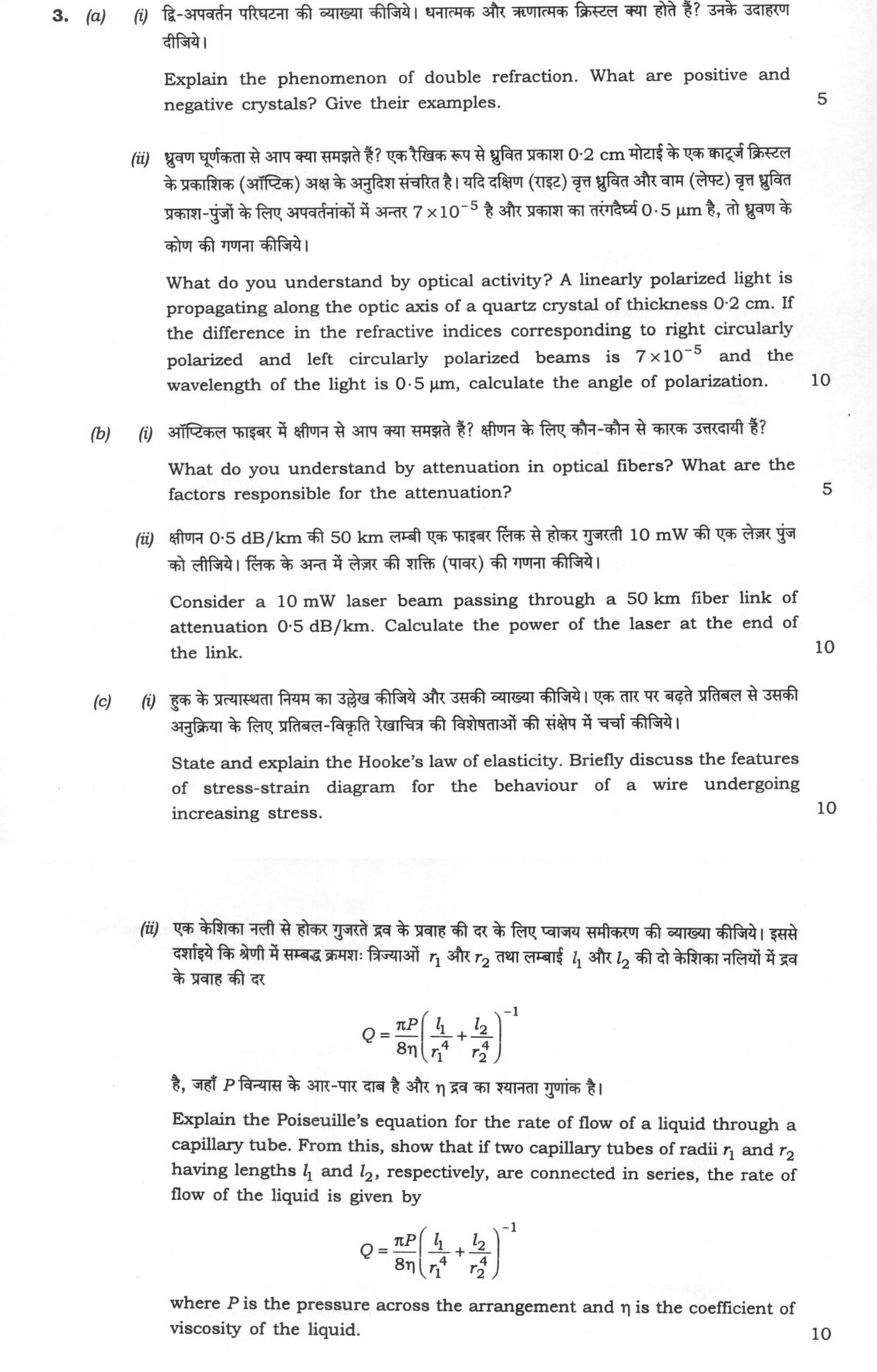
(a) (i) Explain the phenomenon of double refraction. What are positive and negative crystals? Give their examples. (5…
Explain the phenomenon of double refraction. What are positive and negative crystals? Give their examples. 5 marks
What do you understand by optical activity? A linearly polarized light is propagating along the optic axis of a quartz crystal of thickness 0·2 cm. If the difference in the refractive indices corresponding to right circularly polarized and left circularly polarized beams is 7×10⁻⁵ and the wavelength of the light is 0·5 μm, calculate the angle of polarization. 10 marks
What do you understand by attenuation in optical fibers? What are the factors responsible for the attenuation? 5 marks
Consider a 10 mW laser beam passing through a 50 km fiber link of attenuation 0·5 dB/km. Calculate the power of the laser at the end of the link. 10 marks
State and explain the Hooke's law of elasticity. Briefly discuss the features of stress-strain diagram for the behaviour of a wire undergoing increasing stress. 10 marks
Explain the Poiseuille's equation for the rate of flow of a liquid through a capillary tube. From this, show that if two capillary tubes of radii r₁ and r₂ having lengths l₁ and l₂, respectively, are connected in series, the rate of flow of the liquid is given by
Q = (πP/8η)(l₁/r₁⁴ + l₂/r₂⁴)⁻¹
where P is the pressure across the arrangement and η is the coefficient of viscosity of the liquid. 10 marks
हिंदी में प्रश्न पढ़ें
द्वि-अपवर्तन परिघटना की व्याख्या कीजिए। धनात्मक और ऋणात्मक क्रिस्टल क्या होते हैं? उनके उदाहरण दीजिए। (5 अंक)
ध्रुवण चुंबकता से आप क्या समझते हैं? एक रैखिक रूप से ध्रुवित प्रकाश 0·2 cm मोटाई के एक क्वार्ट्ज क्रिस्टल के प्रकाशिक (ऑप्टिक) अक्ष के अनुदिश संचरित है। यदि दक्षिण (राइट) वृत्त ध्रुवित और बाम (लेफ्ट) वृत्त ध्रुवित प्रकाश-पुंजों के लिए अपवर्तनांकों में अंतर 7×10⁻⁵ है और प्रकाश का तरंगदैर्ध्य 0·5 μm है, तो ध्रुवण के कोण की गणना कीजिए। (10 अंक)
ऑप्टिकल फाइबर में क्षीणन से आप क्या समझते हैं? क्षीणन के लिए कौन-कौन से कारक उत्तरदायी हैं? (5 अंक)
क्षीणन 0·5 dB/km की 50 km लंबी एक फाइबर लिंक से होकर गुजरती 10 mW की एक लेजर पुंज को लीजिए। लिंक के अंत में लेजर की शक्ति (पावर) की गणना कीजिए। (10 अंक)
हुक के प्रत्यास्थता नियम का उल्लेख कीजिए और उसकी व्याख्या कीजिए। एक तार पर बढ़ते प्रतिबल से उसकी अनुक्रिया के लिए प्रतिबल-विकृति रेखाचित्र की विशेषताओं की संक्षेप में चर्चा कीजिए। (10 अंक)
एक केशिका नली से होकर गुजरते द्रव के प्रवाह की दर के लिए प्वाज़्यु समीकरण की व्याख्या कीजिए। इससे दर्शाइये कि श्रेणी में संबद्ध क्रमशः त्रिज्याओं r₁ और r₂ तथा लंबाई l₁ और l₂ की दो केशिका नलियों में द्रव के प्रवाह की दर
Q = (πP/8η)(l₁/r₁⁴ + l₂/r₂⁴)⁻¹
है, जहाँ P विस्तार के आर-पार दाब है और η द्रव का श्यानता गुणांक है। (10 अंक)
Model answer
Written by UPSC Answer Check against this question's marking rubric, to the expected length. UPSC does not publish answers for Mains — this is one way to score well, not an official key.
(a)(i) Double Refraction
When a ray of light enters certain anisotropic crystals (e.g., calcite, quartz), it splits into two refracted rays: the ordinary ray (O-ray) and the extraordinary ray (E-ray). This phenomenon is double refraction. The O-ray obeys Snell's law and has refractive index n₀ independent of direction; the E-ray does not obey Snell's law and its refractive index nₑ varies with direction. The cause is the anisotropic arrangement of atoms, which makes the velocity of light direction-dependent.
Crystals are classified by comparing nₑ and n₀. If nₑ > n₀, the crystal is positive (e.g., quartz). If nₑ < n₀, it is negative (e.g., calcite).
(a)(ii) Optical Activity
Optical activity is the rotation of the plane of polarization of linearly polarized light as it passes through certain substances (e.g., quartz, sugar solution). The rotation arises because right-circularly and left-circularly polarized components travel with different velocities (different refractive indices), so a phase difference develops between them, rotating the plane of polarization.
For thickness d, rotation θ = (πd/λ)(n_L − n_R).
Given d = 0.2 cm = 2×10⁻³ m, λ = 0.5 μm = 5×10⁻⁷ m, n_L − n_R = 7×10⁻⁵:
θ = (π × 2×10⁻³ / 5×10⁻⁷) × 7×10⁻⁵ = π × (2×10⁻³ × 7×10⁻⁵)/(5×10⁻⁷) = π × 0.28 = 0.88 rad ≈ 50.4°.
(Using θ = πd(n_L−n_R)/λ directly gives 0.88 rad ≈ 50.4°.)
(b)(i) Attenuation in Optical Fibers
Attenuation is the loss of optical power as light propagates through a fiber, measured in dB/km. Factors: (1) Absorption — intrinsic (UV and IR absorption of silica) and extrinsic (OH⁻ and metal ion impurities); (2) Scattering — Rayleigh scattering from density fluctuations (∝ λ⁻⁴) and Mie scattering from imperfections; (3) Bending losses — micro-bending and macro-bending causing mode leakage.
(b)(ii) Power Calculation
P_out = P_in × 10^(−αL/10). Here α = 0.5 dB/km, L = 50 km, so αL = 25 dB.
P_out = 10 mW × 10^(−2.5) = 10 × 3.16×10⁻³ = 0.0316 mW.
(c)(i) Hooke's Law
Hooke's law states that within the elastic limit, stress is directly proportional to strain: σ = Eε, where E is Young's modulus. The stress-strain diagram for a wire shows: (1) proportional limit — linear region obeying Hooke's law; (2) elastic limit — beyond which permanent deformation begins; (3) yield point — marked increase in strain without stress increase; (4) ultimate stress — maximum stress the wire can bear; (5) breaking stress — point of fracture. The plastic region lies between yield and fracture.
(c)(ii) Poiseuille's Equation
For viscous flow through a capillary of radius r and length l under pressure difference P, the velocity profile is parabolic. The viscous force balances the pressure force, giving:
Q = πPr⁴/(8ηl).
For two tubes in series, the same Q flows through both. Pressure drops: P₁ = 8ηl₁Q/(πr₁⁴), P₂ = 8ηl₂Q/(πr₂⁴). Total P = P₁ + P₂ = (8ηQ/π)(l₁/r₁⁴ + l₂/r₂⁴).
Thus Q = (πP/8η)(l₁/r₁⁴ + l₂/r₂⁴)⁻¹.
This is analogous to electrical resistances in series, where the equivalent resistance is the sum of individual resistances.
What "Explain" is asking you to do
Make the working of something clear — what sets it off, what follows from what, and what it produces. Explain is the Commission's mechanism word: it dominates the technical papers and the “explain why” stems, where the marks sit in the causal chain and not in the label.
Structure that answers it
State what it is → the initiating condition → the chain of cause, step by step → an instance where it plays out → what the chain produces
Where marks are lost
Describing what something looks like instead of why it works that way. Naming the stages without linking them reads as description too.
How this answer will be evaluated
Approach
(a(i)) explain: definition/context > points in order > small example > short close | (a(ii)) calculate: given > formula > substitution > result with units > interpretation | (b(i)) explain: definition/context > points in order > small example > short close | (b(ii)) calculate: given > formula > substitution > result with units > interpretation | (c(i)) explain: definition/context > points in order > small example > short close | (c(ii)) derive: given > assumptions > stepwise derivation > result > check Full marks: Complete derivations with clear steps, correct units, and physical interpretation.
Key points expected
- Define double refraction (birefringence) as splitting into ordinary and extraordinary rays
- Define positive crystal (v > o) and negative crystal (v < o)
- Provide at least one example for each type (e.g., Calcite, Quartz)
- Mention the relationship between refractive indices and ray velocities
- Define optical activity (rotation of plane of polarization)
- State the formula relating rotation angle to thickness and refractive index difference
- Substitute given values (t=0.2 cm, Δn=7×10⁻⁵, λ=0.5 μm) correctly
- Calculate the final angle with correct units (degrees or radians)
Evaluation rubric
Each sub-part is marked on its own, against the marks and word limit printed on the paper.
- (a(i)) Definition of double refraction, distinction between positive/negative crystals, and examples. 5 marks
explain— definition/context → points in order → small example → short close
Must cover
- Define double refraction (birefringence) as splitting into ordinary and extraordinary rays
- Define positive crystal (v > o) and negative crystal (v < o)
- Provide at least one example for each type (e.g., Calcite, Quartz)
- Mention the relationship between refractive indices and ray velocities
Loses marks
- Confusing positive and negative crystal definitions
- Failing to distinguish ordinary and extraordinary rays
Earns more
- Mention the optic axis
- Reference the wavefronts (spherical vs ellipsoidal)
Extra mark
- Draw a labelled diagram of the ray paths in a crystal
- (a(ii)) Definition of optical activity and calculation of the polarization angle for the given quartz crystal. 10 marks
calculate— given → formula → substitution → result with units → interpretation
Must cover
- Define optical activity (rotation of plane of polarization)
- State the formula relating rotation angle to thickness and refractive index difference
- Substitute given values (t=0.2 cm, Δn=7×10⁻⁵, λ=0.5 μm) correctly
- Calculate the final angle with correct units (degrees or radians)
Loses marks
- Unit conversion errors (e.g., mixing cm and μm)
- Using the wrong formula (e.g., for birefringence instead of activity)
Earns more
- Convert units consistently (cm to m, μm to m) before calculation
- Identify the material as a chiral medium
Extra mark
- Mention the specific rotation of quartz
- (b(i)) Definition of attenuation in optical fibers and the factors responsible for it. 5 marks
explain— definition/context → points in order → small example → short close
Must cover
- Define attenuation as the loss of signal power over distance
- Identify absorption as a factor (intrinsic/extrinsic)
- Identify scattering (Rayleigh) as a factor
- Identify bending losses (macro/micro) as a factor
Loses marks
- Confusing attenuation with dispersion
- Listing factors without explaining their physical origin
Earns more
- Mention the unit of attenuation (dB/km)
- Distinguish between material and structural losses
Extra mark
- Mention the wavelength dependence of attenuation (e.g., 1550 nm window)
- (b(ii)) Calculation of the output power of a laser beam after passing through a 50 km fiber link. 10 marks
calculate— given → formula → substitution → result with units → interpretation
Must cover
- State the formula relating input power, output power, and attenuation in dB
- Calculate total attenuation (0.5 dB/km × 50 km)
- Convert the total attenuation from dB to a linear power ratio
- Calculate the final output power in mW
Loses marks
- Forgetting to convert dB to linear scale
- Arithmetic errors in the exponent calculation
Earns more
- Show the logarithmic conversion steps clearly
- State the formula P_out = P_in * 10^(-A/10)
Extra mark
- Mention the significance of the result for long-distance communication
- (c(i)) Statement of Hooke's law and a discussion of the features of the stress-strain diagram. 10 marks
explain— definition/context → points in order → small example → short close
Must cover
- State Hooke's law (stress proportional to strain within elastic limit)
- Identify the proportional limit and elastic limit on the diagram
- Identify the yield point and plastic region
- Identify the fracture point and breaking stress
Loses marks
- Confusing stress and strain axes
- Failing to identify the yield point
Earns more
- Mention the slope of the linear region as Young's modulus
- Distinguish between elastic and plastic deformation
Extra mark
- Draw a labelled stress-strain curve
- (c(ii)) Explanation of Poiseuille's equation and derivation of the flow rate for two capillary tubes in series. 10 marks
derive— given → assumptions → stepwise derivation → result → check
Must cover
- State Poiseuille's equation for flow rate Q in a single tube
- Apply the condition of constant flow rate for series connection
- Express the total pressure drop as the sum of individual pressure drops
- Algebraically manipulate to arrive at the given formula for Q
Loses marks
- Algebraic errors in the derivation
- Failing to use the series connection condition (Q1 = Q2)
Earns more
- Define all variables (P, η, r, l) clearly
- Show the intermediate step of equating Q1 and Q2
Extra mark
- Mention the assumptions of Poiseuille's law (laminar flow, Newtonian fluid)
Practice this exact question
Write your answer and it is marked point by point against the model answer above — what you covered, what you missed, what you got wrong.
Evaluate my answer →More from Physics 2024 Paper I
- Q1 (a) A particle of mass m kg having an initial velocity V₀ is subjected to a retarding for…
- Q2 (a) (i) Briefly discuss the Kepler's laws of planetary motion. 5 marks (ii) Show that the…
- Q3 (a) (i) Explain the phenomenon of double refraction. What are positive and negative cryst…
- Q4 (a) (i) Write down the system matrix for a combination of two thin lenses in paraxial app…
- Q5 (a) In spherical coordinates, V = –25 V on a conductor at r = 2 cm and V = 150 V on anoth…
- Q6 (a) Using Maxwell's equations, obtain Poisson's equation and Laplace's equation. The regi…