Paper I — Q4
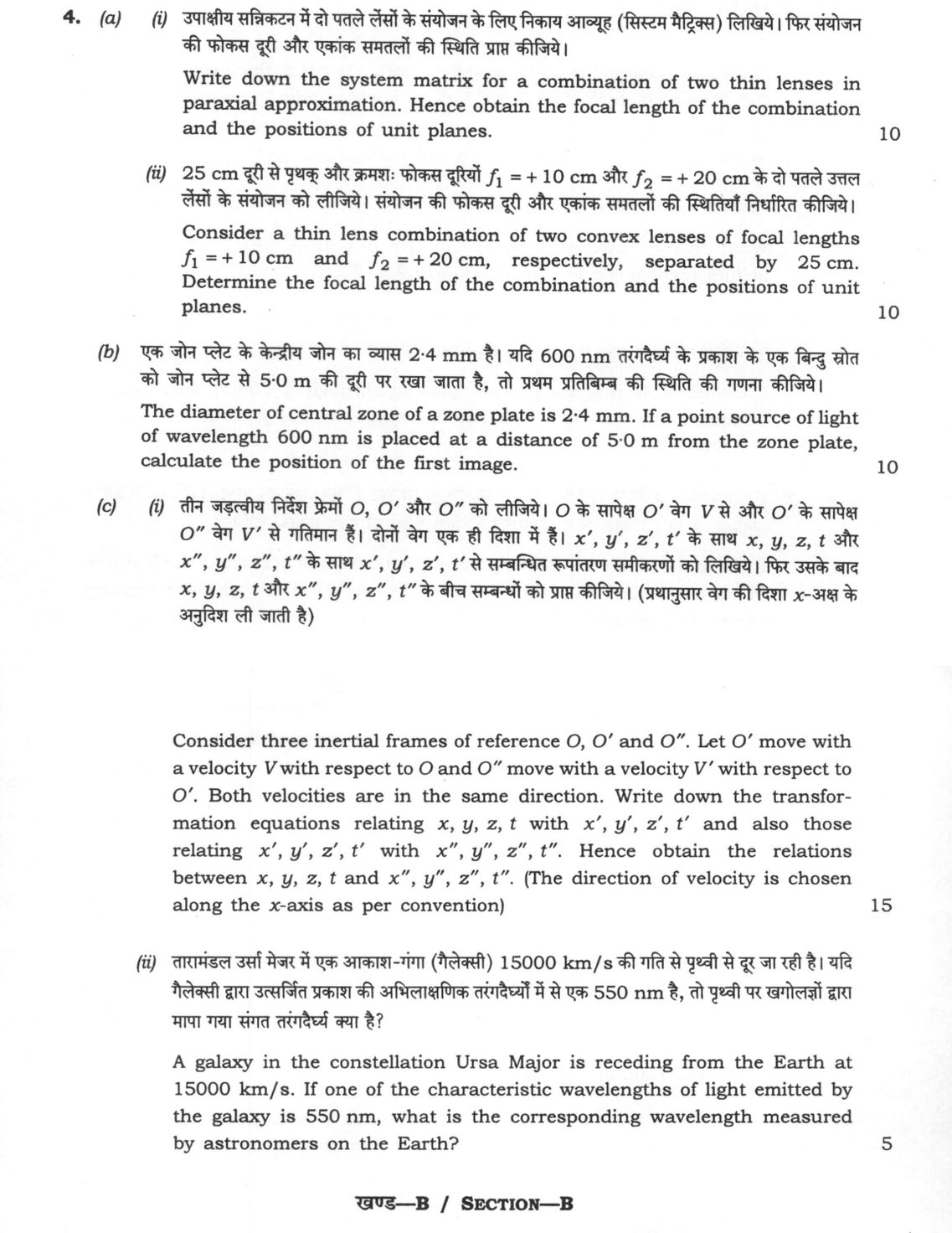
(a) (i) Write down the system matrix for a combination of two thin lenses in paraxial approximation. Hence obtain the focal…
Write down the system matrix for a combination of two thin lenses in paraxial approximation. Hence obtain the focal length of the combination and the positions of unit planes. 10 marks
Consider a thin lens combination of two convex lenses of focal lengths f₁ = + 10 cm and f₂ = + 20 cm, respectively, separated by 25 cm. Determine the focal length of the combination and the positions of unit planes. 10 marks
The diameter of central zone of a zone plate is 2·4 mm. If a point source of light of wavelength 600 nm is placed at a distance of 5·0 m from the zone plate, calculate the position of the first image. 10 marks
Consider three inertial frames of reference O, O' and O''. Let O' move with a velocity V with respect to O and O'' move with a velocity V' with respect to O'. Both velocities are in the same direction. Write down the transformation equations relating x, y, z, t with x', y', z', t' and also those relating x', y', z', t' with x'', y'', z'', t''. Hence obtain the relations between x, y, z, t and x'', y'', z'', t''. (The direction of velocity is chosen along the x-axis as per convention) 15 marks
A galaxy in the constellation Ursa Major is receding from the Earth at 15000 km/s. If one of the characteristic wavelengths of light emitted by the galaxy is 550 nm, what is the corresponding wavelength measured by astronomers on the Earth? 5 marks
हिंदी में प्रश्न पढ़ें
उपाक्षीय सन्निकटन में दो पतले लेंसों के संयोजन के लिए निकाय आव्यूह (सिस्टम मैट्रिक्स) लिखिए। फिर संयोजन की फोकस दूरी और एकांक समतलों की स्थिति प्राप्त कीजिए। (10 अंक)
25 cm दूरी से पृथक और क्रमशः फोकस दूरियाँ f₁ = + 10 cm और f₂ = + 20 cm के दो पतले उत्तल लेंसों के संयोजन को लीजिए। संयोजन की फोकस दूरी और एकांक समतलों की स्थितियाँ निर्धारित कीजिए। (10 अंक)
एक जोन प्लेट के केंद्रीय जोन का व्यास 2·4 mm है। यदि 600 nm तरंगदैर्घ्य के प्रकाश के एक बिंदु स्रोत को जोन प्लेट से 5·0 m की दूरी पर रखा जाता है, तो प्रथम प्रतिबिंब की स्थिति की गणना कीजिए। (10 अंक)
तीन जड़त्वीय निर्देश फ्रेमों O, O' और O" को लीजिए। O के सापेक्ष O' वेग V से और O' के सापेक्ष O" वेग V' से गतिमान है। दोनों वेग एक ही दिशा में हैं। x', y', z', t' के साथ x, y, z, t और x", y", z", t" के साथ x', y', z', t' से संबंधित रूपांतरण समीकरणों को लिखिए। फिर उसके बाद x, y, z, t और x", y", z", t" के बीच संबंधों को प्राप्त कीजिए। (प्रथानुसार वेग की दिशा x-अक्ष के अनुदिश ली जाती है) (15 अंक)
तारामंडल उर्सा मेजर में एक आकाश-गंगा (गैलेक्सी) 15000 km/s की गति से पृथ्वी से दूर जा रही है। यदि गैलेक्सी द्वारा उत्सर्जित प्रकाश की अभिलक्षणिक तरंगदैर्ध्यों में से एक 550 nm है, तो पृथ्वी पर खगोलज्ञों द्वारा मापा गया संगत तरंगदैर्ध्य क्या है? (5 अंक)
Model answer
Written by UPSC Answer Check against this question's marking rubric, to the expected length. UPSC does not publish answers for Mains — this is one way to score well, not an official key.
(a)(i) In paraxial approximation, sin θ ≈ tan θ ≈ θ. Take a ray vector (y, θ), where y is height and θ is slope. The translation matrix through distance d is T(d) = [[1, d], [0, 1]] and the thin-lens matrix is L(f) = [[1, 0], [-1/f, 1]]. For two thin lenses f₁ and f₂ separated by d, the system matrix from just before L₁ to just after L₂ is M = L(f₂) T(d) L(f₁) = [[1 - d/f₁, d], [-(1/f₁ + 1/f₂ - d/(f₁ f₂)), 1 - d/f₂]]. For any system matrix M = [[A, B], [C, D]], the effective focal length satisfies C = -1/f. Hence 1/f = 1/f₁ + 1/f₂ - d/(f₁ f₂). For unit (principal) planes, h₁ = (D - 1)/C and h₂ = (1 - A)/C, measured from the first and second lenses respectively, positive to the right. Substituting A, C, D gives h₁ = f d/f₂, h₂ = - f d/f₁. Thus the first unit plane lies f d/f₂ to the right of L₁, and the second unit plane lies f d/f₁ to the left of L₂.
(a)(ii) Given f₁ = +10 cm, f₂ = +20 cm, d = 25 cm. 1/f = 1/10 + 1/20 - 25/(10×20) = 0.10 + 0.05 - 0.125 = 0.025 cm⁻¹. Therefore f = 1/0.025 = 40 cm. The first unit plane is h₁ = f d/f₂ = (40×25)/20 = 50 cm to the right of L₁. Since L₂ is 25 cm to the right of L₁, this is 25 cm to the right of L₂. The second unit plane is h₂ = - f d/f₁ = -(40×25)/10 = -100 cm relative to L₂, i.e. 100 cm to the left of L₂, or 75 cm to the left of L₁. Final: f = +40 cm; H at +50 cm from L₁; H′ at -75 cm from L₁.
(b) The central-zone diameter is 2.4 mm, so its radius is r₁ = 1.2 mm = 1.2×10⁻³ m. Wavelength λ = 600 nm = 6.0×10⁻⁷ m. For a source at distance u = 5.0 m and first image at distance v, the path difference between the axial ray and the ray through the first-zone edge is approximately r₁²/2 (1/u + 1/v). For the first image, this equals λ/2, so r₁²(1/u + 1/v) = λ. Thus 1/u + 1/v = λ/r₁² = 1/f, where f = r₁²/λ. Now f = (1.2×10⁻³)²/(6.0×10⁻⁷) = 1.44×10⁻⁶/6.0×10⁻⁷ = 2.4 m. Then 1/v = 1/f - 1/u = 1/2.4 - 1/5.0 = 5/12 - 1/5 = 13/60 m⁻¹. Hence v = 60/13 m = 4.615... m ≈ 4.62 m. Final: the first image is real and lies on the opposite side of the zone plate from the source at 60/13 m ≈ 4.62 m from the plate.
(c)(i) Let β = V/c and γ = 1/√(1 - β²). The Lorentz transformation from O to O′ is x′ = γ(x - Vt), y′ = y, z′ = z, t′ = γ(t - Vx/c²). Let β′ = V′/c and γ′ = 1/√(1 - β′²). The transformation from O′ to O″ is x″ = γ′(x′ - V′t′), y″ = y′, z″ = z′, t″ = γ′(t′ - V′x′/c²). Substituting the first pair into the second pair: x″ = γ′[γ(x - Vt) - V′γ(t - Vx/c²)] = γγ′[(1 + VV′/c²)x - (V+V′)t]. Similarly, t″ = γ′[γ(t - Vx/c²) - V′γ(x - Vt)/c²] = γγ′[(1 + VV′/c²)t - (V+V′)x/c²]. Define u = (V+V′)/(1 + VV′/c²), Γ = γγ′(1 + VV′/c²) = 1/√(1 - u²/c²). Then x″ = Γ(x - ut), y″ = y, z″ = z, t″ = Γ(t - ux/c²). This is again a Lorentz transformation with velocity u along the x-axis. Hence the velocity addition law is u = (V+V′)/(1 + VV′/c²).
(c)(ii) For a receding source, the relativistic Doppler formula is λ_obs = λ_emit √((1+β)/(1-β)), where β = v/c. Here β = 15000/(3.00×10⁵) = 0.05. Thus λ_obs = 550 nm × √(1.05/0.95) = 550 nm × √(21/19) ≈ 550 nm × 1.05132 = 578.22 nm. Final: λ_obs ≈ 578.2 nm.
What "Derive" is asking you to do
Reach the stated expression from a starting relation, justifying every step. The destination is printed in the question, so only the route earns marks, and the assumptions you work under are part of that route.
Structure that answers it
Assumptions and notation defined → starting relation or governing equation → each step with its justification → the required expression → limiting case or boundary check
Where marks are lost
Writing the standard result first and fitting three lines to it, which an examiner reads at a glance. Marks also go on assumptions left unstated — lossless medium, small amplitude, errors independent with zero mean — and on symbols used before they are defined, even when the question says usual notations.
How this answer will be evaluated
Approach
Framework: Principle > Setup and diagram > Derivation > Result and limiting case. (a(i)) derive: given > assumptions > stepwise derivation > result > check | (a(ii)) calculate: given > formula > substitution > result with units > interpretation | (b) calculate: given > formula > substitution > result with units > interpretation | (c(i)) derive: given > assumptions > stepwise derivation > result > check | (c(ii)) calculate: given > formula > substitution > result with units > interpretation Full marks: Rigorous derivation with correct matrix algebra and physical interpretation.
Key points expected
- Matrix for first thin lens
- Matrix for translation between lenses
- Matrix for second thin lens
- Product matrix M = M2 T M1
- Substitution of f1, f2, d into matrix
- Calculation of effective focal length
- Calculation of first unit plane position
- Calculation of second unit plane position
Evaluation rubric
Each sub-part is marked on its own, against the marks and word limit printed on the paper.
- (a(i)) System matrix for two thin lenses and derivation of focal length/unit planes. 10 marks
derive— given → assumptions → stepwise derivation → result → check
Must cover
- Matrix for first thin lens
- Matrix for translation between lenses
- Matrix for second thin lens
- Product matrix M = M2 T M1
Loses marks
- Missing translation matrix T
- No derivation of focal length from matrix
Earns more
- Identification of matrix elements A, B, C, D
- Condition for focal length (B=0)
- Condition for unit planes (A=1, D=1)
Extra mark
- Explicit 2x2 matrix notation
- (a(ii)) Numerical focal length and unit plane positions for given lenses. 10 marks
calculate— given → formula → substitution → result with units → interpretation
Must cover
- Substitution of f1, f2, d into matrix
- Calculation of effective focal length
- Calculation of first unit plane position
- Calculation of second unit plane position
Loses marks
- Arithmetic errors in matrix multiplication
- Confusion between focal length and unit plane distance
Earns more
- Correct sign convention for positions
- Verification of results
Extra mark
- Diagram showing unit planes
- (b) Position of the first image formed by the zone plate. 10 marks
calculate— given → formula → substitution → result with units → interpretation
Must cover
- Formula for zone plate focal length
- Identification of first image order
- Substitution of diameter and wavelength
- Final result with units
Loses marks
- Using diameter instead of radius in formula
- Ignoring the source distance (5.0 m)
Earns more
- Explanation of zone plate focusing principle
- Distinction between focal length and image distance
Extra mark
- Diagram of zone plate focusing
- (c(i)) Combined Lorentz transformation for three inertial frames. 15 marks
derive— given → assumptions → stepwise derivation → result → check
Must cover
- Lorentz transformation O to O'
- Lorentzz transformation O' to O''
- Substitution to eliminate O' coordinates
- Simplification to final O to O'' relation
Loses marks
- Using Galilean transformation instead of Lorentz
- Algebraic errors in substitution
Earns more
- Derivation of velocity addition formula
- Identification of gamma factors
Extra mark
- Explicit matrix form of transformation
- (c(ii)) Observed wavelength of light from receding galaxy. 5 marks
calculate— given → formula → substitution → result with units → interpretation
Must cover
- Relativistic Doppler formula for receding source
- Substitution of velocity and wavelength
- Calculation of observed wavelength
- Result in nm
Loses marks
- Using classical Doppler formula for high velocity
- Sign error in velocity term
Earns more
- Justification for using relativistic formula
- Comparison with classical Doppler shift
Extra mark
- Calculation of redshift z
Practice this exact question
Write your answer and it is marked point by point against the model answer above — what you covered, what you missed, what you got wrong.
Evaluate my answer →More from Physics 2024 Paper I
- Q1 (a) A particle of mass m kg having an initial velocity V₀ is subjected to a retarding for…
- Q2 (a) (i) Briefly discuss the Kepler's laws of planetary motion. 5 marks (ii) Show that the…
- Q3 (a) (i) Explain the phenomenon of double refraction. What are positive and negative cryst…
- Q4 (a) (i) Write down the system matrix for a combination of two thin lenses in paraxial app…
- Q5 (a) In spherical coordinates, V = –25 V on a conductor at r = 2 cm and V = 150 V on anoth…
- Q6 (a) Using Maxwell's equations, obtain Poisson's equation and Laplace's equation. The regi…
- Q7 (a) How does Planck's law resolve the ultraviolet catastrophe predicted by classical phys…