Paper I — Q5
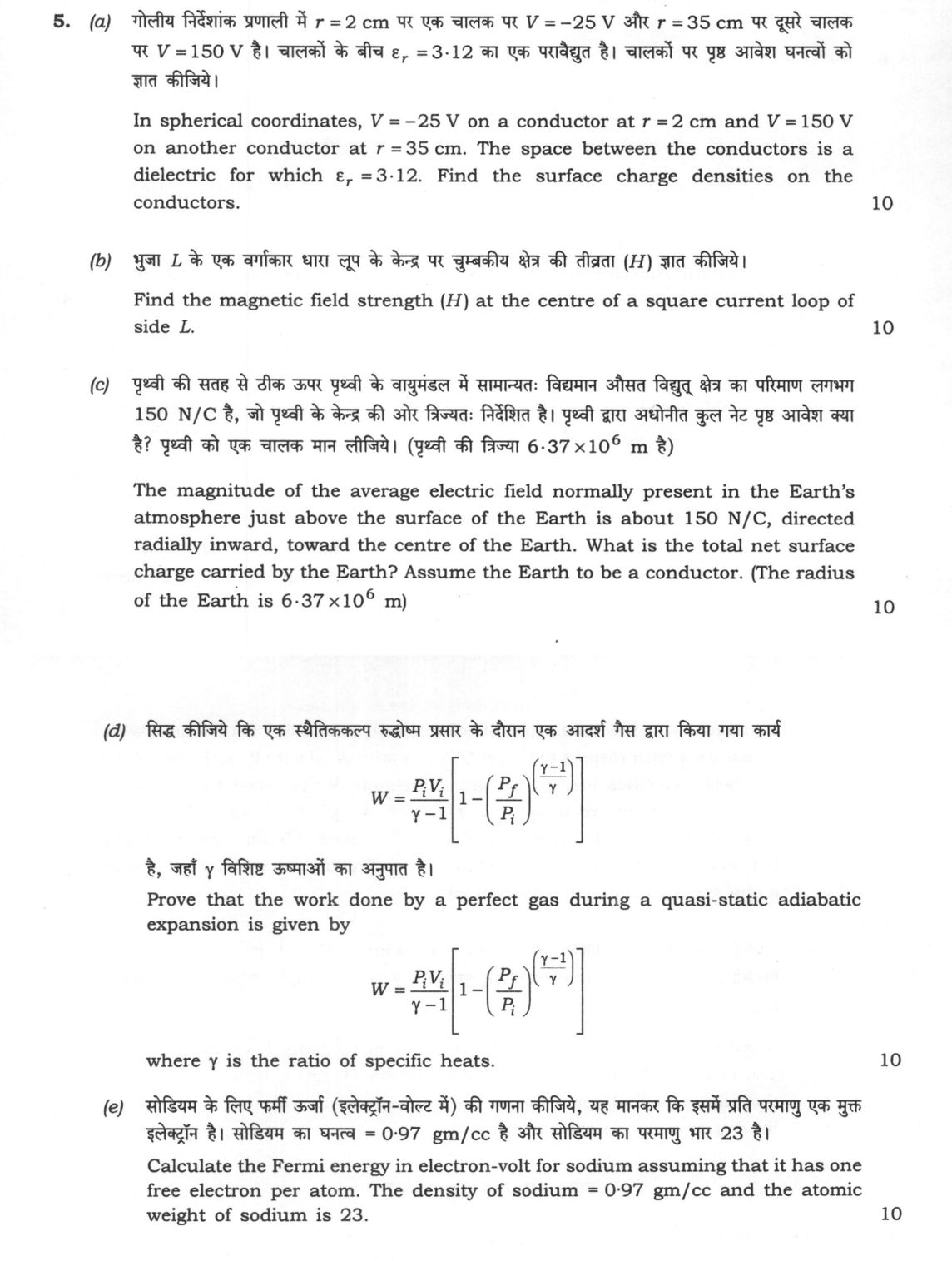
(a) In spherical coordinates, V = –25 V on a conductor at r = 2 cm and V = 150 V on another conductor at r = 35 cm. The space…
In spherical coordinates, V = –25 V on a conductor at r = 2 cm and V = 150 V on another conductor at r = 35 cm. The space between the conductors is a dielectric for which εᵣ = 3·12. Find the surface charge densities on the conductors. 10 marks
Find the magnetic field strength (H) at the centre of a square current loop of side L. 10 marks
The magnitude of the average electric field normally present in the Earth's atmosphere just above the surface of the Earth is about 150 N/C, directed radially inward, toward the centre of the Earth. What is the total net surface charge carried by the Earth? Assume the Earth to be a conductor. (The radius of the Earth is 6·37×10⁶ m) 10 marks
Prove that the work done by a perfect gas during a quasi-static adiabatic expansion is given by
W = (Pᵢ Vᵢ)/(γ - 1)[1 - ((P_f)/(Pᵢ))^((γ-1)/(γ))]
where γ is the ratio of specific heats. 10 marks
Calculate the Fermi energy in electron-volt for sodium assuming that it has one free electron per atom. The density of sodium = 0.97 gm/cc and the atomic weight of sodium is 23. 10 marks
हिंदी में प्रश्न पढ़ें
गोलीय निर्देशांक प्रणाली में r = 2 cm पर एक चालक पर V = –25 V और r = 35 cm पर दूसरे चालक पर V = 150 V है। चालकों के बीच εᵣ = 3·12 का एक परावैद्युत है। चालकों पर पृष्ठ आवेश घनत्वों को ज्ञात कीजिए। (10 अंक)
भुजा L के एक वर्गाकार धारा लूप के केंद्र पर चुंबकीय क्षेत्र की तीव्रता (H) ज्ञात कीजिए। (10 अंक)
पृथ्वी की सतह से ठीक ऊपर पृथ्वी के वायुमंडल में सामान्यतः विद्यमान औसत विद्युत क्षेत्र का परिमाण लगभग 150 N/C है, जो पृथ्वी के केंद्र की ओर त्रिज्यतः निर्देशित है। पृथ्वी द्वारा अधोनत कुल नेट पृष्ठ आवेश क्या है? पृथ्वी को एक चालक मान लीजिए। (पृथ्वी की त्रिज्या 6·37×10⁶ m है) (10 अंक)
सिद्ध कीजिये कि एक स्थैतिकल्प रूद्धोष्म प्रसार के दौरान एक आदर्श गैस द्वारा किया गया कार्य
W = (Pᵢ Vᵢ)/(γ - 1)[1 - ((P_f)/(Pᵢ))^((γ-1)/(γ))]
है, जहाँ γ विशिष्ट ऊष्माओं का अनुपात है। (10 अंक)
सोडियम के लिए फर्मी ऊर्जा (इलेक्ट्रॉन-वोल्ट में) की गणना कीजिये, यह मानकर कि इसमें प्रति परमाणु एक मुक्त इलेक्ट्रॉन है। सोडियम का घनत्व = 0.97 gm/cc है और सोडियम का परमाणु भार 23 है। (10 अंक)
Model answer
Written by UPSC Answer Check against this question's marking rubric, to the expected length. UPSC does not publish answers for Mains — this is one way to score well, not an official key.
(a) Let a = 2 cm = 0.02 m and b = 35 cm = 0.35 m. For spherical symmetry, Laplace's equation gives
V(r) = A/r + B.
Using the boundary values: V(a) = A/a + B = –25 V, V(b) = A/b + B = 150 V.
Subtracting, A(1/b – 1/a) = 175. Now 1/b – 1/a = 1/0.35 – 1/0.02 = 20/7 – 50 = –330/7 m⁻¹. Thus A = –175 × 7/330 = –245/66 V m. Then B = –25 – A/a = –25 + (245/66)/0.02 = 5300/33 V.
Hence V(r) = –245/(66r) + 5300/33 V, and the radial electric field is E_r = –dV/dr = A/r² = –245/(66r²) V/m. The field is negative, i.e. directed radially inward.
For a conductor, the surface charge density is σ = D·n = ε₀εᵣE·n, where n is outward from the conductor into the dielectric.
At the inner conductor r = a, n = +r̂: σ_inner = ε₀εᵣE_r(a) = ε₀εᵣA/a². With ε₀ = 8.854×10⁻¹² F/m, εᵣ = 3.12, a = 0.02 m: σ_inner = –2.56×10⁻⁷ C/m².
At the outer conductor r = b, n = –r̂: σ_outer = –ε₀εᵣE_r(b) = –ε₀εᵣA/b². Thus σ_outer = +8.37×10⁻¹⁰ C/m².
Final: σ_inner ≈ –2.56×10⁻⁷ C/m², σ_outer ≈ +8.37×10⁻¹⁰ C/m².
(b) Let the square loop have side L and carry current I. Use the Biot–Savart law for one side. The magnetic flux density due to a finite straight wire at perpendicular distance d is
B = μ₀I/(4πd)(sinθ₁ + sinθ₂).
At the centre of the square, for any one side, d = L/2. The two end angles are equal: θ₁ = θ₂ = 45°, so sinθ₁ = sinθ₂ = 1/√2. Therefore
B_side = μ₀I/(4π(L/2))(2/√2) = √2 μ₀I/(2πL).
All four sides produce magnetic fields in the same direction at the centre by the right-hand rule. Hence
B_total = 4B_side = 2√2 μ₀I/(πL).
Since H = B/μ₀ in free space, H = 2√2 I/(πL).
Final: H = 2√2 I/(πL) A/m at the centre, directed normal to the plane of the loop according to the right-hand rule.
(c) Treat the Earth as a conducting sphere of radius R = 6.37×10⁶ m. By Gauss's law, outside a conducting sphere,
E = Q/(4π ε₀ R²),
where Q is the total net surface charge. The field magnitude is 150 N/C and is directed radially inward, so Q must be negative. Using magnitudes:
|Q| = 4π ε₀ R² E.
Substitute: |Q| = 4π(8.854×10⁻¹²)(6.37×10⁶)²(150) C.
Now R² = (6.37×10⁶)² = 4.05769×10¹³ m². Thus |Q| = 4π(8.854×10⁻¹²)(4.05769×10¹³)(150) ≈ 6.77×10⁵ C.
Because E is inward, Q = –6.77×10⁵ C.
Final: total net surface charge of the Earth ≈ –6.77×10⁵ C.
(d) Let W be the work done by the gas. For a quasi-static adiabatic process, dQ = 0. By the first law,
dQ = dU + dW,
so dW = –dU.
For a perfect gas, internal energy is U = nC_VT. Since C_V = R/(γ – 1) and PV = nRT, U = PV/(γ – 1).
Therefore, for a finite adiabatic change, W = Uᵢ – U_f = (PᵢVᵢ – P_fV_f)/(γ – 1).
Now use the adiabatic relation for a perfect gas: PV^γ = constant. Thus P_fV_f^γ = PᵢVᵢ^γ, which gives V_f = Vᵢ(Pᵢ/P_f)^(1/γ).
Hence P_fV_f = P_fVᵢ(Pᵢ/P_f)^(1/γ) = PᵢVᵢ(P_f/Pᵢ)^(1 – 1/γ) = PᵢVᵢ(P_f/Pᵢ)^((γ – 1)/γ).
Substituting into W: W = PᵢVᵢ/(γ – 1)[1 – (P_f/Pᵢ)^((γ – 1)/γ)].
Final: W = PᵢVᵢ/(γ – 1)[1 – (P_f/Pᵢ)^((γ – 1)/γ)], valid for a perfect gas undergoing a quasi-static adiabatic expansion.
(e) For sodium, one free electron per atom. The electron number density is
n = ρN_A/M.
Given ρ = 0.97 g/cm³ = 970 kg/m³, M = 23 g/mol = 0.023 kg/mol, and N_A = 6.022×10²³ mol⁻¹:
n = (970 × 6.022×10²³)/0.023 ≈ 2.54×10²⁸ m⁻³.
The Fermi energy is given by the free-electron formula
E_F = (ħ²/(2mₑ))(3π²n)^(2/3).
Using ħ = 1.055×10⁻³⁴ J s and mₑ = 9.109×10⁻³¹ kg: 3π²n = 3π²(2.54×10²⁸) ≈ 7.52×10²⁹ m⁻³. Thus k_F = (3π²n)^(1/3) ≈ 9.10×10⁹ m⁻¹.
Therefore E_F = ħ²k_F²/(2mₑ) ≈ (1.055×10⁻³⁴)²(9.10×10⁹)²/(2 × 9.109×10⁻³¹) J ≈ 5.05×10⁻¹⁹ J.
Converting to electron-volt, E_F = 5.05×10⁻¹⁹/1.602×10⁻¹⁹ eV ≈ 3.15 eV.
Final: Fermi energy of sodium ≈ 3.15 eV.
What "Solve" is asking you to do
Choose the method, then carry it through to a final answer. Identifying what kind of problem this is and why that method applies is the first thing marked; a correct figure arrived at invisibly earns almost nothing.
Structure that answers it
Given data and what is required → method chosen, with the reason it applies → set-up (equation, circuit, free body, trial balance) → working, step by step → answer with units and any condition of validity
Where marks are lost
Doing the middle steps mentally and writing only the result. In mathematics papers, a further loss comes from giving a decimal where the exact value in surds or fractions was wanted, or from skipping the justification a part explicitly asks for.
How this answer will be evaluated
Approach
Framework: Principle > Setup and diagram > Derivation > Result and limiting case. (a) calculate: given > formula > substitution > result with units > interpretation | (b) derive: given > assumptions > stepwise derivation > result > check | (c) calculate: given > formula > substitution > result with units > interpretation | (d) derive: given > assumptions > stepwise derivation > result > check | (e) calculate: given > formula > substitution > result with units > interpretation Full marks: Complete derivations with correct physics, units, and physical interpretation
Key points expected
- Solve Laplace's equation for spherical geometry
- Apply boundary conditions at r=2cm and r=35cm
- Calculate E-field using V(r) derivative
- Apply boundary condition D_n = ρ_s
- Apply Biot-Savart law for one side
- Integrate over finite length L
- Sum contributions from all four sides
- Convert B to H using H = B/μ
Evaluation rubric
Each sub-part is marked on its own, against the marks and word limit printed on the paper.
- (a) Surface charge densities on both spherical conductors. 10 marks
calculate— given → formula → substitution → result with units → interpretation
Must cover
- Solve Laplace's equation for spherical geometry
- Apply boundary conditions at r=2cm and r=35cm
- Calculate E-field using V(r) derivative
- Apply boundary condition D_n = ρ_s
Loses marks
- Using parallel plate capacitor formula
- Ignoring dielectric constant εᵣ
- Missing units in final answer
Earns more
- Correct use of ε = ε₀εᵣ
- Sign convention for charge density
- Unit consistency (SI units)
Extra mark
- Physical interpretation of charge distribution
- (b) Magnetic field strength H at center of square loop. 10 marks
derive— given → assumptions → stepwise derivation → result → check
Must cover
- Apply Biot-Savart law for one side
- Integrate over finite length L
- Sum contributions from all four sides
- Convert B to H using H = B/μ
Loses marks
- Using infinite wire formula directly
- Missing factor of 4 for four sides
- Confusing B and H
Earns more
- Symmetry argument for equal contributions
- Correct geometric setup with angles
- Final result in terms of I and L
Extra mark
- Comparison with circular loop result
- (c) Total net surface charge on Earth. 10 marks
calculate— given → formula → substitution → result with units → interpretation
Must cover
- Apply Gauss's law for spherical surface
- Relate E-field to enclosed charge
- Substitute Earth's radius 6.37×10⁶ m
- Calculate Q = 4πR²ε₀E
Loses marks
- Using E = kQ/r² without derivation
- Ignoring Earth's spherical geometry
- Arithmetic errors in exponent
Earns more
- Correct sign of charge (negative)
- Use of ε₀ value
- Order of magnitude check
Extra mark
- Context of atmospheric electricity
- (d) Proof of work done in adiabatic expansion. 10 marks
derive— given → assumptions → stepwise derivation → result → check
Must cover
- Start with W = ∫P dV
- Use adiabatic relation PV^γ = constant
- Integrate from Vᵢ to V_f
- Express result in terms of Pᵢ, P_f, γ
Loses marks
- Assuming isothermal process
- Incorrect integration of PV^γ
- Algebraic errors in final expression
Earns more
- Clear step-by-step integration
- Correct limits of integration
- Algebraic manipulation to final form
Extra mark
- Physical interpretation of γ dependence
- (e) Fermi energy for sodium in eV. 10 marks
calculate— given → formula → substitution → result with units → interpretation
Must cover
- Calculate electron density n from mass density
- Use Fermi energy formula E_F = (ħ²/2m)(3π²n)^(2/3)
- Convert result to electron-volts
- Use atomic weight 23 and density 0.97 g/cc
Loses marks
- Using wrong formula for Fermi energy
- Unit conversion errors
- Forgetting to convert to eV
Earns more
- Correct unit conversions (g to kg, cc to m³)
- Use of Avogadro's number
- Final answer in eV with proper significant figures
Extra mark
- Comparison with experimental value
Practice this exact question
Write your answer and it is marked point by point against the model answer above — what you covered, what you missed, what you got wrong.
Evaluate my answer →More from Physics 2024 Paper I
- Q2 (a) (i) Briefly discuss the Kepler's laws of planetary motion. 5 marks (ii) Show that the…
- Q3 (a) (i) Explain the phenomenon of double refraction. What are positive and negative cryst…
- Q4 (a) (i) Write down the system matrix for a combination of two thin lenses in paraxial app…
- Q5 (a) In spherical coordinates, V = –25 V on a conductor at r = 2 cm and V = 150 V on anoth…
- Q6 (a) Using Maxwell's equations, obtain Poisson's equation and Laplace's equation. The regi…
- Q7 (a) How does Planck's law resolve the ultraviolet catastrophe predicted by classical phys…
- Q8 (a) (i) Explain the T-s diagram for the reversible Carnot cycle and hence obtain the expr…