Paper I — Q6
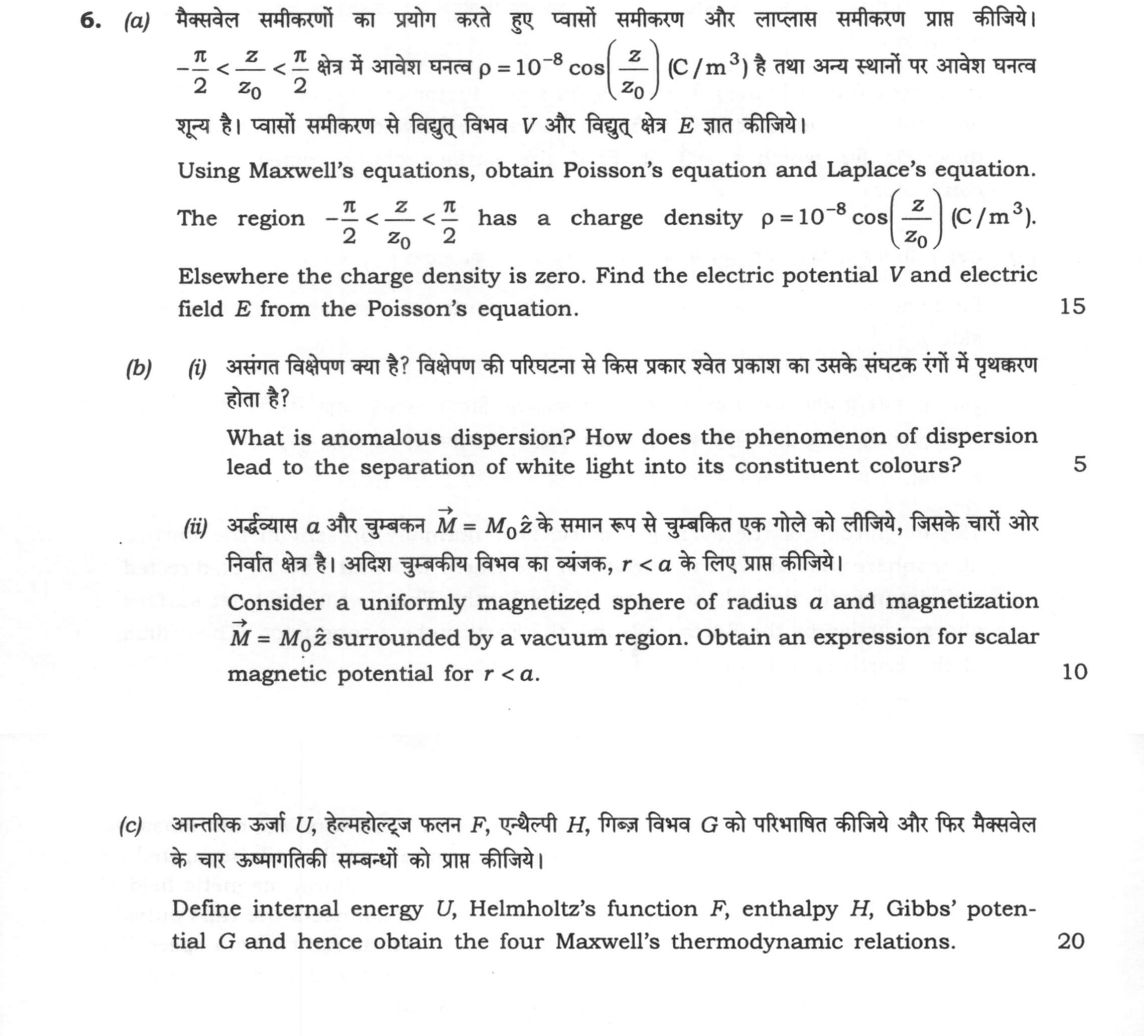
(a) Using Maxwell's equations, obtain Poisson's equation and Laplace's equation. The region -(π)/2 < z/(z₀) < (π)/2 has a charge…
Using Maxwell's equations, obtain Poisson's equation and Laplace's equation.
The region -(π)/2 < z/(z₀) < (π)/2 has a charge density ρ = 10⁻⁸ cos(z/(z₀)) (C/m³). Elsewhere the charge density is zero. Find the electric potential V and electric field E from the Poisson's equation. 15 marks
What is anomalous dispersion? How does the phenomenon of dispersion lead to the separation of white light into its constituent colours? 5 marks
Consider a uniformly magnetized sphere of radius a and magnetization M⃗ = M_0ẑ surrounded by a vacuum region. Obtain an expression for scalar magnetic potential for r < a. 10 marks
Define internal energy U, Helmholtz's function F, enthalpy H, Gibbs' potential G and hence obtain the four Maxwell's thermodynamic relations. 20 marks
हिंदी में प्रश्न पढ़ें
मैक्सवेल समीकरणों का प्रयोग करते हुए प्वासों समीकरण और लाप्लास समीकरण प्राप्त कीजिये।
-(π)/2 < z/(z₀) < (π)/2 क्षेत्र में आवेश घनत्व ρ = 10⁻⁸ cos(z/(z₀)) (C/m³) है तथा अन्य स्थानों पर आवेश घनत्व शून्य है। प्वासों समीकरण से विद्युत विभव V और विद्युत क्षेत्र E ज्ञात कीजिये। (15 अंक)
असंगत विष्केपण क्या है? विष्केपण की परिघटना से किस प्रकार श्वेत प्रकाश का उसके संघटक रंगों में पृथक्करण होता है? (5 अंक)
अर्धव्यास a और चुंबकन M⃗ = M_0ẑ के समान रूप से चुंबकित एक गोले को लीजिये, जिसके चारों ओर निर्वात क्षेत्र है। अदिश चुंबकीय विभव का व्यंजक, r < a के लिए प्राप्त कीजिये। (10 अंक)
आंतरिक ऊर्जा U, हेल्महोल्ट्ज फलन F, एन्थैल्पी H, गिब्स विभव G को परिभाषित कीजिये और फिर मैक्सवेल के चार उष्मागतिकी संबंधों को प्राप्त कीजिये। (20 अंक)
Model answer
Written by UPSC Answer Check against this question's marking rubric, to the expected length. UPSC does not publish answers for Mains — this is one way to score well, not an official key.
(a) From Gauss's law and E = −∇V: ∇·E = ρ/ε₀, so ∇·(−∇V) = ρ/ε₀. Hence ∇²V = −ρ/ε₀ (Poisson's equation). If ρ = 0, this becomes ∇²V = 0 (Laplace's equation).
Here ρ = ρ₀ cos(z/z₀), ρ₀ = 10⁻⁸ C/m³, inside |z| < πz₀/2; elsewhere ρ = 0. By translational symmetry in x and y, V = V(z). Poisson's equation is d²V/dz² = −(ρ₀/ε₀) cos(z/z₀).
Integrating once: dV/dz = −(ρ₀z₀/ε₀) sin(z/z₀) + C₁. Integrating again: V = (ρ₀z₀²/ε₀) cos(z/z₀) + C₁z + C₂.
Symmetry about z = 0 gives C₁ = 0. Taking V(0) = 0 gives C₂ = −ρ₀z₀²/ε₀. Thus for |z| < πz₀/2: V = (ρ₀z₀²/ε₀)[cos(z/z₀) − 1] volt, E = −(dV/dz) ẑ = (ρ₀z₀/ε₀) sin(z/z₀) ẑ V/m.
Outside the slab, ρ = 0, so Laplace's equation gives V = Az + B, E_z = −A. At z = a = πz₀/2, continuity of E gives A = −ρ₀z₀/ε₀. Matching V at z = a gives B = (ρ₀z₀²/ε₀)(π/2 − 1). Therefore for z > πz₀/2: V = (ρ₀z₀²/ε₀)(π/2 − 1 − z/z₀) volt, E = (ρ₀z₀/ε₀) ẑ V/m. For z < −πz₀/2, by symmetry: V = (ρ₀z₀²/ε₀)(π/2 − 1 + z/z₀) volt, E = −(ρ₀z₀/ε₀) ẑ V/m. An arbitrary constant may be added to V; E is unchanged.
(b) (i) Anomalous dispersion is the region of dispersion in which the refractive index decreases as frequency increases, equivalently dn/dλ > 0, usually near an absorption band. Normal dispersion has dn/dλ < 0. In a prism, the refractive index depends on wavelength: violet light has larger n than red in normal dispersion, so violet is deviated more and red less. Hence white light emerges as a spectrum of separated colours.
(b) (ii) Use scalar magnetic potential Φ_m with H = −∇Φ_m. Since ∇·B = 0 and B = μ₀(H + M), ∇²Φ_m = 0 inside and outside because M is uniform inside. At r = a, σ_m = M·r̂ = M₀ cosθ, and ∂Φ_in/∂r − ∂Φ_out/∂r = M₀ cosθ.
The source is cosθ, so retain only the l = 1 term: Φ_in = A r cosθ, Φ_out = B cosθ/r². Continuity at r = a gives A a = B/a², so B = A a³. Now ∂Φ_in/∂r = A cosθ, and ∂Φ_out/∂r = −2B cosθ/a³ = −2A cosθ. Therefore ∂Φ_in/∂r − ∂Φ_out/∂r = A cosθ + 2A cosθ = 3A cosθ = M₀ cosθ. Thus A = M₀/3. Hence for r < a, Φ_m = (M₀ r cosθ)/3 = M₀ z/3, with M₀ in A/m and Φ_m in A. Then H = −M₀ ẑ/3 A/m, and B = (2μ₀M₀/3) ẑ T.
(c) Internal energy U is the total energy associated with the microscopic motions and interactions of the constituents of the system, excluding bulk kinetic and potential energy. For a closed system with only PV work, the first law gives dU = T dS − P dV. Helmholtz function: F = U − TS. Enthalpy: H = U + PV. Gibbs potential: G = U − TS + PV = H − TS = F + PV.
From dU = T dS − P dV, U = U(S,V), so (∂T/∂V)_S = −(∂P/∂S)_V. … (1)
From F = U − TS, dF = −S dT − P dV. Thus (∂S/∂V)_T = (∂P/∂T)_V. … (2)
From H = U + PV, dH = T dS + V dP. Thus (∂T/∂P)_S = (∂V/∂S)_P. … (3)
From G = U − TS + PV, dG = −S dT + V dP. Thus (∂S/∂P)_T = −(∂V/∂T)_P. … (4)
The four Maxwell thermodynamic relations are therefore: (∂T/∂V)_S = −(∂P/∂S)_V, (∂S/∂V)_T = (∂P/∂T)_V, (∂T/∂P)_S = (∂V/∂S)_P, (∂S/∂P)_T = −(∂V/∂T)_P. They are valid for a closed system of fixed composition with only reversible PV work.
What "Derive" is asking you to do
Reach the stated expression from a starting relation, justifying every step. The destination is printed in the question, so only the route earns marks, and the assumptions you work under are part of that route.
Structure that answers it
Assumptions and notation defined → starting relation or governing equation → each step with its justification → the required expression → limiting case or boundary check
Where marks are lost
Writing the standard result first and fitting three lines to it, which an examiner reads at a glance. Marks also go on assumptions left unstated — lossless medium, small amplitude, errors independent with zero mean — and on symbols used before they are defined, even when the question says usual notations.
How this answer will be evaluated
Approach
Framework: Principle > Setup and diagram > Derivation > Result and limiting case. (a) derive: given > assumptions > stepwise derivation > result > check | (b(i)) explain: definition/context > points in order > small example > short close | (b(ii)) derive: given > assumptions > stepwise derivation > result > check | (c) derive: given > assumptions > stepwise derivation > result > check Full marks: Complete derivations with clear steps, correct boundary conditions, and physical interpretation.
Key points expected
- Derive Poisson's equation from Maxwell's equations
- State Laplace's equation as the zero-charge limit
- Solve Poisson's equation for the given region
- Determine electric field E from the potential V
- Define anomalous dispersion
- Explain the mechanism of dispersion
- Describe the separation of white light into colours
- Set up the magnetic scalar potential equation
Evaluation rubric
Each sub-part is marked on its own, against the marks and word limit printed on the paper.
- (a) Derive Poisson/Laplace equations and solve for V and E for the given charge density. 15 marks
derive— given → assumptions → stepwise derivation → result → check
Must cover
- Derive Poisson's equation from Maxwell's equations
- State Laplace's equation as the zero-charge limit
- Solve Poisson's equation for the given region
- Determine electric field E from the potential V
Loses marks
- Formula substitution without derivation
- Dropping units in the final answer
- Ignoring the boundary conditions
Earns more
- Correctly apply boundary conditions at z = ±πz₀/2
- Show the integration steps for the potential
- Verify the solution satisfies the original equation
Extra mark
- Discuss the physical interpretation of the potential distribution
- (b(i)) Define anomalous dispersion and explain how dispersion separates white light. 5 marks
explain— definition/context → points in order → small example → short close
Must cover
- Define anomalous dispersion
- Explain the mechanism of dispersion
- Describe the separation of white light into colours
Loses marks
- Confusing normal and anomalous dispersion
- Vague explanation without physical reasoning
Earns more
- Mention the relationship between refractive index and wavelength
- Provide a simple example of dispersion
Extra mark
- Reference a specific material or experiment
- (b(ii)) Obtain the scalar magnetic potential for a uniformly magnetized sphere (r < a). 10 marks
derive— given → assumptions → stepwise derivation → result → check
Must cover
- Set up the magnetic scalar potential equation
- Apply boundary conditions at the sphere surface
- Solve for the potential inside the sphere (r < a)
- Express the result in terms of M₀ and r
Loses marks
- Incorrect boundary conditions
- Missing the dependence on M₀
Earns more
- Show the symmetry arguments used
- Verify the result in the limit of small r
Extra mark
- Discuss the physical meaning of the potential
- (c) Define U, F, H, G and derive the four Maxwell thermodynamic relations. 20 marks
derive— given → assumptions → stepwise derivation → result → check
Must cover
- Define internal energy U
- Define Helmholtz's function F
- Define enthalpy H
- Define Gibbs' potential G
Loses marks
- Missing any of the four definitions
- Deriving fewer than four Maxwell relations
- Incorrect mathematical steps in the derivation
Earns more
- Derive each Maxwell relation step-by-step
- Show the connection between the thermodynamic potentials
- State the conditions under which each relation holds
Extra mark
- Provide a physical interpretation of each relation
Practice this exact question
Write your answer and it is marked point by point against the model answer above — what you covered, what you missed, what you got wrong.
Evaluate my answer →More from Physics 2024 Paper I
- Q3 (a) (i) Explain the phenomenon of double refraction. What are positive and negative cryst…
- Q4 (a) (i) Write down the system matrix for a combination of two thin lenses in paraxial app…
- Q5 (a) In spherical coordinates, V = –25 V on a conductor at r = 2 cm and V = 150 V on anoth…
- Q6 (a) Using Maxwell's equations, obtain Poisson's equation and Laplace's equation. The regi…
- Q7 (a) How does Planck's law resolve the ultraviolet catastrophe predicted by classical phys…
- Q8 (a) (i) Explain the T-s diagram for the reversible Carnot cycle and hence obtain the expr…