Paper II — Q1
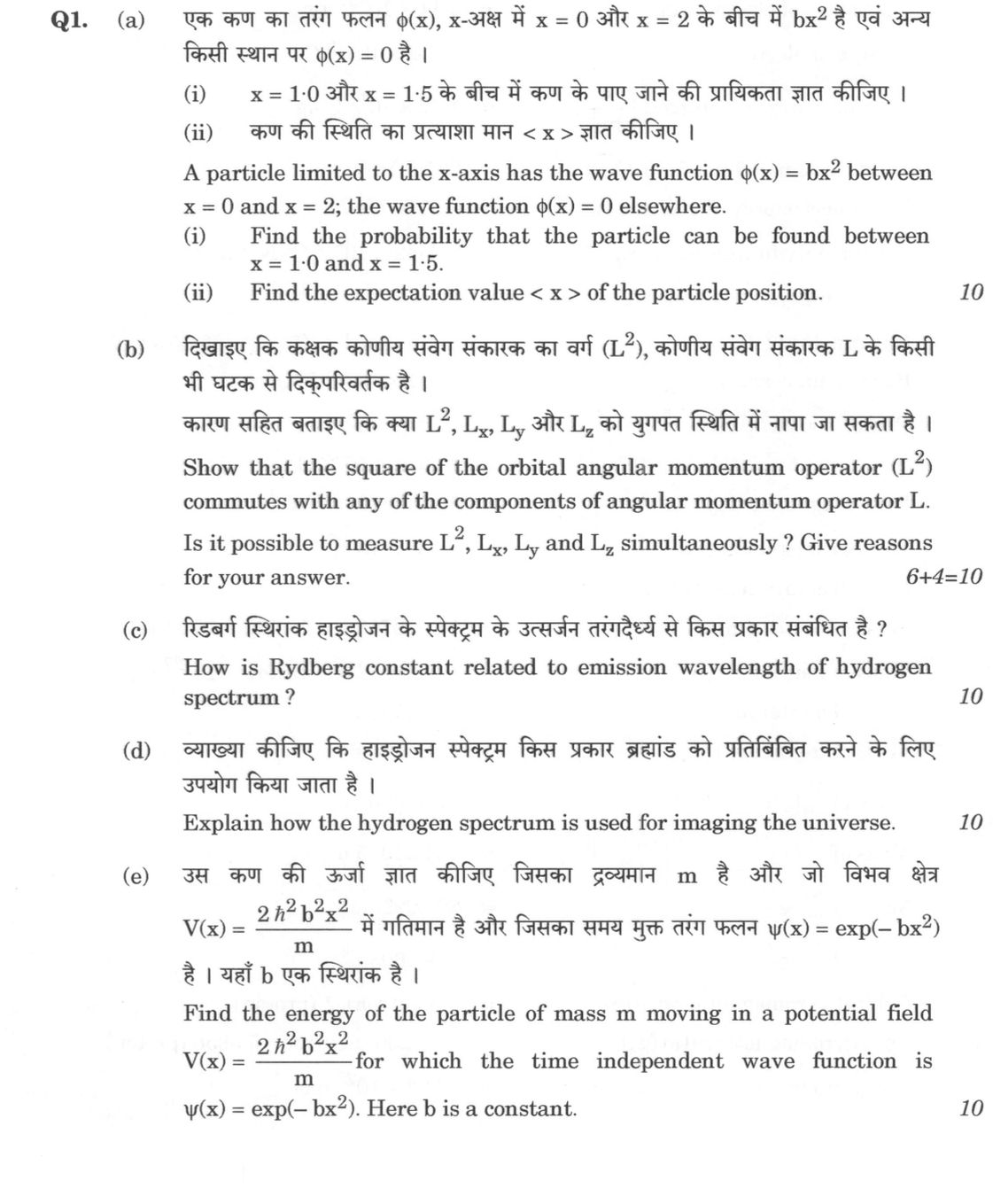
Q1. (a) A particle limited to the x-axis has the wave function φ(x) = bx² between x = 0 and x = 2; the wave function φ(x) = 0…
Q1. (a) A particle limited to the x-axis has the wave function φ(x) = bx² between x = 0 and x = 2; the wave function φ(x) = 0 elsewhere.
Find the probability that the particle can be found between x = 1·0 and x = 1·5.
Find the expectation value < x > of the particle position. 10 marks
Show that the square of the orbital angular momentum operator (L²) commutes with any of the components of angular momentum operator L.
Is it possible to measure L², Lₓ, Lᵧ and Lᵤ simultaneously ? Give reasons for your answer. 6+4=10 marks
How is Rydberg constant related to emission wavelength of hydrogen spectrum ? 10 marks
Explain how the hydrogen spectrum is used for imaging the universe. 10 marks
Find the energy of the particle of mass m moving in a potential field V(x) = 2ℏ²b²x²/m for which the time independent wave function is ψ(x) = exp(– bx²). Here b is a constant. 10 marks
हिंदी में प्रश्न पढ़ें
Q1. (a) एक कण का तरंग फलन φ(x), x-अक्ष में x = 0 और x = 2 के बीच में bx² है एवं अन्य किसी स्थान पर φ(x) = 0 है।
x = 1·0 और x = 1·5 के बीच में कण के पाए जाने की प्रायिकता ज्ञात कीजिए।
कण की स्थिति का प्रत्याशा मान < x > ज्ञात कीजिए। 10 अंक
दिखाइए कि कक्षक कोणीय संवेग संकारक का वर्ग (L²), कोणीय संवेग संकारक L के किसी भी घटक से दिक्परिवर्तक है।
कारण सहित बताइए कि क्या L², Lₓ, Lᵧ और Lᵤ को युगपत स्थिति में मापा जा सकता है। 6+4=10 अंक
रिडबर्ग स्थिरांक हाइड्रोजन के स्पेक्ट्रम के उत्सर्जन तरंगदैर्ध्य से किस प्रकार संबंधित है ? 10 अंक
व्याख्या कीजिए कि हाइड्रोजन स्पेक्ट्रम किस प्रकार ब्रह्मांड को प्रतिबिंबित करने के लिए उपयोग किया जाता है। 10 अंक
उस कण की ऊर्जा ज्ञात कीजिए जिसका द्रव्यमान m है और जो विभव क्षेत्र V(x) = 2ℏ²b²x²/m में गतिमान है और जिसका समय मुक्त तरंग फलन ψ(x) = exp(– bx²) है। यहाँ b एक स्थिरांक है। 10 अंक
Model answer
Written by UPSC Answer Check against this question's marking rubric, to the expected length. UPSC does not publish answers for Mains — this is one way to score well, not an official key.
(a)(i) The wave function is nonzero only between x = 0 and x = 2. Normalize it first. ∫₀² |φ(x)|² dx = |b|² ∫₀² x⁴ dx = |b|² [x⁵/5]₀² = 32|b|²/5 = 1. Hence |b|² = 5/32. Therefore the probability is P = ∫ from x=1 to x=1·5 of |φ(x)|² dx = |b|² [x⁵/5] from 1 to 1·5 = (5/32)((1·5)⁵ – 1⁵)/5 = ((3/2)⁵ – 1)/32. Since (3/2)⁵ = 243/32, P = (243/32 – 1)/32 = (211/32)/32 = 211/1024. So the probability is 211/1024, i.e. about 0·206.
(a)(ii) The expectation value of position is ⟨x⟩ = ∫₀² x |φ(x)|² dx / ∫₀² |φ(x)|² dx. Using |φ|² = |b|² x⁴, the constant |b|² cancels: ⟨x⟩ = ∫₀² x⁵ dx / ∫₀² x⁴ dx = [x⁶/6]₀² / [x⁵/5]₀² = (64/6)/(32/5). Thus ⟨x⟩ = (32/3)(5/32) = 5/3 in the same length unit as x.
(b) Let the three Cartesian components be denoted L₁ = Lₓ, L₂ = Lᵧ, L₃ = Lᵤ. The orbital angular momentum operators satisfy [L₁,L₂] = iℏL₃, [L₂,L₃] = iℏL₁, [L₃,L₁] = iℏL₂. Also L² = L₁² + L₂² + L₃². Using the operator identity [AB,C] = A[B,C] + [A,C]B, [L²,L₁] = [L₂²,L₁] + [L₃²,L₁] = L₂[L₂,L₁] + [L₂,L₁]L₂ + L₃[L₃,L₁] + [L₃,L₁]L₃. Now [L₂,L₁] = –[L₁,L₂] = –iℏL₃ and [L₃,L₁] = iℏL₂. Hence [L²,L₁] = L₂(–iℏL₃) + (–iℏL₃)L₂ + L₃(iℏL₂) + (iℏL₂)L₃ = –iℏ(L₂L₃ + L₃L₂) + iℏ(L₃L₂ + L₂L₃) = 0. By cyclic symmetry, [L²,L₂] = 0 and [L²,L₃] = 0. Hence L² commutes with every component of L.
It is possible to measure L² and any one component of L simultaneously, because L² commutes with each component. For example, simultaneous eigenfunctions of L² and L₃ exist, labelled by l and m. However, L², Lₓ, Lᵧ and Lᵤ cannot all be measured simultaneously in general, because the components do not commute with one another: [Lₓ,Lᵧ] = iℏLᵤ, and cyclic relations hold. Thus Lₓ, Lᵧ and Lᵤ cannot have definite values simultaneously except in the trivial case l = 0. Therefore only L² and one component can be specified together.
(c) For hydrogen, the energy levels are Eₙ = – μ e⁴/(8 ε₀² h² n²), where μ = mₑM/(mₑ + M) is the reduced mass of the electron–nucleus system. A photon emitted in a transition from nᵢ to n_f, with nᵢ > n_f, has energy hν = Eₙᵢ – Eₙ_f = μ e⁴/(8 ε₀² h²)(1/n_f² – 1/nᵢ²). Since ν = c/λ, 1/λ = μ e⁴/(8 ε₀² h³ c)(1/n_f² – 1/nᵢ²). This is the Rydberg formula, usually written 1/λ = R_H(1/n_f² – 1/nᵢ²). Therefore the Rydberg constant is R_H = μ e⁴/(8 ε₀² h³ c). For an infinitely heavy nucleus, R∞ = mₑe⁴/(8 ε₀² h³ c) ≈ 1·097373 × 10⁷ m⁻¹. For hydrogen, R_H is slightly smaller because of the finite proton mass. Thus the emission wavelength of any hydrogen line is inversely proportional to R_H and to the difference of inverse squares of the principal quantum numbers. For example, n_f = 1 gives the Lyman series, n_f = 2 gives the Balmer series, and n_f = 3 gives the Paschen series.
(d) Hydrogen is the most abundant element in the universe, so its spectrum is a powerful probe of cosmic structure. The 21 cm line of neutral hydrogen arises from a hyperfine spin-flip transition of the electron in the hydrogen atom. Its rest wavelength is about 21·1 cm and frequency about 1420·4 MHz. Radio waves at this wavelength pass through dust and gas, so radio interferometers can map neutral hydrogen clouds in the Milky Way and in external galaxies. Doppler shifts of the 21 cm line give line-of-sight velocities; line intensity gives column density. This has been used to map galactic rotation curves, spiral structure, gas clouds, and to infer dark matter.
Redshifted 21 cm radiation from the early universe is used for tomography of the cosmic dark ages, cosmic dawn, and the epoch of reionization. Instruments such as GMRT, FAST, VLA and SKA study these signals. The Lyman series, especially Lyman-α at about 121·6 nm, shifted into the infrared for distant objects, detects high-redshift galaxies and quasars. Absorption by intergalactic hydrogen produces the Lyman-α forest, which maps the distribution, temperature and ionization of the intergalactic medium. Balmer Hα at about 656·3 nm traces ionized hydrogen around young stars and is used to image star-forming regions and galaxy morphology. Thus hydrogen spectral lines provide position–velocity–density maps of the universe across cosmic time.
(e) The time-independent Schrödinger equation is –(ℏ²/2m) d²ψ/dx² + V(x)ψ = Eψ. Given ψ(x) = exp(– bx²), ψ′ = –2bx exp(– bx²), ψ″ = (–2b + 4b²x²) exp(– bx²). Therefore –(ℏ²/2m)ψ″ = –(ℏ²/2m)(–2b + 4b²x²)ψ = (ℏ²b/m – 2ℏ²b²x²/m)ψ. The potential term is Vψ = (2ℏ²b²x²/m)ψ. Adding, Hψ = (ℏ²b/m – 2ℏ²b²x²/m + 2ℏ²b²x²/m)ψ = (ℏ²b/m)ψ. Hence the energy eigenvalue is E = ℏ²b/m. This is the ground-state energy of the harmonic oscillator with angular frequency ω = 2ℏb/m, since E₀ = ½ℏω = ℏ²b/m. The result requires b > 0 so that ψ is normalizable.
What "Solve" is asking you to do
Choose the method, then carry it through to a final answer. Identifying what kind of problem this is and why that method applies is the first thing marked; a correct figure arrived at invisibly earns almost nothing.
Structure that answers it
Given data and what is required → method chosen, with the reason it applies → set-up (equation, circuit, free body, trial balance) → working, step by step → answer with units and any condition of validity
Where marks are lost
Doing the middle steps mentally and writing only the result. In mathematics papers, a further loss comes from giving a decimal where the exact value in surds or fractions was wanted, or from skipping the justification a part explicitly asks for.
How this answer will be evaluated
Approach
Framework: Quantum Mechanics: Wave Mechanics, Angular Momentum Algebra, Spectroscopy, and Schrödinger Equation. (a) calculate: given > formula > substitution > result with units > interpretation | (b) calculate: given > formula > substitution > result with units > interpretation | (c) explain: definition/context > points in order > small example > short close | (d) explain: definition/context > points in order > small example > short close | (e) calculate: given > formula > substitution > result with units > interpretation Full marks: Rigorous derivations, correct algebra, clear physical interpretation, and precise terminology.
Key points expected
- Normalization of wave function
- Commutator algebra for angular momentum
- Rydberg formula derivation
- Astrophysical applications of spectral lines
- Schrödinger equation application
Evaluation rubric
Each sub-part is marked on its own, against the marks and word limit printed on the paper.
- (a) Normalize wave function, then calculate probability and expectation value. 10 marks
calculate— given → formula → substitution → result with units → interpretation
Must cover
- Determine normalization constant b via integral
- Set up probability integral for x=1.0 to 1.5
- Set up expectation value integral <x>
- Evaluate integrals to find final values
Loses marks
- Skipping normalization step
- Arithmetic errors in integration
Earns more
- Correct limits of integration
- Dimensional consistency check
Extra mark
- Physical interpretation of probability distribution
- (b) Prove commutation relation and determine simultaneous measurability. 10 marks
calculate— given → formula → substitution → result with units → interpretation
Must cover
- Show [L², Lz] = 0 using commutator properties
- State generalization to Lx and Ly
- Identify commuting pairs (L², Lz)
- Identify non-commuting pairs (Lx, Ly)
Loses marks
- Assuming commutation without proof
- Confusing L² with L components
Earns more
- Explicit use of [A, BC] identity
- Clear logical deduction for simultaneous measurement
Extra mark
- Mention of common eigenstates
- (c) Derive the relationship between Rydberg constant and wavelength. 10 marks
explain— definition/context → points in order → small example → short close
Must cover
- State Rydberg formula for 1/λ
- Define Rydberg constant R_H
- Relate R_H to fundamental constants (m, e, h)
- Explain dependence on principal quantum numbers
Loses marks
- Writing formula without defining terms
- Confusing frequency and wavelength
Earns more
- Mention of reduced mass correction
- Specific spectral series (Lyman, Balmer)
Extra mark
- Numerical value of R_H
- (d) Describe the application of hydrogen spectrum in astrophysics. 10 marks
explain— definition/context → points in order → small example → short close
Must cover
- Explain redshift/blueshift via spectral lines
- Mention Doppler effect for velocity
- Use of lines for distance measurement
- Identification of hydrogen in celestial bodies
Loses marks
- General talk about light without spectral specifics
- Ignoring the 'imaging' aspect
Earns more
- Reference to H-alpha line
- Mention of Hubble's Law
Extra mark
- Specific example of a galaxy or star
- (e) Substitute wave function into Schrödinger equation to find energy. 10 marks
calculate— given → formula → substitution → result with units → interpretation
Must cover
- Write time-independent Schrödinger equation
- Calculate first and second derivatives of ψ
- Substitute derivatives and V(x) into equation
- Solve for energy E
Loses marks
- Differentiation errors
- Algebraic mistakes in substitution
Earns more
- Correct handling of ℏ and m terms
- Verification of the result
Extra mark
- Comparison with harmonic oscillator ground state
Practice this exact question
Write your answer and it is marked point by point against the model answer above — what you covered, what you missed, what you got wrong.
Evaluate my answer →More from Physics 2024 Paper II
- Q1 Q1. (a) A particle limited to the x-axis has the wave function φ(x) = bx² between x = 0 a…
- Q2 Q2. (a) Prove that : (i) [L², Lz] = 0 (ii) [Lz, L+] = ℏL+ (iii) [L+, L-] = 2ℏLz (iv) L+ L…
- Q3 (a) How do Stokes lines appear in Raman spectrum as per classical and quantum theory of R…
- Q4 (a) (i) Using free electron theory of metals, calculate the Fermi energy level of sodium…