Paper II — Q6
(a) Does the nucleus possess magnetic moment ? Justify your answer. Define nuclear magneton (μN) and Bohr magneton (μB)…
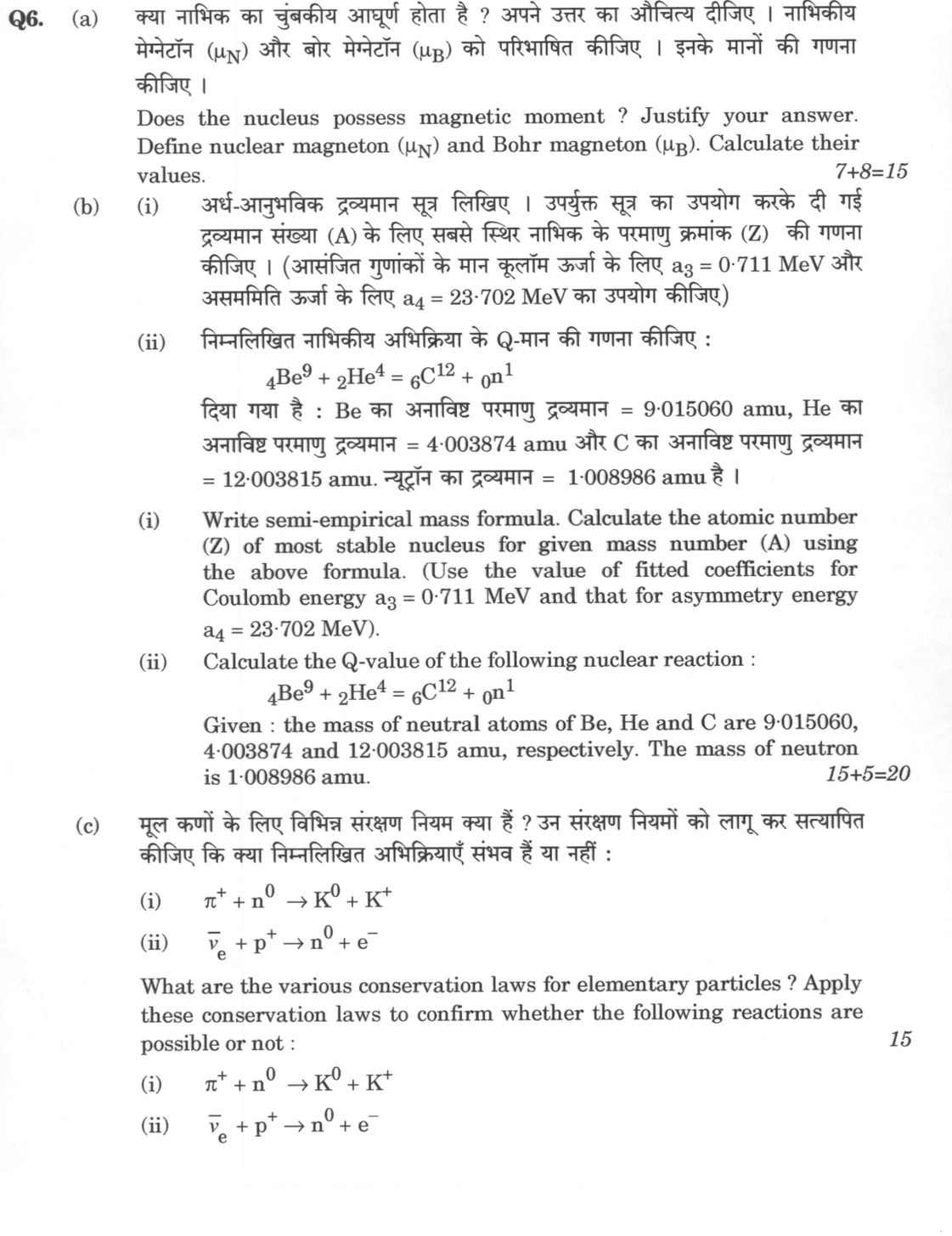
Does the nucleus possess magnetic moment ? Justify your answer. Define nuclear magneton (μN) and Bohr magneton (μB). Calculate their values. 7+8=15
Write semi-empirical mass formula. Calculate the atomic number (Z) of most stable nucleus for given mass number (A) using the above formula. (Use the value of fitted coefficients for Coulomb energy a3 = 0·711 MeV and that for asymmetry energy a4 = 23·702 MeV).
Calculate the Q-value of the following nuclear reaction : 4Be9 + 2He4 = 6C12 + 0n1
Given : the mass of neutral atoms of Be, He and C are 9·015060, 4·003874 and 12·003815 amu, respectively. The mass of neutron is 1·008986 amu. 15+5=20
What are the various conservation laws for elementary particles ? Apply these conservation laws to confirm whether the following reactions are possible or not :
π+ + n0 → K0 + K+
ν̄e + p+ → n0 + e− 15
हिंदी में प्रश्न पढ़ें
क्या नाभिक का चुंबकीय आघूर्ण होता है ? अपने उत्तर का औचित्य दीजिए । नाभिकीय मैग्नेटॉन (μN) और बोर मैग्नेटॉन (μB) को परिभाषित कीजिए । इनके मानों की गणना कीजिए । 7+8=15
अर्ध-अनुभविक द्रव्यमान सूत्र लिखिए । उपर्युक्त सूत्र का उपयोग करके दी गई द्रव्यमान संख्या (A) के लिए सबसे स्थिर नाभिक के परमाणु क्रमांक (Z) की गणना कीजिए । (आसंजित गुणांकों के मान कूलॉम ऊर्जा के लिए a3 = 0·711 MeV और असममिति ऊर्जा के लिए a4 = 23·702 MeV का उपयोग कीजिए)
निम्नलिखित नाभिकीय अभिक्रिया के Q-मान की गणना कीजिए : 4Be9 + 2He4 = 6C12 + 0n1
दिया गया है : Be का अनाविष्ट परमाणु द्रव्यमान = 9·015060 amu, He का अनाविष्ट परमाणु द्रव्यमान = 4·003874 amu और C का अनाविष्ट परमाणु द्रव्यमान = 12·003815 amu. न्यूट्रॉन का द्रव्यमान = 1·008986 amu है । 15+5=20
मूल कणों के लिए विभिन्न संरक्षण नियम क्या हैं ? उन संरक्षण नियमों को लागू कर सत्यापित कीजिए कि क्या निम्नलिखित अभिक्रियाएँ संभव हैं या नहीं :
π+ + n0 → K0 + K+
ν̄e + p+ → n0 + e− 15
Model answer
Written by UPSC Answer Check against this question's marking rubric, to the expected length. UPSC does not publish answers for Mains — this is one way to score well, not an official key.
Part (a) The nucleus possesses a magnetic moment because its charged and spinning constituents generate magnetic dipoles. Protons contribute through spin and orbital motion; neutrons, though neutral, have intrinsic magnetic moments due to their internal charged quark structure. In even-even nuclei paired nucleons cancel, but odd-A nuclei have an unpaired nucleon, giving a net moment whose sign and magnitude lie near the Schmidt limits, confirming the origin. The nuclear magneton is μN = eℏ/(2mp), the natural unit for nuclear moments; the Bohr magneton is μB = eℏ/(2me), the natural atomic unit. Using e=1.602×10⁻¹⁹ C, ℏ=1.055×10⁻³⁴ J s, mp=1.673×10⁻²⁷ kg, me=9.109×10⁻³¹ kg, μN≈5.05×10⁻²⁷ J T⁻¹ and μB≈9.27×10⁻²⁴ J T⁻¹; μB/μN=mp/me≈1836. Nuclear moments are therefore of order μN, much smaller than atomic moments.
Part (b) (i) The semi-empirical mass formula for binding energy is B(A,Z)=a₁A−a₂A²ᐟ³−a₃Z²/A¹ᐟ³−a₄(A−2Z)²/A+δ, where the terms are volume, surface, Coulomb, asymmetry and pairing. The volume term reflects saturation, the surface term reduces binding of surface nucleons, Coulomb repulsion penalises protons, asymmetry penalises neutron-proton imbalance, and pairing favours even-even nuclei. Equivalently, M(A,Z)=Zm_H+(A−Z)m_n−B/c². For fixed A, δ is independent of Z, so the most stable Z maximises B. Differentiating the Z-dependent terms, −2a₃Z/A¹ᐟ³+4a₄(A−2Z)/A=0, so 2a₃Z/A¹ᐟ³=4a₄(A−2Z)/A. Solving gives Zmin=A/[2+a₃A²ᐟ³/(2a₄)]. With a₃=0.711 MeV and a₄=23.702 MeV, a₃/(2a₄)=0.0150, hence Zmin=A/(2+0.0150A²ᐟ³).
(ii) For ⁹Be+⁴He→¹²C+n, use neutral atomic masses. The left atoms contain 4+2=6 electrons and the right carbon atom contains 6, so electron masses cancel exactly; the neutron mass is used as given. Q=[9.015060+4.003874−12.003815−1.008986]u×931.5 MeV u⁻¹ =0.006133×931.5=5.71 MeV. The positive Q-value means the reaction is exothermic.
Part (c) The conservation laws to be checked are energy-momentum, electric charge, baryon number, lepton number (electron, muon and tau separately), angular momentum, and for strong/EM processes strangeness and isospin; weak interactions may change strangeness and violate parity. Energy-momentum can usually be satisfied by kinetic energies, so the decisive checks are the additive quantum numbers.
For π⁺ + n → K⁰ + K⁺: charge is +1 on both sides. Baryon number is not conserved as written: left B=0+1=1, right B=0+0=0. Strangeness also changes from 0 to +1+1=+2. Hence the reaction is forbidden; it cannot proceed by strong or EM interaction, and baryon-number conservation forbids it as written even for weak interaction.
For ν̄e + p → n + e⁻: charge is +1 on the left but −1 on the right, so electric charge is not conserved. Electron lepton number is −1 on the left and +1 on the right, giving ΔLe=+2. Baryon number is conserved, but the failure of charge and lepton number makes the reaction impossible. The allowed inverse beta process is ν̄e + p → n + e⁺.
Conclusion: The nucleus has a magnetic moment measured in μN; the SEMF gives Zmin=A/(2+0.0150A²ᐟ³); the Be-He reaction releases 5.71 MeV; and both particle reactions as written are not possible, the first also failing baryon number and the second failing charge and lepton number.
What "Explain" is asking you to do
Make the working of something clear — what sets it off, what follows from what, and what it produces. Explain is the Commission's mechanism word: it dominates the technical papers and the “explain why” stems, where the marks sit in the causal chain and not in the label.
Structure that answers it
State what it is → the initiating condition → the chain of cause, step by step → an instance where it plays out → what the chain produces
Where marks are lost
Describing what something looks like instead of why it works that way. Naming the stages without linking them reads as description too.
How this answer will be evaluated
Approach
Framework: Nuclear Physics: Magnetic Moments, SEMF, and Conservation Laws. (a) justify: claim > 3-4 reasons > evidence > conclusion | (b) explain: definition/context > points in order > small example > short close | (c) explain: definition/context > points in order > small example > short close Full marks: Rigorous derivations, correct numerical values, and clear application of conservation laws.
Key points expected
- μN = eħ/2mp, μB = eħ/2me
- Z ≈ A / (2 + 0.015 A^(2/3))
- Q = (Mass_initial - Mass_final) * 931.5 MeV
- Reaction (i) violates strangeness conservation
- Reaction (ii) violates lepton number conservation
Evaluation rubric
Each sub-part is marked on its own, against the marks and word limit printed on the paper.
- (a) Justify nuclear magnetic moment existence; define and calculate μN and μB. 15 marks
justify— claim → 3-4 reasons → evidence → conclusion
Must cover
- Justify via proton/neutron spin and charge
- Define Bohr magneton (μB) formula
- Define Nuclear magneton (μN) formula
- Calculate numerical values for both
Loses marks
- Defining without calculating values
- Confusing μB and μN definitions
Earns more
- Mention electron vs proton mass difference
- Correct units (J/T or eV/T)
Extra mark
- Mention g-factors for nucleons
- (b) Write SEMF, derive Z for stability, and calculate Q-value for Be+He reaction. 20 marks
explain— definition/context → points in order → small example → short close
Must cover
- Write full SEMF with all terms
- Derive Z formula using a3 and a4
- Calculate Q-value using mass defect
- Show mass difference calculation steps
Loses marks
- Writing SEMF without deriving Z
- Using atomic mass without subtracting electrons
Earns more
- Identify specific terms (volume, surface, etc.)
- Correct sign convention for Q-value
Extra mark
- Mention binding energy per nucleon
- (c) List conservation laws and apply them to check validity of two reactions. 15 marks
explain— definition/context → points in order → small example → short close
Must cover
- List key conservation laws (charge, baryon, lepton)
- Check charge conservation for both reactions
- Check baryon number for both reactions
- Check lepton number for reaction (ii)
Loses marks
- Listing laws without applying to specific reactions
- Ignoring lepton number in reaction (ii)
Earns more
- Check strangeness for reaction (i)
- Explicitly state 'possible' or 'impossible' for each
Extra mark
- Mention energy/momentum conservation
Practice this exact question
Write your answer and it is marked point by point against the model answer above — what you covered, what you missed, what you got wrong.
Evaluate my answer →More from Physics 2024 Paper II
- Q3 (a) How do Stokes lines appear in Raman spectrum as per classical and quantum theory of R…
- Q4 (a) (i) Using free electron theory of metals, calculate the Fermi energy level of sodium…
- Q5 (a) Compare nuclear density of hydrogen (₁H¹) with its atomic density. (Assume the atom t…
- Q6 (a) Does the nucleus possess magnetic moment ? Justify your answer. Define nuclear magnet…
- Q7 (a) Discuss the distribution and characteristics of the black soil in India. 10 (b) Exami…
- Q8 (a) Discuss the factors responsible for the uneven distribution of population in India. 1…