Paper II — Q7
(a) Discuss the distribution and characteristics of the black soil in India. 10 (b) Examine the role of rivers in the economic…
Discuss the distribution and characteristics of the black soil in India. 10 marks
Examine the role of rivers in the economic development of India. 10 marks
Model answer
Written by UPSC Answer Check against this question's marking rubric, to the expected length. UPSC does not publish answers for Mains — this is one way to score well, not an official key.
(a) Black Soil in India
Black soil, or regur, derives from weathering of basaltic lava of the Deccan Traps. It covers roughly 15% of India's area, spread across Maharashtra, Gujarat, Madhya Pradesh, Karnataka, Telangana and Andhra Pradesh, notably the Malwa plateau, Narmada-Tapi valleys and Deccan plateau.
Its high clay content (montmorillonite) gives strong moisture retention; deep cracks in summer make it self-ploughing. It is rich in iron, lime and magnesia but poor in nitrogen, phosphorus and organic matter. Ideal for cotton (hence "black cotton soil"), it also supports wheat, jowar and sugarcane. Limitations include waterlogging, low humus and difficult tillage when wet.
(b) Rivers and Economic Development
Rivers underpin Indian agriculture: the Ganga system irrigates Uttar Pradesh, Bihar and West Bengal; the Godavari-Krishna deltas sustain intensive cultivation; canals and groundwater recharge support food security.
Hydropower from Bhakra-Nangal, Hirakud and Tehri feeds industry and grids. National Waterways 1 (Ganga), NW-2 (Brahmaputra) and NW-3 (Kerala backwaters) enable cheap freight movement. Rivers drive industrial clustering, thermal plant cooling, and riverfront development at Ahmedabad and Varanasi. Inter-linking projects like Ken-Betwa and Polavaram promise irrigation but raise ecological and displacement concerns.
Challenges persist: soil degradation, pollution, and inter-state disputes like Cauvery. Sustainable river basin management, cleaner waterways and cooperative federalism are essential for harnessing rivers as engines of inclusive growth.
What "Discuss" is asking you to do
Lay the issue out from more than one side — how it arose, what is claimed for it, what is held against it, and where it now stands. UPSC attaches discuss to broad topics with several live dimensions, so coverage of the dimensions earns more than the strength of your opinion.
Structure that answers it
Set the issue up → the case as it is made → the case against → the dimension both sides leave out → where the balance now lies
Where marks are lost
Listing facts with no thread between them, or arguing one side throughout and calling it a discussion.
How this answer will be evaluated
Approach
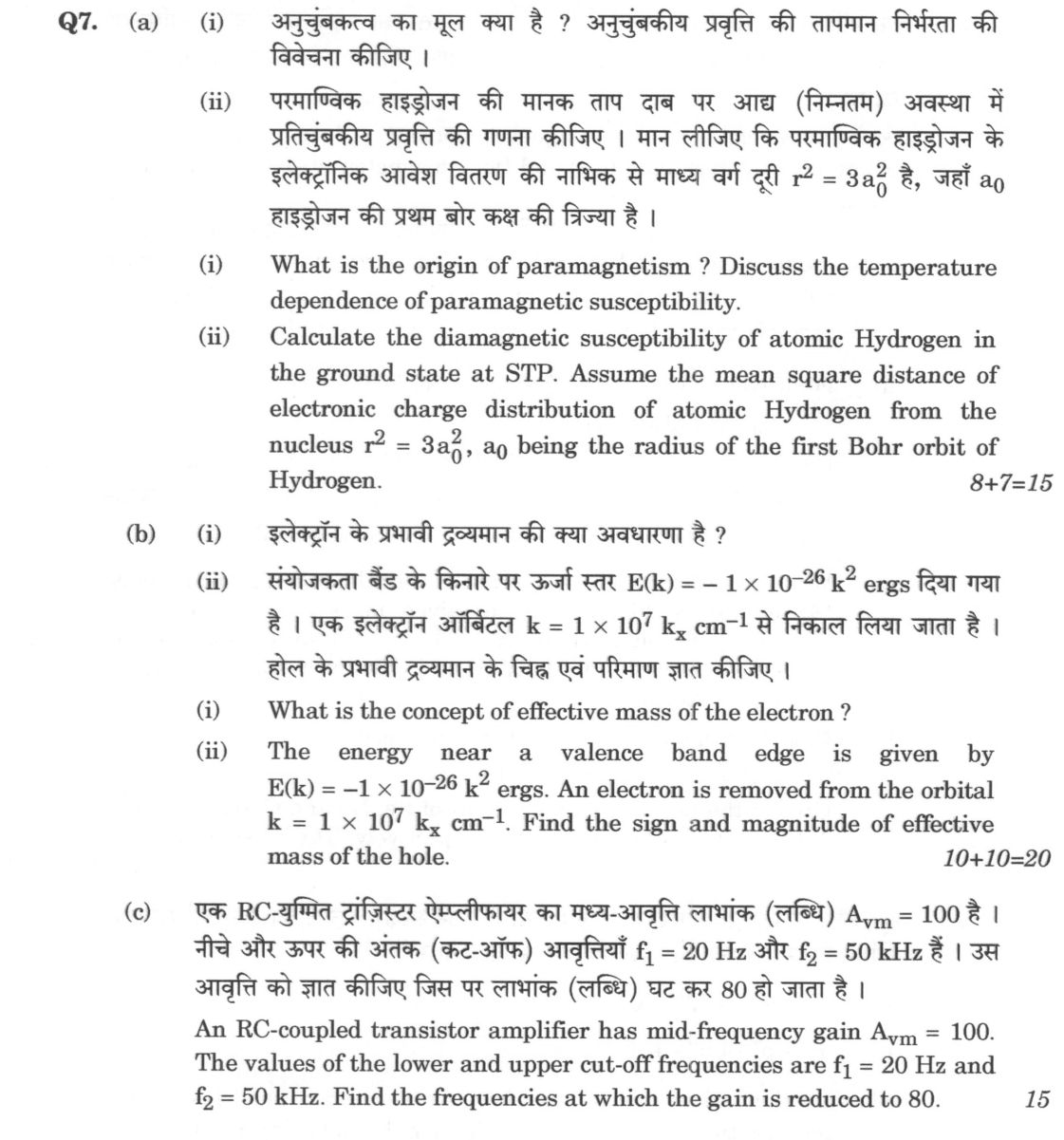
Framework: Principle > Setup and diagram > Derivation > Result and limiting case. (a(i)) discuss: intro > 3-4 dimensions > example > balanced close | (a(ii)) calculate: given > formula > substitution > result with units > interpretation | (b(i)) explain: definition/context > points in order > small example > short close | (b(ii)) calculate: given > formula > substitution > result with units > interpretation | (c) calculate: given > formula > substitution > result with units > interpretation Full marks: All parts with full derivation, correct units, and physical interpretation.
Key points expected
- Origin: unpaired electron spins
- Magnetic moment alignment with field
- Thermal agitation opposes alignment
- Curie's Law: χ ∝ 1/T
- Langevin diamagnetism formula
- Substitution of r² = 3a₀²
- Number density at STP
- Final value with units
Evaluation rubric
Each sub-part is marked on its own, against the marks and word limit printed on the paper.
- (a(i)) Origin of paramagnetism and temperature dependence of susceptibility.
discuss— intro → 3-4 dimensions → example → balanced close
Must cover
- Origin: unpaired electron spins
- Magnetic moment alignment with field
- Thermal agitation opposes alignment
- Curie's Law: χ ∝ 1/T
Loses marks
- Confusing with diamagnetism
- Missing temperature dependence
Earns more
- Langevin function derivation
- Magnetization M = Nμ²B/3kT
Extra mark
- Mention of Pauli paramagnetism
- (a(ii)) Diamagnetic susceptibility of atomic Hydrogen at STP.
calculate— given → formula → substitution → result with units → interpretation
Must cover
- Langevin diamagnetism formula
- Substitution of r² = 3a₀²
- Number density at STP
- Final value with units
Loses marks
- Missing units in final answer
- Incorrect power of 10
Earns more
- Explicit calculation of a₀
- Step-by-step substitution
Extra mark
- Comparison with experimental value
- (b(i)) Concept of effective mass of the electron.
explain— definition/context → points in order → small example → short close
Must cover
- Definition via band curvature
- Relation to free electron mass
- Physical significance in solids
Loses marks
- Treating as constant
- Missing band structure context
Earns more
- E-k diagram illustration
- Distinction from bare mass
Extra mark
- Mention of tensor nature
- (b(ii)) Sign and magnitude of effective mass of the hole.
calculate— given → formula → substitution → result with units → interpretation
Must cover
- Differentiation of E(k) to get 1/m*
- Calculation of d²E/dk²
- Sign determination (negative for hole)
- Magnitude in kg or m₀ units
Loses marks
- Wrong sign for hole mass
- Arithmetic error in k² term
Earns more
- Explicit derivative steps
- Unit conversion
Extra mark
- Comparison with electron mass
- (c) Frequencies where gain is reduced to 80.
calculate— given → formula → substitution → result with units → interpretation
Must cover
- Gain-frequency relation for RC amplifier
- Solve for f where A = 80
- Use f₁ = 20 Hz and f₂ = 50 kHz
- Two frequency values
Loses marks
- Using wrong gain formula
- Missing one of the two frequencies
Earns more
- Derivation of gain formula
- Clear algebraic steps
Extra mark
- Graphical representation
Practice this exact question
Write your answer and it is marked point by point against the model answer above — what you covered, what you missed, what you got wrong.
Evaluate my answer →More from Physics 2024 Paper II
- Q4 (a) (i) Using free electron theory of metals, calculate the Fermi energy level of sodium…
- Q5 (a) Compare nuclear density of hydrogen (₁H¹) with its atomic density. (Assume the atom t…
- Q6 (a) Does the nucleus possess magnetic moment ? Justify your answer. Define nuclear magnet…
- Q7 (a) Discuss the distribution and characteristics of the black soil in India. 10 (b) Exami…
- Q8 (a) Discuss the factors responsible for the uneven distribution of population in India. 1…