Paper II — Q8
(a) Discuss the factors responsible for the uneven distribution of population in India. 10 (b) Analyse the impact of…
Discuss the factors responsible for the uneven distribution of population in India. 10 marks
Analyse the impact of globalization on the Indian economy. 10 marks
Model answer
Written by UPSC Answer Check against this question's marking rubric, to the expected length. UPSC does not publish answers for Mains — this is one way to score well, not an official key.
India’s population is unevenly spread: dense alluvial plains and industrial metros contrast with sparse mountains and deserts, while globalization since 1991 has reshaped the economy spatially and sectorally.
(a) Uneven population distribution
Physical determinants act as spatial constraints. The Himalayan terrain discourages settlement, the Thar desert’s aridity limits carrying capacity, while the Ganga-Brahmaputra alluvial fertility and coastal accessibility support dense habitation. Socio-economic drivers reinforce this: Green Revolution regions (Punjab, Haryana) and industrial corridors (Mumbai-Pune, Delhi-Mumbai) attracted labour, and tertiary-sector concentration in metro cities (Bengaluru, Hyderabad) created new magnets. Thus physical advantages and economic opportunity interact, concentrating population in plains, coasts and metros.
(b) Impact of globalization
The 1991 LPG reforms—de-licensing and trade liberalization—were a structural turning point. Sectorally, IT-BPM emerged in Bengaluru and Hyderabad, while manufacturing faced stagnation (deindustrialization debate) and agriculture experienced distress amid MSP versus market volatility. Spatially, inter-state inequality widened, the workforce informalized, and export-oriented growth generated environmental externalities.
Globalization thus created opportunities alongside exclusionary outcomes. Inclusive development requires labour-intensive manufacturing, agricultural risk mitigation, and balanced regional investment to spread gains equitably.
What "Analyse" is asking you to do
Break the subject into its working parts and show how they act on each other. The marks are in the interconnections — which factor drives which, and what the resulting structure explains — not in the inventory of factors.
Structure that answers it
Define the whole → separate it into its parts → show which part drives which → what that interaction produces → what the structure implies
Where marks are lost
A flat list of causes with no account of which drives which. An answer of neatly separated headings, each self-contained, scores as description.
How this answer will be evaluated
Approach
Framework: Principle > Setup and diagram > Derivation > Result and limiting case. (a) describe: define > structure or process in order > labelled diagram > significance | (b(i)) explain: definition/context > points in order > small example > short close | (b(ii)) describe: define > structure or process in order > labelled diagram > significance | (c) compare: paired headings or table > key differences > significance > conclusion Full marks: Complete, accurate, with diagrams and clear comparisons
Key points expected
- Define nuclear resonance absorption of gamma rays
- Explain Mossbauer effect (recoil-free emission/absorption)
- Describe spectrometer setup (source, absorber, detector)
- List at least two applications
- Define digital system (discrete values)
- Define analog system (continuous values)
- State one key difference (e.g., noise immunity)
- Give one reason for widespread use
Evaluation rubric
Each sub-part is marked on its own, against the marks and word limit printed on the paper.
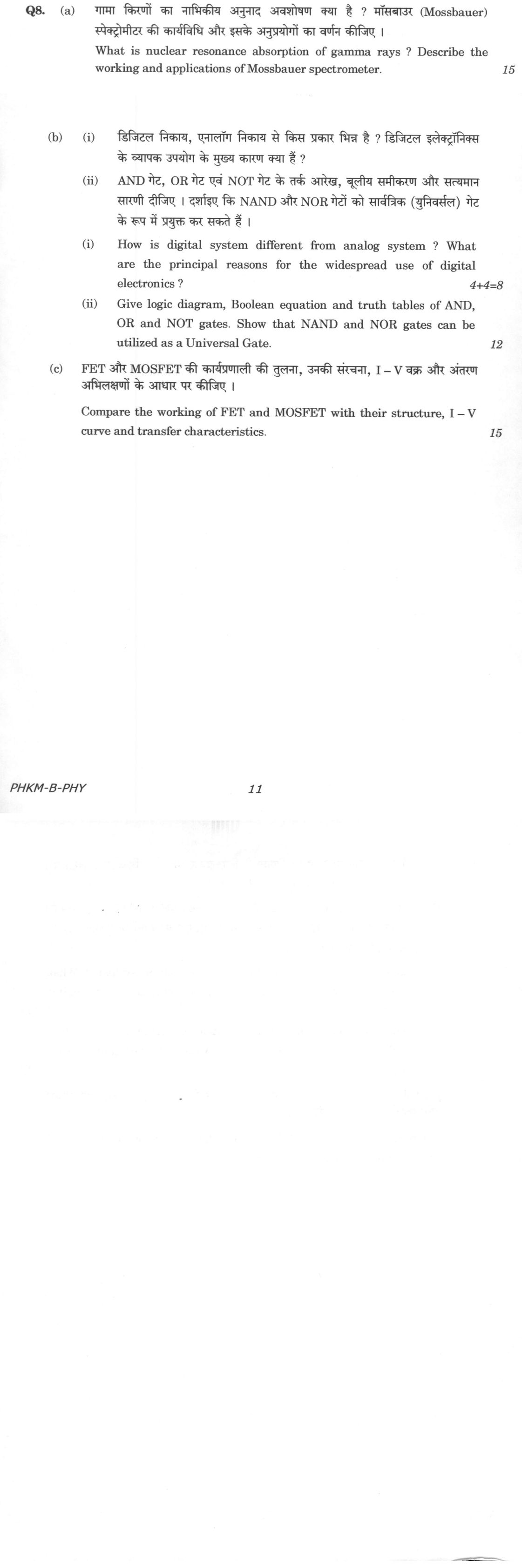
- (a) Define nuclear resonance absorption and explain Mossbauer spectrometer working and applications. 15 marks
describe— define → structure or process in order → labelled diagram → significance
Must cover
- Define nuclear resonance absorption of gamma rays
- Explain Mossbauer effect (recoil-free emission/absorption)
- Describe spectrometer setup (source, absorber, detector)
- List at least two applications
Loses marks
- Confusing with ordinary gamma absorption
- Omitting the recoil-free mechanism
- No mention of applications
Earns more
- Mention Doppler velocity for energy tuning
- Mention isomer shift or hyperfine interactions
- Mention specific isotope (e.g., 57Fe)
Extra mark
- Draw labelled diagram of spectrometer
- Mention specific application like phase transition study
- (b(i)) Differentiate digital from analog systems and state reasons for digital electronics use. 4 marks
explain— definition/context → points in order → small example → short close
Must cover
- Define digital system (discrete values)
- Define analog system (continuous values)
- State one key difference (e.g., noise immunity)
- Give one reason for widespread use
Loses marks
- Vague definitions without discrete/continuous distinction
- No specific reasons for digital use
Earns more
- Mention binary representation
- Mention ease of storage/processing
- Mention flexibility of digital systems
Extra mark
- Mention specific digital advantage like error correction
- (b(ii)) Provide logic diagrams, Boolean equations, truth tables for AND, OR, NOT; show NAND/NOR universality. 8 marks
describe— define → structure or process in order → labelled diagram → significance
Must cover
- Draw logic diagrams for AND, OR, NOT
- Write Boolean equations for AND, OR, NOT
- Provide truth tables for AND, OR, NOT
- Show NAND or NOR as universal gate
Loses marks
- Missing any of diagram, equation, or truth table
- Incorrect truth table entries
- No demonstration of universality
Earns more
- Show NAND implementing AND, OR, NOT
- Show NOR implementing AND, OR, NOT
- Clear and accurate truth tables
Extra mark
- Show both NAND and NOR universality
- Mention De Morgan's laws in derivation
- (c) Compare FET and MOSFET working, structure, I-V curve, and transfer characteristics. 15 marks
compare— paired headings or table → key differences → significance → conclusion
Must cover
- Compare FET and MOSFET structure
- Compare working principle of FET and MOSFET
- Compare I-V characteristics
- Compare transfer characteristics
Loses marks
- Treating FET and MOSFET as identical
- No comparison of I-V or transfer characteristics
- Missing structural comparison
Earns more
- Mention JFET vs MOSFET channel type
- Mention gate biasing differences
- Mention input impedance comparison
Extra mark
- Draw comparative I-V or transfer curves
- Mention specific applications of each
Practice this exact question
Write your answer and it is marked point by point against the model answer above — what you covered, what you missed, what you got wrong.
Evaluate my answer →More from Physics 2024 Paper II
- Q5 (a) Compare nuclear density of hydrogen (₁H¹) with its atomic density. (Assume the atom t…
- Q6 (a) Does the nucleus possess magnetic moment ? Justify your answer. Define nuclear magnet…
- Q7 (a) Discuss the distribution and characteristics of the black soil in India. 10 (b) Exami…
- Q8 (a) Discuss the factors responsible for the uneven distribution of population in India. 1…