Paper II — Q4
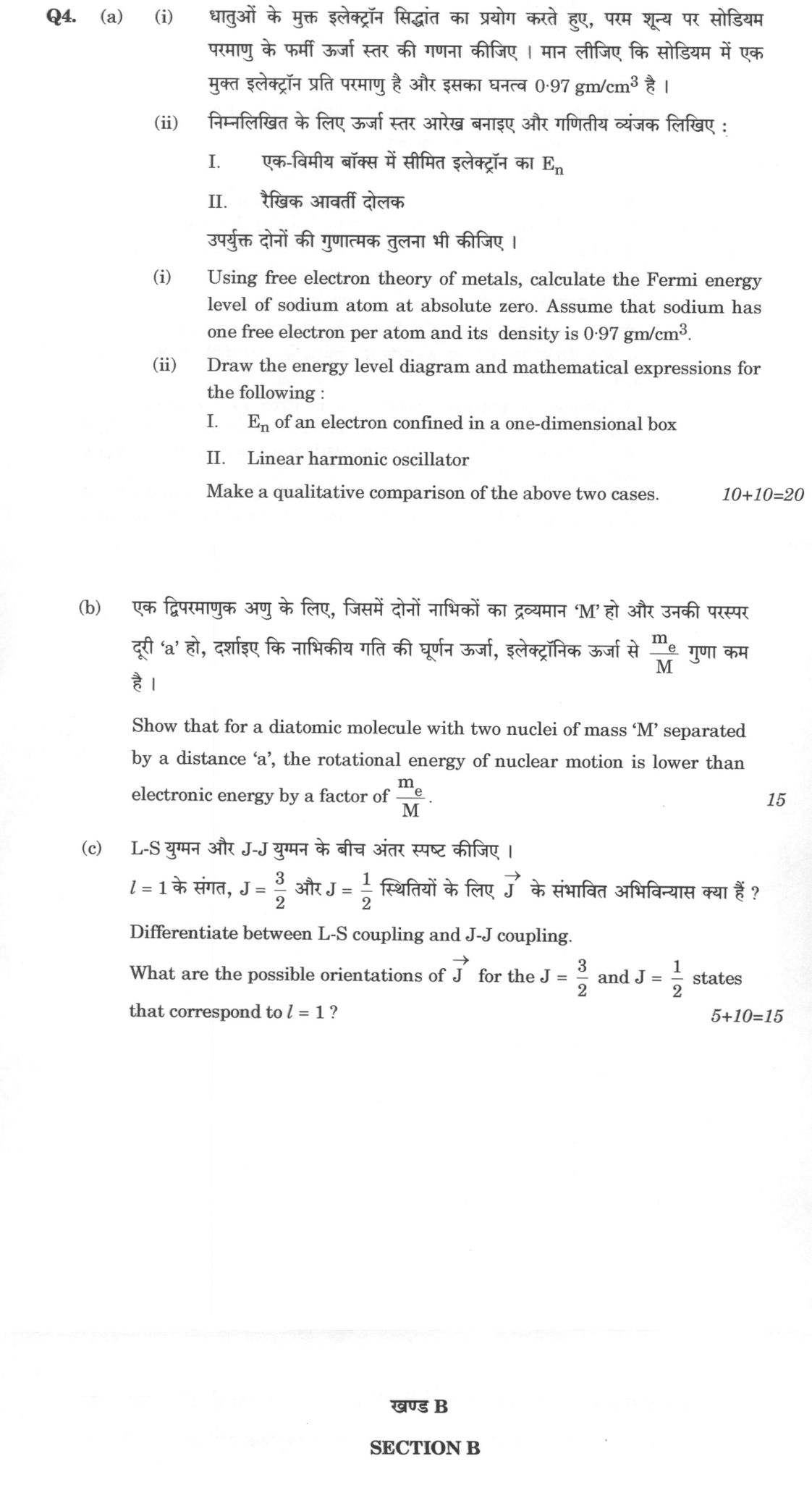
(a) (i) Using free electron theory of metals, calculate the Fermi energy level of sodium atom at absolute zero. Assume that…
Using free electron theory of metals, calculate the Fermi energy level of sodium atom at absolute zero. Assume that sodium has one free electron per atom and its density is 0·97 gm/cm³.
Draw the energy level diagram and mathematical expressions for the following :
I. Eₙ of an electron confined in a one-dimensional box
II. Linear harmonic oscillator
Make a qualitative comparison of the above two cases. 10+10=20 marks
Show that for a diatomic molecule with two nuclei of mass 'M' separated by a distance 'a', the rotational energy of nuclear motion is lower than electronic energy by a factor of (mₑ)/M. 15 marks
Differentiate between L-S coupling and J-J coupling.
What are the possible orientations of J⃗ for the J = 3/2 and J = 1/2 states that correspond to l = 1? 5+10=15 marks
हिंदी में प्रश्न पढ़ें
धातुओं के मुक्त इलेक्ट्रॉन सिद्धांत का प्रयोग करते हुए, परम शून्य पर सोडियम परमाणु के फर्मी ऊर्जा स्तर की गणना कीजिए । मान लीजिए कि सोडियम में एक मुक्त इलेक्ट्रॉन प्रति परमाणु है और इसका घनत्व 0·97 gm/cm³ है ।
निम्नलिखित के लिए ऊर्जा स्तर आरेख बनाइए और गणितीय व्यंजक लिखिए :
I. एक-विमीय बॉक्स में सीमित इलेक्ट्रॉन का Eₙ
II. रैखिक आवर्ती दोलक
उपर्युक्त दोनों की गुणात्मक तुलना भी कीजिए । 10+10=20 अंक
एक द्विपरमाणुक अणु के लिए, जिसमें दोनों नाभिकों का द्रव्यमान 'M' हो और उनकी परस्पर दूरी 'a' हो, दर्शाइए कि नाभिकीय गति की घूर्णन ऊर्जा, इलेक्ट्रॉनिक ऊर्जा से (mₑ)/M गुणा कम है । 15 अंक
L-S युग्म और J-J युग्म के बीच अंतर स्पष्ट कीजिए ।
l = 1 के संगत, J = 3/2 और J = 1/2 स्थितियों के लिए J⃗ के संभावित अभिविन्यास क्या हैं? 5+10=15 अंक
Model answer
Written by UPSC Answer Check against this question's marking rubric, to the expected length. UPSC does not publish answers for Mains — this is one way to score well, not an official key.
(a) (i) By free electron theory at absolute zero, sodium has one conduction electron per atom. Taking atomic mass of sodium as 23 g mol⁻¹,
n = (ρ N_A)/A = (0.97 g cm⁻³ × 6.022×10²³ mol⁻¹)/(23 g mol⁻¹)
n = 2.54×10²² cm⁻³ = 2.54×10²⁸ m⁻³.
For a free electron gas,
E_F = (ħ²/2mₑ)(3π²n)^(2/3), k_F = (3π²n)^(1/3).
Thus k_F = (3π² × 2.54×10²⁸)^(1/3) = 9.09×10⁹ m⁻¹.
E_F = [(1.055×10⁻³⁴)² × (9.09×10⁹)²]/(2 × 9.11×10⁻³¹) J
E_F = 5.05×10⁻¹⁹ J = 5.05×10⁻¹⁹/(1.602×10⁻¹⁹) eV = 3.15 eV.
This holds for T = 0 K, one free electron per atom, and independent free electrons.
(a) (ii) I. Electron in a one-dimensional box For width L and infinite walls, the Schrödinger equation gives
Eₙ = n²h²/(8mL²) = n²π²ħ²/(2mL²), n = 1, 2, 3, ...
ψₙ(x) = sqrt(2/L) sin(nπx/L), 0 < x < L.
Energy level diagram:
n=3 __________ E₃ = 9E₁ n=2 __________ E₂ = 4E₁ n=1 __________ E₁ = π²ħ²/(2mL²)
II. Linear harmonic oscillator For potential V(x) = 1/2 mω²x²,
Eₙ = (n + 1/2)ħω, n = 0, 1, 2, ...
ψₙ(x) = Nₙ Hₙ(αx) exp(−α²x²/2), α = sqrt(mω/ħ).
Energy level diagram:
n=3 __________ E₃ = 7/2 ħω n=2 __________ E₂ = 5/2 ħω n=1 __________ E₁ = 3/2 ħω n=0 __________ E₀ = 1/2 ħω
Qualitative comparison: Both give discrete bound states and nonzero zero-point energy. In the box, Eₙ ∝ n², so level spacing increases; the wavefunctions are sinusoidal and vanish at the walls. In the harmonic oscillator, Eₙ is linear in n, levels are equally spaced; wavefunctions are Hermite-Gaussian and extend beyond classical turning points. The box potential is infinite and flat inside, while the oscillator potential is parabolic.
(b) Let the electronic momentum be pₑ ≈ ħ/a. Then the electronic energy scale is
E_el ≈ pₑ²/(2mₑ) ≈ ħ²/(2mₑa²).
For nuclear rotation, the two nuclei of mass M separated by distance a give a moment of inertia of order I ≈ M a². Hence the rotational energy scale is
E_rot ≈ ħ²/(2I) ≈ ħ²/(2Ma²).
Therefore
E_rot/E_el ≈ [ħ²/(2Ma²)]/[ħ²/(2mₑa²)] = mₑ/M.
Since M ≫ mₑ, E_rot is smaller than E_el by the factor mₑ/M, apart from numerical constants of order unity.
(c) In L-S coupling, electrostatic interaction between electrons dominates. The individual orbital angular momenta couple to give total L, and spins couple to give total S; then J = L + S, …, |L − S|. The good quantum numbers are L, S, J, M_J. It is common in light atoms.
In J-J coupling, spin-orbit interaction for each electron dominates. Each electron has jᵢ = lᵢ ± 1/2, and these jᵢ couple to give total J. The good quantum numbers are jᵢ, J, M_J; L and S are not well defined. It is common in heavy atoms.
For l = 1 and s = 1/2, the possible total J values are
J = l + s = 3/2 and J = l − s = 1/2.
The magnitude is |J| = sqrt(J(J + 1))ħ, and the component along a chosen z-axis is J_z = M_Jħ. The orientation angle θ satisfies
cos θ = M_J/sqrt(J(J + 1)).
For J = 3/2: M_J = 3/2, 1/2, −1/2, −3/2. sqrt(J(J + 1)) = sqrt(15)/2.
cos θ = ±3/sqrt(15) = ±sqrt(3/5) for M_J = ±3/2, θ ≈ 39.2° and 140.8°.
cos θ = ±1/sqrt(15) for M_J = ±1/2, θ ≈ 75.0° and 105.0°.
For J = 1/2: M_J = 1/2, −1/2. sqrt(J(J + 1)) = sqrt(3)/2.
cos θ = ±1/sqrt(3), θ ≈ 54.7° and 125.3°.
Thus J = 3/2 has 4 possible orientations, and J = 1/2 has 2 possible orientations; total 6 = (2l + 1)(2s + 1).
What "Calculate" is asking you to do
Apply the standard formula or schedule to data the question has already supplied — a table of readings, cost records, a balance sheet — and produce the number. The method is rarely in doubt; the marks sit in the named intermediate quantities, each of which has to appear as a labelled line.
Structure that answers it
Data as given → formula or standard treatment, named → substitution → each intermediate, labelled → result with units
Where marks are lost
Omitting an intermediate the marking scheme pays for separately, or rounding at an intermediate line so the final figure drifts. In commerce and accountancy, any figure in a statement that no numbered working note supports is treated as unearned.
How this answer will be evaluated
Approach
Framework: Principle > Setup and diagram > Derivation > Result and limiting case. (a(i)) calculate: given > formula > substitution > result with units > interpretation | (a(ii)) describe: define > structure or process in order > labelled diagram > significance | (b) justify: claim > 3-4 reasons > evidence > conclusion | (c) compare: paired headings or table > key differences > significance > conclusion Full marks: Rigorous derivation with correct units, clear diagrams, and physical interpretation.
Key points expected
- Calculate electron density from mass density and atomic mass
- State Fermi energy formula E_F = (h²/8m)(3N/πV)^(2/3)
- Substitute values with correct unit conversion (g/cm³ to kg/m³)
- Final result in Joules or eV
- Expression E_n = n²h²/8mL² for 1D box
- Expression E_n = (n+1/2)ħω for harmonic oscillator
- Diagram showing discrete levels for 1D box
- Diagram showing equally spaced levels for oscillator
Evaluation rubric
Each sub-part is marked on its own, against the marks and word limit printed on the paper.
- (a(i)) Fermi energy of sodium at absolute zero using free electron theory.
calculate— given → formula → substitution → result with units → interpretation
Must cover
- Calculate electron density from mass density and atomic mass
- State Fermi energy formula E_F = (h²/8m)(3N/πV)^(2/3)
- Substitute values with correct unit conversion (g/cm³ to kg/m³)
- Final result in Joules or eV
Loses marks
- Using atomic mass in grams instead of kg
- Missing the (3/π) factor in density term
Earns more
- Explicitly states assumption of one free electron per atom
- Shows intermediate step for electron density n
Extra mark
- Mention of Fermi temperature T_F
- (a(ii)) Energy level diagrams and expressions for 1D box and harmonic oscillator.
describe— define → structure or process in order → labelled diagram → significance
Must cover
- Expression E_n = n²h²/8mL² for 1D box
- Expression E_n = (n+1/2)ħω for harmonic oscillator
- Diagram showing discrete levels for 1D box
- Diagram showing equally spaced levels for oscillator
Loses marks
- Confusing n=0 and n=1 starting points
- Missing the 1/2 term in oscillator energy
Earns more
- Qualitative comparison of level spacing (n² vs linear)
- Mention of zero-point energy for oscillator
Extra mark
- Sketch of wavefunctions ψ_n(x)
- (b) Ratio of rotational to electronic energy for diatomic molecule. 15 marks
justify— claim → 3-4 reasons → evidence → conclusion
Must cover
- Define reduced mass μ = M/2 for identical nuclei
- Expression for rotational energy E_rot ~ ħ²/2I
- Expression for electronic energy E_el ~ e²/4πε₀a
- Derive ratio E_rot/E_el ~ m_e/M
Loses marks
- Using total mass 2M instead of reduced mass M/2
- Failing to show the mass dependence in the ratio
Earns more
- Explicitly defines moment of inertia I = μa²
- Uses Bohr radius or characteristic length scale for electronic energy
Extra mark
- Numerical estimate of the ratio for a specific molecule
- (c) Difference between L-S and J-J coupling and J orientations. 15 marks
compare— paired headings or table → key differences → significance → conclusion
Must cover
- L-S: L and S couple to J (light atoms)
- J-J: individual j_i couple to J (heavy atoms)
- Identify J=3/2 and J=1/2 as fine structure of p-state (l=1)
- List m_J values: ±3/2, ±1/2 for J=3/2; ±1/2 for J=1/2
Loses marks
- Confusing total J with individual j
- Missing the m_J projections for the specific states
Earns more
- Mention of spin-orbit interaction strength dependence on Z
- Vector diagram of L, S, J coupling
Extra mark
- Mention of Russell-Saunders vs Paschen-Back limits
Practice this exact question
Write your answer and it is marked point by point against the model answer above — what you covered, what you missed, what you got wrong.
Evaluate my answer →More from Physics 2024 Paper II
- Q1 Q1. (a) A particle limited to the x-axis has the wave function φ(x) = bx² between x = 0 a…
- Q2 Q2. (a) Prove that : (i) [L², Lz] = 0 (ii) [Lz, L+] = ℏL+ (iii) [L+, L-] = 2ℏLz (iv) L+ L…
- Q3 (a) How do Stokes lines appear in Raman spectrum as per classical and quantum theory of R…
- Q4 (a) (i) Using free electron theory of metals, calculate the Fermi energy level of sodium…
- Q5 (a) Compare nuclear density of hydrogen (₁H¹) with its atomic density. (Assume the atom t…
- Q6 (a) Does the nucleus possess magnetic moment ? Justify your answer. Define nuclear magnet…
- Q7 (a) Discuss the distribution and characteristics of the black soil in India. 10 (b) Exami…