Paper II — Q2
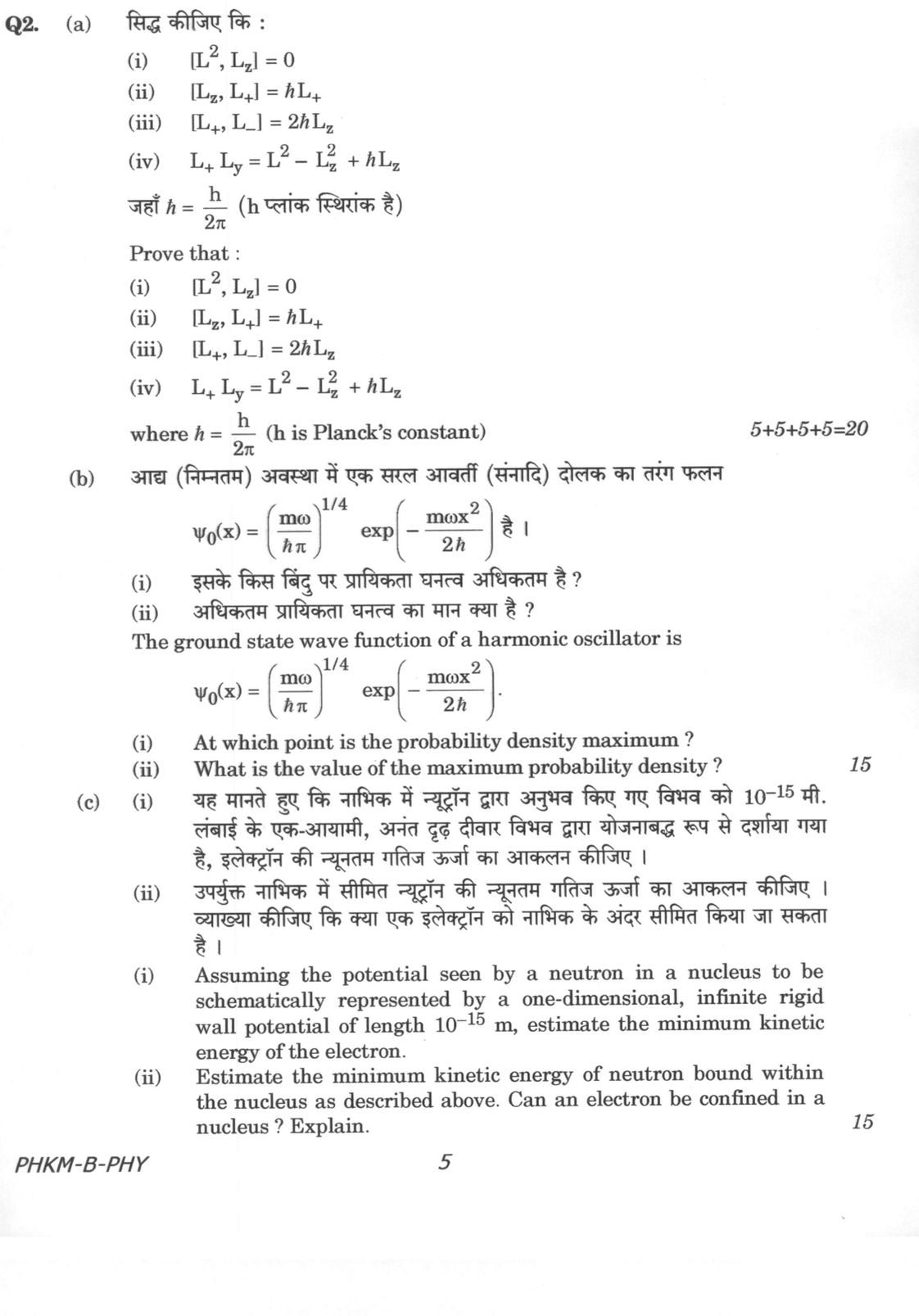
Q2. (a) Prove that : (i) [L², Lz] = 0 (ii) [Lz, L+] = ℏL+ (iii) [L+, L-] = 2ℏLz (iv) L+ L- = L² - Lz² + ℏLz where ℏ = h/2π…
Q2. (a) Prove that :
[L², Lz] = 0
[Lz, L+] = ℏL+
[L+, L-] = 2ℏLz
L+ L- = L² - Lz² + ℏLz
where ℏ = h/2π (ℏ is Planck's constant) 5+5+5+5=20 marks
The ground state wave function of a harmonic oscillator is
ψ₀(x) = (mω/ℏπ)^(1/4) exp(-mωx²/2ℏ).
At which point is the probability density maximum ?
What is the value of the maximum probability density ? 15 marks
Assuming the potential seen by a neutron in a nucleus to be schematically represented by a one-dimensional, infinite rigid wall potential of length 10⁻¹⁵ m, estimate the minimum kinetic energy of the electron.
Estimate the minimum kinetic energy of neutron bound within the nucleus as described above. Can an electron be confined in a nucleus ? Explain. 15 marks
हिंदी में प्रश्न पढ़ें
Q2. (a) सिद्ध कीजिए कि :
[L², Lz] = 0
[Lz, L+] = ℏL+
[L+, L-] = 2ℏLz
L+ L- = L² - Lz² + ℏLz
जहाँ ℏ = h/2π (h प्लांक स्थिरांक है) 5+5+5+5=20 अंक
आध (निम्नतम) अवस्था में एक सरल आवर्ती (सनादि) दोलक का तरंग फलन
ψ₀(x) = (mω/ℏπ)^(1/4) exp(-mωx²/2ℏ) है।
इसके किस बिंदु पर प्रायिकता घनत्व अधिकतम है ?
अधिकतम प्रायिकता घनत्व का मान क्या है ? 15 अंक
यह मानते हुए कि नाभिक में न्यूट्रॉन द्वारा अनुभव किए गए विभव को 10⁻¹⁵ मी. लंबाई के एक-आयामी, अनंत दृढ़ दीवार विभव द्वारा योजनाबद्ध रूप से दर्शाया गया है, इलेक्ट्रॉन की न्यूनतम गतिज ऊर्जा का आकलन कीजिए ।
उपर्युक्त नाभिक में सीमित न्यूट्रॉन की न्यूनतम गतिज ऊर्जा का आकलन कीजिए । व्याख्या कीजिए कि क्या एक इलेक्ट्रॉन को नाभिक के अंदर सीमित किया जा सकता है । 15 अंक
Model answer
Written by UPSC Answer Check against this question's marking rubric, to the expected length. UPSC does not publish answers for Mains — this is one way to score well, not an official key.
(a)(i) Using the angular-momentum commutation relations [Lx, Ly] = iℏLz, [Ly, Lz] = iℏLx, [Lz, Lx] = iℏLy and cyclically, and the identity [A², B] = A[A, B] + [A, B]A,
[L², Lz] = [Lx² + Ly² + Lz², Lz] = [Lx², Lz] + [Ly², Lz] + 0.
Now [Lx, Lz] = −[Lz, Lx] = −iℏLy, so [Lx², Lz] = Lx(−iℏLy) + (−iℏLy)Lx = −iℏ(LxLy + LyLx).
Also [Ly, Lz] = iℏLx, so [Ly², Lz] = Ly(iℏLx) + (iℏLx)Ly = iℏ(LyLx + LxLy).
Adding, the two terms cancel. Hence [L², Lz] = 0 .
(a)(ii) With L+ = Lx + iLy, [Lz, L+] = [Lz, Lx] + i[Lz, Ly]. Now [Lz, Lx] = iℏLy and [Lz, Ly] = −iℏLx. Therefore [Lz, L+] = iℏLy + i(−iℏLx) = ℏLx + iℏLy = ℏ(Lx + iLy) = ℏL+. [Lz, L+] = ℏL+ .
(a)(iii) [L+, L−] = [Lx + iLy, Lx − iLy] = −i[Lx, Ly] + i[Ly, Lx].
Using [Lx, Ly] = iℏLz and [Ly, Lx] = −iℏLz, [L+, L−] = −i(iℏLz) + i(−iℏLz) = ℏLz + ℏLz = 2ℏLz. [L+, L−] = 2ℏLz .
(a)(iv) L+L− = (Lx + iLy)(Lx − iLy) = Lx² + Ly² + i(LyLx − LxLy). But LyLx − LxLy = −[Lx, Ly] = −iℏLz. Hence L+L− = Lx² + Ly² + i(−iℏLz) = Lx² + Ly² + ℏLz. Since L² = Lx² + Ly² + Lz², we get L+L− = L² − Lz² + ℏLz .
(b)(i) The probability density is P(x) = |ψ₀(x)|² = √(mω/(πℏ)) exp(−mωx²/ℏ). The exponential is maximum when x = 0. Therefore the probability density is maximum at x = 0 .
(b)(ii) At x = 0, Pmax = P(0) = √(mω/(πℏ)). Using ℏ = h/2π, this is also Pmax = √(2mω/h). Pmax = √(mω/(πℏ)) , with unit m⁻¹.
(c)(i) For a particle in an infinite square well of width L, Eₙ = n²π²ℏ²/(2mL²) = n²h²/(8mL²), n = 1, 2, 3, ... The minimum kinetic energy is for n = 1. Taking L = 10⁻¹⁵ m and electron mass mₑ = 9.109 × 10⁻³¹ kg,
Eₑ = h²/(8mₑL²) = (6.626 × 10⁻³⁴)²/[8(9.109 × 10⁻³¹)(10⁻¹⁵)²] J ≈ 6.02 × 10⁻⁸ J ≈ 3.76 × 10¹¹ eV = 3.76 × 10⁵ MeV. Eₑ(min) ≈ 376 GeV .
This is the non-relativistic infinite-square-well result. Since it exceeds mₑc² ≈ 0.511 MeV by many orders, the non-relativistic formula is not quantitatively valid for the electron; a relativistic order-of-magnitude estimate would be lower, of order hundreds of MeV, but still far above nuclear binding energies.
(c)(ii) For a neutron, mₙ = 1.675 × 10⁻²⁷ kg. Thus Eₙ = h²/(8mₙL²) = (6.626 × 10⁻³⁴)²/[8(1.675 × 10⁻²⁷)(10⁻¹⁵)²] J ≈ 3.28 × 10⁻¹¹ J ≈ 2.05 × 10⁸ eV = 205 MeV. Eₙ(min) ≈ 205 MeV .
Here Eₙ < mₙc² ≈ 940 MeV, so the non-relativistic estimate is reasonable as an order of magnitude.
An electron cannot be confined inside a nucleus. Its zero-point kinetic energy in a nuclear-sized well would be enormously larger than typical nuclear binding energies, which are only of the order of MeV. Moreover, the electron does not feel the strong nuclear force, and electrostatic attraction by protons cannot supply such enormous confinement energy. In beta decay, electrons are created and emitted; they are not bound inside the nucleus.
What "Prove" is asking you to do
Establish that the statement holds for every case it claims, not for one representative case. The argument must be closed: each line follows from a definition, a hypothesis, or a named theorem you are entitled to use.
Structure that answers it
Given and to prove, restated → theorem or construction to be used, named → the argument line by line → conclusion stated as proved
Where marks are lost
Testing one example, which illustrates but proves nothing. On an if and only if claim, proving one direction and stopping forfeits that half outright, and degenerate cases — zero, the empty set, the equality case — have to be disposed of rather than assumed away.
How this answer will be evaluated
Approach
Framework: Quantum Mechanics: Angular Momentum Algebra & Particle in a Box. (a) derive: given > assumptions > stepwise derivation > result > check | (b) derive: given > assumptions > stepwise derivation > result > check | (c) explain: definition/context > points in order > small example > short close Full marks: Rigorous derivation in (a), precise calculus in (b), and physically sound estimation in (c).
Key points expected
- Angular momentum commutator algebra
- Gaussian probability density maximum
- Particle in a box energy estimation
- Nuclear scale energy comparison
Evaluation rubric
Each sub-part is marked on its own, against the marks and word limit printed on the paper.
- (a) Prove the four commutation relations and operator identity using fundamental angular momentum commutators. 20 marks
derive— given → assumptions → stepwise derivation → result → check
Must cover
- State fundamental commutators [Li, Lj] = iℏεijkLk
- Define L± = Lx ± iLy explicitly
- Show [L², Lz] = 0 via linearity
- Derive L+L- identity by expansion
Loses marks
- Quoting results without derivation
- Sign errors in commutator expansion
Earns more
- Correct use of Jacobi identity
- Clear step-by-step expansion of products
- Consistent use of ℏ notation
Extra mark
- Mention of SU(2) algebra structure
- (b) Determine the location and value of the maximum probability density for the ground state. 15 marks
derive— given → assumptions → stepwise derivation → result → check
Must cover
- Write probability density |ψ₀(x)|²
- Differentiate w.r.t x and set to zero
- Identify maximum at x = 0
- Calculate value (mω/ℏπ)^(1/2)
Loses marks
- Confusing wave function with probability density
- Missing the square root in normalization
Earns more
- Explicit calculation of the derivative
- Verification of second derivative for maximum
Extra mark
- Comparison with classical probability distribution
- (c) Estimate minimum kinetic energy for neutron and electron in a 10⁻¹⁵ m box; explain confinement. 15 marks
explain— definition/context → points in order → small example → short close
Must cover
- Use E = p²/2m with p = h/2L
- Calculate neutron energy (~20 MeV)
- Calculate electron energy (~100 GeV)
- Compare with nuclear binding energy
Loses marks
- Using wrong mass for electron/neutron
- Ignoring the 'infinite wall' boundary condition
Earns more
- Correct unit conversion (MeV/GeV)
- Logical argument for electron exclusion
Extra mark
- Mention of relativistic effects for electron
Practice this exact question
Write your answer and it is marked point by point against the model answer above — what you covered, what you missed, what you got wrong.
Evaluate my answer →More from Physics 2024 Paper II
- Q1 Q1. (a) A particle limited to the x-axis has the wave function φ(x) = bx² between x = 0 a…
- Q2 Q2. (a) Prove that : (i) [L², Lz] = 0 (ii) [Lz, L+] = ℏL+ (iii) [L+, L-] = 2ℏLz (iv) L+ L…
- Q3 (a) How do Stokes lines appear in Raman spectrum as per classical and quantum theory of R…
- Q4 (a) (i) Using free electron theory of metals, calculate the Fermi energy level of sodium…
- Q5 (a) Compare nuclear density of hydrogen (₁H¹) with its atomic density. (Assume the atom t…