Paper II — Q5
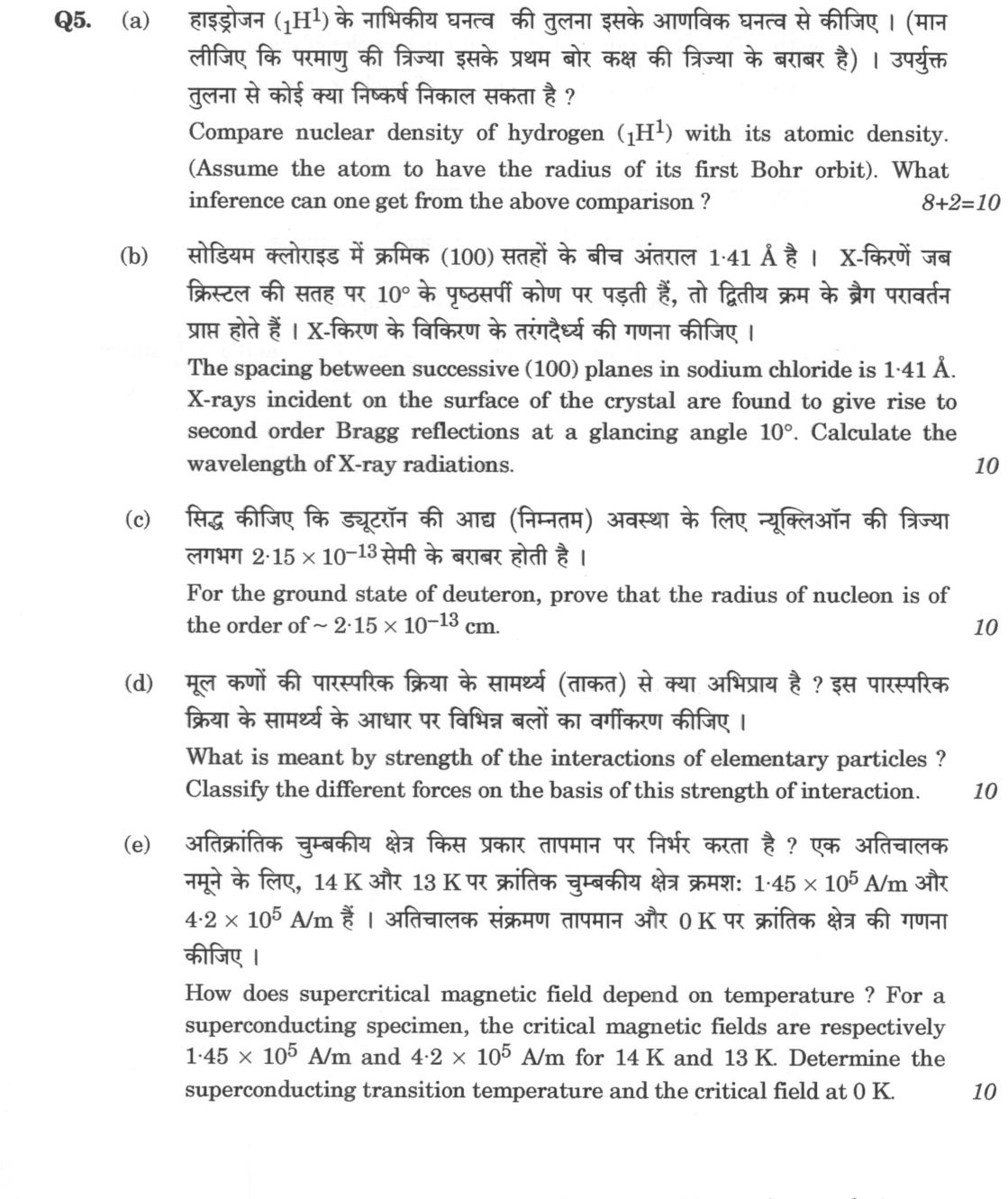
(a) Compare nuclear density of hydrogen (₁H¹) with its atomic density. (Assume the atom to have the radius of its first Bohr…
Compare nuclear density of hydrogen (₁H¹) with its atomic density. (Assume the atom to have the radius of its first Bohr orbit). What inference can one get from the above comparison ? 8+2=10
The spacing between successive (100) planes in sodium chloride is 1·41 Å. X-rays incident on the surface of the crystal are found to give rise to second order Bragg reflections at a glancing angle 10°. Calculate the wavelength of X-ray radiations. 10 marks
For the ground state of deuteron, prove that the radius of nucleon is of the order of ~ 2·15 × 10⁻¹³ cm. 10 marks
What is meant by strength of the interactions of elementary particles ? Classify the different forces on the basis of this strength of interaction. 10 marks
How does supercritical magnetic field depend on temperature ? For a superconducting specimen, the critical magnetic fields are respectively 1·45 × 10⁵ A/m and 4·2 × 10⁵ A/m for 14 K and 13 K. Determine the superconducting transition temperature and the critical field at 0 K. 10 marks
हिंदी में प्रश्न पढ़ें
हाइड्रोजन (₁H¹) के नाभिकीय घनत्व की तुलना इसके आणविक घनत्व से कीजिए । (मान लीजिए कि परमाणु की त्रिज्या इसके प्रथम बोर कक्ष की त्रिज्या के बराबर है) । उपर्युक्त तुलना से कोई क्या निष्कर्ष निकाल सकता है ? 8+2=10
सोडियम क्लोराइड में क्रमिक (100) सतहों के बीच अंतराल 1·41 Å है । X-किरणें जब क्रिस्टल की सतह पर 10° के पृष्ठस्पी कोण पर पड़ती हैं, तो द्वितीय क्रम के ब्रैग परावर्तन प्राप्त होते हैं । X-किरण के विसरण के तरंगदैर्ध्य की गणना कीजिए । 10
सिद्ध कीजिए कि ड्यूटेरॉन की आध (निम्नतम) अवस्था के लिए न्यूक्लॉन की त्रिज्या लगभग 2·15 × 10⁻¹³ सेमी के बराबर होती है । 10
मूल कणों की पारस्परिक क्रिया के सामर्थ्य (ताकत) से क्या अभिप्राय है ? इस पारस्परिक क्रिया के सामर्थ्य के आधार पर विभिन्न बलों का वर्गीकरण कीजिए । 10
अतिक्रांतिक चुंबकीय क्षेत्र किस प्रकार तापमान पर निर्भर करता है ? एक अतिचालक नमूने के लिए, 14 K और 13 K पर क्रांतिक चुंबकीय क्षेत्र क्रमशः: 1·45 × 10⁵ A/m और 4·2 × 10⁵ A/m हैं । अतिचालक संक्रमण तापमान और 0 K पर क्रांतिक क्षेत्र की गणना कीजिए । 10
Model answer
Written by UPSC Answer Check against this question's marking rubric, to the expected length. UPSC does not publish answers for Mains — this is one way to score well, not an official key.
(a) For ₁H¹ the nucleus is a single proton. Its nuclear radius is estimated by the nuclear-radius formula R_N = R₀ A^(1/3), with R₀ ≈ 1·2 × 10⁻¹⁵ m and A = 1. Hence R_N ≈ 1·2 × 10⁻¹⁵ m.
Nuclear volume: V_N = (4/3)πR_N³ = (4/3)π(1·2 × 10⁻¹⁵)³ ≈ 7·24 × 10⁻⁴⁵ m³.
Taking the mass as the proton mass, m ≈ 1·67 × 10⁻²⁷ kg, the nuclear density is ρ_N = m/V_N ≈ 1·67 × 10⁻²⁷ / 7·24 × 10⁻⁴⁵ ≈ 2·3 × 10¹⁷ kg m⁻³.
The atomic radius is the first Bohr radius: a₀ ≈ 5·29 × 10⁻¹¹ m.
Atomic volume: V_atom = (4/3)πa₀³ ≈ (4/3)π(5·29 × 10⁻¹¹)³ ≈ 6·20 × 10⁻³¹ m³.
Atomic density: ρ_atom ≈ 1·67 × 10⁻²⁷ / 6·20 × 10⁻³¹ ≈ 2·7 × 10³ kg m⁻³.
Thus ρ_N / ρ_atom = (a₀/R_N)³ ≈ ((5·29 × 10⁻¹¹)/(1·2 × 10⁻¹⁵))³ ≈ 8·6 × 10¹³.
Final comparison: ρ_N ≈ 2·3 × 10¹⁷ kg m⁻³, ρ_atom ≈ 2·7 × 10³ kg m⁻³, so nuclear density is about 10¹⁴ times atomic density. The inference is that the atom is almost entirely empty space; nearly all mass is concentrated in a tiny nucleus, and nuclear matter has an enormous, nearly constant density.
(b) Use Bragg’s law: nλ = 2d sinθ.
Here n = 2, d = 1·41 Å = 1·41 × 10⁻¹⁰ m, and the glancing angle θ = 10°. Therefore λ = 2d sinθ / n = 2d sin10° / 2 = d sin10°.
So λ = 1·41 × sin10° Å = 1·41 × 0·173648 Å = 0·244844 Å.
Thus λ ≈ 0·2448 Å = 2·448 × 10⁻¹¹ m = 24·48 pm.
Final answer: λ ≈ 0·245 Å = 2·45 × 10⁻¹¹ m.
(c) Let R be the deuteron radius, i.e. the distance of each nucleon from the centre of mass. The separation between proton and neutron is then r = 2R.
The reduced mass is μ = m_p m_n/(m_p + m_n) ≈ M/2, where M ≈ 1·67 × 10⁻²⁷ kg, so μ ≈ 8·35 × 10⁻²⁸ kg.
By the uncertainty principle, the uncertainty in relative momentum is Δp ≈ ħ/r = ħ/(2R).
The relative kinetic energy is therefore T ≈ (Δp)²/(2μ) = ħ²/(8μR²).
In the ground state, this zero-point kinetic energy is of the order of the deuteron binding energy B = 2·224 MeV = 2·224 × 1·602 × 10⁻¹³ J ≈ 3·56 × 10⁻¹³ J.
Putting T ≈ B, ħ²/(8μR²) ≈ B, so R ≈ ħ/√(8μB) = ħ/√(4MB).
Now 4MB = 4 × 1·67 × 10⁻²⁷ × 3·56 × 10⁻¹³ ≈ 2·38 × 10⁻³⁹. Hence √(4MB) ≈ 4·88 × 10⁻²⁰ kg m s⁻¹.
Using ħ = 1·055 × 10⁻³⁴ J s, R ≈ 1·055 × 10⁻³⁴ / 4·88 × 10⁻²⁰ ≈ 2·16 × 10⁻¹⁵ m = 2·16 × 10⁻¹³ cm.
Final result: The deuteron radius is of the order of 2·15 × 10⁻¹³ cm, as required. This is the deuteron size or the nucleon’s orbital radius about the centre of mass, not the intrinsic nucleon radius.
(d) The strength of an interaction of elementary particles means the relative magnitude of the coupling constant associated with that interaction. It determines the probability, cross-section, and rate of the corresponding process. A larger coupling constant means a stronger interaction. For comparing forces, one usually expresses the strength as a dimensionless coupling constant at a suitable energy scale.
The four fundamental interactions are classified as follows.
- Strong interaction: This is the strongest interaction. Its coupling constant is of order α_s ≈ 1 at low energy. It acts between quarks through gluons and between hadrons through the residual strong force. Its range is about 10⁻¹⁵ m. It is responsible for nuclear binding.
- Electromagnetic interaction: This is intermediate in strength. Its coupling constant is the fine-structure constant α ≈ 1/137 ≈ 7·3 × 10⁻³. It acts between charged particles and is mediated by photons. Its range is infinite.
- Weak interaction: This is much weaker than the electromagnetic interaction at ordinary energies. Its effective coupling is of order 10⁻⁶–10⁻⁷ in dimensionless terms. It is mediated by W⁺, W⁻, and Z⁰ bosons and has a very short range, about 10⁻¹⁸ m. It is responsible for beta decay and many flavour-changing processes.
- Gravitational interaction: This is the weakest interaction. Between protons, its dimensionless strength is of order 10⁻³⁹. It acts between all masses and energies and is mediated, in quantum theory, by the hypothetical graviton. Its range is infinite.
Thus, in increasing order of strength: gravitational < weak < electromagnetic < strong.
(e) For a type-I superconductor, the critical magnetic field decreases with increasing temperature according to H_c(T) = H_c(0)[1 − (T/T_c)²], valid for 0 ≤ T ≤ T_c. The field is maximum at absolute zero and vanishes at the transition temperature T_c. Similar decreasing behaviour occurs for the lower and upper critical fields of type-II superconductors.
Given: H_c(14 K) = 1·45 × 10⁵ A m⁻¹, H_c(13 K) = 4·2 × 10⁵ A m⁻¹.
Let x = T_c². Then 1·45 × 10⁵ = H_c(0)[1 − 196/x], 4·2 × 10⁵ = H_c(0)[1 − 169/x].
Dividing the first by the second, [1 − 196/x]/[1 − 169/x] = (1·45 × 10⁵)/(4·2 × 10⁵) = 29/84.
Therefore 84(1 − 196/x) = 29(1 − 169/x).
This gives 84 − 16464/x = 29 − 4901/x.
Hence 55 = 11563/x, so x = T_c² = 11563/55 = 210·236 K².
Thus T_c = √210·236 ≈ 14·50 K.
Now H_c(0) = 1·45 × 10⁵ / [1 − 196/210·236].
Since 1 − 196/210·236 ≈ 0·06772, H_c(0) ≈ 1·45 × 10⁵ / 0·06772 ≈ 2·14 × 10⁶ A m⁻¹.
Final answers: T_c ≈ 14·50 K, H_c(0) ≈ 2·14 × 10⁶ A m⁻¹.
What "Solve" is asking you to do
Choose the method, then carry it through to a final answer. Identifying what kind of problem this is and why that method applies is the first thing marked; a correct figure arrived at invisibly earns almost nothing.
Structure that answers it
Given data and what is required → method chosen, with the reason it applies → set-up (equation, circuit, free body, trial balance) → working, step by step → answer with units and any condition of validity
Where marks are lost
Doing the middle steps mentally and writing only the result. In mathematics papers, a further loss comes from giving a decimal where the exact value in surds or fractions was wanted, or from skipping the justification a part explicitly asks for.
How this answer will be evaluated
Approach
Framework: Principle > Setup > Derivation > Result. (a) compare: paired headings or table > key differences > significance > conclusion | (b) calculate: principle statement > setup and diagram > derivation > result | (c) derive: principle statement > setup and diagram > derivation > result | (d) explain: definition/context > points in order > small example > short close | (e) calculate: principle statement > setup and diagram > derivation > result Full marks: Rigorous derivations, correct units, clear physical interpretation.
Key points expected
- Density ratio ~10^15
- Bragg's law application
- Quantum well model for deuteron
- Fundamental force hierarchy
- Superconducting critical field equation
Evaluation rubric
Each sub-part is marked on its own, against the marks and word limit printed on the paper.
- (a) Calculate and contrast nuclear vs atomic density of Hydrogen-1. 10 marks
compare— paired headings or table → key differences → significance → conclusion
Must cover
- Nuclear radius formula R = R₀A^(1/3)
- Bohr radius a₀ = 0.529 Å
- Density ratio ρ_nuc/ρ_atom ≈ 10¹⁵
- Inference: nucleus is compact
Loses marks
- Using atomic radius for nucleus
- Missing units in final density
Earns more
- Explicit volume ratio calculation
- Mention of empty space in atom
Extra mark
- Comparison with white dwarf density
- (b) Determine X-ray wavelength using Bragg's law for 2nd order. 10 marks
calculate— principle statement → setup and diagram → derivation → result
Must cover
- Bragg's law: nλ = 2d sinθ
- Identify n=2, d=1.41 Å, θ=10°
- Correct substitution of values
- Final answer in Å or m
Loses marks
- Using θ=80° instead of 10°
- Forgetting n=2 (using n=1)
Earns more
- Diagram of Bragg reflection
- Explicit calculation of sin(10°)
Extra mark
- Mention of Miller indices (100)
- (c) Derive nucleon radius from deuteron ground state energy. 10 marks
derive— principle statement → setup and diagram → derivation → result
Must cover
- Infinite square well potential model
- Ground state energy E₁ = π²ħ²/2mL²
- Binding energy ≈ 2.2 MeV
- Relate L to radius R
Loses marks
- Using classical mechanics
- Ignoring reduced mass
Earns more
- Reduction of mass to reduced mass μ
- Unit conversion to cm
Extra mark
- Mention of finite well correction
- (d) Define interaction strength and classify fundamental forces. 10 marks
explain— definition/context → points in order → small example → short close
Must cover
- Definition: coupling constant or relative magnitude
- Strong force (nucleons)
- Electromagnetic force (charged particles)
- Weak and Gravitational forces
Loses marks
- Confusing weak and gravitational strength
- Missing the definition of strength
Earns more
- Relative strength ratios (1 : 10⁻² : 10⁻⁵ : 10⁻³⁸)
- Range of each force
Extra mark
- Mention of gauge bosons
- (e) Find Tc and Hc(0) from two data points. 10 marks
calculate— principle statement → setup and diagram → derivation → result
Must cover
- Formula: Hc(T) = Hc(0)[1 - (T/Tc)²]
- Set up two equations for T=14K, 13K
- Solve for Tc
- Calculate Hc(0)
Loses marks
- Linear interpolation instead of quadratic
- Arithmetic errors in solving system
Earns more
- Step-by-step algebraic elimination
- Correct units for Hc(0)
Extra mark
- Graphical representation of Hc vs T
Practice this exact question
Write your answer and it is marked point by point against the model answer above — what you covered, what you missed, what you got wrong.
Evaluate my answer →More from Physics 2024 Paper II
- Q2 Q2. (a) Prove that : (i) [L², Lz] = 0 (ii) [Lz, L+] = ℏL+ (iii) [L+, L-] = 2ℏLz (iv) L+ L…
- Q3 (a) How do Stokes lines appear in Raman spectrum as per classical and quantum theory of R…
- Q4 (a) (i) Using free electron theory of metals, calculate the Fermi energy level of sodium…
- Q5 (a) Compare nuclear density of hydrogen (₁H¹) with its atomic density. (Assume the atom t…
- Q6 (a) Does the nucleus possess magnetic moment ? Justify your answer. Define nuclear magnet…
- Q7 (a) Discuss the distribution and characteristics of the black soil in India. 10 (b) Exami…
- Q8 (a) Discuss the factors responsible for the uneven distribution of population in India. 1…