Paper I — Q1
(a) Consider a large stationary cylinder of inner radius R. A smaller solid cylinder of radius r rolls without slipping inside…
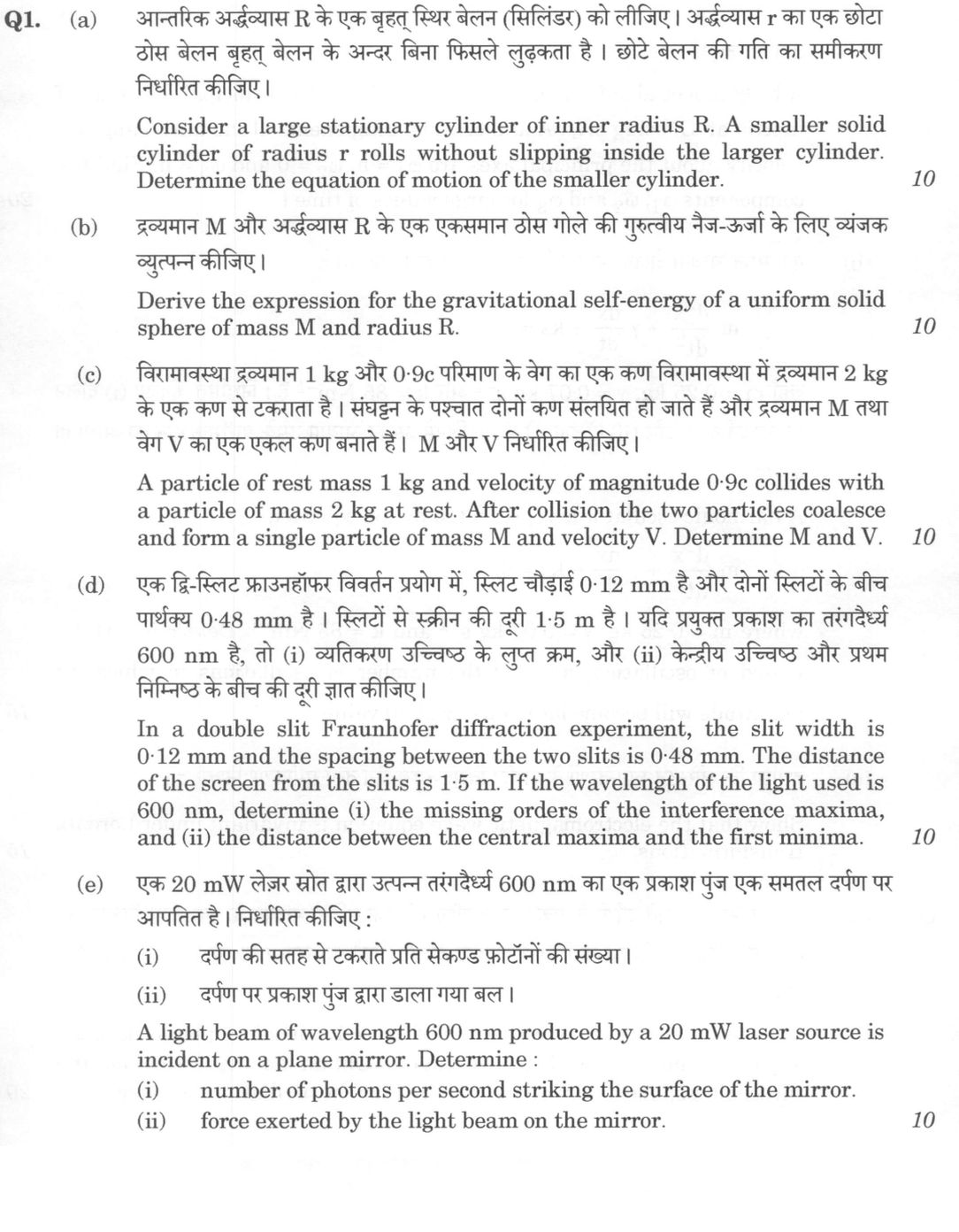
Consider a large stationary cylinder of inner radius R. A smaller solid cylinder of radius r rolls without slipping inside the larger cylinder. Determine the equation of motion of the smaller cylinder. 10 marks
Derive the expression for the gravitational self-energy of a uniform solid sphere of mass M and radius R. 10 marks
A particle of rest mass 1 kg and velocity of magnitude 0·9c collides with a particle of mass 2 kg at rest. After collision the two particles coalesce and form a single particle of mass M and velocity V. Determine M and V. 10 marks
In a double slit Fraunhofer diffraction experiment, the slit width is 0·12 mm and the spacing between the two slits is 0·48 mm. The distance of the screen from the slits is 1·5 m. If the wavelength of the light used is 600 nm, determine (i) the missing orders of the interference maxima, and (ii) the distance between the central maxima and the first minima. 10 marks
A light beam of wavelength 600 nm produced by a 20 mW laser source is incident on a plane mirror. Determine : number of photons per second striking the surface of the mirror.
force exerted by the light beam on the mirror. 10 marks
हिंदी में प्रश्न पढ़ें
आन्तरिक अर्द्धव्यास R के एक बहुत स्थिर बेलन (सिलिंडर) को लीजिए। अर्द्धव्यास r का एक छोटा ठोस बेलन बहुत बेलन के अन्दर बिना फिसले लुढ़कता है। छोटे बेलन की गति का समीकरण निर्धारित कीजिए। 10
द्रव्यमान M और अर्द्धव्यास R के एक एकसमान ठोस गोले की गुरुत्वीय नेज-ऊर्जा के लिए व्यंजक व्युत्पन्न कीजिए। 10
विरामावस्था द्रव्यमान 1 kg और 0·9c परिमाण के वेग का एक कण विरामावस्था में द्रव्यमान 2 kg के एक कण से टकराता है। संघटन के पश्चात दोनों कण संलयित हो जाते हैं और द्रव्यमान M तथा वेग V का एक एकल कण बनाते हैं। M और V निर्धारित कीजिए। 10
एक द्वि-स्लिट फ्राउनहोफर विवर्तन प्रयोग में, स्लिट चौड़ाई 0·12 mm है और दोनों स्लिटों के बीच पार्थक्य 0·48 mm है। स्लिटों से स्क्रीन की दूरी 1·5 m है। यदि प्रयुक्त प्रकाश का तरंगदैर्ध्य 600 nm है, तो (i) व्यतिकरण उच्चिष्ट के लुप्त क्रम, और (ii) केन्द्रीय उच्चिष्ट और प्रथम निम्निष्ट के बीच की दूरी ज्ञात कीजिए। 10
एक 20 mW लेजर स्रोत द्वारा उत्पन्न तरंगदैर्ध्य 600 nm का एक प्रकाश पुंज एक समतल दर्पण पर आपतित है। निर्धारित कीजिए : दर्पण की सतह से टकराते प्रति सेकंड फोटॉनों की संख्या।
दर्पण पर प्रकाश पुंज द्वारा डाला गया बल। 10
Model answer
Written by UPSC Answer Check against this question's marking rubric, to the expected length. UPSC does not publish answers for Mains — this is one way to score well, not an official key.
(a) Let O be the axis of the fixed large cylinder and C the centre of the small rolling cylinder. Let θ be the angle of OC from the downward vertical. The centre C moves on a circle of radius R−r, so its speed is v_C = (R−r) dθ/dt.
Let φ be the rotation angle of the small cylinder about its own axis. For rolling without slipping inside the fixed cylinder, the contact point is instantaneously at rest. The rolling condition is (R−r) dθ/dt + r dφ/dt = 0, so dφ/dt = −((R−r)/r) dθ/dt.
The moment of inertia of a solid cylinder about its axis is I = (1/2) m r². Therefore the kinetic energy is T = (1/2) m (R−r)² (dθ/dt)² + (1/2) I (dφ/dt)² = (1/2) m (R−r)² (dθ/dt)² + (1/2)(1/2 m r²)((R−r)²/r²)(dθ/dt)² = (3/4) m (R−r)² (dθ/dt)².
Taking zero potential energy at the lowest point, V = m g (R−r)(1 − cos θ).
Lagrangian: L = T − V = (3/4) m (R−r)² (dθ/dt)² − m g (R−r)(1 − cos θ).
Using the Euler–Lagrange equation d/dt(∂L/∂(dθ/dt)) − ∂L/∂θ = 0, we get ∂L/∂(dθ/dt) = (3/2) m (R−r)² dθ/dt, so d/dt(∂L/∂(dθ/dt)) = (3/2) m (R−r)² d²θ/dt². Also ∂L/∂θ = − m g (R−r) sin θ. Hence (3/2) m (R−r)² d²θ/dt² + m g (R−r) sin θ = 0. Dividing by m(R−r), d²θ/dt² + (2g/(3(R−r))) sin θ = 0.
This is valid for R > r, no slipping, and the larger cylinder fixed.
(b) Use the shell-assembly method. For a uniform solid sphere of mass M and radius R, density is ρ = M/(4/3 π R³) = 3M/(4π R³).
At radius r, the mass inside is m(r) = (4/3) π r³ ρ = M r³/R³.
Consider a spherical shell of radius r, thickness dr and mass dm = 4π r² ρ dr = 3M r² dr / R³.
The work done in bringing this shell from infinity to radius r against the gravitational field of the mass already inside is dU = − G m(r) dm / r. Substituting, dU = − G (M r³/R³)(3M r² dr/R³)/r = − 3G M² r⁴ dr / R⁶.
Integrate from r = 0 to r = R: U = − (3G M²/R⁶) ∫₀ᴿ r⁴ dr = − (3G M²/R⁶)(R⁵/5) = − 3G M²/(5R).
Therefore the gravitational self-energy is U = − 3G M²/(5R). The negative sign shows that the sphere is bound; its binding energy is 3G M²/(5R).
(c) Let m₁ = 1 kg, u = 0.9c, and m₂ = 2 kg at rest. The Lorentz factor for the moving particle is γ = 1/√(1 − u²/c²) = 1/√(1 − 0.81) = 1/√0.19 = 10/√19.
Total energy before collision: E = γ m₁ c² + m₂ c² = (10/√19 + 2)c².
Total momentum before collision: p = γ m₁ u = (10/√19)(1)(0.9c) = 9c/√19.
For the composite particle of rest mass M and velocity V, M²c⁴ = E² − p²c². Thus M² = (10/√19 + 2)² − (9/√19)² = (4 + 40/√19 + 100/19) − 81/19 = 5 + 40/√19. So M = √(5 + 40/√19) kg ≈ 3.765 kg.
The velocity is V = p c²/E = (9c/√19)/(10/√19 + 2) = 9c/(10 + 2√19) = 3(5 − √19)c/4. Therefore V = [3(5 − √19)/4] c ≈ 0.4808c ≈ 1.44 × 10⁸ m/s.
Rest mass is not conserved in this inelastic collision; kinetic energy is converted into rest mass of the composite particle.
(d)(i) For interference maxima: d sin θ = nλ. For diffraction minima: a sin θ = mλ, m = ±1, ±2, ±3, …
A missing interference maximum occurs when an interference maximum coincides with a diffraction minimum: nλ/d = mλ/a so n = (d/a)m. Here d/a = 0.48 mm/0.12 mm = 4. Thus n = 4m, m = ±1, ±2, ±3, …
Therefore the missing orders are n = ±4, ±8, ±12, ±16, … i.e. all non-zero multiples of 4. The central order n = 0 is not missing.
(d)(ii) For the first interference minimum of the double-slit pattern: d sin θ = λ/2. Using the small-angle approximation, y = D tan θ ≈ D sin θ, so y = Dλ/(2d) = (1.5 m)(600 × 10⁻⁹ m)/(2 × 0.48 × 10⁻³ m) = 9.375 × 10⁻⁴ m = 0.9375 mm = 15/16 mm.
If by “first minima” the first single-slit diffraction minimum is meant, then a sin θ = λ and y = Dλ/a = (1.5 m)(600 × 10⁻⁹ m)/(0.12 × 10⁻³ m) = 7.5 × 10⁻³ m = 7.5 mm = 15/2 mm.
For the complete double-slit pattern, the nearest first minimum is the interference minimum at 0.9375 mm; the first diffraction-envelope minimum is at 7.5 mm.
(e)(i) The energy of one photon is Eγ = hc/λ = (6.626 × 10⁻³⁴ J s)(3 × 10⁸ m/s)/(600 × 10⁻⁹ m) = 3.313 × 10⁻¹⁹ J.
The laser power is P = 20 mW = 20 × 10⁻³ W = 0.020 J/s. Number of photons striking per second is N = P/Eγ = 0.020/(3.313 × 10⁻¹⁹) ≈ 6.04 × 10¹⁶ s⁻¹. Therefore N ≈ 6.04 × 10¹⁶ photons per second.
(e)(ii) Assume normal incidence and perfect reflection by the plane mirror. Each photon has incident momentum p = Eγ/c. On reflection, its momentum changes from +p to −p, so the momentum change per photon is 2p. Thus the force on the mirror is F = 2P/c = 2(20 × 10⁻³ W)/(3 × 10⁸ m/s) = 4 × 10⁻²/(3 × 10⁸) N = 1.33 × 10⁻¹⁰ N.
For a partially reflecting mirror with reflectance R, the force would be F = (1 + R)P/c. For perfect reflection at normal incidence, F = 4/3 × 10⁻¹⁰ N ≈ 1.33 × 10⁻¹⁰ N.
What "Derive" is asking you to do
Reach the stated expression from a starting relation, justifying every step. The destination is printed in the question, so only the route earns marks, and the assumptions you work under are part of that route.
Structure that answers it
Assumptions and notation defined → starting relation or governing equation → each step with its justification → the required expression → limiting case or boundary check
Where marks are lost
Writing the standard result first and fitting three lines to it, which an examiner reads at a glance. Marks also go on assumptions left unstated — lossless medium, small amplitude, errors independent with zero mean — and on symbols used before they are defined, even when the question says usual notations.
How this answer will be evaluated
Approach
(a) derive: given > assumptions > stepwise derivation > result > check | (b) derive: given > assumptions > stepwise derivation > result > check | (c) calculate: given > formula > substitution > result with units > interpretation | (d) calculate: given > formula > substitution > result with units > interpretation | (e) calculate: given > formula > substitution > result with units > interpretation Full marks: Complete derivations with all steps, correct units, and physical interpretation.
Key points expected
- Labelled diagram with radii R, r and angle θ
- Constraint equation linking rolling without slipping
- Kinetic energy expression (translational + rotational)
- Final differential equation of motion
- Definition of self-energy as work done in assembly
- Integration over mass shells or volume
- Use of gravitational potential of a sphere
- Final result in terms of M and R
Evaluation rubric
Each sub-part is marked on its own, against the marks and word limit printed on the paper.
- (a) Equation of motion for a small cylinder rolling inside a large stationary cylinder. 10 marks
derive— given → assumptions → stepwise derivation → result → check
Must cover
- Labelled diagram with radii R, r and angle θ
- Constraint equation linking rolling without slipping
- Kinetic energy expression (translational + rotational)
- Final differential equation of motion
Loses marks
- Missing constraint equation for rolling
- Incorrect moment of inertia for solid cylinder
Earns more
- Use of Lagrangian mechanics
- Identification of effective gravitational acceleration
- Small angle approximation discussion
Extra mark
- Comparison with simple pendulum period
- (b) Expression for gravitational self-energy of a uniform solid sphere. 10 marks
derive— given → assumptions → stepwise derivation → result → check
Must cover
- Definition of self-energy as work done in assembly
- Integration over mass shells or volume
- Use of gravitational potential of a sphere
- Final result in terms of M and R
Loses marks
- Skipping integration steps
- Incorrect limits of integration
Earns more
- Step-by-step integration shown clearly
- Mention of negative sign for bound system
Extra mark
- Comparison with energy of a point mass
- (c) Mass M and velocity V of the coalesced particle after relativistic collision. 10 marks
calculate— given → formula → substitution → result with units → interpretation
Must cover
- Conservation of relativistic energy
- Conservation of relativistic momentum
- Calculation of Lorentz factor for 0.9c
- Solving for M and V
Loses marks
- Using classical mechanics instead of relativistic
- Arithmetic errors in gamma calculation
Earns more
- Explicit calculation of gamma factor
- Units carried through calculation
Extra mark
- Discussion of mass-energy equivalence
- (d) Missing orders of interference maxima and distance between central maxima and first minima. 10 marks
calculate— given → formula → substitution → result with units → interpretation
Must cover
- Condition for missing orders (d/a ratio)
- Calculation of missing orders
- Formula for distance to first minima
- Numerical substitution with units
Loses marks
- Confusing slit width with slit spacing
- Unit conversion errors
Earns more
- Clear identification of slit width and spacing
- Correct use of wavelength in meters
Extra mark
- Diagram of diffraction pattern
- (e) Number of photons per second and force exerted by light beam on mirror. 10 marks
calculate— given → formula → substitution → result with units → interpretation
Must cover
- Energy per photon formula (E = hc/λ)
- Calculation of photons per second
- Momentum change for reflection
- Force calculation using momentum flux
Loses marks
- Using absorption instead of reflection for force
- Unit conversion errors in wavelength
Earns more
- Explicit calculation of photon energy
- Correct use of power in watts
Extra mark
- Discussion of radiation pressure
Practice this exact question
Write your answer and it is marked point by point against the model answer above — what you covered, what you missed, what you got wrong.
Evaluate my answer →More from Physics 2025 Paper I
- Q1 (a) Consider a large stationary cylinder of inner radius R. A smaller solid cylinder of r…
- Q2 (a) A body moves about a point 'O' under no force, the principal moments of inertia at 'O…
- Q3 (a) Consider a laser system consisting of an active medium placed between a pair of mirro…
- Q4 (a) Consider a thick lens of thickness t made of a material of relative refractive index…