Paper I — Q6
(a) Consider a long straight wire of length L carrying a current I. Determine the magnetic vector potential A⃗ at a point P…
Consider a long straight wire of length L carrying a current I. Determine the magnetic vector potential A⃗ at a point P located at distance x from the wire. 20 marks
As shown in the figure, a series circuit connected across a 200 V, 60 Hz line consists of a capacitor of capacitive reactance of 30 Ω, a non-inductive resistor of 44 Ω and a coil of inductive reactance 90 Ω and resistance 36 Ω.
Determine: Power factor of the circuit
Power absorbed by the circuit
Power dissipated in the coil
Consider a mixture of N_A molecules of a monatomic gas A and N_B molecules of a monatomic gas B. For this mixture, obtain the Helmholtz free energy and pressure. (The particle partition function for a monatomic gas is q = (2π mkT/h²)^(3/2) V).
हिंदी में प्रश्न पढ़ें
वि�िद्युत धारा I प्रवाहित लम्बाई L के एक सीधे लम्बे तार को लीजिए। तार से दूरी x पर अवस्थित बिन्दु P पर चुंबकीय सदिश विभव A⃗ ज्ञात कीजिए। (20 अंक)
जैसा कि चित्र में दर्शाया गया है, एक 200 V, 60 Hz लाइन से संबद्ध एक श्रेणी परिपथ में 30 Ω की धारिता प्रतिघात का एक संधारित्र, 44 Ω का एक अप्रेरणिक प्रतिरोधक और 36 Ω प्रतिरोध तथा 90 Ω की प्रेरणिक प्रतिघात की एक कुंडली है।
ज्ञात कीजिए: परिपथ का शक्ति गुणांक
परिपथ द्वारा अवशोषित शक्ति
कुंडली में क्षतिग्रस्त शक्ति
एक एकपरमाणुक गैस A के N_A अणुओं और एक एकपरमाणुक गैस B के N_B अणुओं के एक मिश्रण को लीजिए। इस मिश्रण के लिए, हेल्महोल्ट्ज़ मुक्त ऊर्जा और दाब ज्ञात कीजिए। (एक एकपरमाणुक गैस के लिए कण संवितरण फलन है q = (2π mkT/h²)^(3/2) V).
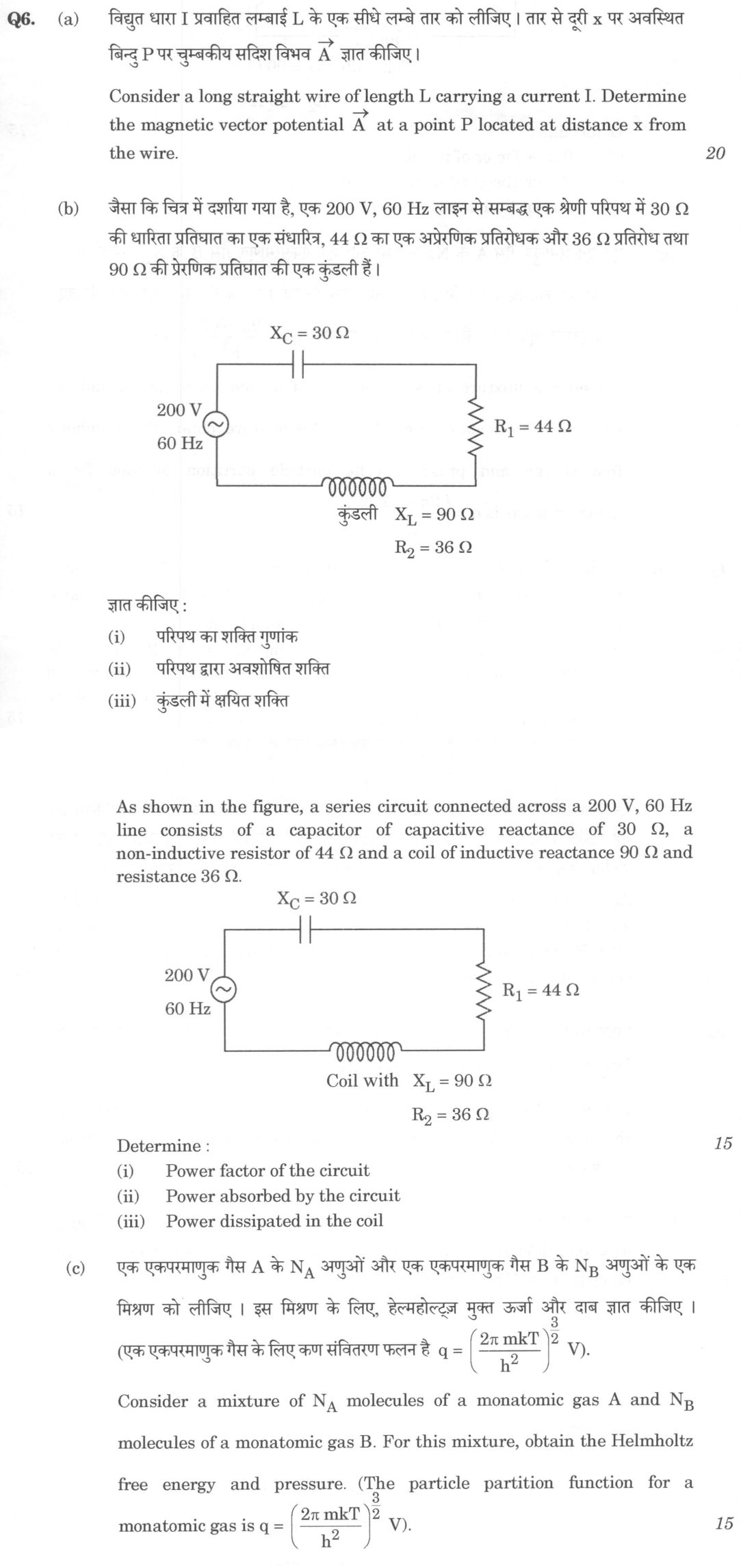
The figure this question refers to, in words
The question paper is a scan and the diagram did not survive as text. This is the figure as read from the original page — every component, value and label — so the question can be worked from the text below.
A series circuit connected across a 200 V, 60 Hz AC source. The circuit consists of: a capacitor with capacitive reactance X_C = 30 ohm, a non-inductive resistor R_1 = 44 ohm, and a coil with inductive reactance X_L = 90 ohm and resistance R_2 = 36 ohm, all connected in series. The 200 V, 60 Hz source is on the left, the capacitor is on the top branch, the resistor R_1 is on the right branch, and the coil (with X_L = 90 ohm and R_2 = 36 ohm) is on the bottom branch. The question asks to determine: (i) Power factor of the circuit, (ii) Power absorbed by the circuit, (iii) Power dissipated in the coil.
Model answer
Written by UPSC Answer Check against this question's marking rubric, to the expected length. UPSC does not publish answers for Mains — this is one way to score well, not an official key.
(a) Use the integral definition of the magnetic vector potential for a steady line current, A(r) = μ₀ I/(4π) ∫ dl/|r-r'|, up to an additive gradient.
Let the wire lie along the z-axis from z = 0 to z = L, current in +z direction. Let P be at perpendicular distance x from the wire, and let the foot of the perpendicular from P to the wire be at z = s. Then dl = dz k̂ and |r-r'| = √(x² + (z-s)²).
Thus A = (μ₀ I/(4π)) k̂ ∫₀^L dz/√(x² + (z-s)²).
Put u = z-s, so limits are u = -s to u = L-s. Using ∫ du/√(x²+u²) = ln(u + √(x²+u²)), we get A = (μ₀ I/(4π)) ln[(L-s+√((L-s)²+x²))/(-s+√(s²+x²))] k̂.
This is the general finite-wire result. If P is opposite the midpoint, s = L/2, so A = (μ₀ I/(2π)) ln[(L/2+√(L²/4+x²))/x] k̂. If P is opposite one end, s = 0, then A = (μ₀ I/(4π)) ln[(L+√(L²+x²))/x] k̂. Valid for x > 0; at the wire the expression diverges.
(b)(i) The elements are in series, so total resistance and net reactance are R = 44 Ω + 36 Ω = 80 Ω, X = X_L - X_C = 90 Ω - 30 Ω = 60 Ω, inductive.
Impedance: Z = √(R²+X²) = √(80²+60²) Ω = 100 Ω.
Power factor: cos φ = R/Z = 80/100 = 0.8 lagging. Also φ = cos⁻¹(0.8) ≈ 36.9°.
(b)(ii) The rms current is I = V/Z = 200 V / 100 Ω = 2 A.
Power absorbed by the circuit is the true power: P = I²R = (2 A)²(80 Ω) = 320 W. Equivalently, P = V I cos φ = 200 × 2 × 0.8 = 320 W. P = 320 W.
(b)(iii) In the coil, only its resistance R₂ = 36 Ω dissipates power. Therefore P_coil = I²R₂ = (2 A)²(36 Ω) = 144 W. The reactive part X_L = 90 Ω only exchanges reactive power, I²X_L = 360 VAR. P_coil = 144 W.
(c) For a monatomic gas A, q_A = (2π m_A kT/h²)^(3/2) V, and for gas B, q_B = (2π m_B kT/h²)^(3/2) V.
For N_A indistinguishable molecules of A and N_B indistinguishable molecules of B, the canonical partition function is Q = (q_A^N_A/N_A!)(q_B^N_B/N_B!).
Using F = -kT ln Q, F = -kT [N_A ln q_A - ln N_A! + N_B ln q_B - ln N_B!].
Apply Stirling’s approximation ln N! ≈ N ln N - N: F = -kT [N_A ln(q_A/N_A) + N_A + N_B ln(q_B/N_B) + N_B].
Substituting q_A and q_B, F = -kT [N_A ln((2π m_A kT/h²)^(3/2) V/N_A) + N_A + N_B ln((2π m_B kT/h²)^(3/2) V/N_B) + N_B].
Pressure follows from P = -(∂F/∂V)_T,N_A,N_B.
Only the V-dependent terms contribute: ∂F/∂V = -kT (N_A+N_B)/V.
Therefore P = (N_A + N_B) kT/V.
This is the ideal-gas mixture pressure. The result assumes non-interacting, classical monatomic gases.
What "Derive" is asking you to do
Reach the stated expression from a starting relation, justifying every step. The destination is printed in the question, so only the route earns marks, and the assumptions you work under are part of that route.
Structure that answers it
Assumptions and notation defined → starting relation or governing equation → each step with its justification → the required expression → limiting case or boundary check
Where marks are lost
Writing the standard result first and fitting three lines to it, which an examiner reads at a glance. Marks also go on assumptions left unstated — lossless medium, small amplitude, errors independent with zero mean — and on symbols used before they are defined, even when the question says usual notations.
How this answer will be evaluated
Approach
Framework: Principle > Setup and diagram > Derivation > Result and limiting case. (a) derive: given > assumptions > stepwise derivation > result > check | (b) calculate: given > formula > substitution > result with units > interpretation | (c) derive: given > assumptions > stepwise derivation > result > check Full marks: Complete derivations with correct setup, units, and physical interpretation.
Key points expected
- State Biot-Savart law for vector potential dA
- Set up integral along wire length L
- Perform integration to find A
- State final result with direction
- Calculate total impedance Z of the circuit
- Calculate current I in the circuit
- Compute power factor cos(phi)
- Compute total power P = VI cos(phi)
Evaluation rubric
Each sub-part is marked on its own, against the marks and word limit printed on the paper.
- (a) Magnetic vector potential A at distance x from a finite wire of length L. 20 marks
derive— given → assumptions → stepwise derivation → result → check
Must cover
- State Biot-Savart law for vector potential dA
- Set up integral along wire length L
- Perform integration to find A
- State final result with direction
Loses marks
- Using Biot-Savart for B instead of A
- Missing integration limits or setup
Earns more
- Draw labelled diagram of wire and point P
- Mention direction of A (azimuthal)
- Check limiting case for infinite wire
Extra mark
- Mention gauge invariance of A
- (b) Power factor, total power absorbed, and power dissipated in the coil. 15 marks
calculate— given → formula → substitution → result with units → interpretation
Must cover
- Calculate total impedance Z of the circuit
- Calculate current I in the circuit
- Compute power factor cos(phi)
- Compute total power P = VI cos(phi)
Loses marks
- Ignoring resistance of the coil
- Confusing real and reactive power
Earns more
- Calculate power dissipated in coil specifically
- Show phasor diagram or impedance triangle
- State units for all quantities
Extra mark
- Mention reactive power Q
- (c) Helmholtz free energy and pressure for a mixture of two monatomic gases. 15 marks
derive— given → assumptions → stepwise derivation → result → check
Must cover
- Write total partition function for the mixture
- Derive Helmholtz free energy F = -kT ln Z
- Derive pressure P = -dF/dV
- Show dependence on N_A and N_B
Loses marks
- Treating mixture as a single gas
- Missing the volume dependence in F
Earns more
- Use given particle partition function q
- Show entropy of mixing term
- Verify ideal gas law limit
Extra mark
- Mention Gibbs free energy
Practice this exact question
Write your answer and it is marked point by point against the model answer above — what you covered, what you missed, what you got wrong.
Evaluate my answer →More from Physics 2025 Paper I
- Q3 (a) Consider a laser system consisting of an active medium placed between a pair of mirro…
- Q4 (a) Consider a thick lens of thickness t made of a material of relative refractive index…
- Q5 (a) Consider a point charge of 5 nC placed at a distance of 1 m from a perfect conducting…
- Q6 (a) Consider a long straight wire of length L carrying a current I. Determine the magneti…
- Q7 (a) A ternary system consists of three components (A, B and C) in equilibrium with two ph…
- Q8 (a) (i) In free space, an electric field (E⃗) is given by the following expression : E⃗ =…