Paper I — Q5
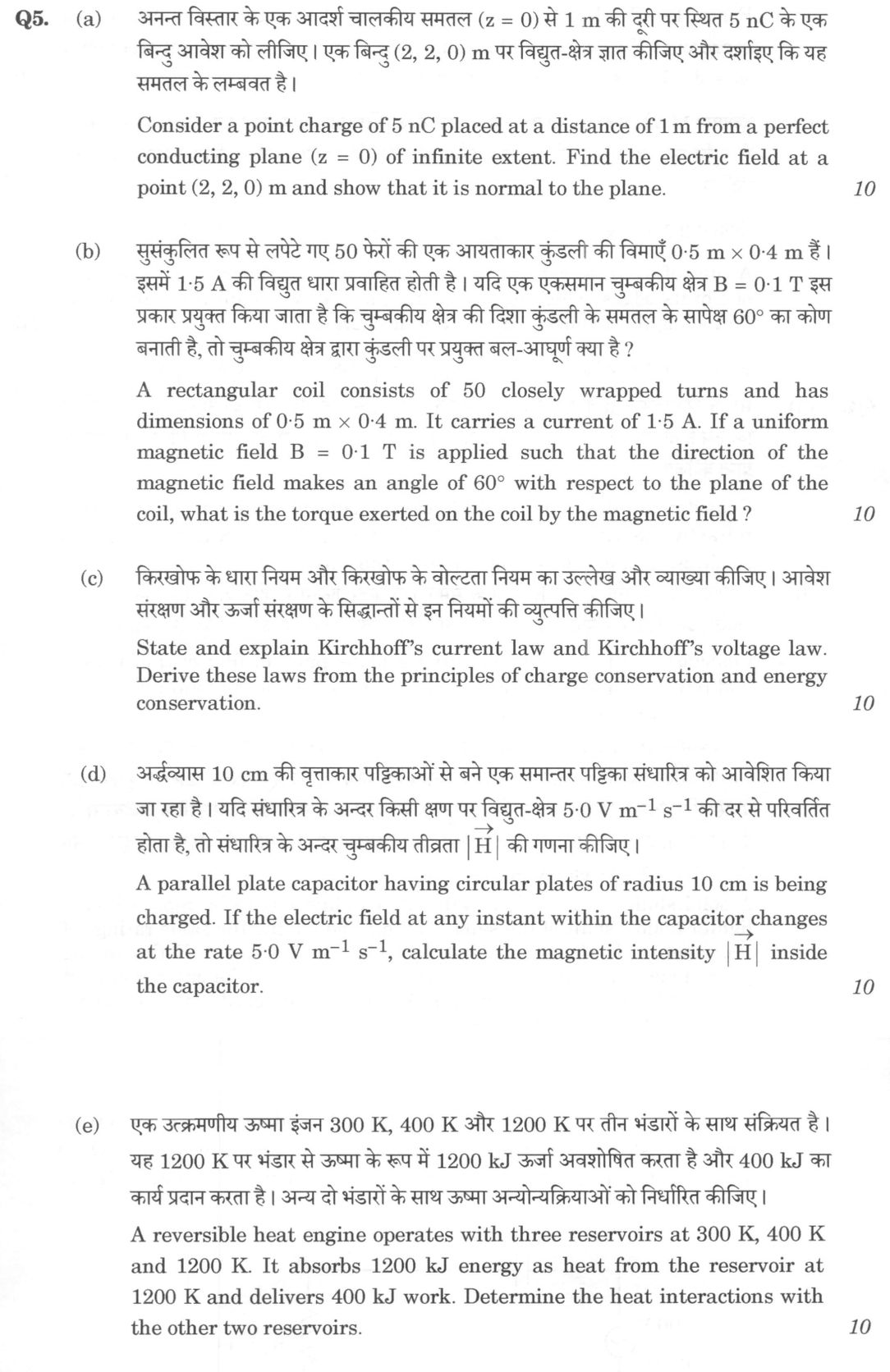
(a) Consider a point charge of 5 nC placed at a distance of 1 m from a perfect conducting plane (z = 0) of infinite extent. Find…
Consider a point charge of 5 nC placed at a distance of 1 m from a perfect conducting plane (z = 0) of infinite extent. Find the electric field at a point (2, 2, 0) m and show that it is normal to the plane. 10 marks
A rectangular coil consists of 50 closely wrapped turns and has dimensions of 0·5 m × 0·4 m. It carries a current of 1·5 A. If a uniform magnetic field B = 0·1 T is applied such that the direction of the magnetic field makes an angle of 60° with respect to the plane of the coil, what is the torque exerted on the coil by the magnetic field? 10 marks
State and explain Kirchhoff's current law and Kirchhoff's voltage law. Derive these laws from the principles of charge conservation and energy conservation. 10 marks
A parallel plate capacitor having circular plates of radius 10 cm is being charged. If the electric field at any instant within the capacitor changes at the rate 5·0 V m⁻¹ s⁻¹, calculate the magnetic intensity |H⃗| inside the capacitor. 10 marks
A reversible heat engine operates with three reservoirs at 300 K, 400 K and 1200 K. It absorbs 1200 kJ energy as heat from the reservoir at 1200 K and delivers 400 kJ work. Determine the heat interactions with the other two reservoirs. 10 marks
हिंदी में प्रश्न पढ़ें
अनंत विस्तार के एक आदर्श चालकीय समतल (z = 0) से 1 m की दूरी पर स्थित 5 nC के एक बिंदु आवेश को लीजिए। एक बिंदु (2, 2, 0) m पर विद्युत-क्षेत्र ज्ञात कीजिए और दर्शाइए कि यह समतल के लम्बवत है। (10 अंक)
सुसंकुलित रूप से लपेटे गए 50 फेरों की एक आयताकार कुंडली की विमाएँ 0·5 m × 0·4 m हैं। इसमें 1·5 A की विद्युत धारा प्रवाहित होती है। यदि एक एकसमान चुंबकीय क्षेत्र B = 0·1 T इस प्रकार प्रयुक्त किया जाता है कि चुंबकीय क्षेत्र की दिशा कुंडली के समतल के सापेक्ष 60° का कोण बनाती है, तो चुंबकीय क्षेत्र द्वारा कुंडली पर प्रयुक्त बल-आघूर्ण क्या है? (10 अंक)
किरखॉफ के धारा नियम और किरखॉफ के वोल्टता नियम का उल्लेख और व्याख्या कीजिए। आवेश संरक्षण और ऊर्जा संरक्षण के सिद्धांतों से इन नियमों की व्युपत्ति कीजिए। (10 अंक)
अर्ध्व्यास 10 cm की वृत्ताकार प्लेटों से बने एक समांतर प्लेट संधारित्र को आवेशित किया जा रहा है। यदि संधारित्र के अंदर किसी क्षण पर विद्युत-क्षेत्र 5·0 V m⁻¹ s⁻¹ की दर से परिवर्तित होता है, तो संधारित्र के अंदर चुंबकीय तीव्रता |H⃗| की गणना कीजिए। (10 अंक)
एक उत्क्रमणीय ऊष्मा इंजन 300 K, 400 K और 1200 K पर तीन भंडारों के साथ संक्रियत है। यह 1200 K पर भंडार से ऊष्मा के रूप में 1200 kJ ऊर्जा अवशोषित करता है और 400 kJ का कार्य प्रदान करता है। अन्य दो भंडारों के साथ ऊष्मा अन्योन्यक्रियाओं को निर्धारित कीजिए। (10 अंक)
Model answer
Written by UPSC Answer Check against this question's marking rubric, to the expected length. UPSC does not publish answers for Mains — this is one way to score well, not an official key.
(a)
Choose the origin at the foot of the perpendicular from the point charge to the plane z = 0. Since the charge is 1 m above the plane, take the charge at (0, 0, 1) m. The observation point is P = (2, 2, 0) m.
For a perfect conducting infinite plane, use the method of images. The plane z = 0 is replaced by an image charge q′ = −q at (0, 0, −1) m, and the field in z > 0 is the superposition of the fields of q and q′.
Given q = 5 nC = 5 × 10⁻⁹ C, and 1/(4π ε₀) = 9 × 10⁹ N m² C⁻².
Vector from real charge at (0, 0, 1) to P: r₁ = (2, 2, −1) m, |r₁| = √(2² + 2² + (−1)²) = √9 = 3 m.
Field due to real charge: E₁ = (1/(4π ε₀)) q r₁/|r₁|³ = (9 × 10⁹)(5 × 10⁻⁹)/27 × (2, 2, −1) = (5/3)(2, 2, −1) = (10/3, 10/3, −5/3) N C⁻¹.
Vector from image charge at (0, 0, −1) to P: r₂ = (2, 2, 1) m, |r₂| = 3 m.
Field due to image charge q′ = −5 × 10⁻⁹ C: E₂ = (1/(4π ε₀)) q′ r₂/|r₂|³ = (9 × 10⁹)(−5 × 10⁻⁹)/27 × (2, 2, 1) = −(5/3)(2, 2, 1) = (−10/3, −10/3, −5/3) N C⁻¹.
Total field at P: E = E₁ + E₂ = (0, 0, −10/3) N C⁻¹.
Thus E = −(10/3) k̂ N C⁻¹ = (0, 0, −3.33) N C⁻¹, where k̂ is the unit vector normal to the plane z = 0. Since E has only a z-component, its tangential component on the plane is zero. Hence the electric field is normal to the conducting plane, as required. At the plane itself, this is the external field just above z = 0; the field inside the conductor is zero.
(b)
For a flat coil in a magnetic field, the magnetic dipole moment has magnitude μ = N I A, where N is the number of turns, I is the current, and A is the area.
Area of the rectangular coil: A = 0.5 m × 0.4 m = 0.20 m².
Therefore, μ = 50 × 1.5 A × 0.20 m² = 15 A m².
The torque magnitude on a magnetic dipole is τ = μ B sin θ, where θ is the angle between the magnetic dipole moment and B. The dipole moment is normal to the plane of the coil. The magnetic field makes 60° with the plane of the coil, so the angle between B and the normal is θ = 90° − 60° = 30°.
Thus, τ = 15 A m² × 0.1 T × sin 30° = 15 × 0.1 × 0.5 N m = 0.75 N m.
Torque = 0.75 N m, directed perpendicular to both the coil normal and B; its sense is given by the right-hand rule from μ⃗ × B⃗.
(c)
Kirchhoff’s current law (KCL): At any junction or node in an electrical network, the algebraic sum of currents entering the node is zero, or the total current entering the node equals the total current leaving it. That is, ∑ I = 0 at a node, taking currents entering as positive and leaving as negative.
Explanation and derivation from charge conservation: Consider a node. If currents I₁, I₂, … flow into it, the net rate at which charge enters the node is ∑ I. Charge conservation requires ∑ I = dq/dt, where q is the charge accumulated at the node. In the lumped-circuit approximation, an ideal node has negligible capacitance and cannot store charge, so dq/dt = 0. Hence ∑ I = 0. More generally, if charge can accumulate, ∑ I_in = ∑ I_out + dq/dt. For steady currents, this reduces exactly to KCL.
Kirchhoff’s voltage law (KVL): Around any closed loop in a network, the algebraic sum of all potential differences is zero, or the sum of electromotive forces equals the sum of potential drops. That is, ∑ V = 0 around a closed loop.
Explanation and derivation from energy conservation: Let a unit positive charge be carried once around a closed loop. In the electrostatic or lumped-circuit approximation, the electric field is conservative, so the work done per unit charge around a closed path is ∮ E⃗ · dl⃗ = 0. Equivalently, the potential at the starting point equals the potential at the ending point after one complete traversal. Therefore, every potential rise must be balanced by an equal potential drop. If sources of emf are present, energy conservation gives ∑ emf = ∑ IR. If a changing magnetic flux links the loop, KVL is modified by Faraday’s law: the induced emf −dΦ/dt must be included, and then ∑ V = −dΦ/dt. In ordinary lumped-circuit analysis, this induced effect is either negligible or represented by an explicit emf source. Thus KCL follows from conservation of charge and KVL from conservation of energy.
(d)
Inside a charging parallel-plate capacitor, the electric field is axial and changing. The changing electric field produces a displacement current density J_d = ε₀ ∂E/∂t.
Use the Ampère–Maxwell law: ∮ H⃗ · dl⃗ = ∫ (J⃗ + ∂D⃗/∂t) · dA⃗. Inside the capacitor gap, conduction current J = 0, and D = ε₀E. Choose a circular Amperian loop of radius r centred on the axis, with r < R. By symmetry, H is azimuthal and has constant magnitude on this loop. Therefore, H (2πr) = ε₀ (dE/dt) (πr²).
Hence, |H⃗| = (ε₀ r/2)(dE/dt).
Given dE/dt = 5.0 V m⁻¹ s⁻¹, ε₀ = 8.854 × 10⁻¹² F m⁻¹, and plate radius R = 10 cm = 0.10 m. At the rim just inside the capacitor, r = R = 0.10 m: |H⃗| = (8.854 × 10⁻¹² × 0.10 × 5.0)/2 A m⁻¹ = 2.2135 × 10⁻¹² A m⁻¹.
Thus |H⃗| at r = 0.10 m is about 2.21 × 10⁻¹² A m⁻¹. More generally, at radial distance r from the axis, |H⃗| = (ε₀ r/2)(dE/dt), so the field is zero on the axis and maximum at the plate edge.
(e)
Let Q₁₂₀₀ = +1200 kJ be the heat absorbed by the engine from the 1200 K reservoir. The engine delivers work W = +400 kJ. Let Q₄₀₀ and Q₃₀₀ be the heat interactions with the 400 K and 300 K reservoirs, taken positive when absorbed by the engine.
By the first law for a cyclic engine, Q₁₂₀₀ + Q₄₀₀ + Q₃₀₀ = W. Therefore, 1200 + Q₄₀₀ + Q₃₀₀ = 400, so Q₄₀₀ + Q₃₀₀ = −800 kJ. … (1)
For a reversible engine, the total entropy change of the engine over a cycle is zero, and the entropy changes of the reservoirs sum to zero: Q₁₂₀₀/T₁ + Q₄₀₀/T₂ + Q₃₀₀/T₃ = 0. Thus, 1200/1200 + Q₄₀₀/400 + Q₃₀₀/300 = 0, or 1 + Q₄₀₀/400 + Q₃₀₀/300 = 0. … (2)
From (1), Q₄₀₀ = −800 − Q₃₀₀. Substitute in (2): 1 + (−800 − Q₃₀₀)/400 + Q₃₀₀/300 = 0. This gives 1 − 2 − Q₃₀₀/400 + Q₃₀₀/300 = 0, so −1 + Q₃₀₀(1/300 − 1/400) = 0. Since 1/300 − 1/400 = 1/1200, Q₃₀₀ = 1200 kJ. Then Q₄₀₀ = −800 − 1200 = −2000 kJ.
Therefore, the engine absorbs 1200 kJ from the 300 K reservoir and rejects 2000 kJ to the 400 K reservoir. The 1200 K reservoir supplies 1200 kJ, and the net heat absorbed is 1200 + 1200 − 2000 = 400 kJ, which equals the work delivered. Check entropy: 1200/1200 + 1200/300 − 2000/400 = 1 + 4 − 5 = 0, confirming reversibility.
What "Solve" is asking you to do
Choose the method, then carry it through to a final answer. Identifying what kind of problem this is and why that method applies is the first thing marked; a correct figure arrived at invisibly earns almost nothing.
Structure that answers it
Given data and what is required → method chosen, with the reason it applies → set-up (equation, circuit, free body, trial balance) → working, step by step → answer with units and any condition of validity
Where marks are lost
Doing the middle steps mentally and writing only the result. In mathematics papers, a further loss comes from giving a decimal where the exact value in surds or fractions was wanted, or from skipping the justification a part explicitly asks for.
How this answer will be evaluated
Approach
(a) calculate: given > formula > substitution > result with units > interpretation | (b) calculate: given > formula > substitution > result with units > interpretation | (c) derive: given > assumptions > stepwise derivation > result > check | (d) calculate: given > formula > substitution > result with units > interpretation | (e) calculate: given > formula > substitution > result with units > interpretation Full marks: Rigorous derivations, correct units, clear diagrams, and physical interpretation.
Key points expected
- Method of images setup with -5 nC at (0,0,-1)
- Superposition of fields from real and image charges
- Calculation of E_x and E_y components at (2,2,0)
- Demonstration that E_z is zero at the plane
- Calculation of magnetic dipole moment m = NIA
- Correct identification of angle theta between m and B
- Application of torque formula tau = mB sin(theta)
- Final result with correct units (N m)
Evaluation rubric
Each sub-part is marked on its own, against the marks and word limit printed on the paper.
- (a) Electric field vector at (2,2,0) using method of images and proof of normality. 10 marks
calculate— given → formula → substitution → result with units → interpretation
Must cover
- Method of images setup with -5 nC at (0,0,-1)
- Superposition of fields from real and image charges
- Calculation of E_x and E_y components at (2,2,0)
- Demonstration that E_z is zero at the plane
Loses marks
- Omitting the image charge contribution
- Failing to show E_z = 0 explicitly
- Dropping units in final vector result
Earns more
- Labelled diagram of charge and image charge
- Explicit vector notation for position vectors
- Verification of boundary condition E_tangential = 0
Extra mark
- Physical interpretation of induced surface charge
- (b) Torque on the rectangular coil in the uniform magnetic field. 10 marks
calculate— given → formula → substitution → result with units → interpretation
Must cover
- Calculation of magnetic dipole moment m = NIA
- Correct identification of angle theta between m and B
- Application of torque formula tau = mB sin(theta)
- Final result with correct units (N m)
Loses marks
- Using 60 degrees directly in sin(theta) without adjustment
- Forgetting the number of turns N in moment calculation
- Incorrect unit for torque
Earns more
- Diagram showing coil plane and B vector
- Explicit calculation of area A = 0.5 * 0.4
- Clarification that theta is 30 degrees (90 - 60)
Extra mark
- Note on direction of torque using right-hand rule
- (c) Derivation of Kirchhoff's laws from conservation principles. 10 marks
derive— given → assumptions → stepwise derivation → result → check
Must cover
- Statement of KCL and KVL
- Derivation of KCL from charge conservation
- Derivation of KVL from energy conservation
- Explanation of loop and junction concepts
Loses marks
- Stating laws without derivation
- Confusing charge conservation with energy conservation
- Lack of clear logical steps in derivation
Earns more
- Mathematical expression of continuity equation for KCL
- Line integral of E field for KVL derivation
- Circuit diagram illustrating junction and loop
Extra mark
- Mention of limitations (e.g., displacement current)
- (d) Magnetic intensity H inside the charging capacitor. 10 marks
calculate— given → formula → substitution → result with units → interpretation
Must cover
- Application of Ampere-Maxwell law
- Calculation of displacement current density J_d
- Integration to find H at the plate radius
- Substitution of given dE/dt value
Loses marks
- Ignoring the displacement current term
- Incorrect integration limits for the Amperian loop
- Arithmetic error in final calculation
Earns more
- Explicit formula for displacement current I_d
- Use of symmetry argument for H direction
- Correct unit conversion for radius (10 cm to 0.1 m)
Extra mark
- Physical interpretation of displacement current
- (e) Heat interactions with the 300 K and 400 K reservoirs. 10 marks
calculate— given → formula → substitution → result with units → interpretation
Must cover
- Application of First Law of Thermodynamics
- Application of Second Law (Clausius inequality)
- Setting up equations for Q_300 and Q_400
- Solving the system of equations
Loses marks
- Ignoring the entropy change of the universe
- Incorrect sign convention for heat transfer
- Failing to solve for both unknowns
Earns more
- Clear definition of heat signs (in/out)
- Explicit entropy balance equation
- Verification of reversibility condition
Extra mark
- Calculation of engine efficiency
Practice this exact question
Write your answer and it is marked point by point against the model answer above — what you covered, what you missed, what you got wrong.
Evaluate my answer →More from Physics 2025 Paper I
- Q2 (a) A body moves about a point 'O' under no force, the principal moments of inertia at 'O…
- Q3 (a) Consider a laser system consisting of an active medium placed between a pair of mirro…
- Q4 (a) Consider a thick lens of thickness t made of a material of relative refractive index…
- Q5 (a) Consider a point charge of 5 nC placed at a distance of 1 m from a perfect conducting…
- Q6 (a) Consider a long straight wire of length L carrying a current I. Determine the magneti…
- Q7 (a) A ternary system consists of three components (A, B and C) in equilibrium with two ph…
- Q8 (a) (i) In free space, an electric field (E⃗) is given by the following expression : E⃗ =…