Paper I — Q4
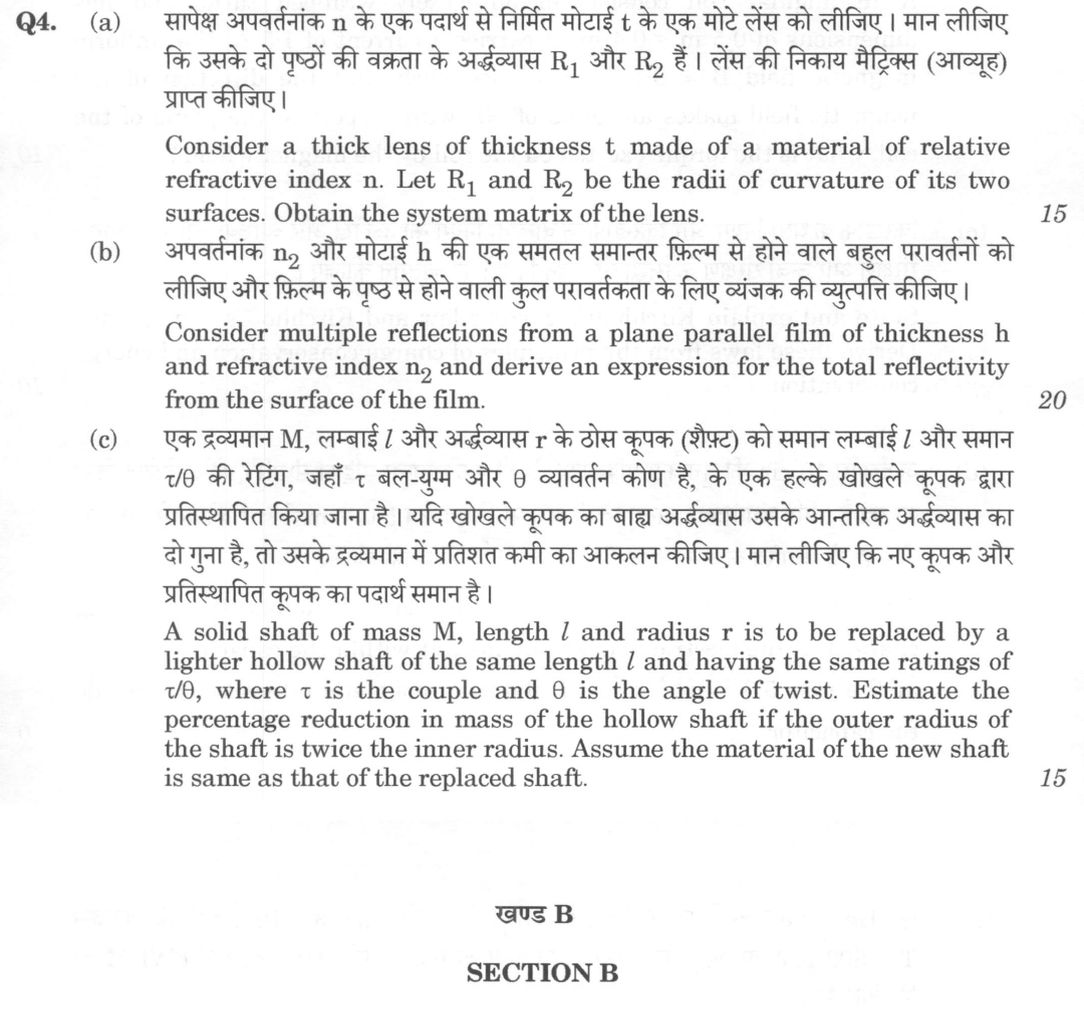
(a) Consider a thick lens of thickness t made of a material of relative refractive index n. Let R₁ and R₂ be the radii of…
Consider a thick lens of thickness t made of a material of relative refractive index n. Let R₁ and R₂ be the radii of curvature of its two surfaces. Obtain the system matrix of the lens. 15 marks
Consider multiple reflections from a plane parallel film of thickness h and refractive index n₂ and derive an expression for the total reflectivity from the surface of the film. 20 marks
A solid shaft of mass M, length l and radius r is to be replaced by a lighter hollow shaft of the same length l and having the same ratings of τ/θ, where τ is the couple and θ is the angle of twist. Estimate the percentage reduction in mass of the hollow shaft if the outer radius of the shaft is twice the inner radius. Assume the material of the new shaft is same as that of the replaced shaft. 15 marks
हिंदी में प्रश्न पढ़ें
सापेक्ष अपवर्तनांक n के एक पदार्थ से निर्मित मोटाई t के एक मोटे लेंस को लीजिए। मान लीजिए कि उसके दो पृष्ठों की वक्रता के अर्ध्व्यास R₁ और R₂ हैं। लेंस की निकाय मैट्रिक्स (आव्यूह) प्राप्त कीजिए। (15 अंक)
अपवर्तनांक n₂ और मोटाई h की एक समतल समांतर फिल्म से होने वाले बहुल परावर्तनों को लीजिए और फिल्म के पृष्ठ से होने वाली कुल परावर्तकता के लिए व्यंजक की व्युत्पत्ति कीजिए। (20 अंक)
एक द्रव्यमान M, लंबाई l और अर्ध्व्यास r के ठोस कूपक (शाफ्ट) को समान लंबाई l और समान τ/θ की रेटिंग, जहाँ τ बल-युग्म और θ व्यावर्तन कोण है, के एक हल्के खोखले कूपक द्वारा प्रतिस्थापित किया जाना है। यदि खोखले कूपक का बाह्य अर्ध्व्यास उसके आंतरिक अर्ध्व्यास का दो गुना है, तो उसके द्रव्यमान में प्रतिशत कमी का आकलन कीजिए। मान लीजिए कि नए कूपक और प्रतिस्थापित कूपक का पदार्थ समान है। (15 अंक)
Model answer
Written by UPSC Answer Check against this question's marking rubric, to the expected length. UPSC does not publish answers for Mains — this is one way to score well, not an official key.
(a) Use the paraxial ray-transfer method. Take the ray vector as a column (y, nθ), where y is height and nθ is the reduced angle. Let R be positive if the centre of curvature lies to the right of the vertex. For refraction from index nᵢ to nₜ at a spherical surface of radius R, the matrix is M_ref = [[1, 0], [-(nₜ - nᵢ)/R, 1]]. For translation through thickness t in medium n: M_trans = [[1, t/n], [0, 1]]. At the first surface, nᵢ = 1, nₜ = n, radius R₁: M₁ = [[1, 0], [-(n - 1)/R₁, 1]]. At the second surface, nᵢ = n, nₜ = 1, radius R₂: M₂ = [[1, 0], [(n - 1)/R₂, 1]]. The system matrix is M = M₂ M_trans M₁. Multiplying, M = [[A, B], [C, D]], where A = 1 - (n - 1)t/(n R₁), B = t/n, C = (n - 1)(1/R₂ - 1/R₁) - (n - 1)² t/(n R₁ R₂), D = 1 + (n - 1)t/(n R₂). Thus M = [[1 - (n - 1)t/(n R₁), t/n], [(n - 1)(1/R₂ - 1/R₁) - (n - 1)² t/(n R₁ R₂), 1 + (n - 1)t/(n R₂)]]. For t → 0, C = (n - 1)(1/R₂ - 1/R₁), so 1/f = -C = (n - 1)(1/R₁ - 1/R₂). This is valid under the paraxial approximation.
(b) Take a plane parallel film of refractive index n₂ and thickness h, with air on both sides. Let the amplitude reflection coefficient at an air-film interface be r = (1 - n₂)/(1 + n₂). At the lower film-air interface and at the upper film-air internal reflection, the reflection coefficient is -r. If t and t′ are the transmission coefficients, then t t′ = 1 - r². Let θ₂ be the angle of refraction inside the film. The round-trip phase is δ = 4π n₂ h cosθ₂/λ = 4π h √(n₂² - sin²θ₁)/λ, where θ₁ is the external incidence angle. At normal incidence, δ = 4π n₂ h/λ. The directly reflected amplitude is r. The first internally reflected beam has amplitude t t′(-r) exp(iδ). Each additional round trip multiplies the amplitude by r² exp(iδ). Hence r_total = r + t t′(-r) exp(iδ) + t t′(-r) r² exp(i2δ) + ... = r - (1 - r²) r exp(iδ)/(1 - r² exp(iδ)). Simplifying, r_total = r(1 - exp(iδ))/(1 - r² exp(iδ)). Therefore the total reflectivity is R = |r_total|² = r² |1 - exp(iδ)|²/|1 - r² exp(iδ)|² = 4 r² sin²(δ/2)/(1 + r⁴ - 2r² cosδ). Writing R₀ = r² = ((n₂ - 1)/(n₂ + 1))², R = 4R₀ sin²(δ/2)/(1 + R₀² - 2R₀ cosδ). If the two outer media are different, the general amplitude is r_total = (r₁ + r₂ exp(iδ))/(1 + r₁ r₂ exp(iδ)), and R = |r_total|². The result assumes no absorption, plane parallel surfaces, and coherence over the multiple reflections.
(c) For torsion, the torsional rating is τ/θ = G J/l, where τ is the couple, θ is the angle of twist, G is the shear modulus, J is the polar second moment of area, and l is the length. Since the material and length are the same, equal τ/θ requires equal J. For the solid shaft of radius r, Jₛ = (π/2) r⁴. For the hollow shaft, let the inner radius be a. The outer radius is 2a. Then Jₕ = (π/2)((2a)⁴ - a⁴) = (π/2)(16a⁴ - a⁴) = (π/2)15a⁴. Equating Jₛ and Jₕ: (π/2)r⁴ = (π/2)15a⁴ ⇒ a⁴ = r⁴/15 ⇒ a² = r²/√15. Mass of solid shaft: M = ρπr²l. Mass of hollow shaft: Mₕ = ρπ((2a)² - a²)l = 3ρπa²l = 3ρπ(r²/√15)l = (3/√15)M. So the fractional reduction is 1 - Mₕ/M = 1 - 3/√15 = 1 - √15/5. Percentage reduction: 100(1 - 3/√15)% = 100(1 - √15/5)% ≈ 22.54%. Thus the hollow shaft gives about 22.5% reduction in mass under the same torsional rating, same length, and same material.
What "Derive" is asking you to do
Reach the stated expression from a starting relation, justifying every step. The destination is printed in the question, so only the route earns marks, and the assumptions you work under are part of that route.
Structure that answers it
Assumptions and notation defined → starting relation or governing equation → each step with its justification → the required expression → limiting case or boundary check
Where marks are lost
Writing the standard result first and fitting three lines to it, which an examiner reads at a glance. Marks also go on assumptions left unstated — lossless medium, small amplitude, errors independent with zero mean — and on symbols used before they are defined, even when the question says usual notations.
How this answer will be evaluated
Approach
Framework: Principle > Setup and diagram > Derivation > Result and limiting case. (a) derive: given > assumptions > stepwise derivation > result > check | (b) derive: given > assumptions > stepwise derivation > result > check | (c) calculate: given > formula > substitution > result with units > interpretation Full marks: Complete derivation with correct matrices/series, clear diagrams, and physical interpretation.
Key points expected
- Define ray vector and matrix convention
- Matrix for refraction at first surface R1
- Matrix for translation through thickness t
- Matrix for refraction at second surface R2
- Fresnel coefficients for single interface
- Summation of infinite geometric series
- Phase difference term 2nh cos(theta)
- Final expression for total reflectivity R
Evaluation rubric
Each sub-part is marked on its own, against the marks and word limit printed on the paper.
- (a) System matrix of a thick lens using ray transfer matrices. 15 marks
derive— given → assumptions → stepwise derivation → result → check
Must cover
- Define ray vector and matrix convention
- Matrix for refraction at first surface R1
- Matrix for translation through thickness t
- Matrix for refraction at second surface R2
Loses marks
- Missing translation matrix for thickness t
- Incorrect sign convention for radii R1, R2
- No derivation, only final formula
Earns more
- Correct multiplication order of matrices
- Final 2x2 system matrix expression
- Identification of focal length from matrix
- Limiting case for thin lens (t=0)
Extra mark
- Physical interpretation of matrix elements
- Check for paraxial approximation validity
- (b) Expression for total reflectivity of a plane parallel film. 20 marks
derive— given → assumptions → stepwise derivation → result → check
Must cover
- Fresnel coefficients for single interface
- Summation of infinite geometric series
- Phase difference term 2nh cos(theta)
- Final expression for total reflectivity R
Loses marks
- Ignoring phase difference between rays
- Incorrect summation of reflection series
- No derivation of Fresnel coefficients
Earns more
- Diagram of multiple reflections in film
- Condition for constructive/destructive interference
- Limiting case for zero thickness
- Discussion of anti-reflection coating
Extra mark
- Physical interpretation of interference fringes
- Mention of Airy function
- (c) Percentage reduction in mass of hollow shaft. 15 marks
calculate— given → formula → substitution → result with units → interpretation
Must cover
- Torsion formula tau = T*r/J
- Polar moment of inertia J for solid shaft
- Polar moment of inertia J for hollow shaft
- Ratio of masses based on cross-sections
Loses marks
- Incorrect formula for polar moment J
- Ignoring the condition tau/theta is constant
- Arithmetic error in percentage calculation
Earns more
- Substitution of outer radius = 2*inner radius
- Calculation of percentage reduction
- Assumption of same material density
- Check for same length l
Extra mark
- Physical interpretation of weight reduction
- Comparison of stiffness to weight ratio
Practice this exact question
Write your answer and it is marked point by point against the model answer above — what you covered, what you missed, what you got wrong.
Evaluate my answer →More from Physics 2025 Paper I
- Q1 (a) Consider a large stationary cylinder of inner radius R. A smaller solid cylinder of r…
- Q2 (a) A body moves about a point 'O' under no force, the principal moments of inertia at 'O…
- Q3 (a) Consider a laser system consisting of an active medium placed between a pair of mirro…
- Q4 (a) Consider a thick lens of thickness t made of a material of relative refractive index…
- Q5 (a) Consider a point charge of 5 nC placed at a distance of 1 m from a perfect conducting…
- Q6 (a) Consider a long straight wire of length L carrying a current I. Determine the magneti…
- Q7 (a) A ternary system consists of three components (A, B and C) in equilibrium with two ph…